
Markets and Trade in Palestine Before 1948
Markets and Trade in Palestine Before 1948: Weekly Markets, Crafts, Merchants, Ports, and the Relationship Between Village and City
Abstract
This study examines the economic and social structure of markets and trade in Palestine during the late Ottoman period and the British Mandate, up to 1948. It explores the various forms of Palestinian markets, from permanent covered markets in cities to weekly and seasonal markets in rural and pastoral areas. It considers traditional crafts and industries, merchant and credit networks, and the role of coastal ports in connecting Palestine to Mediterranean and European markets. It then analyzes the close relationship between village and city as the central axis of the Palestinian economy. The study uses Nablus, Jaffa, Jerusalem, and Acre as case studies and concludes with a list of sources and references for researchers.
1. Geographical and Historical Context
Palestine’s location at the meeting point of Asia and Africa, along the route connecting Egypt, Greater Syria, and the Arabian Peninsula, played a decisive role in shaping its commercial economy. Ancient caravan routes crossed its territory, including the coastal route linking Gaza with Syria, pilgrimage routes extending to the Hijaz, and paths connecting the inland highlands with Mediterranean ports.
Economically, the country comprised three complementary environments: the coastal plain, with its ports, orchards, and export-oriented agriculture; the central highlands, with their olive groves, vineyards, densely settled villages, and long-established commercial cities such as Nablus, Jerusalem, and Hebron; and the southern steppe and the Jordan Valley, with their pastoral activities and trade in livestock and grain. These environments were interconnected, with markets linking them and organizing the exchange of their products.
The nineteenth century brought profound transformations. Ottoman Tanzimat reforms, the Land Code of 1858, and growing European demand for agricultural products gradually integrated Palestine into the global market. The British Mandate period (1920–1948) introduced further changes: paved roads, railways, modern ports, and a new monetary system, alongside intense economic competition that reshaped the geography of trade.
2. The Structure of Markets in Palestinian Cities
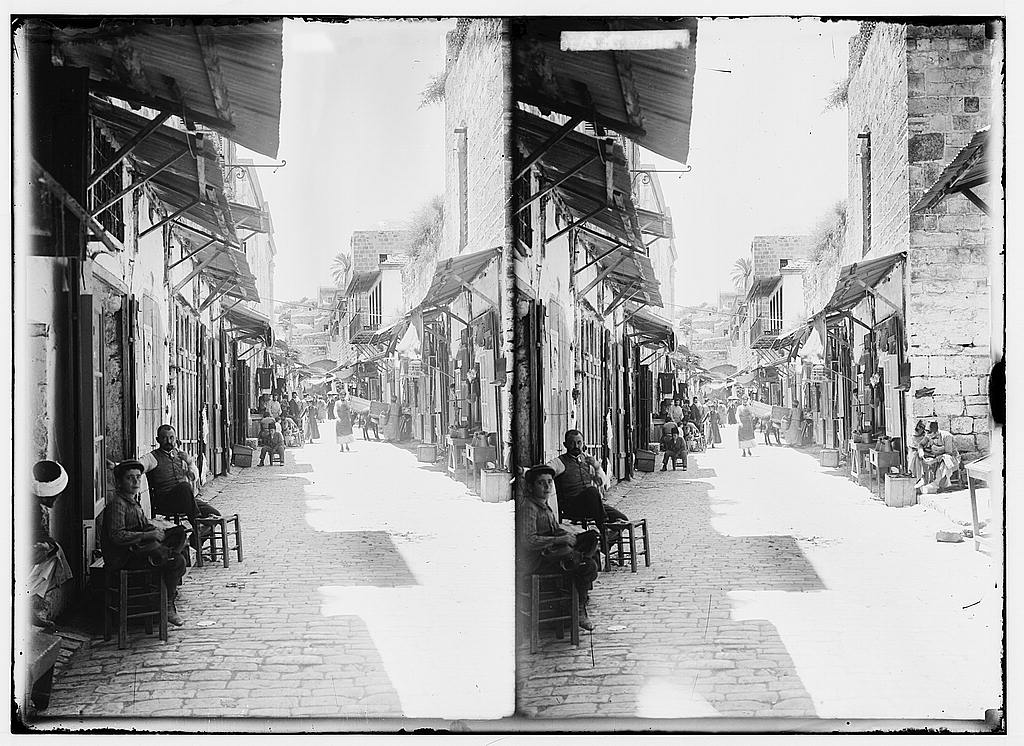
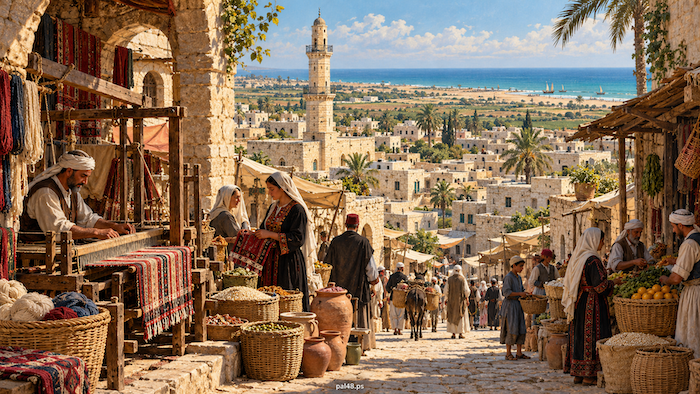
The traditional Palestinian city followed the pattern of the Islamic cities of Greater Syria in organizing its markets. The market usually centered on the main congregational mosque and extended along principal streets covered by stone vaults that sheltered shoppers from summer heat and winter rain, with specialized lanes branching off them.
1. Specialization by Craft and Location
Markets were characterized by specialization, with each commodity or craft having a market bearing its name: the spice and herbalists’ market, the butchers’ market, the goldsmiths’ market, the cotton merchants’ market, the blacksmiths’ market, the coppersmiths’ market, the vegetable market, and the Hisba market. Cleaner and higher-value trades, such as spices, textiles, and jewelry, occupied locations closer to the congregational mosque, while crafts producing noise or odors, such as tanning and blacksmithing, were situated toward the city’s outskirts.
2. Khans, Wikalas, and Qaysariyyas
A khan, or caravanserai, was generally a square building arranged around an open courtyard. Its ground floor accommodated goods and pack animals, while its upper floor provided lodging for visiting merchants. A wikala functioned more like a wholesale warehouse, while a qaysariyya was an enclosed market, locked at night, where valuable goods such as luxury fabrics were sold. These establishments provided the infrastructure for long-distance trade.
3. Organization and Supervision: The Muhtasib and the Guild Head
Markets were supervised by the muhtasib, an official responsible for monitoring weights, measures, prices, the quality of goods, and market cleanliness. Craftspeople were organized into guilds, each led by a shaykh al-kar, or guild head, who represented the craft before the authorities, supervised progression from apprentice to journeyman and then master, and settled disputes among its members. Other established market occupations included the auction broker, who mediated auction sales; the public weigher, who weighed heavy goods; and the money changer, who exchanged the various currencies in circulation.
3. Weekly Markets and Seasonal Festivals
Alongside permanent urban markets, Palestine had a network of weekly markets held on a particular day in a central town or at a crossroads. Villagers and pastoral communities attended them to sell their products and purchase supplies. Markets were often named after the day on which they were held, such as the Thursday Market or Friday Market. Market day also became a social occasion for meeting others, exchanging news, concluding transactions, and arranging marriages.
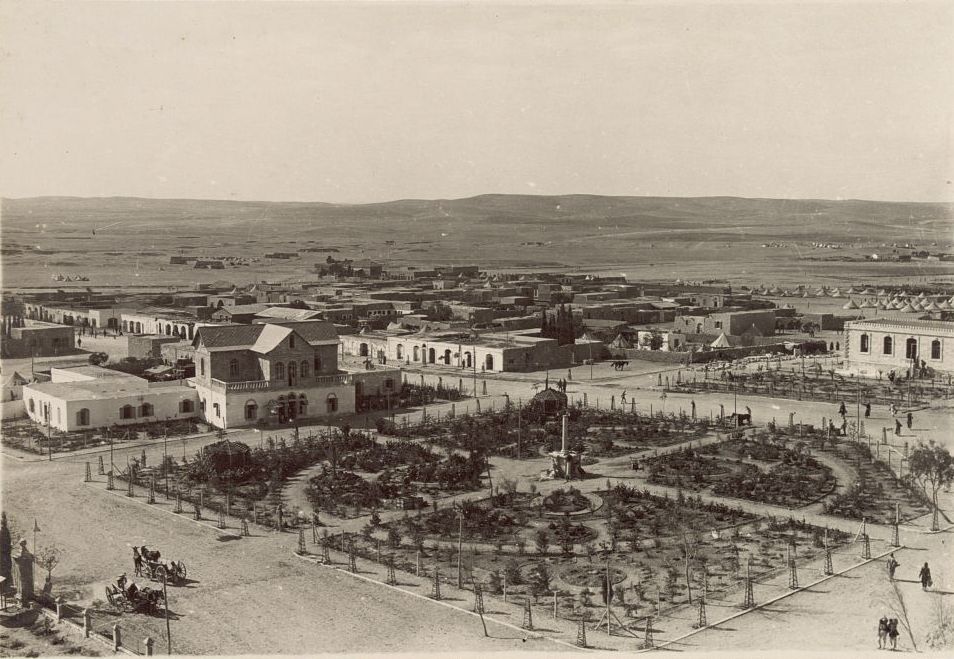
The Beersheba Market
Beersheba’s market was among the best-known weekly markets in southern Palestine. After the Ottoman state established the town at the beginning of the twentieth century as the administrative center of the Negev district, its Thursday market became a major meeting point for Negev tribes and merchants from Gaza and Hebron. Camels, sheep, goats, grain—especially barley—wool, and clarified butter were offered in exchange for textiles, sugar, coffee, and metal tools brought from the cities.
Religious and Popular Festivals as Markets
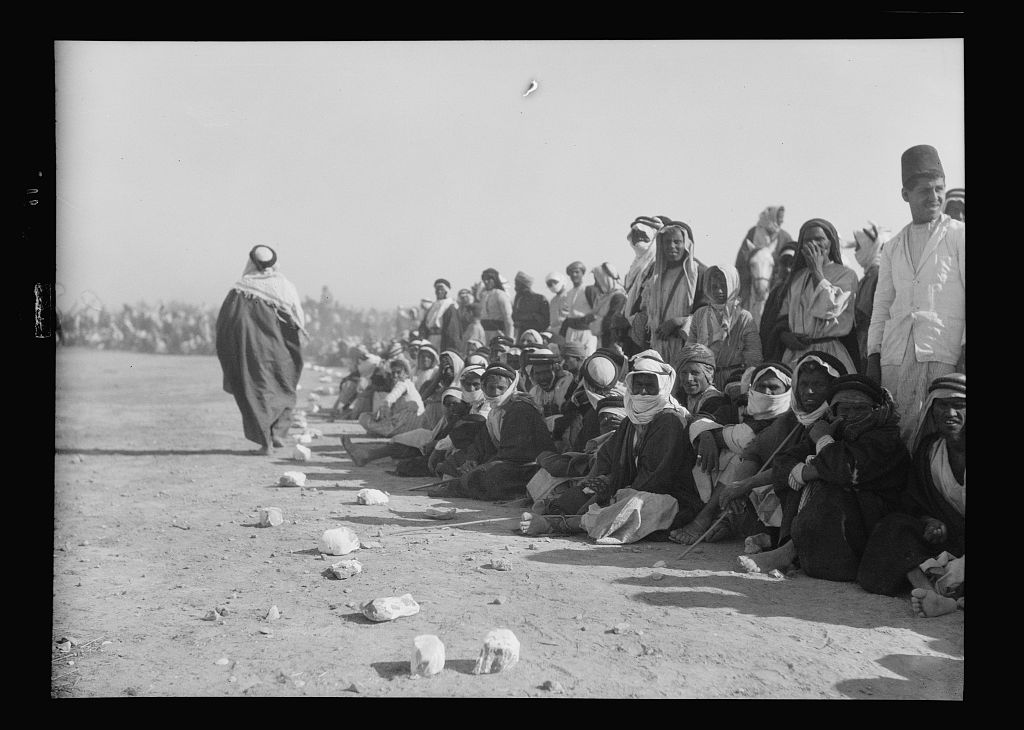
Commercial life extended beyond regular markets to religious and popular seasonal festivals, or mawasim, which brought together thousands of people and generated temporary markets. Among the best known were the Nabi Musa festival near Jericho, whose spring procession set out from Jerusalem, and the Nabi Rubin festival south of Jaffa, where families from Jaffa and nearby villages stayed for weeks during the summer. Tents, cafés, and stalls selling sweets, textiles, and toys were set up. These festivals offered craftspeople and itinerant vendors opportunities to sell their products.
Itinerant Vendors
Itinerant vendors—including stallholders, peddlers, and traveling sellers of spices and herbal remedies—completed this network. They carried textiles, beads, household utensils, and spices on pack animals to remote villages, sometimes exchanging them for wheat, eggs, and oil. This practice illustrates the persistence of barter alongside the monetary economy into the early twentieth century.
4. Nablus: A City of Merchants and Soap
Nablus occupied a prominent position in the Palestinian economy and was known as “Little Damascus” because of its numerous markets and khans and the vitality of its trade. Situated in a valley between Mount Ebal and Mount Gerizim, along routes connecting Jerusalem with Galilee and the coast with Transjordan, the city served as a central market for dozens of villages in the Jabal Nablus region.
Markets and Khans
The markets of Nablus extended along the main thoroughfares of the Old City, with specialized markets for textiles, spices, jewelry, and sweets branching off them. Among its most prominent landmarks was Khan al-Tujjar, an Ottoman-era center for trading textiles and imported goods. The city was also known for its confectionery, especially Nabulsi kunafa, and for its trade in cotton, oil, and soap.
Soapmaking: White Gold
Olive oil soapmaking was a mainstay of the Nablus economy. Nabulsi soap relied on three ingredients: olive oil supplied by the villages of Jabal Nablus; alkali derived from the ash of shinan or ushnan plants, brought from the steppe east of the Jordan River; and water. Production involved cooking the mixture in a large cauldron, spreading it across the casting floor, cutting and stamping it with the soap factory’s mark, drying the bars in conical towers, and finally wrapping them.
The industry expanded substantially in the second half of the nineteenth century. Studies indicate that the number of soap factories in the city doubled between 1860 and 1882. Owning a soap factory became a symbol of wealth and urban prestige, and factories became associated with prominent Nabulsi families. Soap was exported to Egypt, Syria, Transjordan, and the Hijaz.
The industry nevertheless suffered setbacks during the British Mandate. The earthquake of 1927 destroyed several factories, while Egypt and Syria, two of the principal markets for Nabulsi soap, imposed customs duties on imported soap. Production declined in the early 1930s, and Transjordan became its main market.
Merchants and Peasants in Jabal Nablus
Historian Beshara Doumani’s study of Jabal Nablus reveals that relations between urban merchants and village peasants rested on a complex network of credit, kinship, and shared interests. A merchant would provide a peasant with a cash advance before the agricultural season in return for a commitment to deliver a specified quantity of oil, cotton, or grain after the harvest at an agreed price. This arrangement was known as a salam contract. It enabled merchants to control the flow of crops into markets and soap factories and helped turn rural surpluses into urban commercial capital.
5. Jaffa: The Port and the Orange Groves
For centuries, Jaffa was Palestine’s principal maritime gateway. Pilgrims bound for Jerusalem entered through it, while agricultural products departed for Mediterranean ports. During the late Ottoman and British Mandate periods, Jaffa developed into the largest Arab Palestinian city and one of the most economically and culturally vibrant.
The Port and Its Boatmen
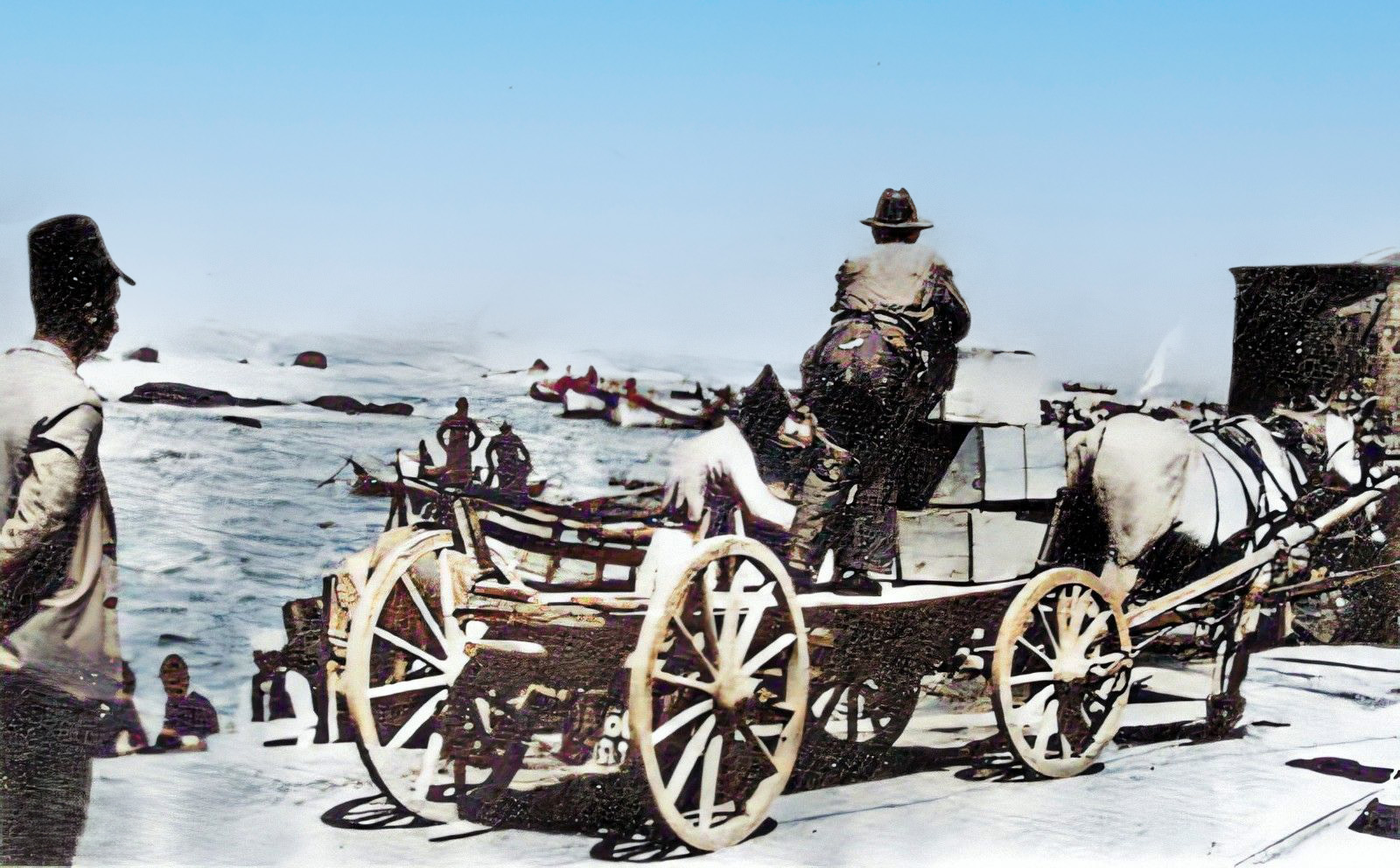
Jaffa was not a deep-water port in the modern sense. Offshore rocks required large vessels to anchor away from the shore, and boatmen transported passengers and cargo between the ships and the quay in smaller boats and lighters. This occupation supported hundreds of Jaffa families and developed its own professional organizations and customs.
Jaffa Oranges
Jaffa became internationally associated with oranges, particularly the Shamouti variety, whose thick peel could withstand long sea voyages. Citrus groves, known locally as bayyarat, spread around the city and throughout the coastal plain’s villages. Each grove formed an integrated production unit, including a well, a water reservoir, a pumping room, a caretaker’s house, and a sorting and packing shed. Citrus cultivation and exports expanded rapidly from the late nineteenth century, reaching their peak in the late 1930s, when citrus became Palestine’s leading export by far, with Britain as its largest market.
This trade generated a wide range of occupations: fruit pickers, sorters, women who wrapped individual oranges in special paper, carpenters who made crates, carriers, cart and boat owners, brokers, and shipping agents.
Jaffa’s Markets
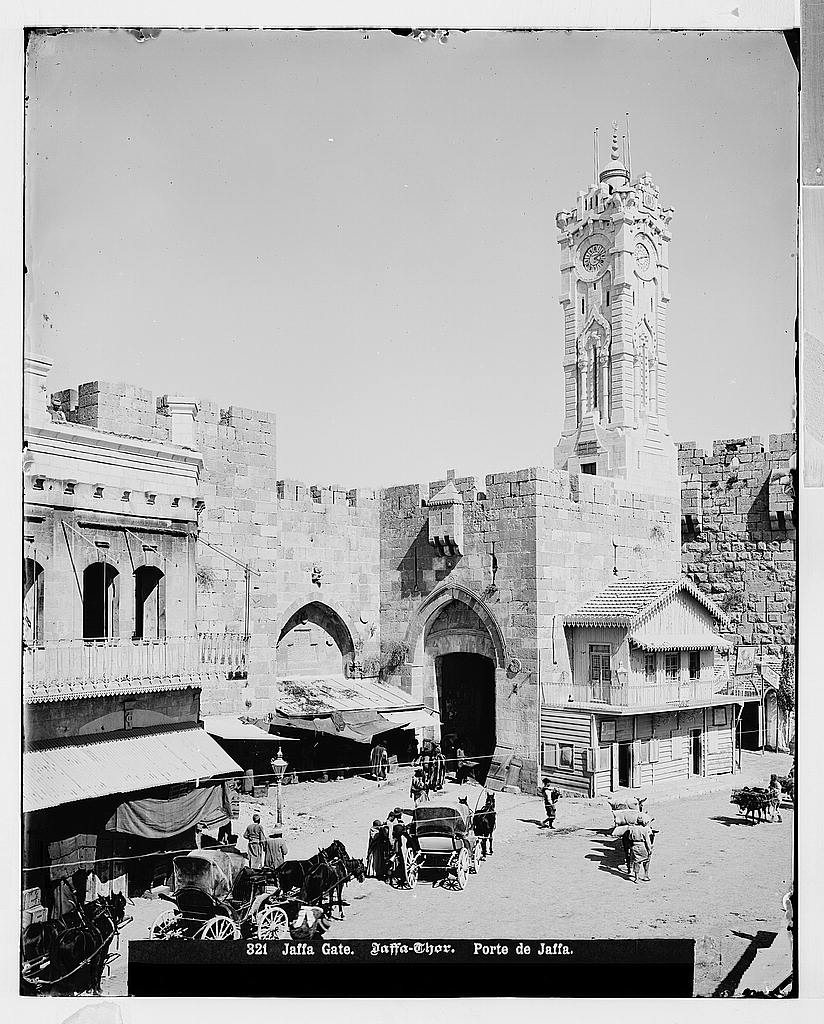
Commercial life in Jaffa centered on Clock Square, whose tower was built in the early twentieth century, and the surrounding markets, including Suq al-Dayr, Suq al-Balabsa, and the shoemakers’ market. Other commercial thoroughfares included Jamal Pasha Street, later King George Street, and Bustros Street. The Jaffa–Jerusalem railway, opened in 1892, reinforced Jaffa’s role as the port serving Jerusalem and its pilgrims.
6. Jerusalem: Markets of the Holy City
Jerusalem’s economy had distinctive features arising from its religious significance. In addition to serving as an administrative center and a market for surrounding villages, the city depended heavily on the pilgrimage and visitor economy, religious endowments, and institutions belonging to different religious communities.
Historic Markets
The Old City contains an interconnected system of markets, most notably:
- The three parallel markets: Suq al-Attarin, the spice market; Suq al-Lahhamin, the butchers’ market; and Suq al-Khawajat. These adjoining covered markets in the heart of the city have a layout dating to the medieval period.
- Suq al-Qattanin: one of the finest Mamluk markets, built by Emir Tankiz in the fourteenth century. It leads directly to al-Aqsa Mosque and was associated with the cotton and textile trades.
- Suq Khan al-Zayt: the commercial artery extending south from Damascus Gate, whose name is associated with trade in oil and foodstuffs.
- Suq Bab al-Silsila, Suq al-Bashura, and Suq Aftimos, the last built in the early twentieth century in the Muristan area.
Expansion Beyond the Walls
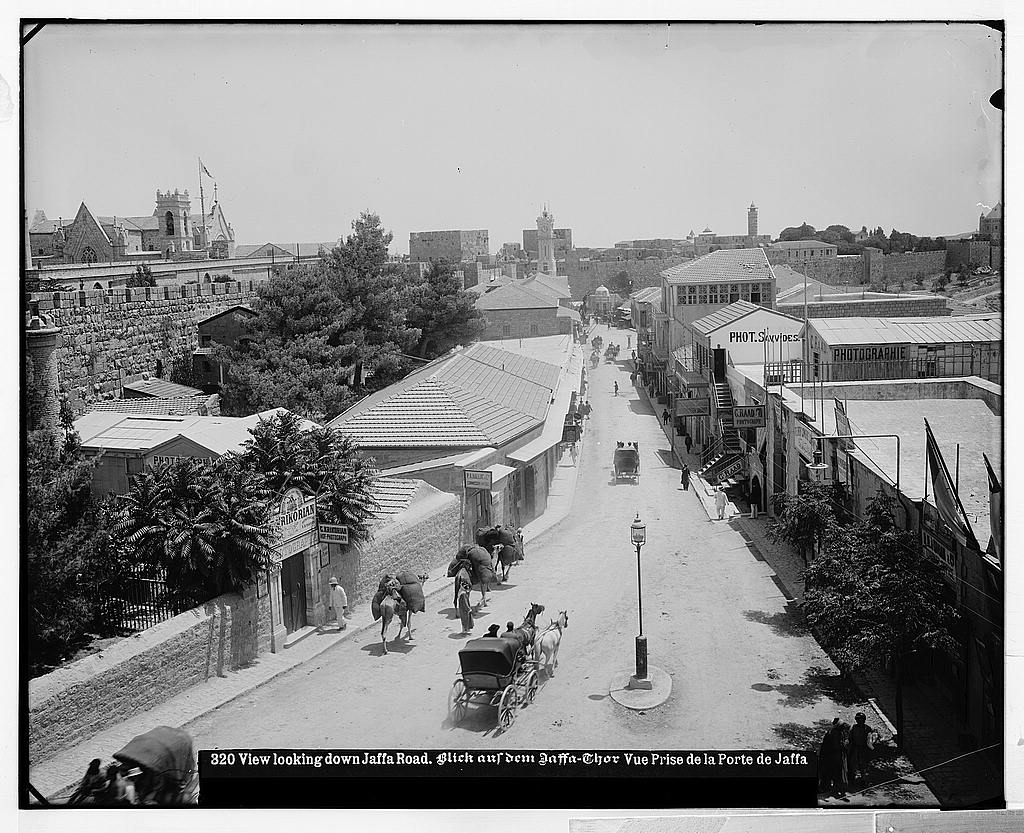
By the late nineteenth century, commercial activity had spread beyond the city walls, particularly around Jaffa Gate and along Jaffa Road. Hotels, travel agencies, banks, and modern shops opened to serve tourists, pilgrims, and foreign communities. This contributed to the formation of a new commercial center alongside the traditional markets.
Industries Associated with Jerusalem and Its Surroundings
Industries linked to pilgrimage developed around Jerusalem, especially the manufacture of religious souvenirs from olive wood and mother-of-pearl in Bethlehem. These included rosaries, crosses, and miniature models of holy sites. Bethlehem merchants exported them to Europe and the Americas and established commercial networks among emigrant communities.
7. Acre: Caravanserais and the Cotton Trade
Acre reached the height of its commercial prosperity in the eighteenth century, when Zahir al-Umar al-Zaydani made it the center of his rule. He rebuilt the city and developed it into a major port for exporting cotton and grain from Galilee to Europe, particularly to France through merchants in Marseille. Zahir al-Umar sought to monopolize the cotton trade by positioning himself as the intermediary between farmers and European merchants.
His successor, Ahmad Pasha al-Jazzar, continued this policy and constructed major commercial buildings. The most notable was Khan al-Umdan, built around 1784–1785 near the port. With its two stories and granite columns brought from Caesarea, it accommodated merchants and stored goods. Acre also contains Khan al-Ifranj, Khan al-Shuna, Khan al-Shawarda, the White Market, and the Turkish Market, all testifying to the city’s commercial vitality.
Acre’s role began to decline in favor of Haifa in the second half of the nineteenth century because its shallow harbor could not accommodate large steamships. Nevertheless, it remained an important market for western Galilee villages and a center for fishing and traditional crafts.
8. Ports and Trade Routes
Palestine’s foreign trade passed through several coastal ports, each supplied by an agricultural hinterland:
- Jaffa: the port serving central Palestine and Jerusalem, and the principal outlet for citrus exports.
- Haifa: its importance grew with the arrival of the Hijaz Railway branch in 1905 and the opening of the modern port in 1933. It became the country’s leading port and a terminus for pipelines carrying Iraqi oil.
- Acre: Galilee’s historic port, associated with the cotton and grain trades.
- Gaza: the southern outlet, known for exporting barley to Britain for brewing, alongside its overland trade with Egypt and the Negev.
Overland routes connected Palestinian cities with Damascus, Beirut, Cairo, and Transjordan. Caravans of camels, mules, and donkeys remained the main means of transport until the early twentieth century. Railways, carts, trucks, and buses subsequently transformed the speed and cost of transport and reshaped relationships between centers and peripheral areas.
9. Traditional Crafts and Industries
Palestinian crafts relied on local raw materials and were distributed geographically according to the availability of those materials and each city’s traditions. The most prominent included:
| Craft | Main Centers | Raw Materials and Markets |
|---|---|---|
| Soapmaking | Nablus, preceded by Jerusalem, Hebron, Jaffa, and Ramla | Olive oil and alkali; exported to Egypt, Greater Syria, and Transjordan |
| Glassmaking | Hebron | Sand and alkali; bracelets, lamps, and vessels sold in Palestine and neighboring countries |
| Pottery | Gaza, Hebron, and numerous villages | Local clay; jars, pitchers, and household vessels |
| Weaving | Al-Majdal, Gaza, and Nablus | Cotton and silk; Majdalawi fabrics used for rural dresses |
| Mother-of-pearl and olive wood crafts | Bethlehem and Beit Jala | Olive wood and imported mother-of-pearl; religious souvenirs for pilgrims and export |
| Embroidery | Palestinian villages generally | Silk and cotton thread; each region had its own distinctive style |
| Olive and sesame processing | Villages and cities | Olives and sesame; stone presses and mills producing tahini and halva |
| Tanning and shoemaking | Hebron, Jerusalem, and Nablus | Livestock hides; shoes, saddles, and waterskins |
These crafts were passed down within families, and some family names became associated with their trades, including glassmaking, copperworking, tanning, and dyeing. Rural women also played an important economic role in embroidery, basketry, straw work, handmade pottery, and dairy production, and later in wage labor in citrus groves during the British Mandate.
10. Merchants and Credit Networks
The Palestinian commercial hierarchy ranged from major merchants engaged in imports and exports and owning khans, soap factories, and citrus groves, to wholesalers in central markets, shopkeepers, and itinerant vendors. Many major merchants belonged to influential urban families that combined commerce with landownership and administrative and religious office.
Trade relied on trust, reputation, and family relationships more than written contracts. Traditional forms of credit were widespread, including salam contracts and debts repayable after the agricultural season. Markets used several currencies: the Ottoman qurush and mejidiye, followed by the Egyptian pound, which predominated after the First World War, until the Mandate authorities introduced the Palestine pound in 1927.
Modern economic institutions emerged during the Mandate, including Arab chambers of commerce in major cities and the Arab Bank, founded by Abdul Hameed Shoman in Jerusalem in 1930. Joint-stock companies and agricultural cooperatives also appeared, reflecting efforts by the Palestinian merchant class to adapt to modern forms of capital.
11. The Relationship Between Village and City
The relationship between countryside and city formed the core of the Palestinian economy before 1948. Most inhabitants were peasants, and the city served as their market, administrative and judicial center, and source of manufactured goods.
The Exchange of Goods
Peasants brought their products to urban markets: wheat, barley, lentils, sesame, olive oil, grapes, figs, fruit syrup, livestock, dairy products, eggs, firewood, and charcoal. In return, they purchased textiles, sugar, rice, coffee, kerosene, metal tools, and salt. Village women carrying baskets of vegetables and fruit on their heads were a familiar daily sight at the gates of Jerusalem, Nablus, and Jaffa.
An Unequal Relationship
Relations between the two sides were not always equal. Many peasants suffered from indebtedness to merchants and moneylenders because of fluctuating harvests, taxes, and high interest rates. Official Mandate reports documented the scale of this indebtedness. It was among the factors that led some peasants to sell or mortgage their land or migrate to cities for wage labor in ports, citrus groves, and military camps.
Economic Integration and Social Interconnections
Nevertheless, the boundaries between village and city were not rigid. Many urban families owned land in villages, while many villagers established marriage ties and business partnerships with urban merchants. Cities processed village products, as illustrated by the transformation of rural olive oil into Nabulsi soap for export—a clear example of economic integration between the two.
12. Transformations Under the British Mandate
The British Mandate brought structural changes to the Palestinian economy, which can be summarized as follows:
- Infrastructure modernization: new roads, an expanded railway network, and the construction of the modern Haifa port facilitated the movement of goods while redistributing commercial importance among cities.
- Customs policies: some craft industries faced competition from inexpensive imported goods, while others lost regional markets because of new borders and tariffs, as happened with Nabulsi soap.
- Economic dualism: a separate Jewish economy gradually emerged, based on incoming capital and its own institutions. It adopted policies favoring Jewish labor and products, placing Arab merchants and workers at a competitive disadvantage.
- The Great Strike of 1936: the country experienced a general strike lasting approximately six months, during which Arab markets and ports closed. It had far-reaching economic consequences and coincided with the strengthening of alternative ports and facilities.
- The Second World War: British military demand temporarily stimulated certain sectors, accompanied by rising prices, rationing, and controls over prices and supplies.
13. The Nakba and the End of the Commercial Landscape
The Nakba of 1948 brought this integrated commercial world to an end. Most inhabitants of Arab cities—including Jaffa, Haifa, Acre, al-Majdal, Lydda, and Ramla—were displaced, and markets lost their merchants, craftspeople, and customers. Inland cities such as Nablus, Hebron, and East Jerusalem were cut off from the ports that had connected them to the wider world, while many villages were separated from their traditional urban centers and markets.
Many markets fell into ruin or were repurposed. Refugees carried their crafts and commercial experience into exile and refugee camps, contributing to the economies of host countries. The memory of Palestine’s old markets remained alive in oral accounts, photographs, and documents.
Conclusion
The study of markets and trade in Palestine before 1948 reveals a vibrant and economically integrated society in which cities interacted with villages and pastoral communities, the inland highlands connected with the coast and ports, and local markets linked with regional and global ones. From the soap factories of Nablus to the citrus groves of Jaffa, from Jerusalem’s covered markets to Acre’s khans, and from Beersheba’s weekly market to the Nabi Rubin and Nabi Musa festivals, a picture emerges of an Arab Palestinian economy with deep roots and the capacity to adapt to change.
These subjects remain a rich field for research. Further work is needed on Islamic court records, chamber of commerce archives, merchant families’ account books, and the oral histories of those who experienced this period, before their testimonies are lost.
Suggested Sources and References for Researchers
Arabic-Language Works
- Al-Dabbagh, Mustafa Murad. Biladuna Filastin [Our Country Palestine]. Multiple volumes and editions.
- Al-Nimr, Ihsan. Tarikh Jabal Nablus wa-al-Balqa [The History of Jabal Nablus and al-Balqa]. Nablus, multiple volumes.
- Doumani, Beshara. Rediscovering Palestine: The People of Jabal Nablus, 1700–1900. Arabic edition. Beirut: Institute for Palestine Studies, 1998.
- Schölch, Alexander. Fundamental Transformations in Palestine, 1856–1882: Studies in Economic, Social, and Political Development. Translated into Arabic by Kamil Jamil al-Asali. Amman: University of Jordan.
- Khalidi, Walid. Before Their Diaspora: A Photographic History of the Palestinians, 1876–1948. Arabic edition. Beirut: Institute for Palestine Studies.
- Nablus Municipality. The Soap Factories of Nablus. Nablus, 1999.
English-Language Works
- Doumani, Beshara. Rediscovering Palestine: Merchants and Peasants in Jabal Nablus, 1700–1900. Berkeley: University of California Press, 1995.
- Schölch, Alexander. Palestine in Transformation, 1856–1882. Washington: Institute for Palestine Studies, 1993.
- Philipp, Thomas. Acre: The Rise and Fall of a Palestinian City, 1730–1831. New York: Columbia University Press, 2001.
- Yazbak, Mahmoud. Haifa in the Late Ottoman Period, 1864–1914: A Muslim Town in Transition. Leiden: Brill, 1998.
- Kark, Ruth. Jaffa: A City in Evolution, 1799–1917. Jerusalem: Yad Izhak Ben-Zvi, 1990.
- Seikaly, Sherene. Men of Capital: Scarcity and Economy in Mandate Palestine. Stanford: Stanford University Press, 2016.
- Government of Palestine. A Survey of Palestine. Jerusalem, 1946.
Visual and Digital Archives
- The G. Eric and Edith Matson Photograph Collection, Library of Congress: more than 23,000 photographs of Palestine between 1898 and 1946, most in the public domain.
- The Palestinian Museum Digital Archive: family and commercial photographs and documents, including photographs of Nablus soap factories.
- PalQuest, the Interactive Encyclopedia of the Palestine Question, published by the Institute for Palestine Studies.
More from the archive
 Download Our Palestine App
The whole archive in the palm of your hand: depopulated villages, the Nakba, the massacres and Al-Aqsa — free, with no ads to erase the story.



Comments
No comments yet — be the first to write one.
Add your comment
Name and email are optional. Comments appear after review.