Palestine That Read: Libraries, Newspapers and Printing Presses Before the Nakba
From Palestine’s Cultural History
Palestine That Read: Libraries, Newspapers and Printing Presses Before the Nakba
From Jerusalem’s book collections to the newsrooms of Jaffa and Haifa, Palestinians built a cultural life shattered by the Nakba. Its surviving pages bear witness to a society that produced knowledge and defended its land through the written word.
When Palestine’s history is told only through the Nakba, the world uprooted in 1948 can disappear from view: cities where people worked, learned and printed; libraries whose owners had gathered books over generations; and newspapers that debated the country’s affairs and its people’s fears for the future. Returning to the history of the printed word brings us closer to the society that experienced the Nakba, and to some of what its people lost when they lost their homes and cities.
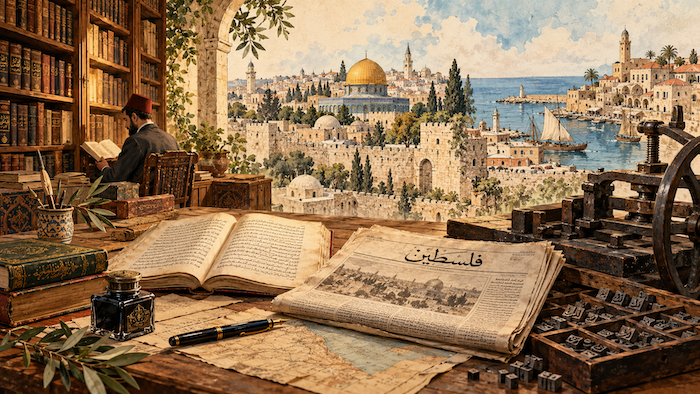
Palestine was a living country whose people were already writing its history. Palestinians left newspapers, magazines, manuscripts and documents carrying their names, questions and aspirations. These materials reveal a diverse society engaged in education, literature, women’s organizing and political debate, with disagreements and unequal opportunities to learn. The Khalidi Library, journalists’ biographies and catalogues of Palestinian periodicals offer tangible ways into that world. [1] [3] [7]

How Printing Became Part of the Country’s Life
Before the national press expanded, printing houses were already finding a place in Palestine’s religious and educational life. In Jerusalem, the St. James Armenian Printing House was established in 1833 and produced religious, scholarly and educational works. Its history reveals part of the city’s cultural diversity and the role of its institutions in carrying knowledge from manuscript to printed book. [2]
By the late nineteenth century, local private initiatives were becoming more prominent. They included Jurji Habib Hanania’s printing house in Jerusalem, which the Palestinian Encyclopedia dates to 1894. As newspaper publishing expanded after the restoration of the Ottoman constitution in 1908, printing houses became increasingly connected to newspapers and spread across Palestinian cities. Behind each printed page stood publishers, editors, press workers and distribution networks: an entire working world that newspaper titles alone cannot capture. [3]
Printing allowed ideas to travel beyond the gathering where they were first expressed. A book remained after a lesson ended; an article moved beyond the newsroom; an old issue became evidence of what mattered on the day it appeared. This is part of the value these pages retain today: they preserve Palestine as its own people wrote about it, including voices that challenged attempts to justify its dispossession.
Jaffa and Haifa: A Press Bearing the Country’s Name and Concerns
Filastin: The Country’s Name on the Masthead
In January 1911, Filastin began publication in Jaffa, with its founding associated with Isa al-Isa and Yusuf al-Isa. Initially concerned with the Arab Orthodox movement, it broadened its engagement with public affairs and warnings about the Zionist project. In this story, Jaffa emerges as a city producing news and opinion and helping shape the national debate. [3] [4]
The newspaper faced suspension and persecution under Ottoman rule. After the First World War, Isa al-Isa resumed publication in March 1921. According to his biography published by the Institute for Palestine Studies, it became a daily in 1930. Its history brings together professional journalism and national commitment: reporting on the country and opposing policies that threatened its people’s right to an independent future. [4]

Al-Karmal: Land at the Centre of the News
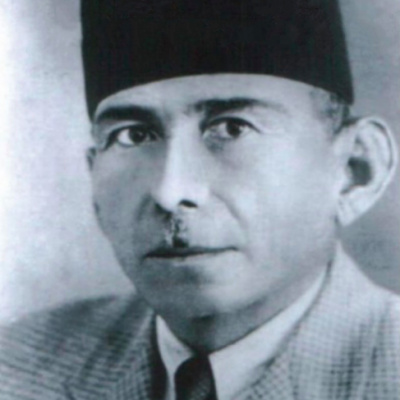
In Haifa, Najib Nassar founded al-Karmal in 1908 after purchasing a printing press from Beirut. His work followed settlement, land transfers and their effects on peasants’ lives, while advocating economic development, education and national organizing. He understood the danger facing Palestine through what was happening on the ground, and argued for knowledge and social action alongside political opposition. [5]
In 1911, Nassar collected material on Zionism in a booklet drawing on his translation of, and commentary on, an entry in the Jewish Encyclopedia. The significance of this step lay in examining the project threatening the country through its own literature and making that understanding available to Arab readers. Palestinian journalism was following events, translating and analysing, and developing its arguments about land and the future. [5]

Al-Difa‘: Another Generation of National Journalism
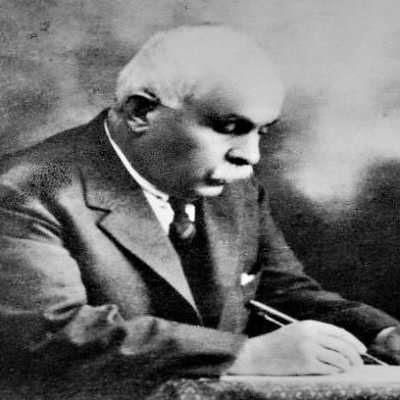
In February 1934, Ibrahim al-Shanti founded al-Difa‘ in Jaffa. The newspaper covered domestic affairs, opposition to Zionism and the British Mandate, and disagreements among Palestinian political parties. The Palestinian Encyclopedia describes its wide circulation, including in villages, and its role as a training ground for young journalists who continued in the profession and established newspapers of their own. [6]
These newspapers show a country debating its future through many voices. Palestinians had differing political positions, social demands and cultural projects. That plurality belongs in any account of Palestinian life before the Nakba.
Sadhij Nassar: Women at the Heart of the Newsroom
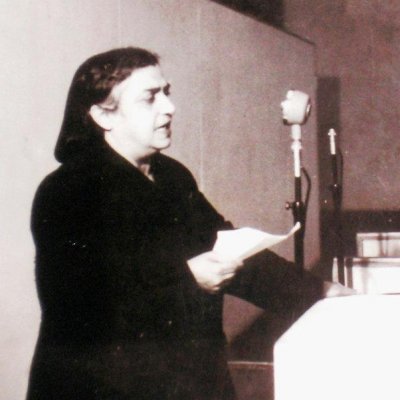
The story of al-Karmal is incomplete without Sadhij Nassar. She began writing for the newspaper in 1923, helped edit and manage it, and introduced the “Women’s Newspaper” column in 1926. She advocated education and employment for women and equal treatment of girls and boys, connecting these issues to women’s political participation and resistance to colonial rule. [8]
Her work extended into organizing. In 1930, she helped establish the Arab Women’s Union in Haifa. British authorities arrested her in late 1938 on charges of supplying weapons to rebels, and detained her for eleven months. She continued her newspaper work until al-Karmal was permanently closed in 1944, then wrote about Palestine’s tragedy from exile after the Nakba. [8]
Her biography places Palestinian women in the position of authors, editors, organizers and opponents of repression. Restoring Sadhij’s name alongside those of her colleagues restores part of the breadth of Palestinian journalism and gives readers a fuller picture of the society that produced its pages.
Literature, Education and a Voice Across the Airwaves
Alongside politics, Palestinian publications carried literature, translation, educational discussions and everyday concerns. The Palestinian Encyclopedia places Khalil Baydas, Khalil al-Sakakini and Is‘af al-Nashashibi among the figures involved in this activity. WAFA’s catalogue also records school, literary, legal, sporting, scouting and cinema periodicals, including al-Huquq in Jaffa, Rawdat al-Ma‘arif in Jerusalem and al-Hayat al-Riyadiyya in Jaffa. [3] [7]
This variety reveals lives that extended beyond responding to political danger, even as that danger grew. Palestinians asked questions about education, language, rights and art, and created places to discuss them. Access to reading was unequal, but the existence of these institutions challenges portrayals that reduce Palestinian society to illiteracy or institutional absence.

In 1936, the Palestine Broadcasting Service began operating, opening another space for writers, poets and musicians through its Arabic section. The station was administered by the Mandate government, but its Arab staff also made its programmes a place for cultural expression. Voices reached listeners in cafés and public spaces, bringing spoken words into the public world that books and newspapers were helping to build. [9]
The Written Word Under Censorship
This newspaper culture developed under restrictions. The Mandate government’s report for 1934 records the suspension of four Arabic newspapers under the 1933 Press Ordinance, for periods ranging from one week to three months. Preserved in the United Nations archive, it is the British administration’s own account: evidence of suspension in the records of the authority that imposed it. [10]
Censorship reveals the price paid for journalism’s public presence. When publication was suspended, the interruption affected workers’ livelihoods and readers’ connections to their newspapers as well as the news itself. From a Palestinian perspective, these episodes help explain the written word as part of the struggle over control of the country and what its people could say about their future.

Jerusalem: Libraries That Preserve Memory
The Khalidi Library: Family Collections Open to Readers
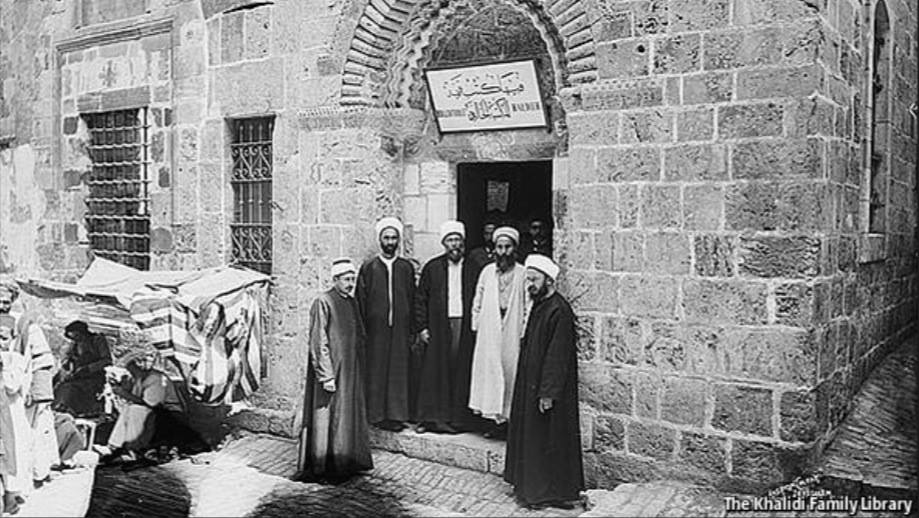
On Tariq Bab al-Silsilah in Jerusalem’s Old City, Haj Raghib al-Khalidi established the Khalidi Library in 1900. Its website describes it as the first Arab public library founded through private initiative in Palestine. Family collections accumulated across generations became an institution offering knowledge to readers and connecting the preservation of books with service to the city. [1]
The Khalidi Library holds manuscripts, printed books and family papers. Its Mamluk building carries a history older than the library’s opening. The relationship between place and books reveals Jerusalem as a city of knowledge: a city of scholars, endowments, correspondence and collections inherited and protected by families. [1]

The Al-Aqsa Library: Continuing an Older Tradition
The Jerusalem Awqaf administration traces the roots of al-Aqsa Mosque’s book treasury to the Ayyubid period. In 1922, the Supreme Muslim Council reopened the library, gathered its manuscripts, added books and manuscripts, and moved it to the Nahwiyya School. This was a milestone in organizing the modern library within a much longer history of preserving books at al-Aqsa. [11]
Home libraries also formed part of Palestine’s world of books. The loss of Khalil al-Sakakini’s library during the Nakba gives that world a painful human face. Books carry traces of their owners’ reading, writing and collecting; losing them can mean losing part of a life. [12]
The Nakba: Readers Uprooted, Books Looted
During the Nakba of 1948, Palestinians were uprooted from towns and villages, and their networks of work, education and publishing were broken apart. Filastin ceased publication in Jaffa in April that year and later resumed elsewhere. Al-Difa‘ also stopped publishing in Jaffa, subsequently moving to Cairo and then Jerusalem. Some newspaper names survived, but the communities and places that had sustained them were uprooted. [4] [6]
The loss extended beyond interrupted institutions. In an article published by Georgetown University’s Center for Contemporary Arab Studies, Palestinian researcher Samar Saeed reports the looting of approximately 30,000 books and manuscripts from the homes of Palestinians expelled from West Jerusalem during the Nakba, including Khalil al-Sakakini’s collection. She also cites a broader estimate of around 70,000 books looted during the Nakba as a whole. These estimates cover different geographical scopes and must not be added together. [12]
Here the cultural dimension of the Nakba becomes clear. Displacement separates readers from their libraries and leaves their papers within reach of those who took possession of their homes. When books are understood as traces of their owners, questions about their fate become questions of ownership and memory: whose were they, how were they transferred, and where do the names they carried survive?
This article approaches Palestinian culture as a life made by its people, and the harm inflicted on it as part of their uprooting from their land. Preserving a looted book in a later institution does not erase its owner’s story, just as a newspaper’s survival after relocation does not erase the city its people were forced to leave.
Recovering the Archive, Continuing the Story
Archives offer ways to reconnect some of what the Nakba scattered. The Palestinian Museum Digital Archive preserves photographs, documents and personal collections. The Khalidi Library’s website presents the institution’s history and routes into its holdings. The Interactive Encyclopedia of the Palestine Question provides biographies and documents that help place people and institutions back in their historical context. [1] [13] [14]
Digitization widens access to documents, but it cannot replace lost originals or diminish their owners’ place in their history. The archive we need preserves Palestinian names, hometowns and the connections between documents and lives. A school photograph belongs to a community; a Jaffa newspaper belongs to the city that produced it.

This story leaves us with Palestine through its people: Hanania at his printing press, al-Isa at his newspaper, Najib and Sadhij at al-Karmal, al-Khalidi at his library, and the teachers and readers beyond the best-known names. They were creating a cultural life with its own questions and aspirations. Reading what they left behind restores their voices to the account of their country and brings into sharper view both what the Nakba uprooted and what Palestinians insisted on keeping alive.
Milestones in the Story
| Year | Milestone | Source |
|---|---|---|
| 1833 | The St. James Armenian Printing House is established in Jerusalem. | [2] |
| 1894 | Jurji Habib Hanania’s printing house is established in Jerusalem. | [3] |
| 1900 | The Khalidi Library is established. | [1] |
| 1908 | Al-Karmal is founded in Haifa as newspaper publishing expands. | [3] [5] |
| 1911 | Filastin begins publication in Jaffa; Nassar publishes his booklet on Zionism. | [4] [5] |
| 1922 | The al-Aqsa Library is reopened and its collections organized. | [11] |
| 1926 | Sadhij Nassar introduces the “Women’s Newspaper” column in al-Karmal. | [8] |
| 1934 | Al-Difa‘ is founded in Jaffa; the Mandate report records four Arabic newspapers being suspended. | [6] [10] |
| 1936 | The Palestine Broadcasting Service begins operating. | [9] |
| 1944 | Mandate authorities permanently close al-Karmal. | [8] |
| 1948 | The Nakba uproots publishing institutions and brings the looting of Palestinian libraries. | [4] [6] [12] |
More from the archive

 Download Our Palestine App
The whole archive in the palm of your hand: depopulated villages, the Nakba, the massacres and Al-Aqsa — free, with no ads to erase the story.
Download Our Palestine App
The whole archive in the palm of your hand: depopulated villages, the Nakba, the massacres and Al-Aqsa — free, with no ads to erase the story.
Comments
No comments yet — be the first to write one.
Add your comment
Name and email are optional. Comments appear after review.