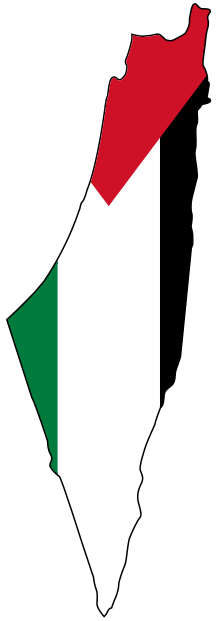
The 1949 Armistice Agreements and the Establishment of the Green Line in Palestine

The 1949 Armistice Agreements and the Establishment of the Green Line in Palestine
Between February and July 1949, in the aftermath of the Nakba and the occupation of large parts of Palestine in 1948, a series of separate General Armistice Agreements were signed between the Zionist occupation state on one side and Egypt, Lebanon, Jordan, and Syria on the other, under United Nations mediation.
These agreements are sometimes collectively referred to as the “1949 Rhodes Armistice Agreements,” although only two of them were actually signed on the Greek island of Rhodes. The Lebanese agreement was signed at Ras al-Naqoura, while the Syrian agreement was signed near Mahanayim.
The agreements brought the principal phase of fighting between the regular armies to an end and established military demarcation lines between the Zionist occupation forces and the Arab forces. These lines later became collectively known as the Green Line.
For Palestinians, however, the armistice did not reverse the consequences of the Nakba. By 1949, Israeli forces controlled approximately 77 percent of Mandatory Palestine, including substantial areas that United Nations Partition Resolution 181 had allocated to the proposed Arab Palestinian state.
More than 725,000 Palestinians had become refugees after being expelled from or fleeing their homes, while hundreds of Palestinian towns, villages, and communities had been depopulated.
From the Nakba to the Armistice Negotiations
On May 14, 1948, David Ben-Gurion proclaimed the establishment of Israel only hours before the British Mandate formally ended.
The following day, regular forces from Egypt, Transjordan, Iraq, Syria, and Lebanon, together with units from other Arab countries, entered Palestine.
The Arab armies initially succeeded in halting some Israeli advances on several fronts, while particularly intense fighting took place around Jerusalem.
The military balance, however, changed significantly during the following months.
During the first United Nations-brokered truce, Israel reorganized its forces and expanded its army. Large shipments of weapons arrived, particularly from Czechoslovakia, while the number of recruits and volunteers increased and the air force was strengthened with aircraft acquired from abroad.
By contrast, the Arab armies suffered from weak unified coordination. Although nominally operating within an Arab League framework, Egyptian, Jordanian, Iraqi, Syrian, and Lebanese forces generally pursued separate military strategies, while in some cases their governments also had differing political objectives regarding the future of Palestine.
The Expansion of Israeli Control Beyond the Partition Plan Boundaries
When fighting resumed after the truces of 1948, Israeli forces launched a series of major military operations that substantially altered the territorial map.
In July, Operation Dani resulted in the occupation of Lydda and Ramla and the displacement of most of their Palestinian inhabitants.
In October, Operation Yoav broke through Egyptian positions in southern Palestine and enabled Israeli forces to expand their control toward the Naqab.
During the same period, Operation Hiram resulted in the occupation of most of the remaining areas of Galilee that had not yet fallen under Israeli control.
This was followed by Operation Horev between December 1948 and January 1949, which placed intense military pressure on Egyptian forces in the south and directly contributed to Egypt's move toward armistice negotiations.
By the beginning of 1949, the map proposed by United Nations Resolution 181 had effectively ceased to exist on the ground.
United Nations Mediation
Throughout the military operations, the United Nations attempted to impose truces and ceasefires and to move the parties toward political and military negotiations.
After United Nations Mediator Count Folke Bernadotte was assassinated by members of the Zionist Lehi organization in Jerusalem in September 1948, American diplomat Ralph Bunche assumed the role of Acting United Nations Mediator.
On November 16, 1948, the Security Council adopted Resolution 62, determining that an armistice should be established in all sectors of Palestine and that the situation should move from temporary ceasefires toward general armistice arrangements.
Following renewed military operations in the Naqab, international pressure for an end to the fighting increased.
Egypt and Israel accepted a ceasefire that entered into force on January 7, 1949, after which formal negotiations began at Rhodes under Ralph Bunche's supervision.
The Four Armistice Agreements
The 1949 armistice was not a single collective agreement between the Arab states and Israel. Each neighboring state negotiated separately.
- Egypt and Israel: February 24, 1949, at Rhodes.
- Lebanon and Israel: March 23, 1949, at Ras al-Naqoura.
- Jordan and Israel: April 3, 1949, at Rhodes.
- Syria and Israel: July 20, 1949, at Hill 232 near Mahanayim.
Iraq, however, did not sign an armistice agreement with Israel.
Iraqi forces had been deployed primarily in parts of the central Palestinian front. When Baghdad decided to withdraw its forces, Jordanian troops assumed the positions they had held, and arrangements concerning those sectors were incorporated into the Jordanian-Israeli Armistice Agreement.
What Did the Armistice Agreements Actually Mean?
The agreements prohibited the armed forces of the signatories from carrying out military or hostile operations across the armistice lines.
They also established mechanisms for monitoring violations and created Mixed Armistice Commissions operating under United Nations supervision.
The agreements, however, were not peace treaties.
They did not definitively settle sovereignty over territory, permanent borders, the Palestinian refugee question, the future of Jerusalem, or the final political status of Palestine.
Instead, the texts explicitly stated that their provisions were based on military considerations and did not prejudice the rights, claims, or positions that either party might advance in an eventual political settlement.
This distinction is essential to understanding the nature of what later became known as the Green Line.
The Green Line
The military demarcation lines established by the 1949 agreements became collectively known as the Green Line, a name associated with the color used to draw the lines on maps.
These lines separated areas under Israeli control after the Nakba and the occupation of Palestine in 1948 from the remaining Palestinian territories that came under Jordanian control or Egyptian administration.
Within most of the territory west of and inside the line, Israel controlled approximately 77 percent of Mandatory Palestine.
The remaining territory consisted principally of the West Bank, including East Jerusalem, which came under Jordanian military control, and the Gaza Strip, which came under Egyptian administration.
The Green Line was a military armistice demarcation line rather than a mutually agreed permanent international border.
However, because it defined the actual limits of military and political control for nearly two decades, it later became the principal geographical reference separating Israel from the West Bank and Gaza Strip until Israel's occupation of the remainder of Palestine in June 1967.
The West Bank and East Jerusalem
The Jordanian Arab Legion retained control of the West Bank and East Jerusalem after the principal military operations had ended.
Under the Jordanian-Israeli Armistice Agreement, the existing military positions at the end of the fighting were converted into armistice lines in most sectors.
Iraqi forces also withdrew from the positions they had occupied, and Jordanian forces replaced them under arrangements incorporated into the agreement.
In 1950, Jordan annexed the West Bank. This was a subsequent political action and should not be confused with the armistice agreement itself, which did not formally determine final sovereignty over the territory.
The Gaza Strip
Egypt retained control of the Gaza Strip after the armistice agreement.
Unlike Jordan in the West Bank, Egypt did not annex the Gaza Strip. It remained under Egyptian administration.
At the same time, the Strip became one of the principal centers of the Palestinian refugee crisis, as large numbers of displaced Palestinians arrived from towns and villages in the southern coastal plain, the Beersheba region, and other areas.
The Faluja Pocket
One of the most complicated issues in the negotiations between Egypt and the Zionist occupation state concerned Egyptian forces trapped in the Faluja Pocket, centered around the Palestinian towns of al-Faluja and Iraq al-Manshiyya.
The Zionist occupation forces had surrounded the Egyptian brigade there since the final months of 1948.
Under the Egyptian-Israeli Armistice Agreement, Egyptian forces were allowed to withdraw from the pocket under United Nations supervision.
The withdrawal began in late February 1949, and Ralph Bunche recorded that approximately 2,900 Egyptian soldiers were evacuated from the area under the supervision of United Nations observers.
Thousands of Palestinian civilians, however, remained in al-Faluja and Iraq al-Manshiyya after the departure of the Egyptian forces.
The armistice arrangements were intended to protect the civilian population and their rights, but developments after the handover of the pocket took a different course.
United Nations observers documented cases of beatings, looting, and attempted assaults committed by Israeli soldiers against residents, while pressure and intimidation were also used to induce Palestinians to leave the two towns.
By April 21, 1949, most of the Palestinian population of the Faluja Pocket had been displaced, even though the agreement did not call for the evacuation of the civilian population from the area.
Did the Armistice Agreements Constitute Arab Recognition of Israel?
The agreements created a practical military relationship between Israel and the neighboring Arab states that signed them, but they did not constitute full diplomatic recognition or peace treaties.
The signing Arab governments did not accept the armistice lines as permanent sovereign borders.
Instead, the texts repeatedly emphasized that these arrangements were provisional and did not prejudice claims or rights to be discussed in any final settlement.
It is therefore more accurate to say that the agreements consolidated a military reality created during the Nakba and the occupation of Palestine in 1948, without legally resolving the competing political and territorial claims concerning Palestine.
The Armistice and the Fragmentation of Palestine
The 1949 agreements left Palestine effectively divided into three principal political and military spaces.
Israel controlled approximately 77 percent of Mandatory Palestine, while the West Bank and East Jerusalem came under Jordanian control and the Gaza Strip under Egyptian administration.
The Arab Palestinian state envisaged by United Nations Partition Resolution 181 was never established.
Instead, the Palestinian people emerged from the Nakba divided among Palestinians who remained in territories under Israeli rule, Palestinians living in the West Bank and Gaza Strip, and hundreds of thousands of refugees dispersed across neighboring Arab countries.
More from the archive
 Download Our Palestine App
The whole archive in the palm of your hand: depopulated villages, the Nakba, the massacres and Al-Aqsa — free, with no ads to erase the story.
Download Our Palestine App
The whole archive in the palm of your hand: depopulated villages, the Nakba, the massacres and Al-Aqsa — free, with no ads to erase the story.

Comments
No comments yet — be the first to write one.
Add your comment
Name and email are optional. Comments appear after review.