
Martyr Majed Abu Sharar

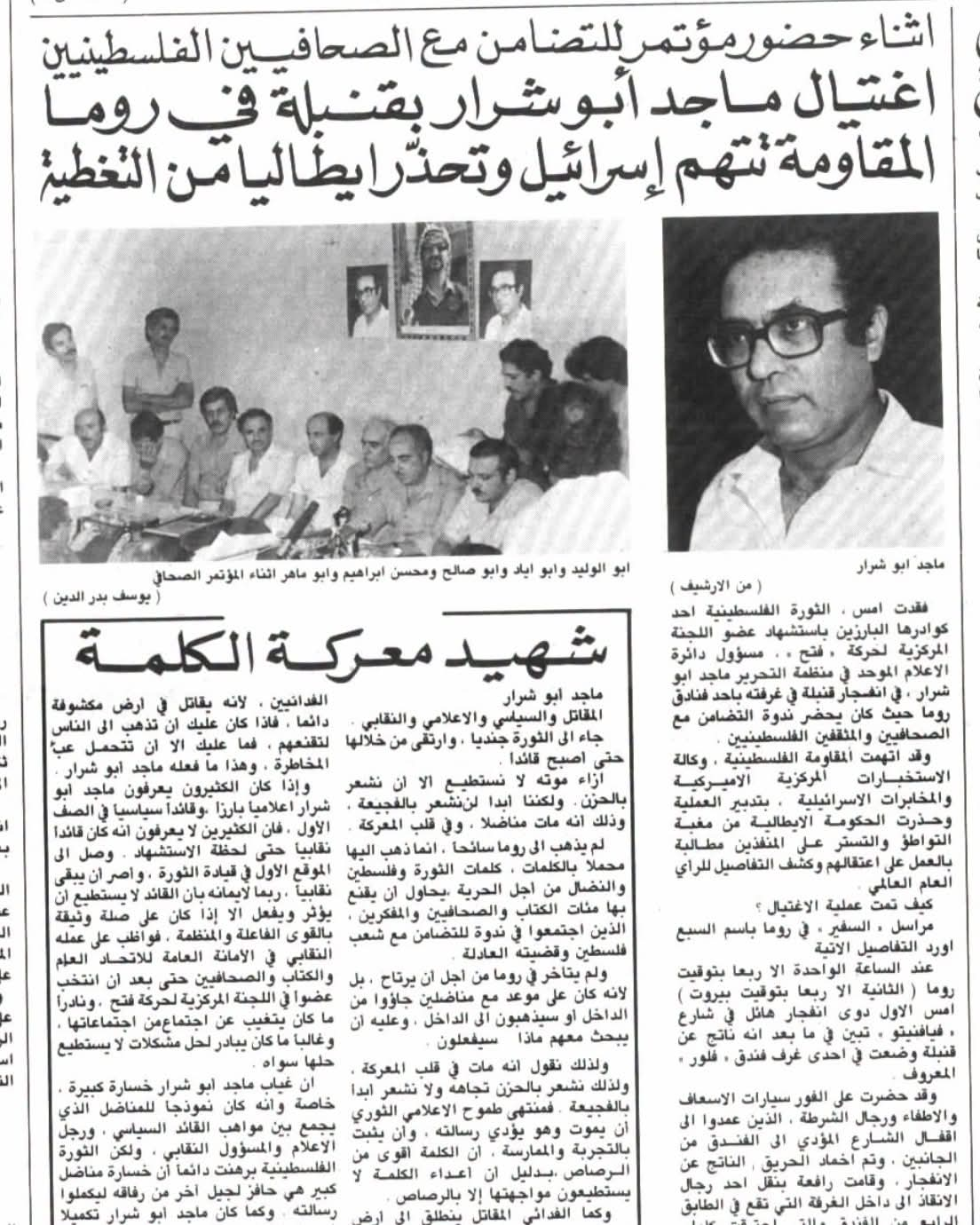
Majed Abu Sharar (1936–1981) was a Palestinian leader and writer from Dura in the Hebron district, author of the collection The Bitter Bread, head of the Palestinian revolution’s unified media and a member of Fatah’s Central Committee. Israel’s Mossad killed him after midnight on 9 October 1981 with a bomb planted under his bed at the Hotel Flora in Rome, where he was attending a world conference in solidarity with the Palestinian people. [1] [2] [3]
This is the fifth article in the series “Assassinated leaders of the Palestinian revolution,” after the articles on Abu Iyad, Abu Jihad, Ghassan Kanafani and the Verdun operation.
Who was Majed Abu Sharar?
Majed Abu Sharar was a Palestinian intellectual, writer and media figure, and one of the leading voices of the democratic left within Fatah [4]. He led the Palestinian revolution’s media after Kamal Adwan’s assassination and helped found the revolutionary cadres school, which aimed to produce “thinking fighters” [1] [3]. Those who knew him described him as more thinker than soldier, a man of revolutionary ideas who warned early that the conflict with the occupation would be long [5].
Majed Abu Sharar at a glance
| Item | Details |
|---|---|
| Name | Majed Muhammad Abd al-Qadir Abu Sharar [1] |
| Born | 1936, Dura, Hebron district [1] [3] |
| Education | Law degree, University of Alexandria (1954–1958) [1] [6] |
| Roles | Editor-in-chief of Fatah’s daily, head of unified media, General Political Commissar (1973–1978), secretary of the Revolutionary Council, Fatah Central Committee member (1980) [1] [7] |
| Works | The short-story collection The Bitter Bread and the satirical column “Jiddan” (Very) [3] [1] |
| Assassinated | 9 October 1981, Hotel Flora, Rome, by a Mossad bomb under his bed [1] [2] [8] |
| Buried | Martyrs’ Cemetery, Beirut [1] |
Timeline
| Year | Event |
|---|---|
| 1936 | Born in Dura, Hebron district [1] |
| 1948 | Family moves to Gaza with his father, a fighter in the Holy Jihad Army [1] [6] |
| 1954–1958 | Studies law at the University of Alexandria [1] |
| 1959 | Works at al-Ayyam newspaper in Dammam [1] [3] |
| 1962 | Joins Fatah [1] [8] |
| 1968 | Devotes himself to revolutionary media in Amman [1] [8] |
| 1969 | Helps found the revolutionary cadres school in al-Asifa forces [1] [3] |
| 1971 | Secretary of the Revolutionary Council after Fatah’s third conference [1] [7] |
| 1973–1978 | Fatah’s General Political Commissar [1] [7] |
| 1980 | Elected to the Central Committee at the fourth conference; The Bitter Bread published [1] [3] |
| 1981 | Assassinated in Rome on 9 October [1] [2] |
From Dura to Gaza and Alexandria
Majed Muhammad Abd al-Qadir Abu Sharar was born in 1936 in Dura, south-west of Hebron, the eldest of seven brothers and thirteen sisters, and finished primary school in his town [1]. His father, Sheikh Muhammad Abd al-Qadir Abu Sharar, worked as a wireless technician for the Mandate government, then in 1947–1948 joined the Holy Jihad Army under Abd al-Qadir al-Husseini as a signals officer [1]. At twelve Majed witnessed the Nakba and the influx of refugees; the family later moved to the Gaza Strip, where he finished secondary school [6] [1].
In 1954 he entered the Faculty of Law at the University of Alexandria, graduating in 1958, and joined the nationalist student movements there [1] [3]. He then worked as a teacher and later principal at a school in the Karak area of Jordan, and in 1959 moved to Dammam in Saudi Arabia to work as an editor at the newspaper al-Ayyam [1] [3] [6].
In Fatah: the revolution’s voice and media
In late 1962 Majed Abu Sharar joined Fatah and helped form popular committees supporting the Palestinian cause in Saudi Arabia and other countries [1] [4]. In summer 1968 he devoted himself to media work in Amman, becoming editor-in-chief of Fatah’s daily and then director of its media centre [1]. In 1969 he helped found the revolutionary cadres school in al-Asifa forces [1] [3].
After Fatah’s third conference in 1971 his comrades elected him secretary of the Revolutionary Council [1] [7]. After Kamal Adwan was killed in the Verdun operation in 1973 he took over central media and then the revolution’s unified media [1]. He served as the movement’s General Political Commissar from 1973 to 1978 [1] [7]. In the 1970s his office in Damascus was a meeting place for leading Fatah cadres [4].
In May 1980 the fourth conference elected him to Fatah’s Central Committee, and he joined the Western Sector committee led by Abu Jihad [6] [1].
The writer: The Bitter Bread and “Jiddan”
Alongside politics, Majed Abu Sharar was a notable short-story writer. His first stories were serialised in the Jerusalem magazine al-Ufuq al-Jadid in the 1960s and collected in 1980 as his only collection, The Bitter Bread [1] [6] [3]. It paints a collective portrait of oppressed Palestinians in a concise realist style, describing life in Dura’s old town and the harshness of occupation [3] [5].
In Fatah’s newspaper he wrote a regular satirical column titled “Jiddan” (Very), building biting phrases around that word [3]. In 2012 the Ministry of Culture in Ramallah published “It Must Return: The Bitter Bread, Unpublished Stories and Articles,” gathering stories of ordinary people facing poverty, illness and loss, and of fedayeen heading to the trenches certain of return [9].
The assassination of Majed Abu Sharar: Hotel Flora, Rome, 1981
In October 1981 Majed Abu Sharar travelled with a delegation from Beirut to Rome for a world conference in solidarity with Palestinian writers and journalists [2] [6]. He was booked under his real name at the Ergife Palace Hotel, where the other delegations stayed, but lodged at the Hotel Flora on Via Veneto under the alias “Abbas Zeitouni” [2].
After midnight on 9 October 1981 a bomb planted under his bed exploded, killing him instantly [1] [2] [6]. Writer Abdel Hamid Siyam recounts that he had given his room to a companion and moved to another [6]. His daughter Samaa, who revisited the hotel decades later, writes that its manager confirmed the blast was in room 420 on the fourth floor, which no longer exists after renovation [2].
Palestinians accused Israel’s Mossad; the Italian investigation reached a dead end and the case remains unsolved. Its leads were cut when investigators were removed and two aides to the PLO representative in Rome were assassinated [2] [8]. The killing was part of the Mossad’s campaign against the revolution’s leaders and intellectuals in Europe, which began with the assassination of Wael Zuaiter in Rome itself in 1972.
His body was flown to Beirut, where the city turned out for his funeral, and he was buried in the Martyrs’ Cemetery, where Ghassan Kanafani and the Verdun martyrs also rest [1] [6].
Legacy
Majed Abu Sharar was killed at forty-five, leaving his daughter Samaa, his son Salam and his daughter Diala [6] [4]. In 2012 artist Youssef Katlo completed a stone mural some ten metres long and three metres high, inspired by The Bitter Bread and the symbols of the pen, the olive and the sun, installed at the entrance to Dura near its international stadium [5]. The Yasser Arafat Foundation marks his birth within its programme “In National Memory: Companions of the Path” [4].
Videos
“The Revolutionary Writer,” a film on Majed Abu Sharar by the Yasser Arafat Foundation (in Arabic) [10]
Writer Yahya Yakhlef on the behind-the-scenes of Majed Abu Sharar’s assassination (in Arabic) [11]
Conclusion
Majed Abu Sharar was the revolution’s intellectual and its satirical pen, carrying The Bitter Bread from the alleys of Dura to the platforms of Beirut, until the Mossad followed him to Rome and blew up his bed. His assassination, like those of Kanafani and Kamal Nasser before him, shows that the occupation saw the Palestinian word as no less dangerous than the rifle.
Also in this series: Ghassan Kanafani, the Verdun operation, Abu Jihad, Abu Iyad.
Frequently asked questions about Majed Abu Sharar
Who was Majed Abu Sharar?
A Palestinian leader and writer from Dura in the Hebron district, head of the revolution’s unified media, a member of Fatah’s Central Committee and author of The Bitter Bread.
When and where was Majed Abu Sharar assassinated?
On 9 October 1981, at the Hotel Flora in Rome.
How was Majed Abu Sharar killed?
By a bomb the Mossad planted under his bed in his hotel room.
What did Majed Abu Sharar write?
The short-story collection The Bitter Bread, the satirical column “Jiddan” in Fatah’s newspaper, and “It Must Return,” published posthumously in 2012.
Where is Majed Abu Sharar buried?
In the Martyrs’ Cemetery in Beirut.
Sources and references
Arabic-language sources are listed with translated titles.
- “41 Years Since the Martyrdom of Leader Majed Abu Sharar,” WAFA, 9 October 2022.
- Samaa Abu Sharar, “Hotel Flora: Revisiting the Hotel Where Majed Abu Sharar Was Assassinated,” Countercurrents (first published in Al-Quds Al-Arabi), 10 October 2026.
- Hussam Abu Hamed, “Majed Abu Sharar and Our Bitter Bread,” Al-Araby Al-Jadeed, 14 October 2025.
- “Yasser Arafat Foundation Commemorates the Birth of the Revolutionary Writer Majid Abu Sharar,” Yasser Arafat Foundation, August 2024.
- Awad al-Rajoub, “A Palestinian Mural to Commemorate Majed Abu Sharar,” Al Jazeera Net, 26 December 2012.
- Abdel Hamid Siyam, “Majed Abu Sharar Remembered: A Knight Martyred with a Smile on His Face and a Book in His Hand,” Al-Quds Al-Arabi, 15 October 2015.
- Samaa Abu Sharar, “About the Life of Majed Abu Sharar on the Anniversary of His Assassination (Part Two),” Institute for Palestine Studies blog.
- “Majid Abu Sharar,” Yasser Arafat Foundation.
- Taghreed Abdel Al, review of “It Must Return: The Bitter Bread, Unpublished Stories and Articles” (Ministry of Culture, Ramallah, 2012), Institute for Palestine Studies.
- “The Revolutionary Writer,” a film on Majed Abu Sharar by the Yasser Arafat Foundation, YouTube.
- “Yahya Yakhlef Reveals the Behind-the-Scenes of Majed Abu Sharar’s Assassination,” YouTube.
Video clips
Photo gallery

More from the archive
 Download Our Palestine App
The whole archive in the palm of your hand: depopulated villages, the Nakba, the massacres and Al-Aqsa — free, with no ads to erase the story.



Comments
No comments yet — be the first to write one.
Add your comment
Name and email are optional. Comments appear after review.