Akar Building Massacre 1982: The Sanayeh Bombing in Besieged Beirut
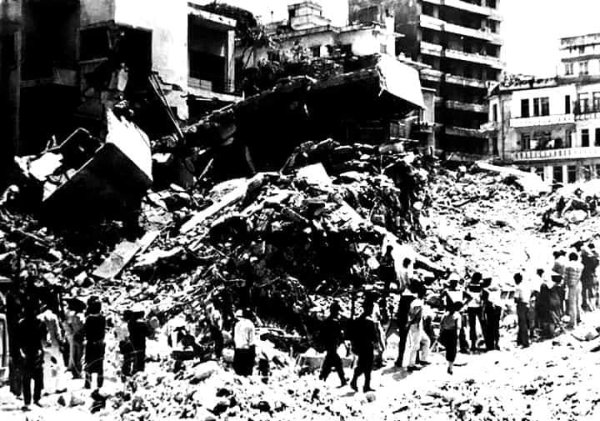
On 6 August 1982, at 1:55 p.m., at the height of the siege of Beirut, Israeli warplanes bombed the Akar building in the Sanayeh district, a seven-story building inhabited by civilians, most of them displaced from the Dbayeh and Jisr al-Basha camps, and razed it to the ground. The dead and wounded were estimated at about 250, and most of those pulled from the rubble were women and children. [1] [2]
It is also known as the Akar tower massacre or the Sanayeh massacre. This article tells the story of the Akar building massacre: its context in the siege of Beirut, what happened that day, the weapon used, the target Israel sought, and how Mahmoud Darwish and Amjad Nasser wrote it into their accounts of the siege.
The Akar building massacre at a glance
| Item | Details |
|---|---|
| Date | Friday, 6 August 1982, 1:55 p.m. [1] [2] |
| Place | The Akar building, Sanayeh district, West Beirut [2] |
| The building | Seven stories, completely destroyed [2] |
| Residents | Civilians, most displaced from the Dbayeh and Jisr al-Basha camps [2] |
| Killed and wounded | About 250 according to the PLO; 100–150 according to Beirut radio [1] |
| Presumed target | The assassination of Yasser Arafat [2] |
Context: the siege of Beirut, 1982
In June 1982 Israel invaded Lebanon and besieged West Beirut, home to the headquarters of the Palestine Liberation Organization, subjecting it to weeks of continuous bombardment from air, land and sea. West Beirut was crowded with the displaced: Lebanese and Palestinians who had fled the south and the destroyed camps, many of them camping in public gardens, among them the Sanayeh garden, which became “a new camp of the children of the old camps,” as the poet Amjad Nasser wrote. [4]
The bombardment peaked in August, shortly before the agreement for the departure of PLO fighters from Beirut. On 12 August alone, according to a PLO letter to the Security Council, nine continuous hours of air raids caused an estimated 300 casualties in West Beirut. [6]
Midday, 6 August: the building the earth swallowed
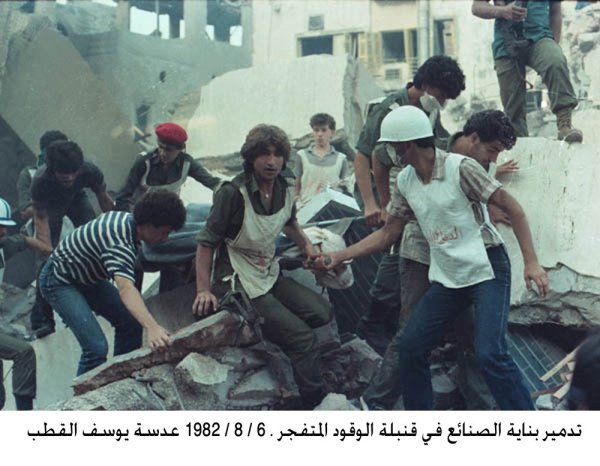
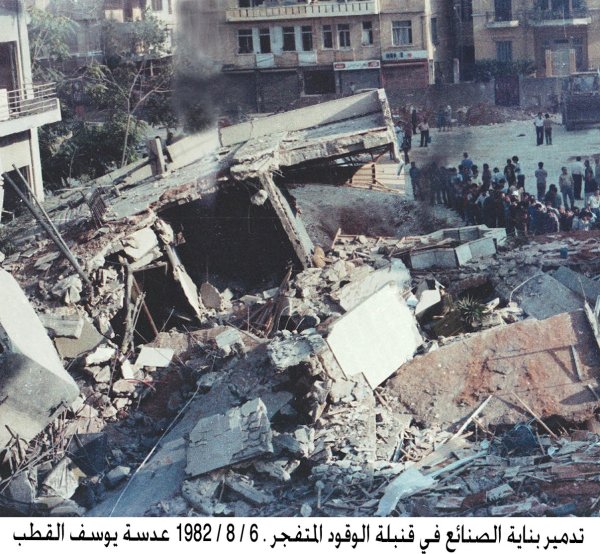
At 1:55 p.m. on Friday, 6 August 1982, Israeli warplanes struck the Akar building in the Sanayeh district, a seven-story building, destroying it completely and bringing it down on its residents. [2] Israel claimed the building housed a PLO “operations room,” while its residents were all civilians. [1] [2]
Many of the bodies pulled from the rubble were those of women and children. [1] Mahmoud Darwish described the scene around the site: hundreds of frightened people surrounding the ruins, and “a building swallowed by the bottom of the earth.” [3]
A missile without sound
It is reported that Israeli warplanes used “vacuum” missiles on the building that had not been used before in the war on Lebanon: witnesses noted that the sound of the missile was not heard far from the building, unlike the powerful tremor, which reached beyond the range of the sound of the explosion. [2] A vacuum bomb is a weapon that consumes the oxygen around the blast and generates immense pressure, so that buildings collapse in on themselves.
The target: Yasser Arafat
According to the Kuwaiti newspaper al-Qabas of 7 August 1982, the aim of the strike was to assassinate Yasser Arafat (Abu Ammar): the Israelis believed he would be in the building after tracking one of his bodyguards, who had brought his family there to protect them from the bombing—his father, his mother, his wife and his four children. Arafat was not there, but the guard’s entire family was killed. [2]
This was not the only such attempt: Israel pursued Arafat during the war, bombing places where it believed he was, including the strike on the Arab University area on 7 June 1982. [7]
The victims: displaced, and killed by displacement twice
Most of the building’s residents were displaced people who had fled the Dbayeh and Jisr al-Basha camps and sought safety in West Beirut, only for death to follow them to their refuge. [2] Amjad Nasser wrote: “The displaced who fled death were buried by death under the rubble.” [4]
Estimates of the number of victims vary: the PLO put the dead and wounded at about 250, Beirut radio at between 100 and 150, while the Red Cross gave a much lower figure. [1]
Read about the Zionist massacres against the Palestinian people on our site.
The massacre in literature: Darwish and Amjad Nasser
The poet Mahmoud Darwish, a son of the depopulated village of al-Birwa in the Acre district, lived through the siege of Beirut and wrote about it in prose in Memory for Forgetfulness, set in Beirut on 6 August 1982, the anniversary of Hiroshima. [3] In it he describes the Sanayeh garden on the day of the massacre as witnessing “one of the scenes of Judgment Day,” with crowds pushing to see “a building swallowed by the bottom of the earth.” [3]
The Jordanian poet Amjad Nasser, in his diaries Beirut Is as Small as the Palm of a Hand: Diaries from the 1982 Siege, wrote about the displaced camping in the Sanayeh garden and about the building that buried those who had fled death. [4]
- al-Birwa: A village in the Acre district, about 10.5 km east of Acre, with 1,460 inhabitants; the birthplace of Mahmoud Darwish in 1941. It was occupied on 11 June 1948. [5]
Conclusion
The Akar building was not a military target but a home for families who had fled death again and again: from Palestine in 1948, then from the Dbayeh and Jisr al-Basha camps, then to the Sanayeh garden and its buildings. At midday on 6 August 1982, death followed them to their last refuge. The massacre has remained in the memory of Beirut and of the Palestinians, and in the pages of Darwish and Amjad Nasser, a witness to a siege that made no distinction between fighter and child.
Frequently asked questions about the Akar building massacre
When did the Akar building massacre take place?
It took place on 6 August 1982 at 1:55 p.m., during Israel’s siege of West Beirut.
Where is the Akar building?
In the Sanayeh district of West Beirut, near the Sanayeh garden, where hundreds of displaced people took refuge during the siege.
How many victims did the Akar building massacre claim?
The PLO put the dead and wounded at about 250 and Beirut radio at between 100 and 150; most of those pulled from the rubble were women and children.
Why was the Akar building bombed?
According to the Kuwaiti newspaper al-Qabas, the Israelis believed Yasser Arafat would be in the building after tracking one of his bodyguards who had brought his family there; the building was bombed and the guard’s family was killed, but Arafat was not there.
Who wrote about the Akar building massacre?
Mahmoud Darwish wrote about it in Memory for Forgetfulness, and Amjad Nasser in Beirut Is as Small as the Palm of a Hand: Diaries from the 1982 Siege.
Sources and references
Arabic-language sources are listed with translated titles.
- “Friday, August 6, 1982,” Chronology of the Palestine Question, Institute for Palestine Studies.
- Al-Qabas (Kuwait), 7 August 1982, as cited in accounts of the massacre.
- Mahmoud Darwish, Memory for Forgetfulness: August, Beirut, 1982, trans. Ibrahim Muhawi, University of California Press.
- Amjad Nasser, Beirut Is as Small as the Palm of a Hand: Diaries from the 1982 Siege (in Arabic).
- “al-Birwa,” Depopulated Villages section, Palestinina.
- Letter from the Palestine Liberation Organization to the President of the Security Council, UN document S/15354, 12 August 1982.
- Mark Garfield, “Beirut Diary,” MERIP, September 1982.
Video clips
Photo gallery



More from the archive
 Download Our Palestine App
The whole archive in the palm of your hand: depopulated villages, the Nakba, the massacres and Al-Aqsa — free, with no ads to erase the story.

Comments
No comments yet — be the first to write one.
Add your comment
Name and email are optional. Comments appear after review.