
Beach Camp (Al-Shati) in Gaza

Beach Camp (Al-Shati) in Gaza
Beach Camp (Al-Shati) in Gaza: History, Population, the Genocide in Gaza and the Right of Return
Beach Camp, known in Arabic as Mukhayyam al-Shati, is a Palestine refugee camp on the Mediterranean coast in Gaza City. It was founded after the Nakba for about 23,000 refugees driven from Jaffa, Lydda, Ramla, Beersheba and the coastal villages of southern Palestine during the occupation of Palestine in . It is the third-largest camp in the Gaza Strip and one of the most densely populated places in the world, with more than 84,000 registered refugees on just 0.52 km². Since October 2023, the camp has been bombed, invaded and largely destroyed in the genocide in Gaza, while its ruins now shelter tens of thousands of displaced people in tents. This guide covers its history, origins, population, living conditions and current situation.
Quick Facts About Beach Camp
| Arabic name | مخيم الشاطئ (Mukhayyam al-Shati) |
|---|---|
| Country / Region | Palestine, Gaza Strip |
| Governorate | Gaza Governorate (western Gaza City) |
| Year established | After the Nakba of ; consolidated on its current site around 1951 |
| Area | About 0.52 km² (UNRWA) |
| Registered refugees | More than 84,077 (UNRWA), the third-largest camp in the Gaza Strip |
| Original population | About 23,000 refugees |
| UNRWA facilities (before October 2023) | 19 schools in 10 buildings (18 on double shifts) and 1 health centre |
| Origin of residents | Jaffa, Lydda, Ramla, Beersheba, al-Majdal and the coastal villages of the Gaza district |
| Main livelihood (historically) | Fishing, about 30% of the camp's economy |
| Current status | Heavily destroyed since October 2023; sheltering large numbers of displaced people in tents as of 2026 |
Note: UNRWA counts refer to refugees registered in the camp, not necessarily the number of people living there at any given time.
The Nakba: Why Beach Camp Exists
Beach Camp was born from the Nakba (Arabic for "catastrophe"): the mass expulsion of Palestinians during the occupation of Palestine in . Roughly 750,000 Palestinians were driven from their homes, and more than 200,000 of them poured into the narrow Gaza Strip.
Many of those who reached Gaza City came from the coast: fishermen and farmers from Jaffa, al-Majdal, al-Jura, Hamama and Isdud, along with families from Lydda, Ramla and the Beersheba region. They first lived in scattered temporary camps and rented rooms across Gaza City, before being gathered on the sand dunes by the sea, the site that became Beach Camp.
The Right of Return
The right of return is the central demand of Beach Camp's refugees. It rests on several foundations in international law:
- UN General Assembly Resolution 194 (), paragraph 11, resolved that refugees wishing to return to their homes and live at peace with their neighbours should be permitted to do so at the earliest practicable date, and that compensation should be paid to those choosing not to return and for loss of or damage to property.
- The Universal Declaration of Human Rights (Article 13) affirms everyone's right to leave any country, including their own, and to return to it.
- UN General Assembly Resolution 3236 () reaffirmed the "inalienable right" of Palestinians to return to their homes and property.
The coastal villages that most of the camp's families came from lie only a short distance north along the same shoreline. Over the decades, the refugees of Beach Camp have also rejected resettlement schemes designed to end their refugee status, insisting that only return can close their case.
History of the Camp
From scattered camps to the seashore (1948–1951)
After the Nakba, refugees in Gaza City lived in three temporary camps: Halazoun camp west of the Saraya, al-Jummaizat camp south of al-Shifa hospital, and Qarqash camp north of the Yarmouk stadium, while others rented rooms around the city. Relief was first provided by the International Committee of the Red Cross and the Quakers. Around 1951, these refugees were gathered on a coastal site of about 512 dunums, forming Beach Camp.
Early shelters
In the early 1950s, UNRWA replaced the tents with one-room units built of cement blocks and roofed with cement tiles, each with a small walled courtyard. The rooms served as bedrooms at night and kitchens by day. Toilets were shared public facilities in the streets, water came from UNRWA wells, and a public bathhouse was used by schoolchildren once a week. The camp was laid out in blocks separated by 8-metre streets and narrow alleys.
Demolitions and resettlement under occupation (1967–1993)
After the occupation of the West Bank and Gaza Strip in , the camp became a centre of resistance. In , the Israeli occupation authorities demolished more than 2,263 rooms in the camp to cut wide roads through it, presented as "camp improvement" but aimed at crushing armed resistance. Many of the families whose homes were destroyed were moved to al-Arish in Sinai, which was also under occupation at the time.
The occupation also built the Sheikh Radwan housing project to the east, offering refugees new homes on condition that they demolish their shelters in the camp. The project was intended to empty the camp and resettle the refugees, ending their status as refugees.
Intifadas and siege (1987–2023)
The camp played a major role in the First Intifada (1987–1993) and the Second Intifada (2000). It produced political and military leaders from across the Palestinian factions. After the blockade imposed on Gaza in 2007, unemployment soared, a ban on cement made it impossible to build or repair homes, and a three-mile fishing limit devastated the camp's fishermen. The camp was struck repeatedly in the wars of 2008–2009, 2012, 2014 and 2021; in July 2014, a strike killed ten people, eight of them children playing in the street, on the first day of Eid al-Fitr.
Beach Camp and the Genocide in Gaza (2023 onward)
Since October 2023, Beach Camp has been among the hardest-hit areas of Gaza City in the genocide in Gaza. In September 2025, the UN Independent International Commission of Inquiry concluded that Israel has committed genocide against Palestinians in Gaza, finding that four of the five acts defined in the 1948 Genocide Convention had been committed. A genocide case brought by South Africa against Israel is also before the International Court of Justice. Israel rejects these findings. By mid-2026, Gaza's health ministry reported more than 72,000 Palestinians killed since October 2023.
Bombardment and invasion (2023–2024)
- October–November 2023: residents were ordered to leave northern Gaza, but many refused to abandon their homes. The camp was then hit with intense carpet bombing ("fire belts") that destroyed large parts of it, including old homes and most of its mosques.
- November 2023: Israeli ground forces invaded the camp after fierce fighting.
- 2024: repeated strikes continued; aerial images from mid-2024 showed large parts of the camp reduced to rubble.
A refuge under fire (2025–2026)
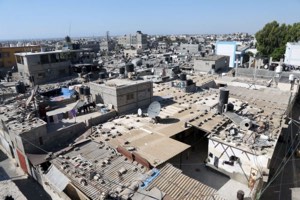
As other areas of Gaza City and the north were destroyed, the ruins of Beach Camp became a refuge for tens of thousands of displaced people living in tents and makeshift shelters by the sea. Even so, the camp has continued to be struck:
- July 2025: overnight strikes on the camp killed at least 13 people and wounded more than 50, according to Gaza's civil defence.
- After the ceasefire agreement of October 2025: strikes did not stop. In May 2026, an airstrike destroyed a home in the camp and damaged dozens of nearby buildings; in June 2026, a drone strike on a tent of displaced people wounded ten; and in July 2026, strikes set buildings on fire and displaced dozens more families.
- Winter storms: heavy rain, wind and high waves have repeatedly flooded and torn apart the tents of displaced families in the camp, with shelter materials still restricted from entering Gaza.
For the people of Beach Camp, these events are a second Nakba: the grandchildren of the refugees of 1948 have been killed, starved and displaced again, while those who remain live in tents on the ruins of the camp their grandparents built.
Origin of the Name
The camp is named al-Shati, Arabic for "the beach" or "the shore", because it lies directly on the Mediterranean coast. UNRWA and English-language sources call it Beach Camp; it is also spelled Shati, Shatti or Al-Shatea.
Location and Geography
Beach Camp lies in the Gaza Governorate, on the western edge of Gaza City along the Mediterranean shore, about 4 km from the city centre. To its east lies the Sheikh Radwan neighbourhood, and to its south the al-Rimal area and the port. Al-Shifa hospital, once Gaza's largest, is nearby. The camp sits on low coastal sand dunes and has a Mediterranean climate, with mild, rainy winters and hot, humid summers. Its seafront location exposes tents to storms and high waves in winter.
Area and Land
UNRWA gives the camp's area as about 0.52 square kilometres. With more than 84,000 registered refugees on this small area before the war, Beach Camp was one of the most densely populated places on earth, with very narrow streets and alleys and almost no open space.
Villages of Origin
Beach Camp's refugees came mainly from the coastal towns and villages of central and southern Palestine, in the districts of Gaza, Jaffa, Lydda, Ramla and Beersheba, with a few from the north. Villages and towns of origin include:
- The coast: Al-Jura, Hamama, Isdud, al-Majdal, Hiribya and Barbara
- Inland Gaza district: Burayr, Dayr Sunayd, Dimra, Al-Jiyya, Julis, Al-Sawafir, Al-Batani, Ibdis, Simsim, Huj, Karatiyya, Al-Masmiyya and Al-Khisas
- Jaffa, Lydda and Ramla, and Yibna in the Ramla district
Because so many families came from fishing villages such as al-Jura, Hamama and Jaffa, they carried their trade with them, and fishing became a pillar of the camp's life.
Population and Demographics
| Period | Population | Source |
|---|---|---|
| Around 1951 | About 23,000 refugees | UNRWA |
| 1970s | Population reduced by demolitions and transfers to Sheikh Radwan and al-Arish | Historical sources |
| Before October 2023 | More than 84,077 registered refugees | UNRWA |
| 2023–2026 | Residents repeatedly displaced; the camp now also shelters large numbers of people displaced from other areas | UN agencies |
Housing and Infrastructure
Before October 2023, the camp's homes were packed tightly along narrow alleys, and families built upward to make room for new generations. The blockade's ban on cement and gravel made it impossible to build or repair shelters, power cuts were constant, and about 90% of the water was unfit for drinking.
Since 2023, much of the camp's housing, roads, water and sewage networks has been destroyed. Most residents and displaced families now live in tents, damaged buildings or shelters made from rubble, with building materials still barred from entering Gaza.
Health Situation
Before the war, one UNRWA health centre provided primary care to the camp, and al-Shifa hospital lay nearby. Since 2023:
- Al-Shifa and other hospitals in Gaza City have been besieged, attacked and largely put out of service.
- Famine and malnutrition have spread, especially during periods of total siege.
- Contaminated water, destroyed sewage systems and overcrowded tents have led to the spread of disease.
- Wounded people are often carried on foot or by cart because of fuel shortages, and field clinics struggle to cope.
- Children and families suffer severe psychological trauma.
Economic Situation and Fishing
Fishing historically made up about 30% of the camp's economy, carried on by families from the coastal villages of Palestine. The three-mile fishing limit imposed under the blockade shrank the catch, destroyed livelihoods and deepened poverty. Unemployment rose sharply after 2007, and a large share of the population came to depend on UNRWA food and cash assistance.
Since 2023, the camp's economy has been almost entirely destroyed. Fishing boats and the port have been targeted, naval fire has threatened fishermen, and nearly all families depend on humanitarian aid, which has itself been severely restricted.
Education
Before October 2023, UNRWA ran 19 schools in 10 buildings in the camp, 18 of them on a double-shift system because of overcrowding. Since 2023, schools have been turned into shelters, many have been damaged or destroyed, and the camp's children have lost years of schooling.
Frequently Asked Questions About Beach Camp
Where is Beach Camp (Al-Shati) located?
Beach Camp is on the Mediterranean coast in western Gaza City, in the Gaza Governorate, about 4 km from the city centre.
How many refugees live in Beach Camp?
UNRWA reports more than 84,077 registered refugees on about 0.52 square kilometres, making it the third-largest camp in Gaza and one of the most densely populated places in the world.
When was Beach Camp established?
It was founded after the Nakba of 1948 and consolidated on its current seaside site around 1951 for about 23,000 refugees who had been living in temporary camps across Gaza City.
Where do Beach Camp's refugees come from?
Mainly from Jaffa, Lydda, Ramla, Beersheba, al-Majdal and coastal villages of the Gaza district such as al-Jura, Hamama, Isdud, Hiribya and Barbara.
What happened to Beach Camp in 1971?
The Israeli occupation authorities demolished more than 2,263 rooms in the camp to cut wide roads through it, and moved many affected families to al-Arish in Sinai.
What happened to Beach Camp since October 2023?
The camp has been heavily bombed and invaded in the genocide in Gaza, with large parts destroyed. Its ruins now shelter tens of thousands of displaced people in tents, and strikes on the camp have continued into 2026.
Conclusion
Beach Camp was built on the sand by refugees from the fishing towns and villages of Palestine's coast. It survived the demolitions of the 1970s, schemes to resettle its people, decades of siege and repeated wars. Since 2023, it has been devastated by the genocide in Gaza, yet it has also become a refuge for people displaced from across the Strip. Its families still face the sea, a short distance from the coast they were driven from in 1948, and still hold onto their right to return.
More from the archive
 Download Our Palestine App
The whole archive in the palm of your hand: depopulated villages, the Nakba, the massacres and Al-Aqsa — free, with no ads to erase the story.
Download Our Palestine App
The whole archive in the palm of your hand: depopulated villages, the Nakba, the massacres and Al-Aqsa — free, with no ads to erase the story.



Comments
No comments yet — be the first to write one.
Add your comment
Name and email are optional. Comments appear after review.
Social Situation
Beach Camp was known for its strong community ties, its many mosques, its sea-based way of life and its deep political engagement. Its families valued education highly after losing their land and property, seeing it as a path to dignity and to defending their rights.
The genocide has torn this social fabric apart: families have lost many members, homes and mosques that held generations of memory have been destroyed, and the camp's alleys are now crowded with tents of people displaced from across Gaza.