Abdel Qader al-Husseini: Holy War Army Commander, Killed at Qastal

“You are criminals. History will record that you lost Palestine.”
(Abdel Qader al-Husseini to the Arab League Military Committee in Damascus, late March 1948) [1]
Abdel Qader al-Husseini (1908–1948) was a Palestinian military commander from Jerusalem, son of the national leader Musa Kazim al-Husseini, who fought the British occupation in the Great Revolt, led the Army of the Holy War in the defence of Jerusalem in 1948, and was killed on 8 April 1948 leading the attack to retake the village of al-Qastal from Zionist forces, after the Arab League’s Military Committee had refused to arm him. [2] [1]
Who was Abdel Qader al-Husseini?
Abdel Qader al-Husseini was the foremost Palestinian field commander of the 1948 war. He spread commanders and fighters across Jerusalem’s villages and neighbourhoods, organised “garrisons” within the Army of the Holy War, and brought in weapons left over from the Second World War in Egypt’s Western Desert [3]. When the partition resolution passed, he told his comrade Bahjat Abu Gharbiyya: “Partition will pass – let it pass over our bodies. I will fight to defend our country until death” [3].
Abdel Qader al-Husseini at a glance
| Item | Details |
|---|---|
| Name | Abdel Qader Musa Kazim al-Husseini [2] |
| Born | 1908, Istanbul [2] |
| Parents | Musa Kazim Pasha al-Husseini and Zakiyya al-Husseini [2] [4] |
| Family | Wife Wajiha; sons Musa, Faisal and Ghazi and daughter Haifa [2] |
| Education | Rawdat al-Ma’arif and Bishop Gobat School in Jerusalem, then mathematics at the American University in Cairo [2] |
| Role | Commander-in-chief of the Army of the Holy War [2] [5] |
| Killed | 8 April 1948, Battle of al-Qastal west of Jerusalem [2] [1] [6] |
| Buried | Near the Haram al-Sharif in Jerusalem, beside his father [2] |
Timeline
| Date | Event |
|---|---|
| 1908 | Born in Istanbul [2] |
| 1927 | Finishes secondary school at Bishop Gobat School, Jerusalem [2] |
| 1932 | Accuses the American University in Cairo of serving imperialism at his graduation and is expelled from Egypt [2] |
| 1934 | His father Musa Kazim al-Husseini dies of injuries from a beating by British soldiers at an October 1933 demonstration [4] |
| 1936 | Co-founds the Holy War Organisation; wounded and captured at al-Khader (October) [2] |
| 1938 | Gravely wounded at Bani Naim (October) [2] |
| 1941 | Joins Rashid Ali al-Kaylani’s revolt in Iraq, then exiled to Zakho [2] |
| 1943–1945 | Lives in Saudi Arabia; secret explosives training [2] |
| 1946 | Moves to Cairo and organises arms purchases and smuggling [2] [3] |
| December 1947 | Returns to Palestine and commands the Army of the Holy War [2] |
| Late March 1948 | Meets the Arab League Military Committee in Damascus [2] [1] |
| 6 April 1948 | His memo to the Arab League Secretary-General [7] |
| 8 April 1948 | Killed in the Battle of al-Qastal [2] [1] |
| 9 April 1948 | The Deir Yassin massacre [6] [1] |
Palestine under the British Mandate
Britain’s occupation of Palestine (1917–1948) was the umbrella under which the Zionist project grew: mass Jewish immigration, settlements, and armed militias that committed massacres while British forces crushed the Palestinians. London’s intentions were clear from the moment it issued the Balfour Declaration in 1917 and then appointed the Zionist politician Herbert Samuel as the first High Commissioner for Palestine in 1920.
Read also: The Balfour Declaration
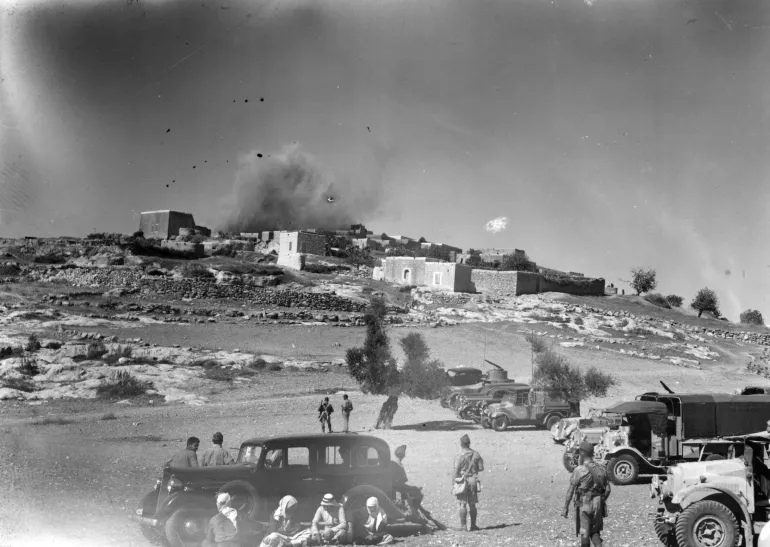
British forces targeting areas near Haifa during the Great Arab Revolt
In this climate a number of leaders rose to lead the resistance against British occupation and the Zionist project, foremost among them Abdel Qader al-Husseini, who lived only forty years and filled them with acts of courage against the British and the Zionist militias.
Read also: What was the Great Revolt of 1936?
Birth and family
Abdel Qader al-Husseini was born in Istanbul in 1908 to Zakiyya al-Husseini and Musa Kazim Pasha al-Husseini [2]. His father was a senior Ottoman administrator who served as district governor in several provinces including Asir, Najd and Hauran, and became mayor of Jerusalem in 1918 after the British occupation, refusing to make Hebrew an official language of the municipality [4]. He headed the Arab Executive Committee and was called the “Sheikh of the Cause” and the “Venerable Father” of the Palestinian national movement [4].
In October 1933 British soldiers beat Musa Kazim al-Husseini with batons and rifle butts during a demonstration against the Mandate; he died of his injuries on 26 March 1934 and was buried in the Khatuniyya school at Bab al-Hadid, west of al-Aqsa Mosque [4].
Abdel Qader al-Husseini married Wajiha al-Husseini; they had three sons, Musa, Faisal and Ghazi, and a daughter, Haifa [2]. His son Faisal al-Husseini later became one of Jerusalem’s foremost leaders, known as the “Prince of Jerusalem” [8].

Bottom row, from left: Qasim al-Rimawi, Abdel Qader al-Husseini, Kamel Erekat and Malik al-Husseini, 1948
Education: from Jerusalem to Cairo
Abdel Qader al-Husseini studied at Rawdat al-Ma’arif al-Wataniyya and then Bishop Gobat School (Zion College) in Jerusalem, matriculating in 1927 [2]. He studied for a time at the American University of Beirut [5], then enrolled in the science faculty of the American University in Cairo, studying mathematics [2].
At his graduation ceremony in 1932 he stood up and publicly accused the university of serving imperialism, and was expelled from Egypt [2].
In the Great Revolt, 1936–1939
On his return he worked for the Palestine Arab Party in Jerusalem, and when the Great Palestinian Revolt broke out in April 1936 he prepared for armed action, co-founded the Holy War (al-Jihad al-Muqaddas) Organisation in the Jerusalem district and fought alongside Sa’id al-‘As [2].

Abdel Qader al-Husseini
In October 1936 he was wounded at the Battle of al-Khader near Bethlehem, where Sa’id al-‘As was killed; the British arrested him, but he escaped to Damascus to complete his treatment [2].
Read also: What was the Battle of al-Khader?
Read also: The Battle of Jurat Bahlas (Ras al-Joura), one of the largest battles of the Hebron rebels
He returned to Palestine as the revolt intensified, and in October 1938 was gravely wounded at the Battle of Bani Naim in the Hebron district and treated secretly in Hebron [2].
Read also: What was the Battle of Bani Naim?
Exile: Iraq and Saudi Arabia
Al-Husseini moved to Iraq, where he trained as a reserve officer and taught mathematics in Baghdad, then joined Rashid Ali al-Kaylani’s revolt against the British in April 1941 [2]. After it failed, the pro-British authorities exiled him to Zakho on the Turkish border, and he was later held at al-Amara camp until the end of 1943 [2].
After his release King Abdulaziz Al Saud hosted him for about two years, out of friendship with his father; during that time he travelled secretly to Germany and trained for six weeks in explosives and mines [2].
The Army of the Holy War, 1947–1948
In early 1946 al-Husseini moved with his family to Cairo, from where he organised arms purchases and smuggling routes into Palestine [2], gathering weapons left over from the Second World War in the Western Desert and setting up a workshop in Egypt to maintain them [3].
After the partition resolution of November 1947 he entered Palestine across the Egyptian border in December 1947, rebuilt the Army of the Holy War and took command of it [2]. His army’s explosives unit carried out the bombing of the Jewish Agency in Jerusalem [2]. His forces fought at Beit Surik, Ramallah, Latrun, Nabi Samwil, Nabi Ya’qub and Bethlehem [5].
Read also: Antoine Daoud and the bombing of the Jewish Agency in Jerusalem
Damascus: “You are criminals”
In late March 1948 Abdel Qader al-Husseini went to Damascus to ask the Arab League Military Committee, which oversaw the fighting in Palestine, for weapons matching those of the Zionist forces to defend Jerusalem; the answer was no [1] [2]. During the meeting he learned that Zionist forces had seized the village of al-Qastal, and insisted he could retake it if given ammunition and arms [1].
When he was refused he told the committee: “You are criminals. History will record that you lost Palestine,” and told his comrade Qasim al-Rimawi they must return to Palestine to die there or win [1]. He came back with no more than half a sack of bullets [7] [5].
On 6 April 1948 he wrote a memo to the Arab League Secretary-General, signed in his name: “I hold you responsible, having left my men at the height of their victories without help or weapons” [7] [5].
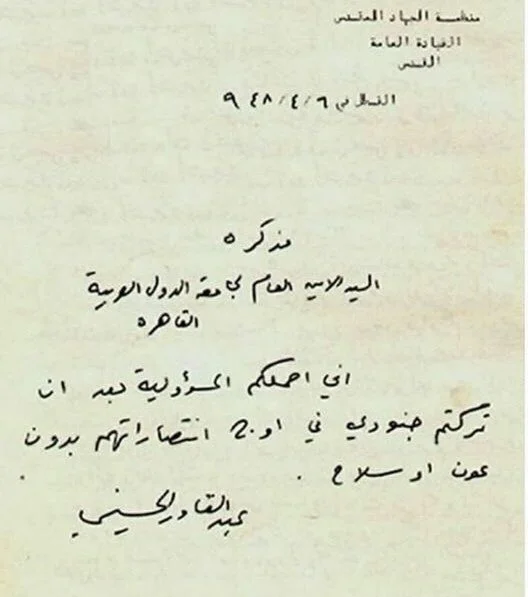
Abdel Qader al-Husseini’s memo to the Arab League Secretary-General, 6 April 1948: “I hold you responsible, having left my men at the height of their victories without help or weapons.” Two days later its author was killed, three days later came the Deir Yassin massacre, and within weeks Haifa and Jaffa fell
The Battle of al-Qastal and his death
Al-Qastal lies on the road between Jerusalem and Jaffa; Zionist forces had seized it as part of Operation Nachshon to open the road to Jerusalem [1]. The Palestinian attack to retake it began on 4 April 1948 and lasted about three days, during which the fighters ran out of ammunition while the Haganah was resupplied by air [1].
Al-Husseini returned to the front and led the counterattack in person [2] [9]. On 8 April 1948 he was surrounded with only one comrade left beside him and was killed; fighters from the surrounding villages then rallied, entered al-Qastal around 3 p.m. and retook it, holding it for about six hours [1].

Abdel Qader al-Husseini (centre) among his men shortly before his death, 7 April 1948
His death was “a major military loss” for the resistance [9]. While the fighters were attending his funeral, Palmach forces returned to al-Qastal on the night of 8–9 April, found it empty, surrounded it with armoured vehicles, demolished its houses and expelled its people [1].
Read also: What was the Battle of al-Qastal?
The funeral and the Deir Yassin massacre
Hundreds of fighters, rebels and Jerusalemites gathered for his funeral; prayers were held in the precinct of the Dome of the Rock, and some mourners went straight back to the front [9]. He was buried near the Haram al-Sharif beside his father, Musa Kazim al-Husseini [2].

The funeral of the martyr Abdel Qader al-Husseini
On 9 April 1948, as Jerusalem mourned its commander, Zionist militias committed the Deir Yassin massacre, less than five kilometres from al-Qastal [6] [1]. Nothing was left of the village but the rubble of its homes and the bodies of its people.

Legacy
The Arab Higher Committee mourned him as “a great and heroic commander” [2]. His name remains a symbol of resistance in the face of official Arab abandonment. His son Faisal al-Husseini later carried Jerusalem’s banner [8].
His words to the Arab Military Committee, “History will record that you lost Palestine,” remain among the best-known lines spoken about the Nakba [1].
Read also: Who was the Palestinian poet and fighter Abdel Rahim Mahmoud?
Video
Conclusion
From Istanbul to Jerusalem, from a graduation hall in Cairo to the hills of Hebron and exile in Iraq, Abdel Qader al-Husseini lived as a fighter. When the Arab armies shut their arsenals to him, he went back to al-Qastal with half a sack of bullets, retook it and fell there, a lasting witness to both the heroism of the resistance and its abandonment.
Frequently asked questions about Abdel Qader al-Husseini
Who was Abdel Qader al-Husseini?
A Palestinian military commander from Jerusalem, son of Musa Kazim al-Husseini, who led the Army of the Holy War in the defence of Jerusalem in 1948.
Where was Abdel Qader al-Husseini born?
In Istanbul, in 1908.
When was Abdel Qader al-Husseini killed?
On 8 April 1948, in the Battle of al-Qastal west of Jerusalem.
What did Abdel Qader al-Husseini tell the Arab League?
He told its Military Committee in Damascus: “You are criminals. History will record that you lost Palestine,” and wrote to its Secretary-General: “I hold you responsible, having left my men at the height of their victories without help or weapons.”
Where is Abdel Qader al-Husseini buried?
Near the Haram al-Sharif in Jerusalem, beside his father Musa Kazim al-Husseini.
How was Abdel Qader al-Husseini related to Faisal al-Husseini?
Faisal al-Husseini was his son, and later one of Jerusalem’s foremost leaders.
How is his death linked to the Deir Yassin massacre?
The Deir Yassin massacre took place on 9 April 1948, the day after he was killed, less than five kilometres from al-Qastal.
Sources and references
Arabic-language sources are listed with translated titles.
- “The Battle of al-Qastal: The Day al-Husseini Told the Arab League ‘You Are Criminals’,” Al Jazeera Encyclopedia, 4 December 2024.
- “Abd al-Qadir al-Husayni,” Interactive Encyclopedia of the Palestine Question, Institute for Palestine Studies.
- Juman Abu Arafa, “The Nakba Is ‘Not Just Defeats’: Untold Stories of Heroism in Jerusalem,” Al Jazeera Net, 14 May 2020.
- “Musa Kazim al-Husseini: Sheikh of the Cause and ‘Venerable Father’ of the Palestinian Movement,” Al Jazeera Encyclopedia, 16 June 2024.
- Wafaa Hilal, “Forgotten Heroics of the Palestinian Nakba and Before,” Noon Post, 16 May 2018.
- “The Most Important Events of April,” Yasser Arafat Museum.
- Jamil al-Salhout, “The Bey and Half a Sack of Bullets,” Diwan al-Arab, 7 April 2018.
- “Faisal al-Husseini: Prince of Jerusalem,” Al Jazeera Net, 31 May 2017.
- “Farewell to al-Husseini,” Palestinian Camps Encyclopedia (Mokhayyam).
Photo gallery


More from the archive
 Download Our Palestine App
The whole archive in the palm of your hand: depopulated villages, the Nakba, the massacres and Al-Aqsa — free, with no ads to erase the story.

Comments
No comments yet — be the first to write one.
Add your comment
Name and email are optional. Comments appear after review.