Abdel Rahim Mahmoud: The Martyr Poet of al-Shajara, 1948
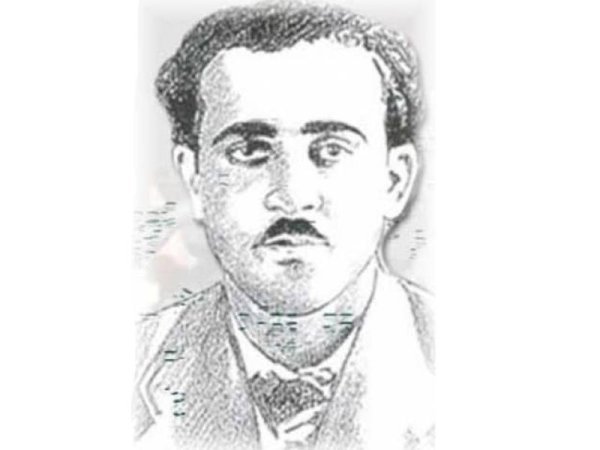
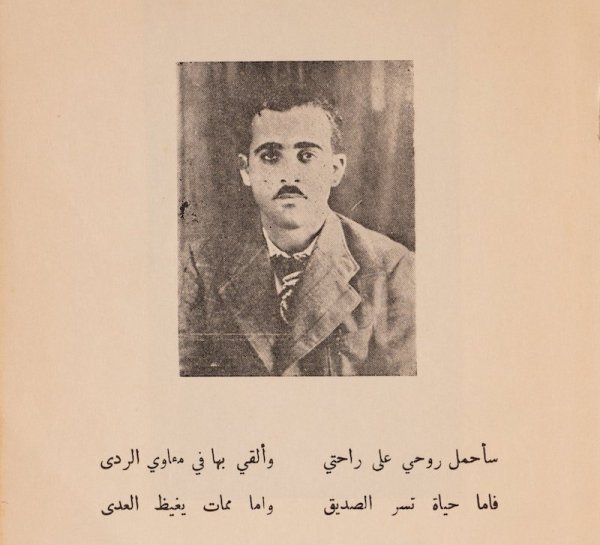
Abdel Rahim Mahmoud (1913–1948) was a Palestinian poet and fighter from Anabta in the Tulkarm district, one of the foremost Palestinian poets of the first half of the twentieth century. Uniting word and rifle, he fought in the 1936 revolt and the 1948 war and was killed at the Battle of al-Shajara in the Tiberias district on 13 July 1948, earning the name “the Martyr Poet.” [1] [2]
Who was Abdel Rahim Mahmoud?
Abdel Rahim Mahmoud was a poet whose deeds matched his words: he wrote of martyrdom, then went to meet it on the battlefield [3] [4]. His poems revolved around the homeland, resistance to British colonialism and the Zionist project, sacrifice, Arab unity and solidarity with peasants and workers [2]. He organised poetry evenings and recited his poems in Jerusalem, Nazareth, Nablus and Haifa to alert people to the danger facing the country [2].
Abdel Rahim Mahmoud at a glance
| Item | Details |
|---|---|
| Name | Abdel Rahim Mahmoud Abdel Halim, “the Martyr Poet” [1] |
| Born | 1913, Anabta, Tulkarm district [1] [2] |
| Parents | Sheikh Mahmoud Abdel Halim, poet and jurist, and Mahfuza Nassar [1] [2] |
| Children | Al-Tayyib, Talal and Ruqayya [1] |
| Education | Anabta, then al-Fadiliyya school in Tulkarm, then al-Najah National School in Nablus; Iraqi Military College (1939–1940) [1] [2] |
| Work | Arabic teacher at al-Najah; headmaster of al-Ashar school in Basra [1] [2] |
| Killed | 13 July 1948, Battle of al-Shajara, Tiberias district [1] |
| Buried | Nazareth [1] |
Timeline
| Date | Event |
|---|---|
| 1913 | Born in Anabta [1] [2] |
| 1931 | Graduates from al-Najah secondary school in Nablus [4] |
| 1 February 1933 | Joins the police school in Bethlehem, later resigning rather than pursue rebels [1] [2] |
| 1933–1937 | Teaches Arabic at al-Najah [2] [1] |
| Summer 1935 | Recites his poem before Prince Saud bin Abdulaziz in Anabta [1] [4] |
| 1937 | Joins the rebels under Abdel Rahim al-Hajj Muhammad [1] [2] |
| 1939–1940 | Iraqi Military College in Baghdad [1] |
| 1941 | Takes part in Rashid Ali al-Kaylani’s revolt [1] [2] |
| 1942–1947 | Returns to teaching at al-Najah and publishes most of his poems [2] [1] |
| January 1948 | Joins the Arab Liberation Army and trains at Qatana camp [1] [2] |
| May 1948 | Moves to the Galilee; promoted to first lieutenant [1] |
| 13 July 1948 | Killed at the Battle of al-Shajara; buried in Nazareth [1] [4] |
Birth and upbringing
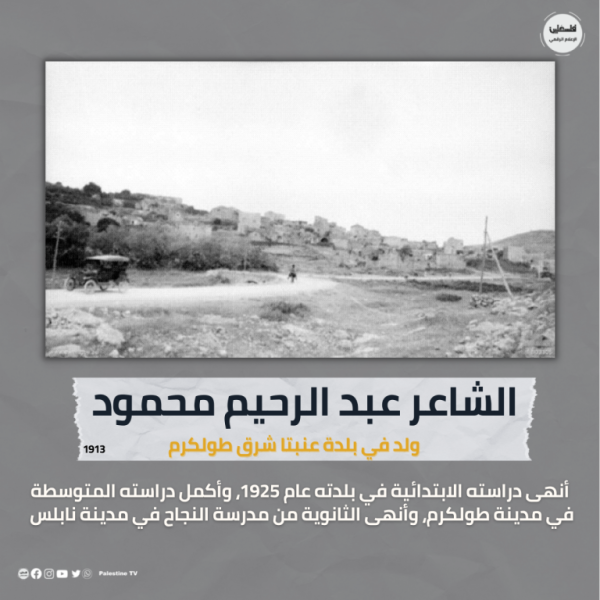
Abdel Rahim Mahmoud was born in 1913 in Anabta, Tulkarm district [1]; sources differ between 1910, 1913 and 1914, and the editors of An-Najah University’s encyclopedia favour 1913 on the basis of his school certificate and his collected poems [2]. His father, Sheikh Mahmoud Abdel Halim, an al-Azhar graduate, was a jurist and poet in the Sharia court in Tulkarm; he died when Abdel Rahim was about six, so the boy grew up an orphan. His mother was Mahfuza Nassar [2] [1].
He went to primary school in Anabta, then al-Fadiliyya school in Tulkarm, where his poetic gift emerged, then al-Najah National School in Nablus, where he studied under the poet Ibrahim Tuqan, whom he took as a model, graduating in 1931 [2] [1] [4].
The police, and resignation
On 1 February 1933 he joined the police school in Bethlehem for six months, then served in the Nazareth police [1]. When he was ordered to arrest a patriot and pursue rebels, he refused and resigned [1] [2] [4]. He returned to Nablus to teach Arabic language and literature at al-Najah [1] [2].
The 1935 poem: a warning over al-Aqsa
In the summer of 1935 Prince Saud bin Abdulaziz passed through Anabta on a visit to Palestine, and Abdel Rahim Mahmoud recited a poem of welcome warning of the Zionist danger to Palestine and its holy places [1] [4]. One line became famous: it asks the prince whether he has come to visit al-Aqsa Mosque, or to bid it farewell before it is lost – one of the best-known warnings of the loss of Palestine [1].
In the 1936 revolt
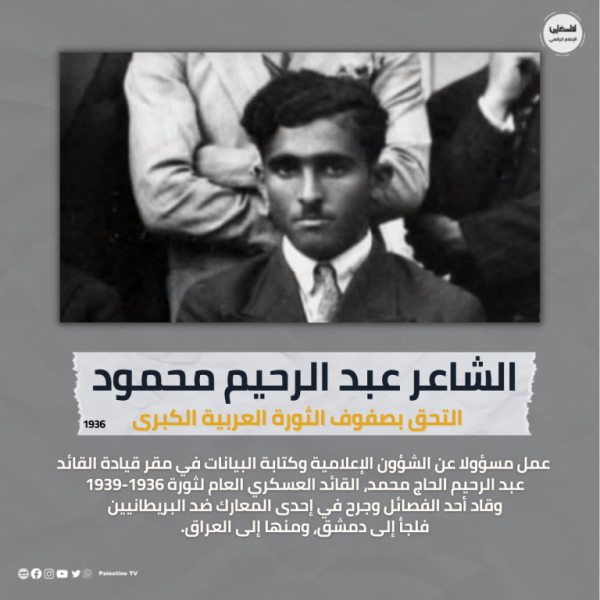
After the general strike and the outbreak of the Great Palestinian Revolt in 1936, he joined the rebels in 1937 under commander Abdel Rahim al-Hajj Muhammad (Abu Kamal) of Dhinnaba, fighting with rifle and pen alike [1] [2]. He wrote an elegy for his commander when he was killed in 1939 [4]. Pursued by the British Mandate authorities, he was forced to take refuge in Damascus and then Baghdad [1].
Iraq: military college and the Kaylani revolt
In Baghdad he enrolled at the Iraqi Military College (1939–1940) and graduated as a lieutenant; there he met the commander Abdel Qader al-Husseini [1]. He taught at and then headed al-Ashar school in Basra, and was influenced by the Iraqi poets Ma’ruf al-Rusafi and Muhammad Mahdi al-Jawahiri [1] [2].
In 1941 he joined Palestinian exiles in Iraq in Rashid Ali al-Kaylani’s revolt against the British, and after it failed he returned to Palestine [1] [2] under a general amnesty issued by the Mandate authorities [4].
His poetry
From 1942 to 1947 he went back to teaching at his old school, now called al-Najah National College, and published most of his poems and articles, especially in the Haifa newspaper al-Ittihad and the magazine al-Ghad [1] [2].
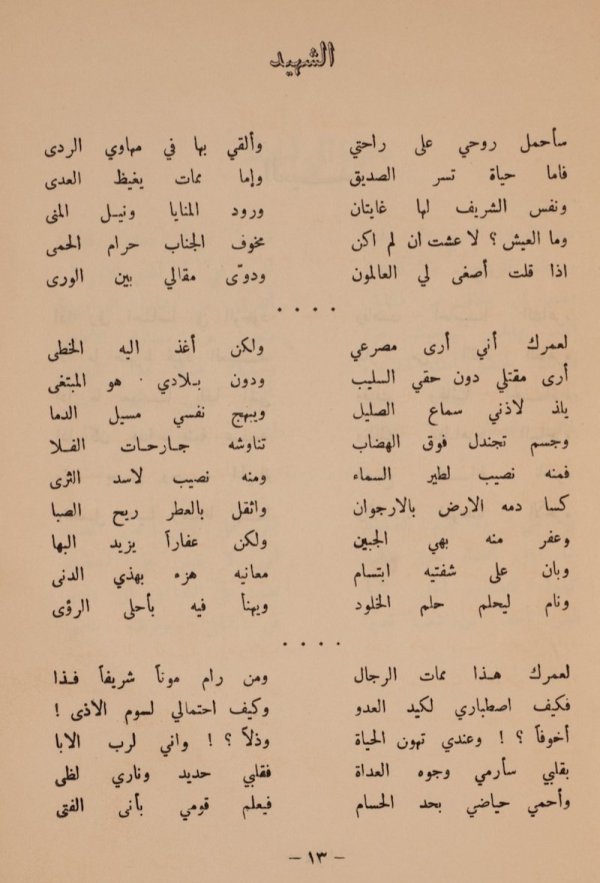
His poetry belongs to the classical school, with traditional metres and rhymes and a strong, clear diction shaped by the Qur’an and Abbasid poetry; he admired al-Mutanabbi [2]. His best-known poem is “The Martyr,” in which a fighter carries his soul in his palm and casts it towards death: either a life that gladdens friends or a death that enrages enemies [3] [2]. The poem portrays the martyr advancing fearlessly into battle, indifferent to the fate of his body, seeing death as a road to immortality [3].
The 1948 war: the Hittin battalion
After the partition resolution and the outbreak of fighting, Abdel Rahim Mahmoud joined the Arab Liberation Army, the irregular force of Arab volunteers formed by the Arab League [1] [2]. In mid-January 1948 he travelled to Damascus, completed an officers’ course at Qatana camp, and returned to Palestine commanding a company of the Hittin battalion, which fought Zionist forces in Marj Ibn Amer [1].
In May 1948 the battalion moved to the Galilee; Abdel Rahim Mahmoud was promoted to first lieutenant as adjutant to the battalion commander and fought in several battles around Nazareth [1] [2].
His death at the Battle of al-Shajara
At the Battle of al-Shajara in the Tiberias district, during the Hittin battalion’s attack on the colony of Sajara next to the Arab village, he was hit by a shell and killed on 13 July 1948; he was buried in Nazareth [1]. Historian Abdel Qader Yassin relates that he was wounded on 12 July and that the ambulance carrying him fell into a valley, where he died – as he had foretold in his poetry [4].
Abdel Rahim Mahmoud was killed at thirty-five, months after his comrade Abdel Qader al-Husseini fell at al-Qastal, in the midst of the Nakba in which Zionist militias drove hundreds of thousands of Palestinians from their towns and villages, al-Shajara itself among them.
Commemoration
- A memorial gathering was held for him in Amman on 14 September 1956 [1] [2].
- A special committee published a collection of his poetry in Amman in 1958, which was incomplete (about 428 lines) [1] [2].
- Fuller editions followed, including one edited by Hanna Abu Hanna (1985) [2].
- The poet Izz al-Din al-Manasra edited and published his complete works, poems and articles, in 1988 (about 1,874 lines) [1] [2].
- In 1990 the PLO awarded him the Jerusalem Medal for Culture, Arts and Literature [1].
- Anabta’s boys’ secondary school was named after him in 1995, and An-Najah University held a symposium on him the same year [2].
- The municipal councils of Nablus and Anabta each named a street after him [1].
Read also: Abdel Qader al-Husseini, Ali Fouda, Samih al-Qasim.
Video
Frequently asked questions about Abdel Rahim Mahmoud
Who was Abdel Rahim Mahmoud?
A Palestinian poet and fighter from Anabta who fought in the 1936 revolt and the 1948 war and was killed at the Battle of al-Shajara.
Why is Abdel Rahim Mahmoud called the Martyr Poet?
Because he wrote of martyrdom in his poem “The Martyr” and then fell on the battlefield, his deeds matching his words.
When was Abdel Rahim Mahmoud killed?
On 13 July 1948, at the Battle of al-Shajara in the Tiberias district.
Where is Abdel Rahim Mahmoud buried?
In the city of Nazareth.
What are Abdel Rahim Mahmoud’s best-known poems?
“The Martyr,” and his 1935 poem before Prince Saud bin Abdulaziz warning of the loss of al-Aqsa Mosque.
Who was Abdel Rahim Mahmoud’s teacher?
The poet Ibrahim Tuqan, who taught him at al-Najah National School in Nablus.
How was Abdel Rahim Mahmoud connected to Abdel Qader al-Husseini?
They met in Baghdad while Abdel Rahim Mahmoud studied at the Iraqi Military College (1939–1940).
Sources and references
Arabic-language sources are listed with translated titles.
- “Abd al-Rahim Mahmud,” Interactive Encyclopedia of the Palestine Question, Institute for Palestine Studies.
- “Abd al-Rahim Mahmoud,” An-Najah National University Encyclopedia.
- Khaled al-Maamari, “The Martyr and the Meanings of Immortality,” Oman Daily, 13 November 2023.
- Abdel Qader Yassin, “Abd al-Rahim Mahmoud,” Diwan al-Arab, 4 August 2007.
Photo gallery


More from the archive
 Download Our Palestine App
The whole archive in the palm of your hand: depopulated villages, the Nakba, the massacres and Al-Aqsa — free, with no ads to erase the story.

Comments
No comments yet — be the first to write one.
Add your comment
Name and email are optional. Comments appear after review.