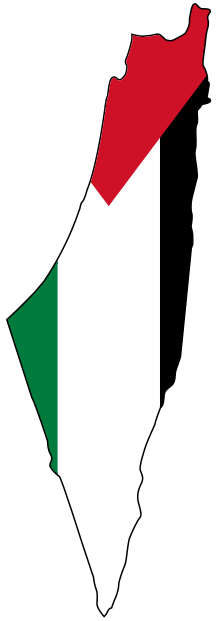
The Establishment of Rishon LeZion in Palestine

Rishon LeZion, established on August 15, 1882, is regarded as one of the earliest Zionist settlements founded in Palestine. It was established southeast of the Palestinian city of Jaffa.
Its Hebrew name means “First in Zion,” a symbolic reference to the settlement’s place as an early practical step toward realizing the vision of establishing a “Jewish national home” in Palestine.
Background to Its Establishment
Rishon LeZion was founded by a group of Jewish immigrants who arrived from Russia and Poland, with financial and organizational support from European Jewish settlement associations.
The settlement later expanded with direct assistance from Baron Edmond de Rothschild, who became one of the most prominent financiers of the emerging Zionist settlement enterprise in Palestine.
Although its founders presented Rishon LeZion primarily as an agricultural settlement, its significance extended far beyond farming. It helped consolidate a permanent Jewish settler presence in Palestine and contributed to the creation of an organized settler community that would later serve the broader Zionist political project.
Impact on the Palestinians
From a Palestinian perspective, Rishon LeZion marked an important and troubling precedent in the history of Zionist settlement. It was among the early settlements associated with the displacement of Palestinian peasants from lands on which they had lived and worked, while European Jewish settlers were established in their place.
This pattern — the removal or dispossession of Palestinian inhabitants followed by the establishment of new settler communities — would recur in different forms across Palestine in the decades that followed, becoming increasingly central to the Palestinian experience of land loss and displacement.
Rishon LeZion therefore represented more than the establishment of a single agricultural community. It formed part of the early foundations of a wider process of demographic and territorial transformation in Palestine: a process that sought to establish and expand a Jewish settler presence on a land whose indigenous population was overwhelmingly Arab Palestinian.
Under the outward language of agriculture, investment, and development, these early settlements helped lay the physical and institutional groundwork for a political project that would profoundly reshape Palestine and the lives of its Palestinian people.
More from the archive


 Download Our Palestine App
The whole archive in the palm of your hand: depopulated villages, the Nakba, the massacres and Al-Aqsa — free, with no ads to erase the story.
Download Our Palestine App
The whole archive in the palm of your hand: depopulated villages, the Nakba, the massacres and Al-Aqsa — free, with no ads to erase the story.
Comments
No comments yet — be the first to write one.
Add your comment
Name and email are optional. Comments appear after review.