The Expulsion and Destruction of Qisarya: An Early Organized Palestinian Village Expulsion in 1948
The Occupation of Qisarya and the Displacement of Its Residents: An Early Stage of the Palestinian Nakba
In February 1948, approximately three months before the end of the British Mandate and the declaration of the State of Israel, a unit of the Palmach, the elite strike force of the Zionist armed organization Haganah, occupied the Palestinian coastal village of Qisarya in the Haifa Subdistrict, and the village was emptied of its Palestinian inhabitants.
Qisarya holds particular significance in the history of the Nakba because its displacement was not merely an incidental consequence of military confrontations. According to historical sources, the operation has been described as the first pre-planned and organized expulsion of an Arab community carried out by the Haganah in 1948.
From a Palestinian historical perspective, Qisarya represents one of the clearest early stages of the organized displacement process that expanded during the following months with the widening occupation of Palestine and the Palestinian Nakba of 1948.
Qisarya Before 1948
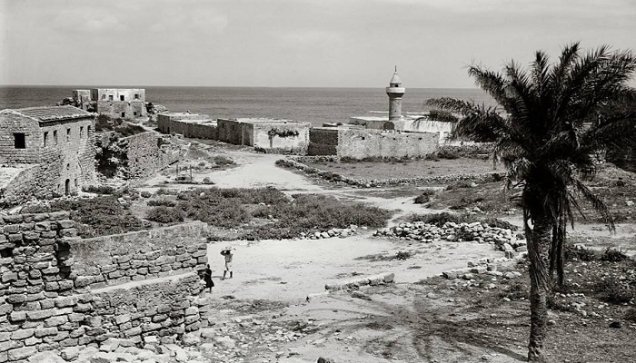
Qisarya was a Palestinian village located on the Mediterranean coast, approximately 37 kilometers south of Haifa.
The village stood among the ruins of ancient Caesarea, one of the most historically and archaeologically significant sites on the Palestinian coast. The modern village was home to Palestinian Arab Muslim and Christian families who formed a settled community around the archaeological site, the coast, and the surrounding agricultural lands.
According to the official statistics for 1944/1945, the statistical unit of Qisarya had a population of 1,120 people, including 960 Arabs and 160 Jews. The Arab population consisted of approximately 930 Muslims and 30 Christians.
The total registered land area of the statistical unit amounted to approximately 31,786 dunums, distributed as follows:
- 20,959 dunums in Palestinian ownership.
- 874 dunums in Jewish ownership.
- 9,953 dunums of public land.
The villagers relied primarily on agriculture, cultivating cereals, citrus fruits, bananas, orchards, and irrigated land. Wells were also used to provide water for domestic and agricultural purposes.
Qisarya had an elementary school for boys dating back to the late nineteenth century, reflecting the continuity of social and educational life in the village long before the Nakba.
The Road to the Displacement of Qisarya
At the beginning of 1948, operations by Zionist armed groups were expanding across Palestine following the United Nations partition resolution of November 29, 1947.
Palestinian coastal villages became increasingly exposed to raids, threats, and military attacks, while Zionist armed organizations sought to expand their control over areas they considered necessary for the establishment of the proposed Jewish state and for linking areas under their control.
Qisarya lay within the central coastal zone, which had acquired considerable strategic importance in Zionist military planning.
Some villagers had already begun leaving before the Palmach entered the village, fearing an imminent attack and the deteriorating security situation, and some sought refuge in nearby Palestinian villages.
A Pre-Planned Decision to Displace and Destroy the Village
One of the most significant aspects of what happened in Qisarya is that the decision to destroy the village houses preceded its occupation.
The decision to demolish the houses was taken in early February 1948 during a meeting of the Haganah General Staff.
This means that the destruction of the village was not a spontaneous act carried out in the midst of a military clash, but a deliberate military decision concerning the future of the Palestinian inhabitants and their homes after the village had been seized.
PalQuest, drawing on later historical research, reports that Yitzhak Rabin, then a Palmach officer involved in operations in the area, objected to the demolition of the village.
A representative of the left-wing Mapam movement also objected, noting that the residents of Qisarya had made efforts to maintain peaceful relations within the village and its surrounding area.
These objections did not prevent the demolition from being carried out.
The Destruction of Qisarya on February 20, 1948
On February 20, 1948, five days after the village had been occupied, a Palmach unit returned to destroy Qisarya’s houses.
Explosives were used to demolish 30 houses.
Six houses remained standing, according to historical accounts, because the unit carrying out the demolition ran out of explosives.
The destruction eliminated much of the physical foundation for the continued existence of the Palestinian community in the village and made the return of those who had left or been forced to leave increasingly difficult.
From a Palestinian perspective, the combination of occupation, displacement, and the deliberate destruction of homes is essential to understanding what happened in Qisarya. The residents were not simply people who left because of military confrontations; their village was deliberately demolished after Zionist forces had secured control over it.
The Displacement of the Palestinian Coastal Plain
The destruction of Qisarya did not occur in isolation from developments taking place in surrounding Palestinian areas.
It formed part of a broader process of expanding Zionist military control over sections of the coastal plain during the first months of 1948.
In the following weeks, numerous Palestinian villages in the coastal region were subjected to raids, attacks, expulsions, and threats. In some cases, inhabitants were expelled directly, while others left after hearing of attacks on neighboring villages and areas.
The British Mandate authorities were still formally responsible for security and public order in Palestine, but they were preparing to withdraw and did not prevent the displacement of several Palestinian villages during this period.
By March and April 1948, the depopulation of areas along the Palestinian coast had expanded considerably.
Was Qisarya the First Act of Ethnic Cleansing?
Neither the Haganah nor the British Mandate authorities used the term “ethnic cleansing” in their contemporary documents to describe what happened in Qisarya.
However, the reality of what occurred brought together several clear elements: the removal of a civilian population from its village, the military seizure of the village, and the deliberate destruction of their homes in order to prevent the continuation of their presence there.
Sedot Yam and the Lands of Qisarya
Zionist settlement on lands historically associated with Qisarya had begun before the destruction of the Palestinian village.
In 1940, the kibbutz Sedot Yam was established on lands traditionally considered part of Qisarya, approximately one kilometer south of the village site.
This fact is important when tracing the changes in patterns of landownership and settlement in the area before and after the Nakba.
Or Akiva and the Village Lands After the Nakba
In 1951, the settlement of Or Akiva was established northeast of the destroyed village site.
The settlement later expanded onto lands belonging to Qisarya and to the neighboring Palestinian locality known as Barrat Qisarya.
The modern Israeli locality known as Qesarya was formally recognized later, in 1977.
What Remains of Qisarya?
Most of Qisarya’s Palestinian houses were destroyed after the village was occupied.
The site was later subjected to extensive archaeological excavations and transformed into a tourist area focused primarily on the Roman, Byzantine, and Crusader remains of ancient Caesarea.
This transformation significantly altered the physical landscape of the place where the modern Palestinian village had stood until 1948.
Published field descriptions indicate that several of the few surviving Palestinian buildings were converted into restaurants and commercial facilities.
The village mosque also survived, but was later used for commercial purposes.
Qisarya and the Early Stages of the Palestinian Nakba
Qisarya was emptied of its inhabitants approximately three months before the declaration of the State of Israel and before the armies of neighboring Arab states entered Palestine.
This chronology is central to understanding the Palestinian Nakba, because it demonstrates that the displacement of Palestinians had already begun before the end of the British Mandate and before May 15, 1948.
By the spring of 1948, the pattern that had appeared early in Qisarya—fear, followed by military occupation, displacement, the destruction of homes, and the prevention of return—was being repeated on a much larger scale in numerous Palestinian towns and villages.
This process expanded during the occupation of Palestine in 1948 and the Palestinian Nakba, ultimately resulting in the displacement of hundreds of thousands of Palestinians and the depopulation and destruction of hundreds of Palestinian towns, villages, and communities.
Qisarya in Palestinian Memory
In Palestinian memory, Qisarya represents far more than a destroyed village.
It documents an early stage in which military planning, displacement, and the physical destruction of a Palestinian community came together within a single organized operation.
Its historical significance lies precisely in the fact that the village was emptied of its inhabitants and its homes were deliberately destroyed in February 1948, before the Nakba reached its full scale during the following months.
Today, the ancient remains of Caesarea remain prominent and preserved as an archaeological and tourist site, while much of the physical landscape of the modern Palestinian community that lived among those ruins until 1948 has disappeared.
From this perspective, Qisarya became one of the earliest documented examples of the organized dispossession that accompanied the Nakba and the occupation of Palestine in 1948: a village emptied of its people, its homes destroyed, and its inhabitants denied return to their community and land.
Photo gallery
More from the archive
 Download Our Palestine App
The whole archive in the palm of your hand: depopulated villages, the Nakba, the massacres and Al-Aqsa — free, with no ads to erase the story.
Download Our Palestine App
The whole archive in the palm of your hand: depopulated villages, the Nakba, the massacres and Al-Aqsa — free, with no ads to erase the story.

Comments
No comments yet — be the first to write one.
Add your comment
Name and email are optional. Comments appear after review.