The Bombing of Jerusalem’s King David Hotel by the Zionist Irgun
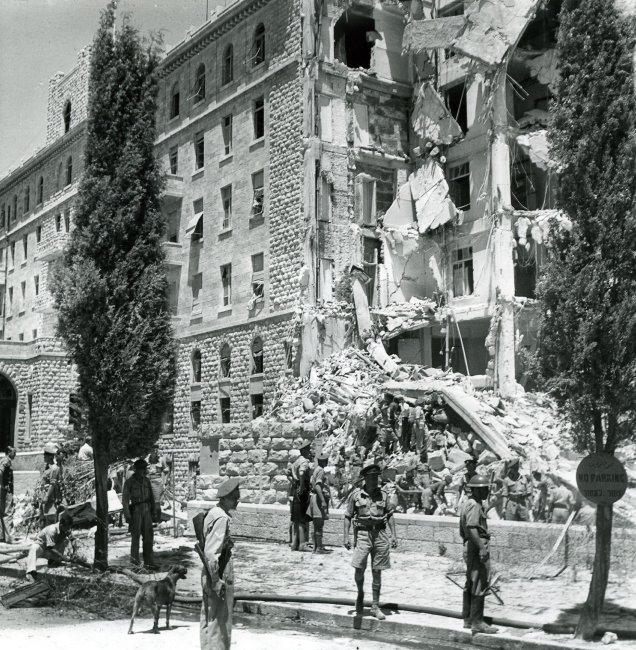
On July 22, 1946, the Zionist underground organization Irgun Zvai Leumi (Etzel), led by Menachem Begin, carried out one of the deadliest attacks of the British Mandate period when it bombed the southern wing of the King David Hotel in Jerusalem.
The targeted section of the hotel housed the central offices of the British Mandatory administration, including the Government Secretariat and sections of the British military headquarters. The enormous explosion caused much of the southern wing to collapse, killing 91 people, the majority of them civilians and government employees.
Among the dead were 41 Arabs, 28 Britons, 17 Jews, and five people of other nationalities.
From a Palestinian historical perspective, the attack is an important episode in the final years of British rule because it illustrates the extent to which Zionist armed organizations had developed military structures capable of striking the very center of Mandatory power while simultaneously building the institutions that would later form the foundations of the Israeli state.
The King David Hotel Under British Rule
The King David Hotel had opened in Jerusalem during the early 1930s as one of the city's most prestigious hotels.
During the Great Palestinian Revolt of 1936–1939, British authorities began requisitioning parts of the building for official use.
By the 1940s, most of the southern wing had been transformed into a major center of British authority in Palestine. It housed the Government Secretariat, military headquarters, and offices connected with British security and intelligence services.
Fewer than a third of the hotel's rooms remained available for ordinary civilian guests.
The hotel therefore occupied a peculiar position: it remained a functioning civilian hotel while simultaneously serving as one of the most important centers of British political and military administration in Palestine.
The Zionist Armed Revolt Against Britain
By 1946, relations between Britain and the Zionist movement had deteriorated sharply.
Zionist organizations strongly opposed Britain's restrictions on Jewish immigration imposed under the White Paper of 1939, particularly as the scale of the Holocaust and the desperate situation of Jewish survivors in Europe became clear.
Three principal Zionist armed organizations operated in Palestine during this period:
- Haganah, the largest Zionist military organization.
- Irgun Zvai Leumi (Etzel), led by Menachem Begin.
- Lehi, also known by the British as the Stern Group.
For a period after the Second World War, the three organizations coordinated some of their operations against British rule through what became known as the Hebrew Resistance Movement.
Their operations included sabotage of railways, bridges, police installations, military facilities, and other British targets.
Operation Agatha and the Decision to Attack the Hotel
A major escalation occurred on June 29, 1946, when British forces launched a large operation against Zionist institutions and armed organizations, known to the British as Operation Agatha and remembered within the Yishuv as “Black Saturday.”
British forces raided the offices of the Jewish Agency, arrested Zionist leaders, seized weapons, and confiscated large quantities of documents that British intelligence believed demonstrated links between Zionist political institutions and underground military operations.
Some of these documents were believed to have been taken to British offices inside the King David Hotel.
Destroying the British administrative center—and potentially destroying the seized documents stored there—became one of the objectives behind the proposed attack.
Coordination with the Hebrew Resistance Movement
The attack was not initially conceived entirely outside the framework of wider Zionist military coordination.
On July 1, 1946, Moshe Sneh, a senior Haganah commander and one of the leaders involved in coordinating the Hebrew Resistance Movement, sent Menachem Begin a message authorizing an operation against the King David Hotel, which was referred to by a code name.
The operational plan was developed principally by Amichai Paglin, the Irgun's chief operations officer, and was coordinated during its planning stages with representatives of the wider resistance framework.
However, as the political situation changed, Haganah leaders subsequently requested that operations be delayed. The relationship between this earlier authorization and the final decision to proceed on July 22 later became the subject of bitter controversy between the Irgun and the mainstream Zionist leadership.
The Attack — July 22, 1946
Shortly before noon on July 22, an Irgun unit arrived at the service entrance of the King David Hotel.
Members of the group disguised themselves as Arab workers, while the operation's commander was dressed to resemble one of the hotel's Sudanese employees.
The attackers entered the service area and held hotel employees at gunpoint.
They then carried several large milk churns filled with explosives into the basement restaurant known as La Régence.
The explosives were placed beside structural columns supporting the floors above them.
During the withdrawal, members of the Irgun encountered a British army officer who attempted to intervene. He was shot and mortally wounded.
An alarm was raised, and an exchange of fire followed between British security personnel and the escaping attackers. Members of the Irgun were wounded as they fled the hotel.
The Warning Calls
One of the most controversial questions surrounding the bombing concerns warnings that the Irgun claimed to have issued before the explosives detonated.
Evidence indicates that telephone warnings were indeed made to the King David Hotel, the French Consulate, and the Palestine Post.
The Irgun later claimed that British officials had been given approximately 25 to 30 minutes to evacuate the building and had deliberately ignored the warning.
Later historical research presents a more complicated picture.
The warning reached the hotel's telephone system only shortly before the explosion, and confusion, previous false alarms, security procedures, and failures of internal communication meant that the building was not evacuated.
The evidence therefore supports the conclusion that warnings were issued, but does not support the simplified claim that British officials knowingly kept hundreds of people inside a building despite receiving a clear and timely evacuation order.
Nor did the existence of a warning remove responsibility from those who had planted a large quantity of explosives beneath a building filled with civilian employees, hotel workers, visitors, and government personnel.
The Explosion
At approximately 12:37 p.m., the explosives detonated.
The blast tore through the southern wing of the King David Hotel, causing several floors of stone, concrete, offices, and rooms to collapse into one another.
Rescue teams worked for days to search through the ruins.
In total, 91 people were killed:
- 41 Arabs
- 28 British citizens
- 17 Jews
- 2 Armenians
- 1 Russian
- 1 Greek
- 1 Egyptian
The victims included senior officials, clerks, secretaries, typists, hotel and restaurant workers, soldiers, police officers, and civilians who happened to be inside or near the building.
Although the hotel contained important British government and military offices, the overwhelming majority of those killed were civilians.
Some later accounts give a total of 92 deaths. That figure includes an Irgun member who died from wounds sustained during the operation. The generally accepted number of people killed by the attack itself is 91.
The Irgun Accepts Responsibility
The Irgun acknowledged responsibility for the bombing but attempted to place responsibility for the large death toll on the British authorities, arguing that its warnings had not been acted upon.
Menachem Begin continued for years to defend the operation as an attack on the headquarters of British colonial authority rather than as an attack deliberately intended to kill civilians.
That interpretation remains contested.
The hotel undoubtedly housed major British administrative and military institutions, but it was also occupied by hundreds of civilian government employees, hotel workers, guests, and visitors. The bombing therefore produced a devastating civilian death toll regardless of the intended political target.
Menachem Begin and the Irgun
The attack also has particular historical significance because of the later political career of Menachem Begin.
Begin had become commander of the Irgun in 1943–1944 and led its campaign of armed attacks against British rule.
After the establishment of Israel, the Irgun was dissolved and many of its members were incorporated into the new Israeli military.
Begin subsequently entered parliamentary politics and founded the political movement that eventually developed into the Herut and later Likud traditions.
In 1977, he became Prime Minister of Israel.
The Bombing Through a Palestinian Lens
From a Palestinian historical perspective, the bombing of the King David Hotel exposes an important contradiction in the final years of the British Mandate.
For decades, Britain had provided the political framework within which Zionist immigration, settlement, military organization, and state-building institutions expanded in Palestine.
By the mid-1940s, however, Zionist armed organizations were increasingly turning their weapons against the same British authority when its policies no longer fully served their political objectives.
Palestinian Arabs were caught within this changing struggle.
They remained the indigenous population seeking national independence after decades of British colonial rule, yet they were also among the largest group of victims in the King David Hotel bombing: 41 of the 91 people killed were Arabs.
Their deaths are sometimes marginalized in narratives that present the bombing primarily as a confrontation between the Zionist underground and Britain.
Yet Palestinians were not spectators to this conflict. It was their country whose political future was being contested, divided, and transformed.
A Sign of the Approaching End of the British Mandate
The bombing became one of the most dramatic symbols of Britain's deteriorating control over Palestine.
It demonstrated that Zionist armed organizations possessed the intelligence networks, explosives, personnel, logistics, and operational capacity to strike directly at one of the most heavily protected centers of British authority in Jerusalem.
The attack alone did not cause Britain to leave Palestine, but it formed part of a wider armed campaign that increased the military, political, and financial pressure confronting the Mandatory administration.
Less than a year later, Britain referred the Palestine question to the United Nations.
On November 29, 1947, the UN General Assembly recommended partitioning Palestine into Arab and Jewish states.
As British rule approached its end, Palestine descended into war. Zionist military organizations—including the Haganah, Irgun, and Lehi—would play major roles in the fighting that accompanied the Nakba of 1948.
For Palestinians, the bombing of the King David Hotel therefore belongs not only to the history of the Zionist struggle against Britain, but also to the turbulent final years of the Mandate in which armed Zionist organizations expanded their power shortly before the mass displacement of the Palestinian people and the establishment of Israel.
More from the archive
 Download Our Palestine App
The whole archive in the palm of your hand: depopulated villages, the Nakba, the massacres and Al-Aqsa — free, with no ads to erase the story.
Download Our Palestine App
The whole archive in the palm of your hand: depopulated villages, the Nakba, the massacres and Al-Aqsa — free, with no ads to erase the story.
Comments
No comments yet — be the first to write one.
Add your comment
Name and email are optional. Comments appear after review.