The Khan Yunis and Rafah Massacres, November 1956
The Khan Yunis and Rafah Massacres, November 1956
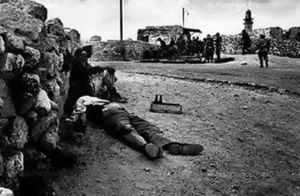
During the Israeli occupation of the Gaza Strip in November 1956, the territory witnessed two major episodes of mass killing: the first in Khan Yunis on November 3, and the second in the Rafah refugee camp on November 12.
The two incidents occurred during the Tripartite Aggression against Egypt in 1956, when Israel, Britain, and France coordinated military action against Egypt following President Gamal Abdel Nasser’s nationalization of the Suez Canal.
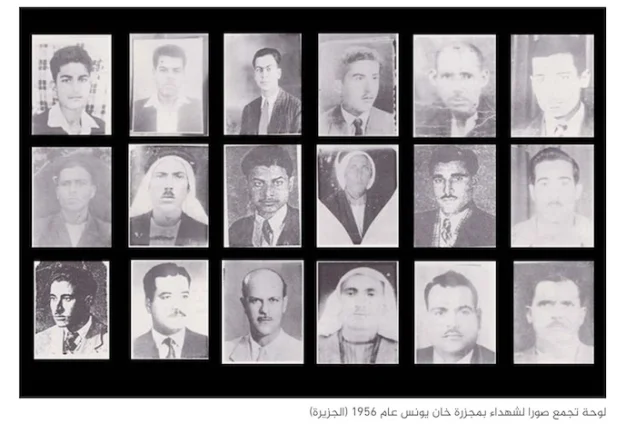
A contemporary report issued by the United Nations Relief and Works Agency for Palestine Refugees in the Near East (UNRWA) documented lists containing the names of 275 people reported killed in Khan Yunis and 111 people in Rafah, while acknowledging that the precise circumstances surrounding the killings were disputed.
Palestinian testimonies describe survivors and unarmed civilians being rounded up, searched, and shot in streets and courtyards and during house-to-house searches, while Israeli authorities stated that some of the casualties occurred during resistance to the occupation or during security operations aimed at locating fighters and weapons.
The two incidents later became known in Palestinian historical memory as the Khan Yunis and Rafah Massacres of 1956.
The Political Background: The Tripartite Aggression Against Egypt
The massacres took place in the context of the confrontation that developed between Egypt and the Western powers over the Suez Canal.
On July 26, 1956, Egyptian President Gamal Abdel Nasser announced the nationalization of the Suez Canal Company.
Britain and France strongly opposed the decision because of their political, economic, and strategic interests connected to the canal.
At the same time, relations between Egypt and Israel were tense because of border clashes, fedayeen operations originating from the Gaza Strip, Egyptian restrictions on Israeli shipping, and the broader regional military balance.
Between October 22 and 24, 1956, representatives of Israel, Britain, and France met secretly at Sèvres near Paris and agreed on a plan for military action against Egypt.
On October 29, Israeli forces began their invasion of the Sinai Peninsula.
Britain and France subsequently intervened militarily after issuing an ultimatum to Egypt and Israel, marking the beginning of the principal phase of the Tripartite Aggression.
The Occupation of the Gaza Strip
At the time, the Gaza Strip was under Egyptian administration.
A large proportion of its population consisted of Palestinian refugees who had been displaced from Palestinian towns and villages during the Nakba and the occupation of Palestine in 1948.
By 1956, more than two-thirds of the population in the Strip receiving UNRWA services were refugees who depended on the agency for food, health care, education, and other basic services.
Israeli forces began attacking the Gaza Strip on November 1, 1956, and rapidly expanded their military control over most of the territory.
Khan Yunis, in the southern Gaza Strip, became one of the principal areas where fighting and large numbers of casualties occurred during the occupation.
The Khan Yunis Massacre – November 3, 1956
Israeli forces occupied the city of Khan Yunis and the adjacent UNRWA refugee camp on the morning of November 3, 1956.
A large number of Palestinians were killed during the hours accompanying the occupation and immediately afterward.
The contemporary UNRWA report presents two partially conflicting accounts of what occurred.
Israeli authorities stated that armed resistance continued as the forces entered and that some Palestinian refugees participated in it.
Testimonies provided to UNRWA by refugees, however, stated that organized resistance had already ended when a substantial portion of the killings occurred, and that Israeli forces subsequently moved through the city and camp searching for weapons and fighters, killing unarmed civilians in the process.
275 Names on UNRWA Lists
UNRWA emphasized that, under the conditions following the occupation, it was unable to determine the final number of dead and wounded with complete certainty.
United Nations armistice observers were also not permitted to conduct the kind of broad independent investigation that would normally have followed incidents along the armistice lines.
The Director of UNRWA therefore relied on testimony from agency employees, refugees, and other sources he considered reliable.
He reported receiving lists containing the names of 275 people said to have been killed in Khan Yunis on November 3.
They were divided as follows:
- 140 Palestinian refugees registered with UNRWA.
- 135 local residents of Khan Yunis.
The figure of 275 consequently became the principal contemporary figure appearing in United Nations documentation regarding those killed in Khan Yunis that day.
Palestinian Testimonies of Field Killings
Palestinian survivor testimonies describe Israeli soldiers ordering men out of their homes and gathering residents in public places during searches.
Testimonies collected later also describe men being separated from their families and groups being ordered to stand against walls or gather in courtyards and in front of public buildings.
Some survivors described machine-gun fire being directed at groups of men, while others spoke of killings occurring during searches for weapons and people suspected of belonging to the fedayeen.
The details of some individual testimonies vary, particularly those recorded decades after the events, but the contemporary UNRWA document confirms large-scale killing of civilians during the occupation of Khan Yunis, while disagreement remains over the precise circumstances of individual deaths.
Who Were the Victims of Khan Yunis?
Among the dead were refugees living in the UNRWA camp and established residents of Khan Yunis itself.
The massacre therefore did not take place exclusively inside the refugee camp, nor were all of those killed refugees from the Nakba.
UNRWA’s lists show that the total was divided almost evenly between refugees and local residents.
For families in the city and camp, however, such administrative distinctions meant little compared with the reality of losing fathers, sons, brothers, and relatives during the days of occupation.
Other Palestinian Estimates of the Khan Yunis Death Toll
Later Palestinian studies produced estimates higher than the figure contained in the UNRWA report.
Local researcher and historian Ihsan Khalil al-Agha, in his studies of Khan Yunis, compiled the names of larger numbers of Palestinians killed in executions, shelling, and other incidents during the Israeli occupation in 1956.
These figures, however, cover a broader geographical and chronological scope than the events of November 3 alone and therefore should not be treated as a direct replacement for UNRWA’s list of 275 names for that day.
Other Palestinian researchers, including Ghazi al-Surani, have likewise published higher estimates of casualties across the entire Gaza Strip during the period of Israeli occupation.
It is therefore necessary to distinguish between the victims of the Khan Yunis Massacre on November 3 and the broader number of people killed throughout the Strip during the months of occupation in 1956–1957.
Rafah – Another Mass Killing Nine Days Later
Nine days after the events in Khan Yunis, another episode of mass killing occurred in the Rafah refugee camp.
On November 12, 1956, Israeli forces conducted a large-scale security screening and search operation in Rafah.
Israeli authorities stated that the purpose was to locate members of the Egyptian-organized “Palestine Brigade” and people suspected of involvement in fedayeen operations.
A twenty-four-hour curfew was imposed.
Men within designated age groups were ordered through loudspeakers to report to assembly and screening points, while Israeli soldiers searched houses and refugee shelters for people who had remained behind.
111 Dead on the Rafah Lists
As in Khan Yunis, the Director of UNRWA obtained lists of victims from sources he considered reliable.
The report recorded the names of 111 people said to have been killed in Rafah on November 12.
They consisted of:
- 103 Palestinian refugees.
- 7 local residents.
- 1 Egyptian.
UNRWA submitted an official protest to the Israeli authorities over the incident and warned that repeated violence against refugees could make it extremely difficult for the agency to continue carrying out its responsibilities in the Gaza Strip.
The Israeli government responded that it was taking measures to establish the facts and prevent similar incidents from recurring.
Two Separate Incidents, Not One Continuous Massacre
It is historically important to distinguish between what happened in Khan Yunis and what happened in Rafah.
The list of 275 names reported by UNRWA relates to Khan Yunis on November 3.
The list of 111 names relates to the Rafah incident on November 12.
The incidents were separated by nine days and occurred under different immediate circumstances.
The killings in Khan Yunis took place during the occupation of the city and refugee camp and in the aftermath of the fighting that preceded Israeli control of them.
In Rafah, the killings occurred during a security screening and search operation after Israeli forces had already established military control over the area.
Palestinian memory nevertheless connects the two incidents because both occurred during the same period of Israeli occupation of the Gaza Strip and affected Palestinian communities, a large proportion of whom were themselves refugees from the Nakba.
Violence Was Not Limited to Khan Yunis and Rafah
Palestinian accounts and studies emphasize that killings and abuses during the Israeli occupation of the Strip were not confined to these two incidents.
Killings, shootings, arrests, disappearances, and mistreatment were reported in other areas of Gaza as well.
Later Palestinian studies have consequently produced estimates for casualties during the entire occupation period that substantially exceed the combined UNRWA lists for Khan Yunis and Rafah.
These broader estimates, however, should remain separate from the contemporary figures associated specifically with the two incidents.
The Reported Mass Grave Near Khan Yunis
After Israeli forces withdrew from the Gaza Strip in March 1957, later Palestinian studies and accounts reported the discovery of a mass grave near Khan Yunis.
These sources state that the grave contained the bodies of approximately 40 Palestinian men.
Some accounts describe the victims as having been shot in the back of the head, while other sources state that some had their hands bound.
This account, however, does not appear in the special UNRWA report issued in December 1956, as the grave was reportedly discovered only after the Israeli withdrawal the following year.
It is therefore important to distinguish this later historical account from the casualty lists documented contemporaneously by UNRWA regarding the events of November 1956.
The Israeli Withdrawal from the Gaza Strip
International pressure eventually led to the withdrawal of British, French, and Israeli forces from territories occupied during the Tripartite Aggression.
The United Nations established the United Nations Emergency Force (UNEF) to supervise the cessation of hostilities and assist in implementing the withdrawal.
Israeli forces, however, remained in the Gaza Strip for several months after the principal military operations had ended.
On March 6 and 7, 1957, Israeli forces withdrew from most areas of the Strip, while United Nations Emergency Force units entered to take over their positions.
On the evening of March 7, the last remaining Israeli forces left the Rafah refugee camp, and the United Nations Secretary-General announced the following day that the withdrawal from the Gaza Strip had been completed.
Egyptian administration was subsequently restored in the Strip.
Joe Sacco and Footnotes in Gaza
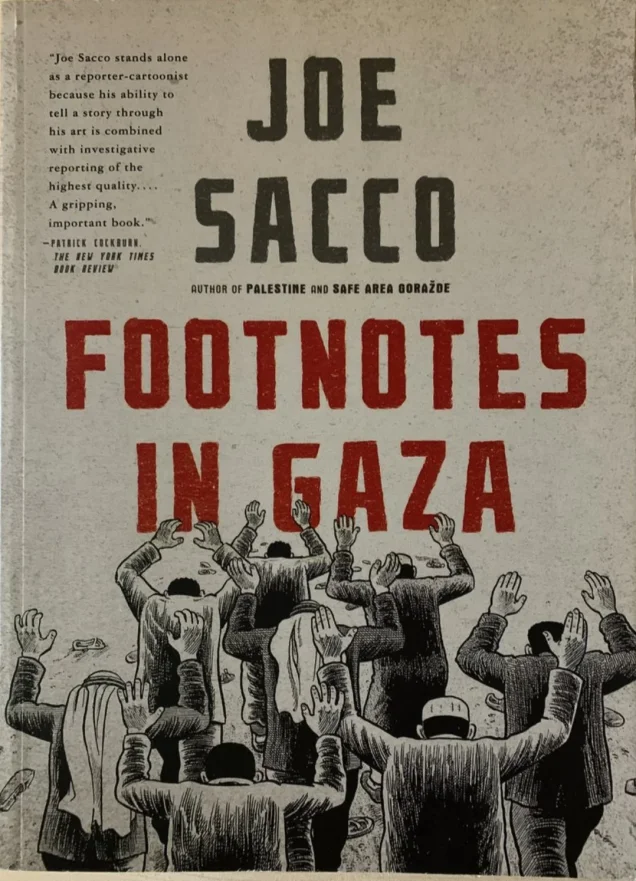
More than half a century later, the Khan Yunis and Rafah massacres became the subject of one of the most prominent works of graphic journalism concerning Palestine.
In 2009, Malta-born American journalist and cartoonist Joe Sacco published his book Footnotes in Gaza.
Sacco had encountered references to the events of 1956 while working as a journalist in Gaza during the Second Palestinian Intifada.
He was struck by the fact that two incidents of this scale, despite casualty figures appearing in United Nations documents, had received only limited attention in many widely circulated Western historical accounts of the Suez Crisis.
He subsequently spent years researching the events in Khan Yunis and Rafah.
He interviewed survivors and witnesses, consulted local historians, reviewed United Nations documents, and compared differing testimonies concerning events that had taken place nearly half a century earlier.
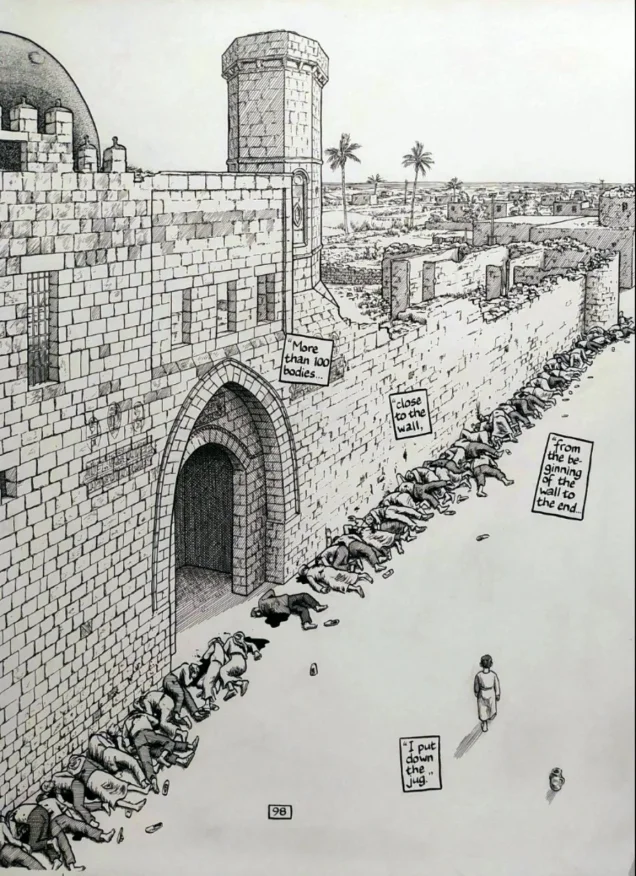
The book therefore combined oral history, archival documentation, investigative journalism, and visual reconstruction.
Memory and Historical Evidence
One of the important aspects of Joe Sacco’s work is that he did not treat every individual testimony as necessarily precise in every detail.
He addressed differences between witnesses, the limitations of memory, contradictions in some accounts, and the difficulty of reconstructing violent events decades after they occurred.
His work therefore does not replace the contemporary UNRWA report.
Rather, it adds the voices of Palestinians whose experiences often appeared in official documents only as numbers, lists, and brief paragraphs.
Why Were the 1956 Massacres Absent from Many International Narratives?
The events in Khan Yunis and Rafah did not receive sustained international attention proportionate to the scale of the casualties when compared with the larger geopolitical drama of the Suez Crisis and the Tripartite Aggression.
Global attention focused on the nationalization of the Suez Canal, the Israeli invasion of Sinai, the British and French intervention, the dispute between the United States and its European allies, the Soviet position, and the creation of the United Nations Emergency Force.
Amid these major international developments, the killing of Palestinian civilians in the Gaza Strip appeared in many historical narratives as a marginal event.
It was from this idea that Joe Sacco drew the concept of “footnotes” for his book: events treated almost as footnotes in the international political narrative, but which remained central, life-changing experiences for the families of Khan Yunis and Rafah.
The Khan Yunis and Rafah Massacres in Palestinian Memory
In Palestinian memory, the events of November 1956 are connected to a longer history that began with the Palestinian Nakba.
A large number of those killed in Khan Yunis and Rafah were already refugees.
Only eight years earlier, they or their families had been displaced from Palestinian towns and villages that came within the territories occupied by Israel in 1948.
By 1956, they were living in refugee camps in the Gaza Strip when Israeli military occupation reached them once again.
This historical sequence gave the massacres a particular meaning: Palestinians who had survived the first displacement during the Nakba were subjected only a few years later to another military occupation, and some were killed inside the very camps that had originally been established as temporary shelters after their displacement in 1948.
The Historical Significance of the Khan Yunis and Rafah Massacres
Contemporary documentation establishes several essential facts about the events of November 1956.
Israeli forces occupied Khan Yunis and its refugee camp on November 3, and large numbers of Palestinians were killed during and immediately after the occupation.
The Director of UNRWA received from sources he considered reliable lists containing the names of 275 people said to have been killed, while recording the disagreement between Palestinian and Israeli accounts regarding the precise circumstances of the killings.
Nine days later, during a screening and search operation conducted by Israeli forces in Rafah, another large group of Palestinians was killed.
The Director of UNRWA received lists containing the names of 111 people killed in the Rafah incident, while the agency’s report confirmed serious problems in the manner in which the operation was organized and carried out.
The two UNRWA lists therefore contained a combined total of 386 names.
Palestinian sources and studies provide higher estimates for the number of people killed during the broader Israeli occupation of the Gaza Strip, but these figures must be distinguished from the two UNRWA lists relating specifically to Khan Yunis on November 3 and Rafah on November 12.
From a Palestinian historical perspective, Khan Yunis and Rafah remained more than two incidents occurring on the margins of the Tripartite Aggression against Egypt; they became massacres against a Palestinian society still carrying the consequences of the Nakba and displacement, only to find itself under another military occupation in the Gaza Strip eight years later.
Their relative absence from many international narratives of the Suez Crisis also became part of their historical legacy: hundreds of Palestinian lives reduced for decades to a few lines in United Nations reports, while the families of Khan Yunis and Rafah continued to carry the memory of what happened in the streets, homes, and refugee camps of Gaza in November 1956.
Photo gallery



More from the archive
 Download Our Palestine App
The whole archive in the palm of your hand: depopulated villages, the Nakba, the massacres and Al-Aqsa — free, with no ads to erase the story.
Download Our Palestine App
The whole archive in the palm of your hand: depopulated villages, the Nakba, the massacres and Al-Aqsa — free, with no ads to erase the story.
Comments
No comments yet — be the first to write one.
Add your comment
Name and email are optional. Comments appear after review.