
The Looted Beirut Archive: How the Israeli Occupation Stole Palestinian Memory in 1982
In September 1982, as forces of the Israeli occupation overran West Beirut, three military trucks were loaded outside a building on Hamra Street. They carried no soldiers and no ammunition. Their cargo was of another kind: the memory of the Palestinian people.
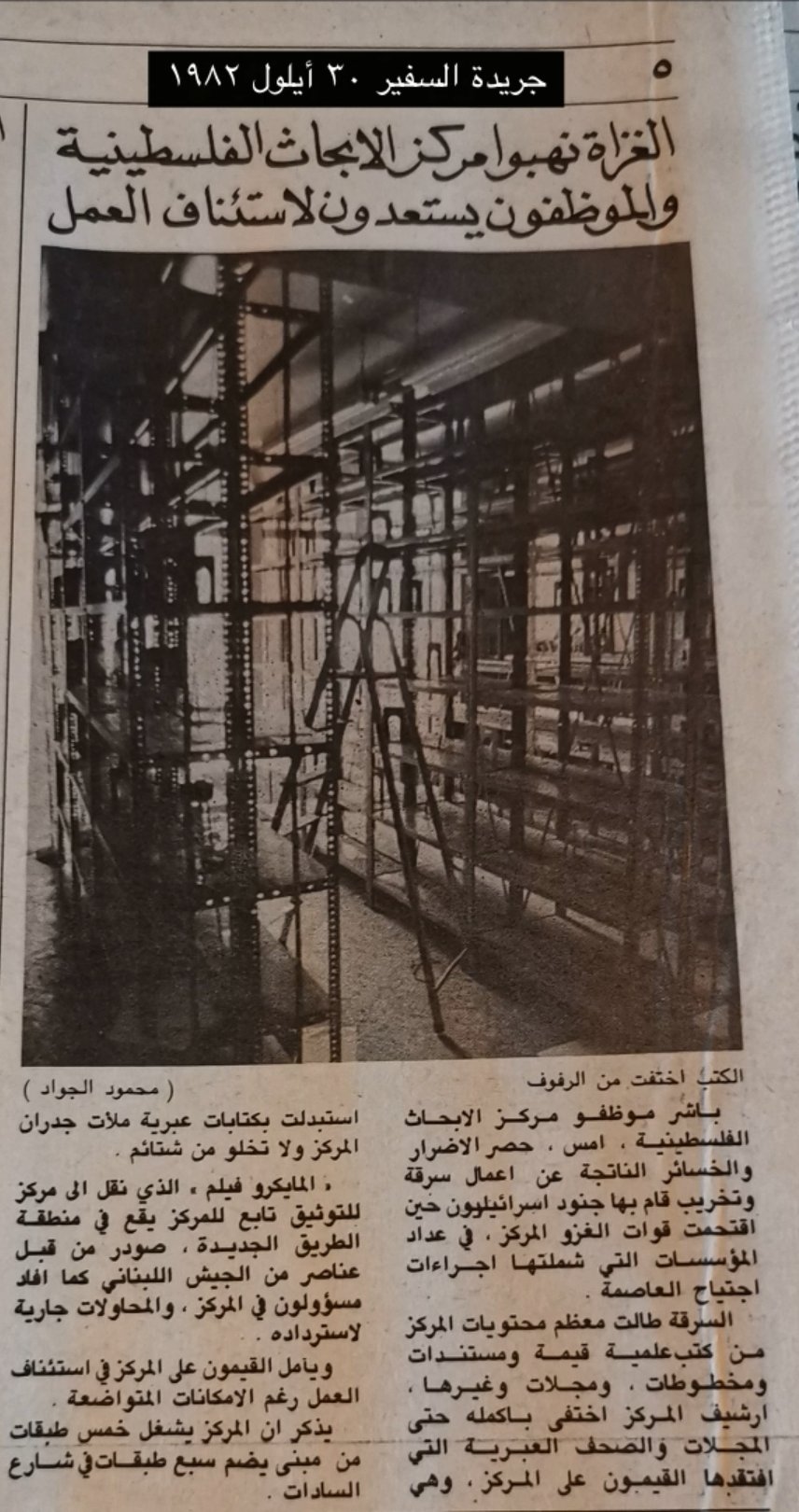
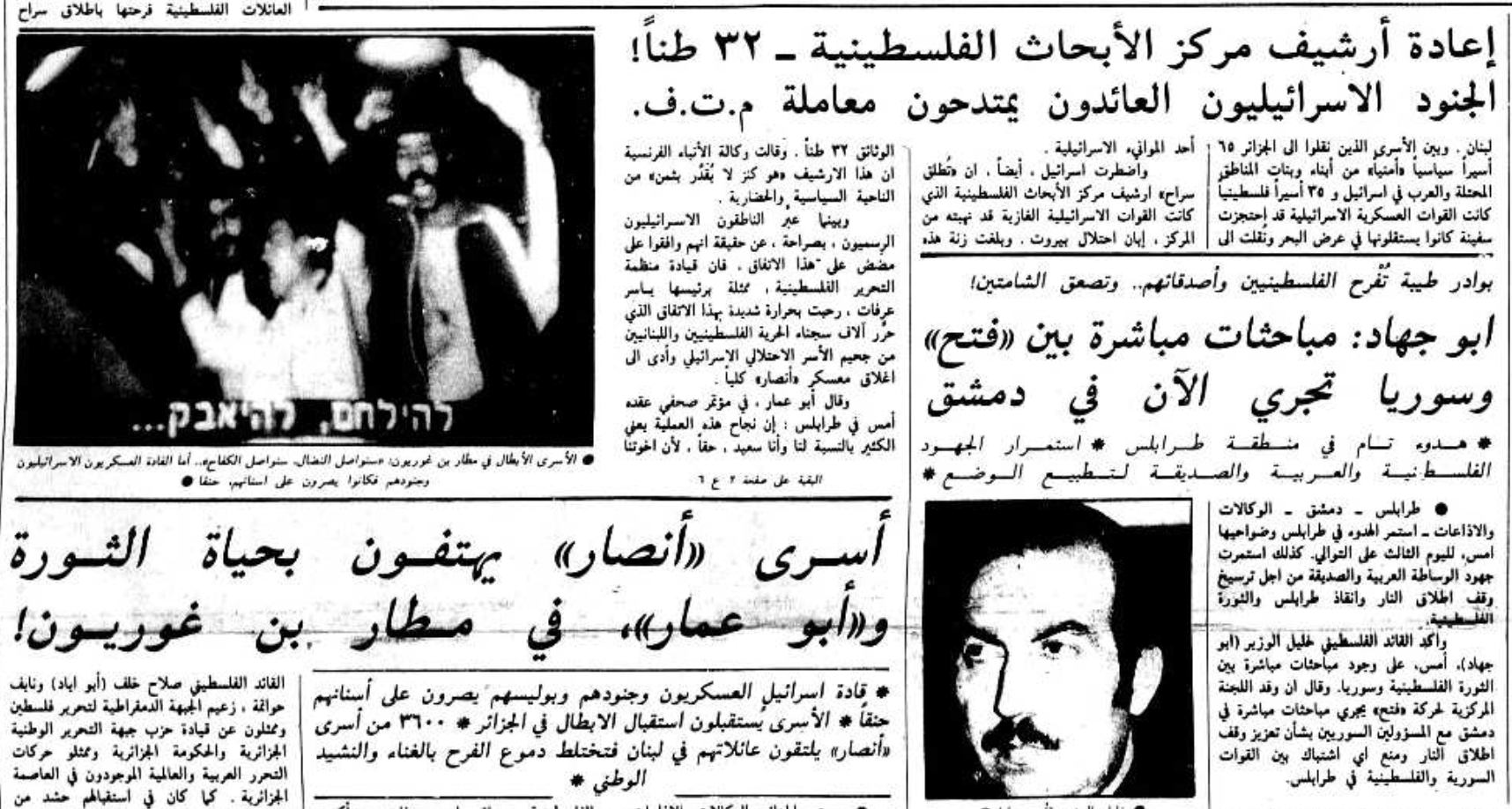
In those weeks, the occupation army looted the library and archive of the Palestine Research Center, the first Palestinian film archive vanished, and thousands of photographs documenting Palestinian life before and after the Nakba were confiscated. Some of it was returned a year later in a prisoner exchange, only to be lost in the desert. Some of it is still held today in the occupation army's archive, classified as "restricted material."
Beirut before 1982: capital of Palestinian memory
After the 1948 Nakba, the occupation of Palestine and the scattering of Palestinians into exile, Beirut became the cultural centre of the Palestinian revolution in the 1970s. Institutions founded there shared a single mission: for Palestinians to write their own history and film it through their own lenses.
| Institution | Founded | What it held |
|---|---|---|
| PLO Palestine Research Center | 1965 | About 25,000 volumes in Arabic, English and Hebrew, a document archive and a microfilm collection |
| Palestine Film Unit, later the Palestinian Cinema Institution | Late 1960s | Nearly 90 Palestinian films and Arab and international solidarity films; Khadijeh Habashneh called it "the first film archive in the Arab world" |
| PLO Culture and Arts Section | 1970s | Photo collections documenting Palestine before and after 1948 and life in the refugee camps |
The Research Center was founded by scholar Fayez Sayegh by decision of the PLO Executive Committee on 28 February 1965. His brother Anis Sayegh ran it until 1977, poet Mahmoud Darwish led it during the transition, and Sabri Jiryis then took over, according to Wikipedia. Ahmad Shuqeiri called it "the brain of the organisation." By the late 1970s it employed about 80 researchers and staff, according to The Times of Israel.
The Center was not safe before 1982 either: a parcel bomb exploded there in 1971, another cost director Anis Sayegh a finger and damaged his hearing in 1972, and the building was hit by rockets in late 1974.
15 September 1982: three trucks for the Research Center's library
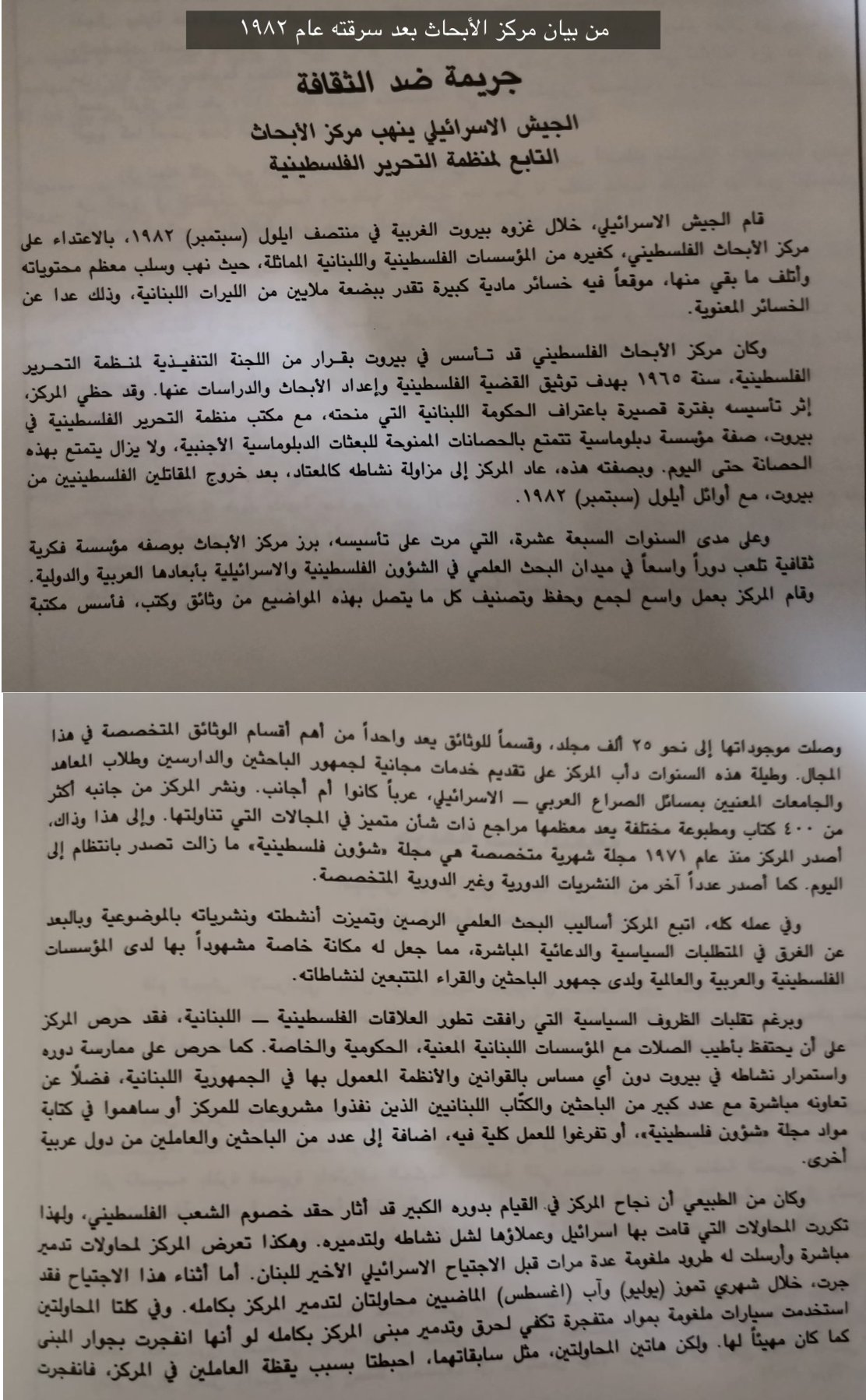
During the Israeli invasion of Lebanon, a Golani Brigade battalion stormed the Research Center's building in Hamra, and a specialised intelligence unit then collected the documents, according to Al Majalla.
Occupation soldiers held the building for a full week. On 15 September 1982, the Center's library and microfilm collection were loaded onto three trucks and taken to the occupation state. The soldiers did not stop at the books: they smashed furniture, broke open the safe, and took the telephones, heaters, fans and printing press. The material loss was estimated at about $1.5 million, according to Wikipedia.
But Sabri Jiryis had anticipated the worst. Before the invasion he moved rare documents and sensitive files out of Lebanon, including manuscripts of Palestinian testimonies he called "the real archive," according to the Institute for Palestine Studies.
The Palestinian film archive: "Israeli soldiers stole my film"
In the same days, the most precious moving-image record of the Palestinian revolution disappeared: the archive of the Palestinian Cinema Institution. The unit had been founded in the late 1960s as the PLO's audiovisual arm. Its founders included cameraman Hani Jawhariyeh, who was killed while filming on the front line, and director Mustafa Abu Ali.
Director Khadijeh Habashneh organised and built the archive. When the occupation invaded Beirut, she was editing her second film, Women in Palestine, in a Beirut studio. A few days later she sent people to retrieve the material; they found nothing. "Israeli soldiers stole my film, and it no longer exists," she says, adding that only Israeli soldiers had been in the area, according to Ara.
When the archive's staff returned after the invasion, they found the office empty. Only a few films survived, those held at foreign labs or by distributors. The occupation army confiscated at least 120 films and documentaries collected in Beirut and took them to Tel Aviv.
Searching for the lost archive
Habashneh spent years searching for the archive in Lebanon, Syria and inside the occupation state. Director Azza El-Hassan documented that search in her film Kings and Extras (2004), which took the search as far as the Martyrs' Cemetery in Beirut in case the archive had been buried there, according to Frieze.
Scattered fragments surfaced later: about 200 reels of Palestinian film found in Rome, which Mustafa Abu Ali had smuggled to the Italian Communist Party, and an original copy of Palestine in the Eye (1976) found at the home of Hani Jawhariyeh's daughter. The complete archive remains missing.
February 1983: the Center bombed after it was looted
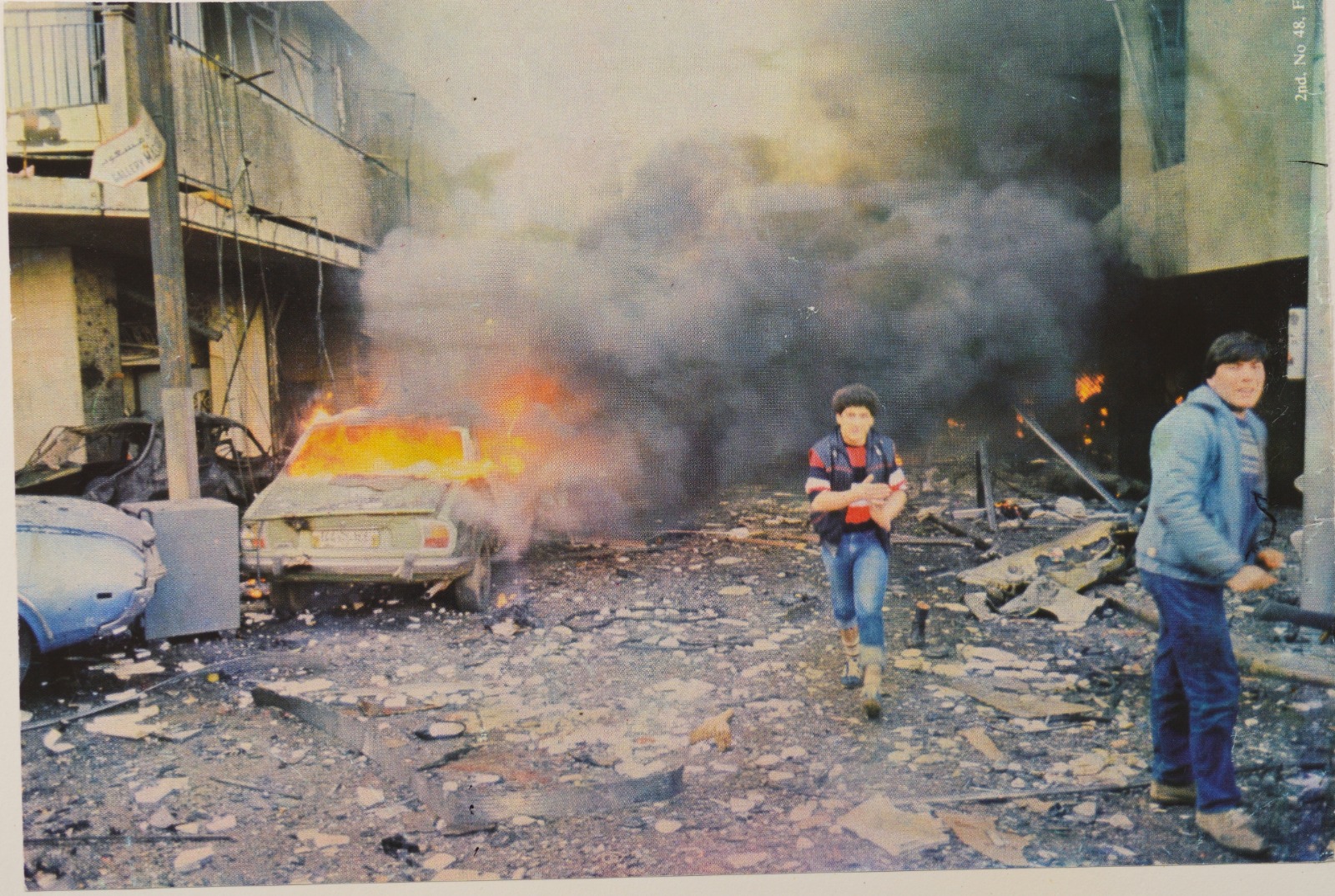
Months after the looting, the Research Center resumed work in its building. But in February 1983 a car bomb exploded outside, destroying the PLO's last working office in Beirut. At least 20 people were killed and about 100 injured, according to the Christian Science Monitor.
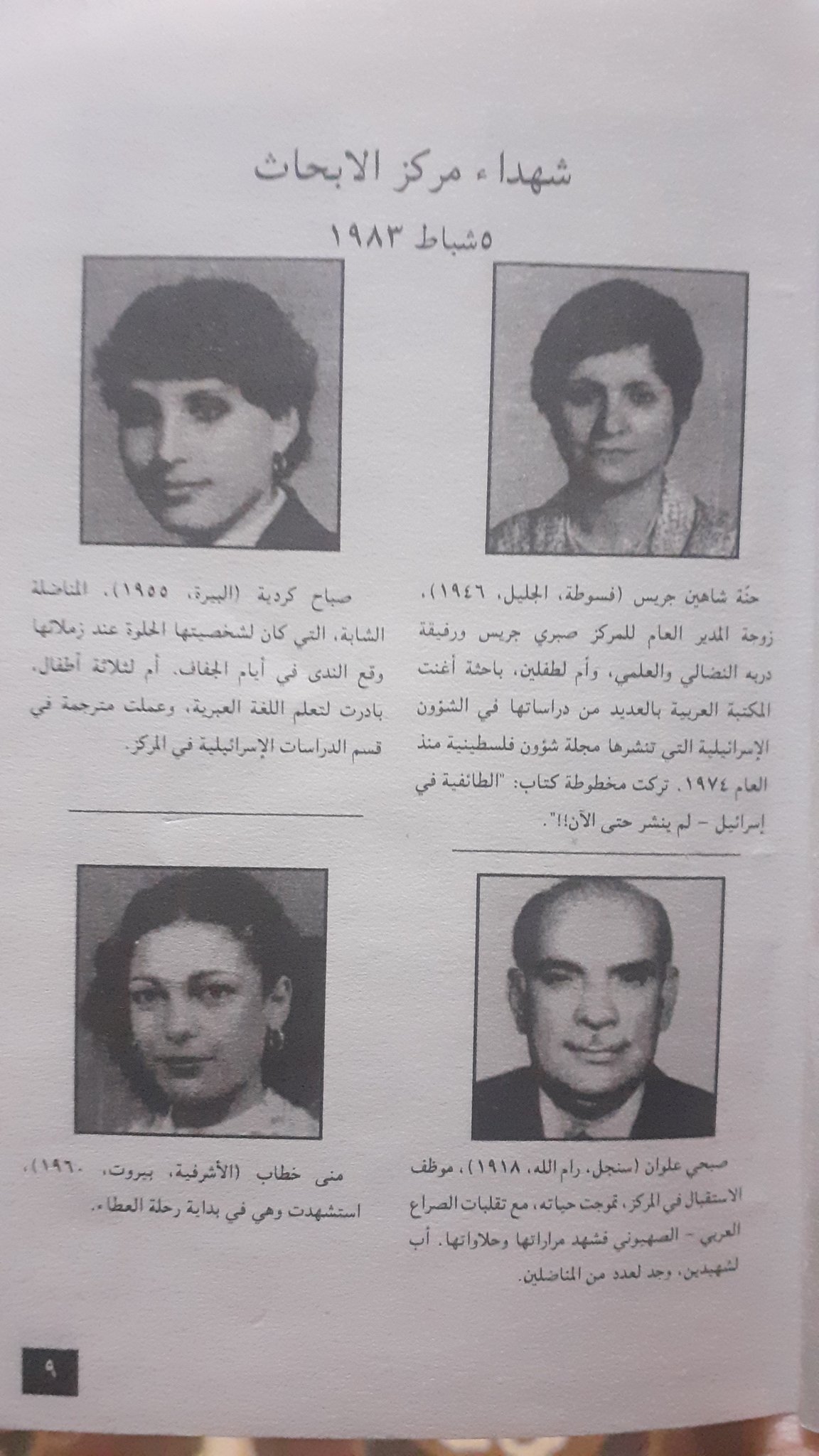
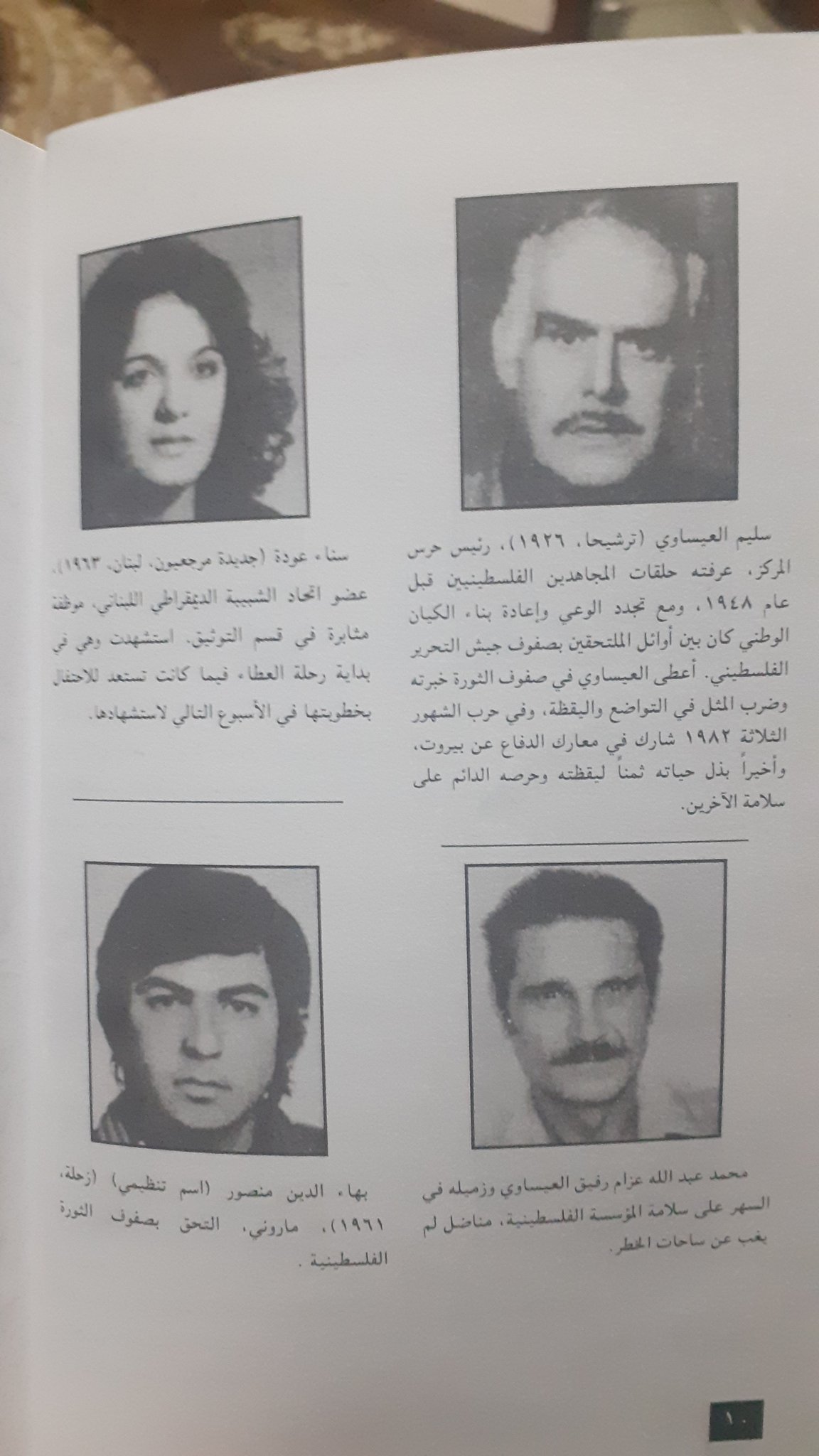
Among the dead was Hanneh Shaheen, the wife of director Sabri Jiryis, who had stopped by the office before the weekend. Three people trapped in the lift died of smoke inhalation, and the building's concierge and a telephone operator were killed. The Center then moved to Nicosia, Cyprus.
An archive held hostage: from a prisoner swap to the Algerian desert
The PLO made the archive's return a condition of prisoner-exchange negotiations. On 24 November 1983 the deal went through: the occupation released about 5,000 Arab prisoners in exchange for 6 Israeli soldiers, and handed over what it said was the PLO archive. But the occupation had copied the entire archive before returning it. In December 1983 the UN General Assembly condemned the occupation state for seizing it, according to Wikipedia.
Then a second journey of loss began. The archive was repacked into 100 crates and sent via the International Red Cross to Algeria, moved between several sites, and finally left at a base in the El Bayadh region in the country's southwest.
Today the director of the Research Center in Ramallah, Samih Shabeeb, says the archive's whereabouts are unknown; it is presumed to be in Algeria. Reports suggest rain, heat, rodents and neglect may have destroyed its contents. The archive that survived looting may not survive oblivion.
In the occupation army's archive: "Looted and Hidden"
What was not returned in 1983 stayed in the occupation state. Israeli researcher and curator Rona Sela, a lecturer at Tel Aviv University, has spent about twenty years digging through Israeli archives for confiscated Palestinian material.
Sela revealed that during the 1982 invasion the occupation army seized an entire photo collection from the PLO's Culture and Arts Section in Beirut, in addition to the films, according to The Art Newspaper. The material includes photographs and films of Palestinian life before and after 1948 and in the diaspora, and voice recordings of Palestinian artists and producers.
"Restricted material"
When Sela asked to see the "PLO archive," she was told it was "restricted material." Much of this material was sealed for nearly five decades, and some is still off-limits, according to the Institute for Palestine Studies. Israeli law allows military archive documents to be sealed for up to 70 years, or indefinitely if they concern security or foreign relations.
In 2017 Sela made her documentary Looted and Hidden, built on letters exchanged between her and Palestinians connected to the stolen material, and an Israeli soldier who served in Beirut, according to +972 Magazine.
Not the first looting
Beirut was not the first time the Zionist occupation pursued Palestinian memory. During the Nakba in 1948, the studio of Jerusalem photographer Khalil Rassas, a pioneer of Palestinian photography, was looted during the attack on West Jerusalem's neighbourhoods, and tens of thousands of books were taken from Palestinian homes in what is known as the Great Book Robbery. And in 2001 the occupation again confiscated Research Center archives when the Center tried to re-establish itself in East Jerusalem.
Why does the occupation steal archives?
It may seem strange for an army in the middle of a war to send trucks for books and films. But the story repeats from 1948 to 1982 to 2001 for a clear reason: the archive is the evidence.
- Photographs prove existence: a picture of a wedding in Jaffa or a harvest in the Galilee before 1948 demolishes the "land without a people" narrative on its own.
- Documents prove rights: testimonies and records are what refugees build their claims to return and compensation on.
- Whoever holds the archive holds the narrative: when Palestinian photographs sit in the occupation army's archive, the occupation decides who sees them, when, and how they are interpreted.
The looting of the Beirut archive was not an incidental episode of war but a direct extension of the Nakba: the Zionist occupation that drove Palestinians from their land in 1948 pursued their memory into exile 34 years later. But what survives of that memory, in Rome, in a martyr's daughter's home, and in the hearts of those who made it, is enough to say that Palestinians were here, that they photographed, wrote, and will remain.
Frequently asked questions about the looted Beirut archive
What did the Israeli occupation loot from Beirut in 1982?
It looted the Palestine Research Center's library (about 25,000 volumes), its microfilm collection and its document archive, confiscated at least 120 Palestinian films and documentaries, and seized a photo collection from the PLO's Culture and Arts Section.
When was the Palestine Research Center's library looted?
On 15 September 1982, after occupation soldiers had held the building on Beirut's Hamra Street for a week, the library was loaded onto three trucks and taken to the occupation state.
Was the PLO archive returned?
Part of it was returned in the prisoner exchange of 24 November 1983, after the occupation had copied it. It was then sent in 100 crates to Algeria, and its location and condition today are unknown.
What happened to the Palestinian film archive?
It vanished after the Israeli invasion of Beirut in 1982 and has never been found in full. Fragments have surfaced, including about 200 reels in Rome.
What is the film Looted and Hidden?
A 2017 documentary by Israeli researcher Rona Sela that exposes the Palestinian films and photographs the occupation army seized in Beirut and keeps in its archive.
Who is Khadijeh Habashneh?
A Palestinian filmmaker who organised the Palestinian Cinema Institution's archive in Beirut. Her film Women in Palestine was stolen during the 1982 Israeli invasion, and she spent years searching for the lost archive.
Read more on Our Palestine
Sources
- Palestine Research Center, Wikipedia
- "Reading Herzl in Beirut": the looted Research Center (Arabic), Imad al-Ahmad, Al Majalla, 25 August 2024
- Know thine enemy: When the PLO hosted 80 scholars at a Beirut Israel studies center, The Times of Israel
- Car bomb destroys last PLO office in Beirut, Christian Science Monitor, 7 February 1983
- "Israeli soldiers stole my film, and it no longer exists", Xavi Serra, Ara, 10 November 2025
- The search for Palestine's lost cinema, Nathan Geyer, Frieze, 28 November 2018
- "Looted and Hidden": Israel's futile attempts to erase Palestinian history (Arabic), Institute for Palestine Studies, 5 October 2017
- Looted from Beirut 35 years ago, now on display in Tel Aviv, Rami Younis, +972 Magazine, 4 December 2017
- Palestinian stories reconstructed through films, photographs and artefacts confiscated by Israel, The Art Newspaper, 7 June 2018
Photo gallery
 Download Our Palestine App
The whole archive in the palm of your hand: depopulated villages, the Nakba, the massacres and Al-Aqsa — free, with no ads to erase the story.



Comments
No comments yet — be the first to write one.
Add your comment
Name and email are optional. Comments appear after review.