
Palestinian Olive Oil Under Occupation: Uprooted Trees and Settlement Oil in Europe
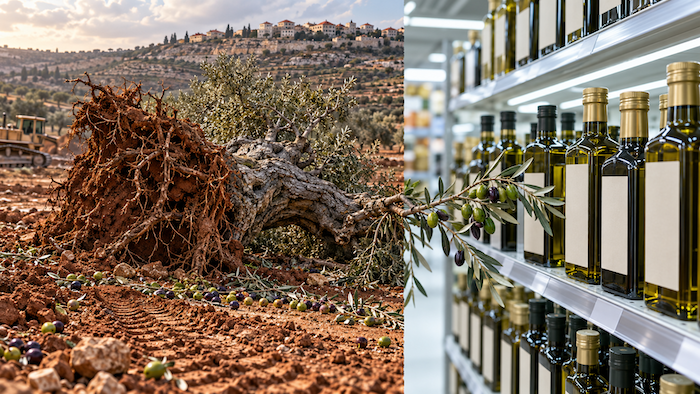
Every October, Palestinian families head out to the olive groves: the grandfather spreads tarpaulins under the tree, the children climb the branches, and the mother prepares food in the shade. In Palestine, the olive season is not just a harvest but a family festival and a bond with the land passed down through generations.
In recent years, though, this festival has become a battleground. After the Nakba of 1948, when the Zionist occupation seized the groves of hundreds of depopulated villages, and then the occupation of the West Bank in 1967, the Israeli occupation and its settlers have uprooted more than a million olive trees by the most conservative estimates, and the harvest has become the most dangerous season of the year. At the same time, the occupation state declared the olive its "national tree," and oil from its settlements reaches European markets. This is the story of Palestinian olive oil under occupation.

Olives in Palestine: half the land and the livelihood of 100,000 families
Olives are no ordinary crop in Palestine. According to Middle East Eye:
- Olives are grown on about half of all agricultural land in the occupied Palestinian territory.
- About 100,000 families in the West Bank depend on olive harvest income, including about 15% of working women, according to UN figures.
- In a good year, olive exports bring almost $200 million into the Palestinian economy, according to the Palestinian Trade Centre.
- Olives are Palestine's most widely harvested crop and its most valuable per kilo.
Many trees are hundreds of years old, planted by ancestors long before the occupation. That is why farmers say the olive tree carries the memory of their forebears, according to Mongabay.
Millions of trees uprooted since 1967
Estimates vary, but all point to an enormous scale:
| Period | Olive trees uprooted or destroyed | Source |
|---|---|---|
| Since 1967 (recent official estimate) | About 2.5 million trees | Official Palestinian sources, 2026 |
| Since 1967 (older estimate, c. 2006) | More than 1.2 million trees | Applied Research Institute–Jerusalem (ARIJ) |
| 2000–2005 (Second Intifada) | 464,945 trees in the West Bank and Gaza | Palestinian Ministry of Agriculture |
| 2020 – April 2026 | More than 120,000 trees in the West Bank | Colonization and Wall Resistance Commission |
| 2025 alone | More than 26,000 trees | Colonization and Wall Resistance Commission |
The gap between the first and second estimates reflects that uprooting has not stopped but has accelerated over the past two decades.
The harvest: from festival to battleground
Figures from the UN Office for the Coordination of Humanitarian Affairs (OCHA) show a sharp jump in settler attacks during harvest seasons, according to a report by Israeli group Yesh Din published on 22 December 2025:
| Season | Harvest-related settler attacks (October–November) |
|---|---|
| Up to 2023 | 30 to 60 attacks per season |
| 2024 | 213 attacks |
| 2025 | 178 attacks, about 3 per day |
In the 2025 season alone:
- Attacks hit 88 Palestinian communities, four times the number in 2020.
- More than 6,000 olive trees and saplings were vandalised, the highest figure in six years.
- October 2025 was the most violent month for settler attacks since OCHA began recording in 2006, with 264 attacks, or 8.5 a day.
The army is present, but does not intervene
Yesh Din documents that occupation soldiers, Border Police and settlement security were present at many attacks without stopping them, and sometimes blocked Palestinians from reaching their land. In areas requiring prior "coordination," permits were issued very late and for only one or two days, not enough to finish the harvest, so fruit rotted or was stolen by settlers from nearby outposts.
Documented examples include Burin on 1 November 2025, where a settlement security guard expelled farmers holding coordination and spilled their olives on the ground while the army stood by; and Kisan, where settlers harvested a Palestinian plot, uprooted its trees and chased the family away. In the 2024 season about 20% of West Bank olives went unharvested, with losses estimated by the UN at about $10 million.

When the army uproots: al-Mughayyir and Arraba
Uprooting is not limited to settlers. In August 2025, the occupation army uprooted thousands of olive trees in the village of al-Mughayyir northeast of Ramallah during a three-day siege. The head of the local council put the number at about 3,000 trees, according to Al Jazeera, while Middle East Eye reported 10,000. The army said the trees posed a "security threat" to a settler road running through the village's land.
In September 2026, occupation bulldozers razed hundreds of ancient olive trees in Arraba, southwest of Jenin, under military protection and to make way for new settlement projects. Cameras captured a Palestinian woman embracing an olive tree on her land, saying goodbye before the bulldozers reached it, according to Al-Quds.
Gaza: 74% of olive groves destroyed
In the Gaza Strip, the war since October 2023 has destroyed about 74% of the area planted with olives, nearly 2,290,000 trees, according to the Palestinian Ministry of Agriculture. The number of working olive presses in the Strip fell from 37 to just 4, according to OCHA. More than 52,300 trees were destroyed in the West Bank over the same period, according to Mongabay.
The olive, "Israel's national tree"
Here the irony peaks. In 2021, the occupation state declared the olive its national tree, citing its symbolism of peace and longevity, according to Mongabay.
A state whose forces and settlers have uprooted more than a million Palestinian olive trees adopts the olive as its national symbol. It is the same pattern seen with hummus, dabke and the thobe: an element is taken from its owners, then presented as a symbol of the identity of those who took it.
Settlement oil in Europe: the battle over the label
While Palestinian farmers are prevented from harvesting their olives, West Bank settlements export their products, including olive oil, to Europe. For years these products carried the label "Made in Israel."
2015: the EU rules
On 11 November 2015, the European Commission issued rules barring settlement products from the West Bank, East Jerusalem and the Golan from being labelled "Made in Israel." The rules explicitly named olive oil alongside wine, poultry and dates. Settlement oil must now carry the label "Product from West Bank (Israeli settlement)", while Palestinian oil carries "Product from Palestine", according to Scripps News and Olive Oil Times. Netanyahu called the decision "hypocritical" and a "double standard."
2019: the European Court of Justice decides
In November 2019, the European Court of Justice ruled that EU states must label products made in settlements to show their origin, and may not label them "Made in Israel." The court said consumers need this information to make "informed choices," and described settlements as a policy of population transfer that violates international humanitarian law, according to Israel Hayom.
But experts noted that enforcement is unclear, since the real origin of produce is not always easy to trace. Palestinian official Hanan Ashrawi urged Europe to go further and ban settlement products entirely rather than merely labelling them.

Why the olive?
Why is the olive targeted like this? Because in Palestine the olive tree is more than a livelihood:
- The olive is proof of ownership: a tree hundreds of years old on a plot of land testifies that someone planted and tended it long before the occupation. Uprooting it erases that witness.
- The olive keeps the farmer on the land: cultivated land is visited by its owner every season. Empty land is easier to seize on the grounds that it is "abandoned."
- The olive is a symbol of steadfastness: a tree that lives for centuries and bears fruit despite drought has become a symbol of the Palestinian who stays on the land no matter what.
That is why uprooting an olive tree is not an attack on a crop but a continuation of the Nakba by other means: the Zionist occupation that expelled villagers in 1948 and seized their groves is today uprooting the groves of those who stayed. When a woman in Arraba embraces her tree before the bulldozer reaches it, she is not saying goodbye to a tree alone, but to part of her family.
Frequently asked questions about Palestinian olives
How many olive trees has the occupation uprooted since 1967?
Estimates vary: about 2.5 million trees according to recent official Palestinian sources, and more than 1.2 million according to an older ARIJ estimate from around 2006. More than 26,000 trees were uprooted in the West Bank in 2025 alone.
Why do settlers attack the olive harvest?
Because olives are the livelihood of about 100,000 families and tie farmers to their land. Blocking the harvest and destroying trees impoverishes farmers and pushes them off their land, making it easier to seize for settlement expansion.
How many settler attacks were there in the 2025 olive season?
OCHA documented 178 harvest-related attacks between 1 October and 30 November 2025, in 88 Palestinian communities, with more than 6,000 trees vandalised.
What share of Gaza's olive groves has been destroyed?
About 74% of the area planted with olives, nearly 2.29 million trees, according to the Palestinian Ministry of Agriculture, and working presses fell from 37 to 4.
Is settlement olive oil sold in Europe?
Yes. But since the EU rules of 2015 and the European Court of Justice ruling of 2019, it must carry a label showing it comes from an Israeli settlement, not "Made in Israel."
How can I tell Palestinian olive oil apart?
Under EU rules, Palestinian oil carries the label "Product of Palestine," while settlement oil must be labelled "Product from West Bank (Israeli settlement)."
When did Israel declare the olive its national tree?
In 2021, citing its symbolism of peace and longevity, even though its forces and settlers have uprooted hundreds of thousands of Palestinian olive trees.
Read more on Our Palestine
Sources
- 2025 Olive Harvest Season: Violence, denied harvest and olive tree destruction, Yesh Din, 22 December 2025
- Why are Israeli settlers destroying the Palestinian olive harvest?, Daniel Tester, Middle East Eye, 29 October 2025
- Israeli military uproots thousands of Palestinian olive trees in West Bank, Al Jazeera, 23 August 2025
- With hugs and tears, a Palestinian woman bids farewell to olive trees in Arraba, Al-Quds, 3 September 2026
- Uprooted olive trees, Applied Research Institute–Jerusalem (ARIJ)
- Gaza and West Bank farmers salvage olive harvest amid displacement, destruction and Israeli settler violence, Mongabay, March 2025
- EU mandates new labeling on exports from Israeli settlements, Scripps News, 11 November 2015
- Israel denounces EU rules for labeling olive oil from occupied territories, Olive Oil Times, 16 November 2015
- EU court rules goods from Israeli settlements must be labeled, Israel Hayom, 13 November 2019
More from the archive
 Palestinian heritage
The Dead Sea Scrolls: How the Israeli Occupation Seized a Palestinian Treasure Found on the Eve of the Nakba
 Palestinian heritage
The Looted Beirut Archive: How the Israeli Occupation Stole Palestinian Memory in 1982
 Palestinian heritage
The Great Book Robbery: How the Zionist Occupation Looted 70,000 Palestinian Books in the Nakba
 Download Our Palestine App
The whole archive in the palm of your hand: depopulated villages, the Nakba, the massacres and Al-Aqsa — free, with no ads to erase the story.



Comments
No comments yet — be the first to write one.
Add your comment
Name and email are optional. Comments appear after review.