
Gaza's Heritage Under Genocide: The Great Omari Mosque, Pasha's Palace and Central Archives
Gaza is one of the oldest continuously inhabited cities in the world. Pharaohs, Philistines, Greeks, Romans, Byzantines, Crusaders, Mamluks and Ottomans all passed through, and each left a mark: a port, a church, a mosque, a bathhouse, a palace. In Gaza's Old City these layers lived side by side: people prayed in a centuries-old mosque, bathed in a Mamluk hammam, and shopped in a market under stone arches.
Since October 2023, the genocidal war waged by the Israeli occupation on the Gaza Strip has destroyed most of these layers. By March 2026, UNESCO had verified damage to 164 cultural sites, including the Great Omari Mosque, the Pasha's Palace and the Qissariya Market. Alongside them, the Central Archives burned and libraries and museums were razed. This is the story of Gaza's heritage under genocide.
By the numbers: 164 cultural sites damaged
According to the preliminary assessment that UNESCO updates using satellite imagery with the UN Satellite Centre (UNOSAT), by 24 March 2026 the organisation had verified damage to 164 cultural sites in the Gaza Strip since 7 October 2023:
| Type of site | Sites damaged |
|---|---|
| Buildings of historical or artistic interest | 128 |
| Religious sites | 14 |
| Monuments | 9 |
| Archaeological sites | 8 |
| Depositories of movable cultural property | 3 |
| Museums | 2 |
| Total | 164 |
The overwhelming majority, 153 sites, are in Gaza Governorate, in and around the Old City. In February 2025 the World Bank estimated that about 53% of the Strip's cultural property had been damaged or completely destroyed, according to a report on UN findings.
Notably, these figures rely mostly on satellite imagery, so they count only what can be seen from the sky. UNESCO began rapid on-site assessments only after the ceasefire of 10 October 2025, where access and security allowed.
The Great Omari Mosque: 1,600 years turned to rubble
The Great Omari Mosque was Gaza's largest and oldest mosque, and the second-oldest mosque in Palestine after Al-Aqsa, covering about 4,100 square metres at the heart of the Old City, with five doors opening onto the alleys of old Gaza. Its stones told the city's whole history, according to Al Jazeera Net:
| Period | What the site went through |
|---|---|
| Pre-Christian era | A pagan temple |
| 407 CE | The Romans built the "Church of Porphyrius" on the site |
| 634 CE | Amr ibn al-As conquered Gaza under Caliph Omar ibn al-Khattab; the mosque was built on the larger part of the site and named "Omari" after the caliph |
| 1149 CE | During the Crusades the mosque was demolished and a church built in its place; three of its arcades still stand |
| 1192 CE | The mosque was rebuilt after Saladin's victory; the Mamluks and Ottomans later added arcades and doors |
Its Mamluk-style minaret is square in its lower half and octagonal in its upper tiers, and the historian Othman al-Tabbaa described the mosque as resting on 38 marble columns. Its library held thousands of books and manuscripts, the oldest from the 14th century, having survived looting in the Crusades, the French campaign and British bombardment in the First World War. Fortunately, 211 manuscripts were digitised from February 2020, with support from the British Library's Endangered Archives Programme and HMML, according to HMML.
December 2023
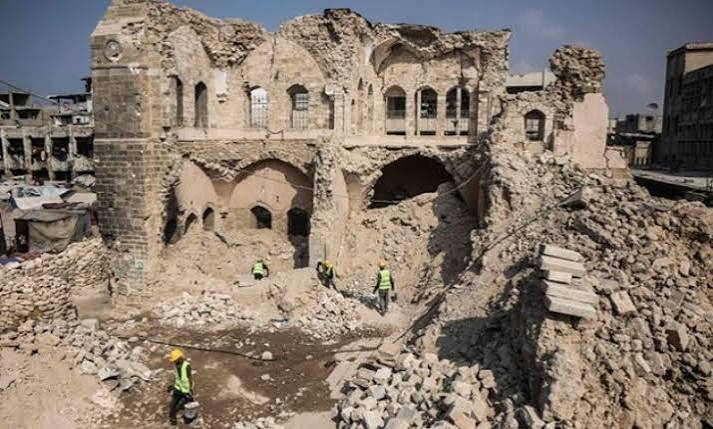
On 8 December 2023, Israeli occupation aircraft struck the mosque and destroyed it almost completely, according to the Al Jazeera Encyclopedia; parts of it had already been damaged in the 2014 war. The roof collapsed, the main hall was buried in rubble, and the Mamluk minaret was left partly standing. Mustafa Shahawani, 22, said the place where people prayed on holidays and in Ramadan had become "a hole," according to NPR.
An Israeli official said the mosque grounds held a tunnel shaft used by Hamas fighters, without providing evidence. Whatever the pretext, international law, specifically the 1954 Hague Convention, requires special protection for cultural property in armed conflict.
The Pasha's Palace: from Baybars to Napoleon, and a museum whose pieces are missing

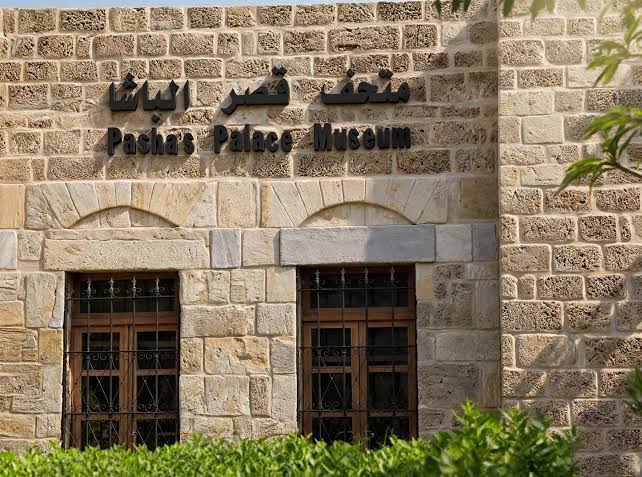
The Pasha's Palace is one of Gaza's most important landmarks, in the al-Daraj neighbourhood of the Old City, east of Gaza City. It was built in 1260 CE by Gaza's governor, Emir Jamal al-Din Aqush al-Shuqayqi, on the orders of the Mamluk Sultan al-Zahir Baybars. The proof is Baybars' emblem carved at its entrance: two facing lions, each bearing Arabic inscriptions, according to the Al Jazeera Encyclopedia.
The palace's name changed with its rulers: it was the "Deputy's Palace" under the Mamluks, then the "Palace of the Radwan family" under the Ottomans, after the dynasty that ruled Gaza and most of Palestine for about a century and a half, from 1530 to 1681, before becoming known as the "Pasha's Palace." Its architecture blends both eras: a Mamluk ground floor of sandy kurkar stone with domed ceilings, an Ottoman upper floor of rock and limestone, and decoration of star patterns, muqarnas, wheat-ear motifs and hexagonal and octagonal shapes.

From seat of government to girls' school
| Period | Use of the palace |
|---|---|
| Mamluk | Seat of Gaza's governor (the "Deputy's Palace") |
| Ottoman | Seat of Gaza's governors and of the Radwan dynasty |
| 1799 | Napoleon Bonaparte stayed three nights during his campaign in Palestine, before his defeat at the walls of Acre |
| British Mandate (1917–1948) | Police station; two basement rooms became jails, one for women and one for men |
| Egyptian administration (1948–1967) | "Princess Ferial" School, later the "Fatima al-Zahraa" Girls' Secondary School until 2000 |
| Since 2010 | Archaeological museum |
The palace shrank from about 60 dunams to just 600 square metres under the British Mandate, as parts of it and its garden were demolished. It was damaged by British shelling in the 1917 Battle of Gaza, then suffered vandalism and neglect under the Israeli occupation after 1967, and in the 1980s settlers deliberately set it on fire.

A museum of five rooms
After the Palestinian Authority took it over, the Ministry of Tourism and Antiquities restored it in 2005; it became a museum in 2010 and was restored again in two phases, in 2012 and 2015, under the UN Development Programme. The museum was divided into five rooms: the Roman era, the Byzantine era, women's adornment through the ages, stones, columns and capitals, and the Islamic era. Among its highlights:
- A Philistine-era pottery piece painted with a swan.
- A manuscript of the "Psalms of David" in ancient Armenian, about 2,000 years old, described as one of the rarest manuscripts in the world.
- A Quran manuscript on papyrus from the Ottoman period.
- Coins, pottery, copper jugs and bronze and iron pieces.

December 2023: the palace turned to ruins
In December 2023 Israeli occupation aircraft bombed the palace, demolishing large parts of it and turning it into ruins, according to the Al Jazeera Encyclopedia, which reports that Palestinian authorities see this as part of an Israeli plan to erase national heritage. Only some walls and arches remain, according to NPR, and reports say it was bulldozed after the bombing.
The most painful question: where are the antiquities? Archaeologists do not know whether they were removed before the building was destroyed, according to Al-Monitor. The Psalms of David manuscript, the papyrus Quran and the Philistine swan piece are all unaccounted for.
The Central Archives: 150 years of memory burned
In the Gaza Municipality building, the Central Archives of Gaza City held records covering about 150 years of the city's history. According to the Librarians and Archivists with Palestine report, the archive was completely destroyed by direct shelling that started a fire, as announced on 29 November 2023, when the head of Gaza Municipality said "Israel destroyed Central Archives of Gaza City."
With the archive, Gaza lost the record of its daily life: ownership of homes and land, the growth of its neighbourhoods and streets, and the documents of generations of its people. It recalls the 1982 theft of the PLO archive from Beirut, part of a recurring pattern of targeting Palestinian memory.
Read also: The Looted Beirut Archive, 1982 →
Libraries and museums: from Rashad Shawa to the Rafah Museum
A report by Librarians and Archivists with Palestine documented damage, destruction or looting at 27 institutions, archives, libraries and museums, in the first months of the war alone, describing them as "only a fraction" of the actual damage, according to the report. Among the most notable:
| Institution | What happened |
|---|---|
| Rashad Shawa Cultural Center and Diana Tamari Sabbagh Library | Completely destroyed by shelling on 25 November 2023 while sheltering displaced people; tens of thousands of books lost |
| Gaza Municipal Library | Damaged by fire in the building, late November 2023 |
| Edward Said Library, Beit Lahia | Destroyed; librarian Doaa Al-Masri was killed on 7 December 2023 |
| Rafah Museum | Completely destroyed by airstrikes in early October 2023 |
| Al-Qarara Cultural Museum, Khan Younis | Heavily damaged; its entire pottery collection, about 3,500 pieces, destroyed |
| Al-Israa University Library and National Museum | The museum was looted before the university was blown up on 18 January 2024 |
From the destroyed Rafah Museum, a child's embroidered dress survived: the blast threw it onto a neighbouring roof, where it stayed for eight months before becoming the final piece in the "Thread Memory" exhibition in Scotland. At the Al-Mathaf hotel and museum owned by collector Jawdat Khoudary, the UN Commission of Inquiry documented suspected looting by Israeli military personnel.
Read also: Palestinian Embroidery at UNESCO →
Churches, bathhouses and the ancient harbour
- Church of Saint Porphyrius: in al-Zaytoun neighbourhood, described by the Al Jazeera Encyclopedia as the third-oldest church in the world, built in the early 5th century. In an Israeli strike on the night of 19 October 2023, displaced people sheltering there were killed: at least eight according to The New Arab, and more than 20 according to Al Jazeera.
- Hammam al-Samra: a domed bathhouse restored in 1320 and once run by members of the Samaritan community. It was levelled, leaving only some arches and the old sign. The Israeli military said it targeted "a Hamas squad and tunnels."
- Anthedon Harbour: Gaza's first known seaport and one of three sites in the Strip on the World Heritage Tentative List, severely damaged.
- The Roman cemetery: nearly wiped out, according to The New Arab.
What has UNESCO done?
In December 2023 UNESCO granted the Monastery of Saint Hilarion (Tell Umm Amer) "provisional enhanced protection" under the 1954 Hague Convention. On 26 July 2024, at the 46th session of the World Heritage Committee in New Delhi, it inscribed the site on both the World Heritage List and the List of World Heritage in Danger under the emergency procedure, according to UNESCO. The monastery is one of the oldest sites in the Middle East and home to the first monastic community in the Holy Land.
But many have criticised UNESCO's response as weak relative to the scale of destruction. The organisation documents and issues statements, but has no tool to stop the bombing.
"An irony of history": antiquities that survived because they were outside Gaza
One collection of Gaza's antiquities survived intact: about 260 pieces from the collection of Jawdat Khoudary, which left Gaza for Geneva's Museum of Art and History in late 2006 for an exhibition. Then Hamas took control of the Strip in June 2007 and the blockade was imposed, so the pieces never returned, and a planned archaeological museum in Gaza stalled.
Former museum curator Jean-Marc Haldimann called this "an irony of history," according to Al-Monitor: the blockade that kept the pieces from returning is what saved them, while the collections that stayed in Gaza were destroyed. Khoudary's mansion in Gaza was destroyed, and the Al-Mathaf hotel was left damaged and partly looted.
Among the rubble: who is saving what remains?
Despite everything, Gazans are trying to save what they can:
- Women volunteers, coordinated by the Eyes on Heritage Institute, are recovering what remains of the Omari Mosque library's manuscripts, describing their work as "first aid" without specialist resources. The Institute's own offices were bombed in September 2025.
- Residents began restoration work at the Omari Mosque after the January 2025 ceasefire, resuming after the October 2025 ceasefire with a focus on clearing rubble while waiting for building materials to enter.
- In September 2026, UNESCO awarded historian Abdul Latif Abu Hashem and researcher Haneen Al-Amassi of Eyes on Heritage the UNESCO/Jikji Memory of the World Prize for rescuing and digitising more than 25,000 pages of Mamluk and Ottoman manuscripts from under the rubble. They are the first individuals to receive the prize since it was founded in 2004, according to The Art Newspaper.
The destruction of Gaza's heritage is not "collateral damage" in a war. It is another link in the same chain the Zionist occupation began with the Nakba: from the looting of books in Jerusalem in 1948, to the looting of the Beirut archive in 1982, to the burning of Gaza's archive in 2023. The aim is the same: to erase the evidence that a people lived here for centuries, building, writing and praying. But as long as a woman is brushing dust off a manuscript among the rubble, Gaza has not lost its memory.
Frequently asked questions about Gaza's heritage
How many cultural sites have been damaged in Gaza since October 2023?
By 24 March 2026, UNESCO had verified damage to 164 cultural sites, including 128 buildings of historical or artistic interest, 14 religious sites, 2 museums and 8 archaeological sites.
What happened to the Great Omari Mosque in Gaza?
Israeli occupation aircraft struck it on 8 December 2023, destroying it almost completely; its Mamluk minaret was left partly standing. It is Gaza's largest and oldest mosque, built in 634 CE on the site of a church dating to 407 CE.
What is the Pasha's Palace in Gaza?
A Mamluk palace in Gaza's al-Daraj neighbourhood, built in 1260 by Emir Aqush al-Shuqayqi on the orders of Sultan Baybars. Napoleon stayed there for three nights in 1799, and it became an archaeological museum in 2010. The Israeli occupation bombed it in December 2023, turning it into ruins, and the fate of its antiquities is unknown.
What happened to Gaza's Central Archives?
It was completely destroyed by shelling and fire in late November 2023. It held documents covering about 150 years of the city's history.
Does Gaza have any World Heritage Sites?
Yes. The Monastery of Saint Hilarion (Tell Umm Amer) was inscribed on 26 July 2024 on the World Heritage List and the List of World Heritage in Danger under the emergency procedure.
Did any of Gaza's antiquities survive?
About 260 pieces from the Jawdat Khoudary collection survived because they had been at a museum in Geneva since 2006 and could not return due to the blockade. And 211 manuscripts from the Omari Mosque library survive digitally because they were digitised before the war.
Read more on Our Palestine
- The genocide in Gaza
- Archaeological sites in Palestine
- All Palestinian heritage articles on Our Palestine
Sources
- The Pasha's Palace: standing since the Mamluk era until Israel demolished it (Arabic), Al Jazeera Encyclopedia, 24 February 2024
- Historic sites destroyed by the Israeli aggression on the Gaza Strip (Arabic), Inam al-Nunu, Al Jazeera Encyclopedia, 6 January 2024
- The Great Omari Mosque in Gaza: invaders came and went, and it still stands (Arabic), Raed Musa, Al Jazeera Net, 15 April 2022
- Impact on cultural heritage in Gaza, UNESCO, March 2026
- Israeli strike leaves Gaza's oldest mosque in ruins, NPR, 9 December 2023
- A requiem for Gaza's iconic sites destroyed in war, NPR, 2024
- Gaza's historic treasures saved by 'irony of history', Al-Monitor (AFP), 10 April 2024
- Israeli Damage to Archives, Libraries, and Museums in Gaza, Librarians and Archivists with Palestine, 2024
- How Israel's war is erasing Gaza's history and culture, Alessandra Bajec, The New Arab, 18 December 2023
- Monastery of Saint Hilarion/Tell Umm Amer inscribed on the World Heritage List and the List of World Heritage in Danger, UNESCO, 26 July 2024
- UN denounces destruction of Palestinian cultural heritage due to Israeli attacks, Finestre sull'Arte, 18 June 2025
- Where We're Working: Gaza, HMML
- Researchers rescuing war-damaged manuscripts in Gaza receive Unesco prize, The Art Newspaper, 17 September 2026
More from the archive
 Download Our Palestine App
The whole archive in the palm of your hand: depopulated villages, the Nakba, the massacres and Al-Aqsa — free, with no ads to erase the story.



Comments
No comments yet — be the first to write one.
Add your comment
Name and email are optional. Comments appear after review.