
The Battles of Sheikh Jarrah 1948: The 13 April Convoy and the Stand on the Mount Scopus Road
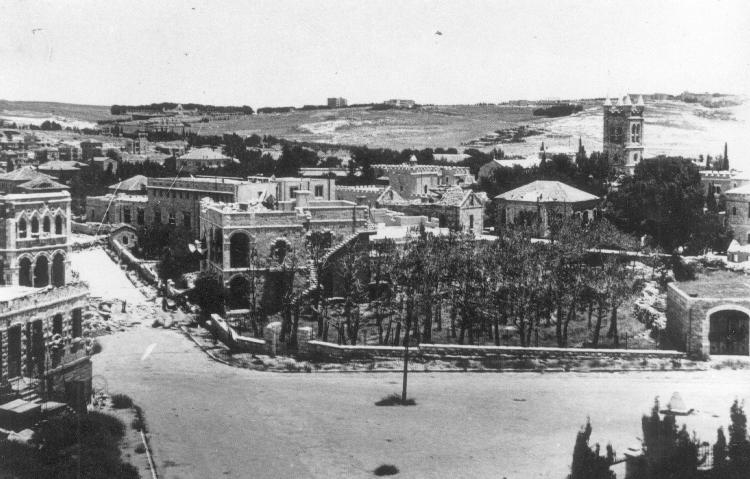
Sheikh Jarrah is an Arab Jerusalem neighbourhood north of the Old City, crossed by the road on which the Zionist militias depended to supply their positions on Mount Scopus, home of the Hebrew University and Hadassah Hospital, and the settlements north of Jerusalem with arms and men. In 1948 it therefore saw some of the largest battles of Jerusalem, above all the convoy battle of 13 April, which came days after Abd al-Qadir al-Husseini’s martyrdom at al-Qastal and the Deir Yassin massacre. [1][2][3]
The neighbourhood withstood the militias’ assault in Operation Yevusi at the end of April until British forces halted it, and then saw the battles of May after the British withdrew from Jerusalem. [4][1]
Contents
- At a glance
- The neighbourhood and the road
- 13 April: the convoy battle
- April: supply and the Zionist assault
- May: after the British withdrawal
- Differences between the accounts
- Timeline
- Frequently asked questions about the battles of Sheikh Jarrah, 1948
At a glance
| Item | Details |
|---|---|
| Dates | January – May 1948, most notably 13 April, 24–27 April and 19 May |
| Place | The Sheikh Jarrah neighbourhood north of the Old City, on the Jerusalem–Nablus road to Mount Scopus |
| Arab forces | Holy Jihad fighters in the neighbourhood, with reinforcements from al-Musrara, Wadi al-Joz and Bab al-Sahira |
| Commander in the convoy battle | Adel Abd al-Latif (or Muhammad Adel al-Najjar in another account) |
| The 13 April convoy | 9 vehicles, two of them armoured, carrying Haganah fighters, ammunition and fortification materials |
| Enemy losses on 13 April | 78 killed according to the Al Jazeera Encyclopedia; about 120 according to WAFA and Bahjat Abu Gharbiyya’s memoirs |
| Arab martyrs | 12 according to WAFA and Abu Gharbiyya, most of them shot by British forces |
| Outcome | The convoy destroyed; the Yevusi assault repulsed in April; the May battles |
The neighbourhood and the road
The neighbourhood takes its name from Emir Hussam al-Din al-Jarrahi, Saladin’s physician, who was buried there; a Sufi zawiya built beside his tomb became in the nineteenth century a mosque whose minaret still stands. From the eighteenth century Jerusalem families summered there among vineyards and olive groves, and the houses of the Husseini and Nashashibi families and the Mufti’s residence stood there. [2]
The road through the neighbourhood was the Zionist militias’ artery to Mount Scopus and the settlements north of Jerusalem, so the British set up a post commanding it after the Zionist convoys came under attack. From late 1947 the fighters attacked Zionist buses and convoys in the neighbourhood; on 10 January 1948 they used Bren guns for the first time, and they cut the water pipes to the Jewish neighbourhoods. [1][2]
13 April: the convoy battle
On 13 April 1948 the Haganah sent a convoy of nine vehicles, two of them armoured, through Sheikh Jarrah to Mount Scopus. It claimed the convoy carried doctors, nurses, food and medical supplies; according to the Arab account it was carrying a number of armed Haganah fighters, ammunition and materials for building trenches and fortifications. Adel Abd al-Latif, commander of the fighters in the neighbourhood, had learned what it really carried and decided to confront it. [3][2]
The fighters laid mines on the Jerusalem–Nablus road; they exploded under the convoy, destroying an armoured car and a truck, and the rest of the vehicles fell back. WAFA says the fighters struck to avenge the martyrdom of their commander Abd al-Qadir al-Husseini a week earlier, and Al Jazeera Net links it too to the Deir Yassin massacre three days before. [3][1][2]
The Jewish Agency appealed to the British army, which sent a large force with mortars that began shelling the fighters, and an armoured car from the British police camp on Mount Scopus joined the firing. But the fighters held, and reinforcements poured in from al-Musrara, Wadi al-Joz and Bab al-Sahira, raising their number from 24 at the start of the battle to more than 200, fighting the Zionists and the British together. [3][1]
The fighters tightened the noose on the convoy’s remaining men until they offered to surrender. The fighters’ commander agreed on condition that all weapons be handed over and the Haganah fighters taken prisoner, with a pledge that the women would not be harmed. WAFA relates that the Zionists killed the Arab envoy sent to deliver the terms, and the fighting flared up again, more violently, until evening. [3][1]
Accounts of the toll differ: the Al Jazeera Encyclopedia gives 78 Haganah dead, while WAFA and the memoirs of the fighter Bahjat Abu Gharbiyya speak of about 120, with only eight of the convoy surviving according to WAFA. Twelve fighters were martyred, most of them killed by the British, and six British soldiers were killed or wounded. Afterwards the Haganah blamed the British for being slow to come to its aid, and tried in the media to belittle the fighters by claiming the convoy was purely medical. [3][1][2]
April: supply and the Zionist assault
After the convoy battle the fighters took control of the Augusta Victoria Hospital and the village of al-Issawiya near the Hebrew University; the Haganah moved its Harel Brigade, and a convoy of some 350 vehicles set out for Jerusalem; it ran into an Arab ambush and got through only hours later, when a large relief force reached it. [1]
At the end of April the Palmach launched Operation Yevusi to isolate Jerusalem and seize its Arab neighbourhoods outside the walls, with Sheikh Jarrah one of its three axes. On 24 April the militias attacked the neighbourhood; the battle went on through the night and the defenders held, and then British forces intervened, forced the Palmach to withdraw and kept the neighbourhood under their protection. [1][4]
May: after the British withdrawal
The Al Jazeera Encyclopedia says Britain handed Sheikh Jarrah to the Zionist militias on 14 May 1948 before withdrawing, and that the militias took it in Operation Kilshon. WAFA, for its part, says fighting continued in the neighbourhood after the British left Jerusalem, the most important battle being that of 19 May, in which the fighters, with a remnant of the Arab Liberation Army, prevented the fall of the whole of Jerusalem, and that the Zionist forces’ later attempts to break through the neighbourhood failed, forcing them to cut alternative roads around it. [4][1]
On 7 July 1948 the “Hadassah Agreement” was signed to demilitarise Mount Scopus and place it under UN supervision, leaving the Hebrew University and Hadassah Hospital an isolated enclave inside the Arab lines. [3]
Differences between the accounts
The toll of the convoy battle ranges from 78 dead in the Al Jazeera Encyclopedia, to 38 in the first phase and 120 overall in WAFA, to “about 122” in Bahjat Abu Gharbiyya’s memoirs. The Al Jazeera Encyclopedia mentions one Arab martyr among the mine-layers in the first phase, while WAFA and Abu Gharbiyya speak of 12 martyrs. The battle’s commander is named Adel Abd al-Latif in one source and Muhammad Adel al-Najjar in another. The sources also differ on the neighbourhood’s fate in May, between its handover to the militias on 14 May and its holding out in the battle of 19 May; most likely the militias entered parts of it before being driven out. WAFA dates the Zionist assault on the neighbourhood to 24 April, while the Al Jazeera Encyclopedia says Operation Yevusi began on 27 April. [3][1][2][4]
Timeline
| Date | Event |
|---|---|
| 10 January 1948 | A battle in the neighbourhood; Bren guns used for the first time [2] |
| 8 April | Abd al-Qadir al-Husseini martyred at al-Qastal [1] |
| 9 April | The Deir Yassin massacre [2] |
| 13 April | The convoy battle; the British intervene [3] |
| Late April | Fighters at Augusta Victoria and al-Issawiya; the ambush of the 350-vehicle convoy [1] |
| 24 April | The Palmach attacks the neighbourhood in Operation Yevusi; the defenders hold [1] |
| 14 May | The British withdraw from the neighbourhood [4] |
| 19 May | The great battle of Sheikh Jarrah [1] |
| 7 July | The Hadassah Agreement demilitarising Mount Scopus [3] |
Frequently asked questions about the battles of Sheikh Jarrah, 1948
Why did Sheikh Jarrah matter in 1948?
Because the road through it was the Zionist militias’ artery to Mount Scopus and the settlements north of Jerusalem. [1][3]
What happened on 13 April 1948?
The fighters destroyed a Haganah convoy bound for Mount Scopus with mines and fought the Zionists and the British together until evening. [3][1]
Was the convoy a medical one?
The Haganah claimed so, but the Arab account maintains it was carrying armed fighters, ammunition and fortification materials. [3][2]
What were the losses?
Between 78 and about 120 Haganah dead according to the sources, and 12 fighters martyred, most of them killed by the British. [3][1][2]
What was Operation Yevusi?
A Palmach offensive at the end of April 1948 to isolate Jerusalem, which Sheikh Jarrah withstood until British forces halted it. [4][1]
Read also on Palestinuna
Sources and references
- WAFA – Palestinian National Information Centre, “Battles of the Nakba”: “The Battle of Sheikh Jarrah” (in Arabic).
- “Sheikh Jarrah: Between the Tomb of Saladin’s Physician and the Graveyard of the Zionist Gangs,” Al Jazeera Net, 13 May 2021 (in Arabic).
- “The Hadassah Agreement: Demilitarising Mount Scopus in Jerusalem,” Al Jazeera Encyclopedia, 14 October 2025 (in Arabic).
- “Plan Dalet: Military Operations by Which the Zionist Gangs Expelled the Palestinians during the Nakba,” Al Jazeera Encyclopedia, 13 January 2025 (in Arabic).
More from the archive
 Download Our Palestine App
The whole archive in the palm of your hand: depopulated villages, the Nakba, the massacres and Al-Aqsa — free, with no ads to erase the story.



Comments
No comments yet — be the first to write one.
Add your comment
Name and email are optional. Comments appear after review.