
The Zuqaq al-Mawt Operation 2002: The al-Quds Brigades' Ambush in Wadi al-Nasara, Hebron
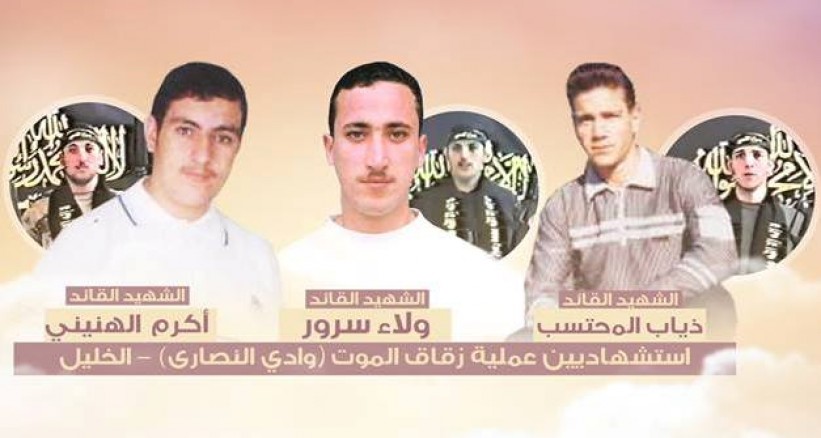
On the evening of Friday 15 November 2002, the tenth of Ramadan, three fighters of the al-Quds Brigades, the armed wing of Islamic Jihad, set an ambush in Wadi al-Nasara in Hebron, on the road settlers take between the gate of the Kiryat Arba settlement and the Ibrahimi Mosque under the occupation army’s guard. The battle lasted about four hours, the alley becoming a trap for every force that tried to enter it; the occupation army’s Hebron brigade commander, Brigadier General Dror Weinberg, was killed along with more than ten soldiers, officers and guards, before the three fighters were martyred around midnight. [1][2]
The occupation afterwards called the place “the Alley of Death,” and the name became the title of one of the best-known operations of the al-Aqsa Intifada, aimed at the occupation forces and the settlement’s guards in the heart of Hebron. [2]
Contents
- At a glance
- The place
- The planning
- The battle
- The toll
- After the operation
- Between the accounts
- Timeline
- Frequently asked questions about the Zuqaq al-Mawt operation
At a glance
| Item | Details |
|---|---|
| Date | Evening of 15 November 2002 (10 Ramadan 1423), from about 7:13 p.m. until near midnight |
| Place | Wadi al-Nasara, between the Kiryat Arba gate and the Ibrahimi Mosque, Hebron |
| Carried out by | The al-Quds Brigades, armed wing of Islamic Jihad |
| Fighters | Akram Abd al-Mohsen al-Hneini (20), Walaa Hashem Dawoud Sarour (21) and Mohammed Abd al-Mu’ti al-Muhtaseb (22), all from Hebron |
| Planning | The prisoner Nour Jaber with the martyr Mohammed Sidr; reconnaissance by the prisoner Mohammed Imran |
| Weapons | M16 rifles with eight magazines per fighter, and hand grenades |
| Forces targeted | The occupation army, Border Police, the Nahal brigade and settlement security |
| Occupation losses | Between 11 and 14 killed according to the accounts, and dozens wounded, including the Hebron brigade commander |
| Outcome | All three fighters martyred |
The place
Wadi al-Nasara is a neighbourhood in the heart of Hebron through which runs the road linking the Kiryat Arba gate to the Ibrahimi Mosque. Every Sabbath settlers walked along it to the mosque for what they called “Sabbath prayer,” under heavy protection from the occupation army and Border Police – a march the people of Hebron saw as a constant provocation in their divided city. [1]
The planning
The sources credit the planning to the prisoner Nour Jaber and his comrade the martyr Mohammed Sidr, who chose the site. Jaber spent about three months watching the settlement, while the prisoner Mohammed Imran mapped the open ground and recorded patrol movements and shift changes. [2]
The plan was for the fighters to take position in the alley while a third fighter outside it drew the forces in, with a hand grenade as the signal to begin, timed with the settlers’ entry into the mosque, which was guarded by a Nahal unit. The sources present the operation as a response to the assassination of Iyad Sawalha, the al-Quds Brigades’ commander in the northern West Bank. [2][1]
The battle
At about seven in the evening the fighters took up positions overlooking the so-called “Worshippers’ Street,” some 300 metres from the settlement gate. At about 7:13 they opened fire on a reserve army jeep, a Border Police jeep and a patrol near the road. [1]
They then moved into a rear alley that they turned into a “kill zone”; when a Border Police jeep entered it, it was attacked at close range. Successive attempts to enter the alley failed; the Hebron brigade commander, Brigadier General Dror Weinberg, was shot as he approached in an armoured jeep, and an attempt by a Nahal company deputy commander also failed. [1]
The occupation brought in flares, helicopters, armoured bulldozers and missiles. When the last two fighters ran out of ammunition they fought on with weapons taken from dead soldiers, until the firing stopped near midnight with the martyrdom of all three. [1]
The toll
Among the occupation’s dead were the Hebron brigade commander, Brigadier General Dror Weinberg; Major Samih Swaidan, the Border Police operations officer in Hebron; the Kiryat Arba settlement security officer; a Nahal company deputy commander; and a Border Police company commander, while the security officer of the settler enclave in the Old City was seriously wounded. The accounts put the dead at between 11 and 14, with dozens wounded. [1][2]
All the dead, according to the sources, were soldiers, officers and armed settlement guards, which is why Israeli officials retreated from the description of a “massacre of innocent worshippers” they had used in the first hours. [1]
After the operation
The occupation army held an inquiry that ended with the dismissal of several mid-ranking officers, including a Nahal deputy battalion commander, the Border Police operations officer in Hebron and a reserve battalion commander, with notes placed in the files of others. Islamic Jihad’s then secretary-general, Ramadan Shallah, was put at the top of the wanted list, and the al-Quds Brigades later published a book about the operation. [2]
On 14 August 2003 occupation forces surrounded Mohammed Sidr’s home in Hebron throughout the morning and then fired rockets at it, killing him. [3]
Between the accounts
Death toll: the al-Hurriya article gives 14 dead in one place and 12 in others, the al-Quds Brigades’ statement on the night of the operation spoke of 11, and al-Khanadeq says the fighters “hunted down” 13 soldiers and wounded 18. [1][2]
Name of the third fighter: al-Hurriya names him Mohammed Abd al-Mu’ti al-Muhtaseb, while al-Khanadeq calls him Diab al-Muhtaseb. [1][2]
Duration: about four hours by one account, five by another, and until about 10:30 p.m. according to al-Khanadeq. [1][2]
Timeline
| Date | Event |
|---|---|
| Before November 2002 | Nour Jaber watches the settlement for about three months; Mohammed Imran tracks the patrols [2] |
| About 7:00 p.m., 15 November 2002 | The fighters take position above “Worshippers’ Street” [1] |
| About 7:13 p.m. | Fire opened on two jeeps and a patrol [1] |
| During the battle | Hebron brigade commander Dror Weinberg killed; attempts to enter the alley fail [1] |
| Near midnight | The three fighters martyred [1] |
| 14 August 2003 | Mohammed Sidr killed when his Hebron home is shelled [3] |
Frequently asked questions about the Zuqaq al-Mawt operation
What was the Zuqaq al-Mawt operation?
An ambush laid by three al-Quds Brigades fighters for occupation forces in Wadi al-Nasara, Hebron, on the evening of 15 November 2002; the battle lasted about four hours. [1]
Why is the place called “the Alley of Death”?
It is the name the occupation gave the alley after it became a trap for every force that tried to enter. [2]
Who carried it out?
Akram al-Hneini, Walaa Sarour and Mohammed al-Muhtaseb, all from Hebron; all three were martyred in the battle. [1]
Which occupation commanders were killed?
The Hebron brigade commander, Brigadier General Dror Weinberg, the Hebron Border Police operations officer, the Kiryat Arba security officer and others. [1]
Who planned it?
The prisoner Nour Jaber and the martyr Mohammed Sidr, with reconnaissance help from the prisoner Mohammed Imran. [2]
Read also on Palestinuna
Sources and references
More from the archive
 Download Our Palestine App
The whole archive in the palm of your hand: depopulated villages, the Nakba, the massacres and Al-Aqsa — free, with no ads to erase the story.



Comments
No comments yet — be the first to write one.
Add your comment
Name and email are optional. Comments appear after review.