
PFLP Aircraft Hijackings | From Algiers 1968 to "Revolution Airport" and Mogadishu 1977
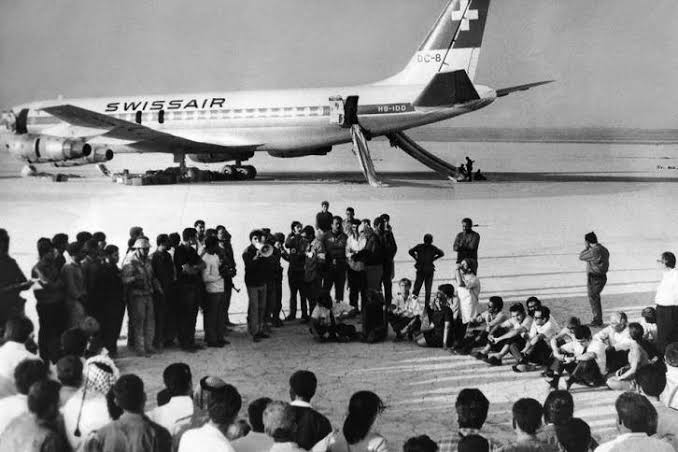
In the late 1960s, after the Zionist entity occupied the rest of Palestine in 1967 while its people’s cause remained absent from Western public opinion, the Popular Front for the Liberation of Palestine turned to a new method: hijacking aircraft. Its declared aims were two: to “draw the world’s attention to the injustice suffered by the Palestinian people,” and to free Arab and Palestinian prisoners from the occupation’s jails by exchanging them for hostages. [1]
These operations were run by the Front’s “external operations” apparatus led by Wadie Haddad. The Front officially abandoned hijacking in 1972, but Haddad continued with his apparatus until he was expelled from the Front in 1976. This article sets out the operations in chronological order, as documented in Arab sources, including the hostages and the victims. [2]
Contents
- At a glance
- 1968: the El Al plane to Algiers
- 1969: Flight 840 to Damascus
- September 1970: “Revolution Airport”
- 1972: Lufthansa to Aden
- 1972–1977: Wadie Haddad’s apparatus
- The outcome
- Between the accounts
- Timeline
- Frequently asked questions about the aircraft hijackings
At a glance
| Item | Details |
|---|---|
| Group | The Popular Front for the Liberation of Palestine, its “external operations” apparatus led by Wadie Haddad |
| First operation | July 1968: an El Al plane from Rome to Algiers |
| Best-known operation | September 1970: planes hijacked to Dawson’s Field in Jordan |
| Declared aim | To make the Palestinian cause known and free prisoners |
| Front abandons the method | 1972 |
| Wadie Haddad expelled | 1976, after the failure of the Entebbe operation |
| Last operation | October 1977: a Lufthansa plane to Mogadishu |
1968: the El Al plane to Algiers
In July 1968 PFLP fedayeen hijacked a plane of the Israeli airline El Al that had taken off from Rome for Tel Aviv, and diverted it to Dar el-Beida airport in Algiers, known today as Houari Boumediene airport. The Algerian official Jalloul Malaika said Algeria accepted the landing for humanitarian reasons because the plane was running out of fuel. [3]
Western passengers were released first, and the Israeli passengers were held for 40 days. President Houari Boumediene refused to bow to pressure, and Algeria held to the demand for the release of prisoners in negotiations with American, French and Soviet intermediaries. The crisis ended on 30 August 1968 with the release of the hostages, in return for the occupation’s release of 15 Arab prisoners – Syrians, Jordanians and Egyptians – according to Malaika. [3]
1969: Flight 840 to Damascus
On 29 August 1969 Leila Khaled and Salim al-Issawi of the PFLP boarded a TWA Boeing 707 in Rome bound for Athens and then Tel Aviv. About half an hour after take-off, during meal service, they seized the cockpit; Leila Khaled ordered the pilot to head for Palestine and read out a political statement in English. When the pilot tried to turn toward an American base in Libya she noticed and forced him to continue. [1][5]
The plane flew over Haifa, Leila Khaled’s city, from which she had been driven out as a child, and then landed in Damascus, where 116 passengers disembarked and the cockpit was blown up. The Syrian authorities held the hijackers for about six weeks and then released them. The affair ended with an exchange of Israeli passengers for Syrian pilots and Palestinian prisoners. [1][5]
September 1970: “Revolution Airport”
On 6 September 1970 the PFLP carried out its largest simultaneous hijacking, overseen by Wadie Haddad. Youm7 reports that George Habash instructed Haddad: “Set the region alight,” and that Haddad prepared an abandoned Second World War military airstrip in the Jordanian desert – Dawson’s Field, which the Front named “Revolution Airport” – with about 30 fighters, explosives, a hundred empty cans, fuel, a wooden ladder and a megaphone. [6][5]
- A TWA plane from Frankfurt to New York, with about 142 to 150 passengers, landed at Dawson’s Field.
- A Swissair plane from Zurich to New York, with about 150 to 155 people aboard, landed at the same airstrip.
- An El Al plane from Amsterdam, which Leila Khaled and the Nicaraguan Patrick Argüello tried to hijack after two other hijackers were refused boarding. The attempt failed: the pilot locked the cockpit, Israeli security and a passenger beat Leila Khaled until her ribs broke and she lost consciousness, and an officer shot Argüello dead. The plane made an emergency landing in London, and Leila Khaled was arrested.
- A British plane from Bahrain, hijacked on 9 September and brought down at Dawson’s Field, to pressure Britain into releasing Leila Khaled.
The hijackers demanded the release of Palestinian prisoners from the occupation’s jails and European prisons. On 12 September 1970 the Front blew up the planes at the airstrip after their passengers had been taken off. On 30 September Britain released Leila Khaled in exchange for German and Swiss hostages; she was flown to Cairo and freed with other prisoners on 1 October. [5][7]
The operation turned the existing tension in Jordan into an international crisis, and came on the eve of the events of September 1970, which ended with the Palestinian factions leaving Jordan for Lebanon. [7]
1972: Lufthansa to Aden
In February 1972 five Palestinians of the PFLP hijacked a Lufthansa Boeing 747 over India, on a flight from New Delhi to Athens with 172 passengers and 14 crew. The pilot persuaded them not to land on a desert strip near Amman, and they came down in Aden. They demanded money and the release of three Jordanians held in West Germany. Women and children were released first, then the other passengers and crew, and the hijackers surrendered in Aden. The BBC cites reports of a ransom whose size was never officially announced. [8]
1972–1977: Wadie Haddad’s apparatus
In 1972 the PFLP abandoned the “strategy of hijacking aircraft.” But the “external operations” apparatus led by Wadie Haddad continued operations in cooperation with foreign leftist organisations, until the Front expelled Haddad in 1976 after the failure of the Entebbe operation. [2]
July 1973: the Japanese plane
In July 1973 a Japan Air Lines plane (Flight 404) was hijacked over the Netherlands and taken to Libya, to demand the release of the Japanese Kozo Okamoto, held by the occupation after the Lod airport operation of 1972. When negotiations failed, the passengers and crew were released and the hijackers blew up the plane in the Libyan desert. The Al Jazeera Encyclopedia attributes the operation to the Japanese Red Army, the PFLP’s partner in other operations. [9]
June 1976: Entebbe
On 27 June 1976 two Palestinians of the PFLP and two Germans of the “Revolutionary Cells” hijacked an Air France Airbus after its stop in Athens, on a flight from Tel Aviv to Paris carrying 248 passengers, 103 of them Israelis, and 12 crew. After a stop in Libya it landed at Entebbe airport in Uganda. The hijackers demanded the release of 53 Palestinian prisoners from the occupation’s jails and four other countries. On 1 July the non-Israeli hostages were released. [10]
On 4 July 1976 the occupation landed a special force at the airport. All the hijackers were killed, along with about 20 Ugandan soldiers, 3 of the hostages, and the Israeli force’s commander, Yonatan Netanyahu, brother of Benjamin Netanyahu. After the operation failed, Wadie Haddad was expelled from the PFLP. [10][2]
October 1977: the “Landshut” to Mogadishu
On 13 October 1977 a PFLP group hijacked a Lufthansa plane (Flight 181) after it took off from Palma de Mallorca in Spain for Frankfurt, with 86 passengers and 5 crew, to demand the release of 11 imprisoned members of the German “Red Army” organisation. The plane moved between Rome, Larnaca, Bahrain, Dubai and Aden, where the hijackers’ leader killed the pilot, Jürgen Schumann. On 18 October a German special force stormed the plane in Mogadishu: three hijackers were killed and the fourth wounded, and the hostages came out unharmed. [4]
The outcome
The first hijackings achieved what the Front wanted in media terms: they received wide international coverage, raised the profile of the Palestinian cause, and in Algiers 1968, Damascus 1969 and September 1970 led to the release of prisoners. But the method then spread among several organisations in the 1970s and 1980s, and its last operations ended with hostages and hijackers killed, so the PFLP itself abandoned it. [1][2][10]
Timeline
| Date | Event |
|---|---|
| July 1968 | El Al plane hijacked to Algiers [3] |
| 30 August 1968 | Hostages freed in exchange for Arab prisoners [3] |
| 29 August 1969 | Leila Khaled and Salim al-Issawi hijack Flight 840 to Damascus [1] |
| 6 September 1970 | Planes hijacked to “Revolution Airport”; El Al hijack fails [5] |
| 9 September 1970 | A British plane hijacked to Dawson’s Field [5] |
| 12 September 1970 | The hijacked planes blown up at the airstrip [5] |
| 1 October 1970 | Leila Khaled freed [5] |
| February 1972 | Lufthansa plane hijacked to Aden [8] |
| 1972 | The PFLP abandons hijacking [2] |
| July 1973 | Japanese plane hijacked and blown up in Libya [9] |
| 27 June 1976 | Air France plane hijacked to Entebbe [10] |
| 4 July 1976 | The Israeli raid on Entebbe [10] |
| 1976 | Wadie Haddad expelled from the Front [2] |
| 13–18 October 1977 | The “Landshut” hijacked and stormed in Mogadishu [4] |
Frequently asked questions about the aircraft hijackings
What was the PFLP’s first hijacking?
The hijacking of an El Al plane from Rome to Algiers in July 1968, which ended with the release of Arab prisoners. [3]
Why did the Front turn to hijacking?
To make the Palestinian cause known in the West, and to free prisoners by exchanging them for hostages. [1]
What was “Revolution Airport”?
The abandoned Dawson’s Field military airstrip in the Jordanian desert, where the Front landed the planes hijacked in September 1970 and then blew them up. [5][6]
When did the Front stop hijacking?
It officially abandoned it in 1972, but Wadie Haddad’s apparatus continued until 1977. [2][4]
Read also on Palestinuna
Sources and references
- Al Jazeera Encyclopedia, “‘Flight 840’: the first hijacking to make Palestine known,” 29 September 2016 (in Arabic).
- Saqr Abu Fakhr, “The poor peasant and the well-off doctor,” Journal of Palestine Studies (Arabic), issue 132, autumn 2022.
- Echorouk (Algeria), “Algeria held Israeli hostages in 1968,” 17 August 2007 (in Arabic).
- Al-Jarida (Kuwait), on the return of the “Landshut” to Germany 40 years after its hijacking, 24 September 2017 (in Arabic).
- Al Jazeera Encyclopedia, “Leila Khaled: the hijacker who terrified the Israeli occupation,” 18 November 2023 (in Arabic).
- Youm7, Said al-Shahat, “On this day, 6 September 1970: Wadie Haddad oversees the hijacking of three planes,” 6 September 2018 (in Arabic).
- Al Jazeera Net, “September 1970: the memory of a wound in the Arab conscience,” 18 September 2019 (in Arabic).
- “This day in history, 1972: hijackers surrender and free Lufthansa crew,” from BBC News, Macau Daily Times.
- Al Jazeera Encyclopedia, “The Japanese Red Army: an Asian organisation that supported the Palestinian resistance,” 6 May 2024 (in Arabic).
- Al Jazeera Encyclopedia, “The Entebbe operation,” 4 July 2016 (in Arabic).
More from the archive
 Article
Operation Dispelled Illusion 2006: The Kerem Shalom Tunnel and Shalit's Capture to the Wafa al-Ahrar Exchange
 Article
The Zuqaq al-Mawt Operation 2002: The al-Quds Brigades' Ambush in Wadi al-Nasara, Hebron
 Article
The Battle of al-Samu 1966: Five Hours of Resistance Before the Occupation of the West Bank
 Download Our Palestine App
The whole archive in the palm of your hand: depopulated villages, the Nakba, the massacres and Al-Aqsa — free, with no ads to erase the story.



Comments
No comments yet — be the first to write one.
Add your comment
Name and email are optional. Comments appear after review.