The Bombing of the Semiramis Hotel in Jerusalem
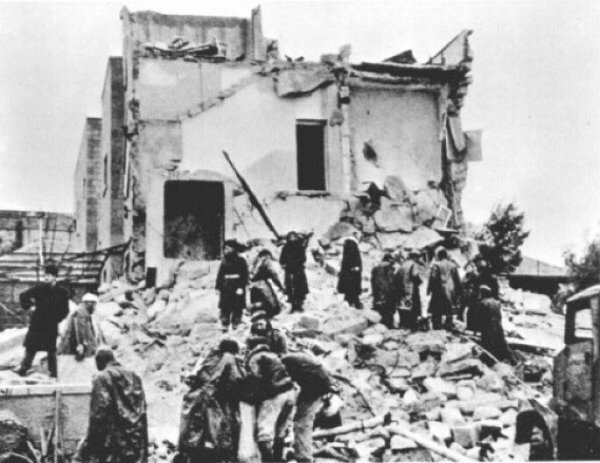
The Semiramis Hotel Massacre in Jerusalem: The Haganah Bombing of Katamon on the Eve of the Palestinian Nakba
In the early hours of January 5, 1948, members of the Zionist armed organization Haganah bombed the Semiramis Hotel in the Palestinian neighborhood of Katamon in western Jerusalem.
The explosion destroyed a large part of the building while guests and families were still inside. Palestinian sources commonly record the deaths of approximately 26 civilians and the wounding of more than twenty others, although historical sources differ slightly on the final death toll, with most estimates ranging between 24 and 26 people.
Most of those killed were Palestinian Arabs, including women, children, and several members of the Abu Suwan family, as well as Manuel Allende Salazar, the Spanish vice-consul in Jerusalem.
Katamon Before the Bombing
Katamon was one of Jerusalem’s most prominent Palestinian Arab neighborhoods. Its streets were lined with stone houses, villas, churches, schools, and family residences belonging largely to Palestinian Christian and Muslim families.
The neighborhood occupied an important position in western Jerusalem and lay close to several Jewish neighborhoods at a time when armed confrontations were rapidly escalating following the adoption of United Nations Partition Resolution 181 on November 29, 1947.
By January 1948, Jerusalem had entered an increasingly dangerous phase in the struggle over the city, as confrontations intensified between Palestinian forces and Zionist armed organizations over roads, neighborhoods, strategic positions, and communication routes, while the British Mandate authorities were preparing to withdraw from Palestine.
Palestinian civilians increasingly found themselves living amid armed attacks, bombings, roadblocks, and the breakdown of security, while uncertainty grew over the future of their city and homeland.
The Semiramis Hotel
The Semiramis was a small Arab-owned hotel belonging to Palestinian Christian families in Katamon. At the time of the bombing, it housed Palestinian families and other civilians.
The Haganah claimed that the building was being used as a headquarters or meeting place for Palestinian armed groups and that weapons were being distributed from it to areas and villages surrounding Jerusalem.
However, the British Mandatory authorities rejected this justification after the attack, and the British investigation concluded that the allegation that the hotel served as a headquarters for Arab armed organizations was without foundation.
The question of the hotel’s actual use is particularly significant because the Haganah used the claim that it contained a military headquarters to justify an operation against a building occupied by a large number of civilians and families.
The Haganah Attack on the Hotel
On the night of January 4–5, 1948, a Haganah unit entered Katamon and approached the Semiramis Hotel.
The attackers used explosives to breach an entrance to the building and then placed additional charges inside the hotel or in its lower section.
When the explosives detonated, large sections of the building collapsed on those inside.
The scale of the destruction made rescue operations extremely difficult, and rescuers had to recover bodies and survivors from beneath the rubble.
The Haganah subsequently acknowledged responsibility for carrying out the bombing.
The British Mandatory authorities strongly condemned the operation, rejected the Haganah’s justification that the hotel was a legitimate military headquarters, and used highly condemnatory language in their reports because of the civilian casualties.
The Victims of the Semiramis Massacre
Sources record approximately 26 people killed and more than twenty wounded, while other historical accounts place the death toll between 24 and 26.
The dead included Palestinian Muslims and Christians, members of families who had sought shelter in the hotel, as well as workers and other civilians.
The Abu Suwan family was among those most severely affected, with several members of the family killed together beneath the ruins of the hotel.
Manuel Allende Salazar, the Spanish vice-consul in Jerusalem, was also killed.
The presence of women, children, and entire families among the victims reinforced the Palestinian understanding of the bombing as more than an attack on a building, since civilians bore the overwhelming consequences of the operation.
Was the Hotel an Arab Military Headquarters?
The Haganah justified the operation by claiming that the Semiramis Hotel was an important gathering place for Palestinian fighters and that weapons were being distributed from it to other areas.
This account was challenged almost immediately after the bombing.
The British Mandatory authorities stated that the information available to them did not support the allegation that the hotel was being used as a headquarters for Arab armed groups.
Later historical studies, drawing on documents from the period, indicate that the Haganah had suspected that the hotel was being used as a headquarters for local fighters, but that this suspicion was most likely mistaken.
The incident consequently became an early example of the contradiction between the justifications offered by Zionist armed organizations for targeting buildings in Palestinian areas and other testimony and documentation emphasizing the civilian character of many of the victims and targeted locations.
Katamon and the Struggle for Jerusalem
During the following months, Katamon became one of the major battlegrounds in the struggle for control of Jerusalem.
Zionist forces regarded the Palestinian neighborhoods of southern and western Jerusalem as strategically important because of their location between areas controlled by Zionist organizations and the roads connecting Jerusalem with the coast.
In the weeks preceding its occupation, Katamon was subjected to repeated shelling and attacks, while increasing numbers of Palestinian civilians left the neighborhood.
In late April 1948, Haganah and Palmach forces launched major attacks to seize Katamon as part of Operation Yevusi, with one of the most important battles centered around the Monastery of San Simon.
By May 1, 1948, Zionist forces had effectively taken control of Katamon, and most of its Palestinian residents had either fled or been displaced.
The residents left behind their homes, property, furniture, businesses, and neighborhood institutions, and the occupation of Katamon was followed by widespread looting of Palestinian homes and property.
The Semiramis Bombing and the Palestinian Nakba
The bombing of the Semiramis Hotel took place more than four months before the formal end of the British Mandate and the declaration of the State of Israel.
This chronology is particularly significant because it demonstrates that the displacement of Palestinians and the Nakba did not begin after May 15, 1948. Palestinians had already been subjected to attacks, bombings, the seizure of strategic positions, the collapse of security, and forced displacement before the end of the British Mandate.
From late 1947 and into early 1948, Palestinian neighborhoods, towns, and villages were subjected to military operations carried out by Zionist armed organizations, and these operations intensified as the end of British rule approached.
In Jerusalem, operations such as the bombing of the Semiramis Hotel contributed to a climate of fear that preceded the depopulation and occupation of a number of Palestinian neighborhoods in western Jerusalem, including Katamon, Talbiya, and Baq’a.
The Semiramis bombing therefore formed part of the early stages of the Palestinian Nakba and the occupation of Palestine in 1948—a process that witnessed the fragmentation of Palestinian society across wide areas, the occupation of towns, villages, and neighborhoods, the displacement of their inhabitants, and the transformation of hundreds of thousands of Palestinians into refugees and displaced persons.
Video clips
More from the archive
 Download Our Palestine App
The whole archive in the palm of your hand: depopulated villages, the Nakba, the massacres and Al-Aqsa — free, with no ads to erase the story.
Download Our Palestine App
The whole archive in the palm of your hand: depopulated villages, the Nakba, the massacres and Al-Aqsa — free, with no ads to erase the story.
Comments
No comments yet — be the first to write one.
Add your comment
Name and email are optional. Comments appear after review.