The Deir Yasin Massacre

On April 9, 1948, Zionist forces from the Irgun (Etzel) and Lehi (Stern Gang), supported during the fighting by elements of the Haganah and Palmach, attacked the Palestinian village of Deir Yasin west of Jerusalem.
The attack ended in one of the best-known massacres of the 1948 war. Men, women, children, and elderly villagers were killed, homes were blown up, prisoners were paraded through Jewish neighborhoods of Jerusalem, and some captives were later executed.
The massacre had consequences far beyond the village itself. News of what happened in Deir Yasin spread rapidly throughout Palestine and became a major source of fear among Palestinian civilians during the weeks in which Zionist forces were expanding their offensives and Palestinian communities were increasingly being displaced.
Deir Yasin Before 1948
Deir Yasin was a Palestinian Arab village in the Jerusalem Subdistrict, located approximately 5 kilometers west of Jerusalem.
By 1948, its population was estimated at approximately 750 people, living in around 144 houses.
The village had developed a prosperous local economy based on quarrying, stone cutting, transportation, trade, and agriculture. Its proximity to Jerusalem enabled many villagers to work in the city and in nearby British installations.
Deir Yasin established an elementary school for boys in 1943 and a girls' school in 1946, both financed through contributions from the villagers.
The village also had mosques, shops, guesthouses, wells, a social club, and local businesses.
A Village That Had Sought to Remain Outside the Fighting
One of the most significant aspects of the Deir Yasin massacre was that the village had previously attempted to avoid involvement in the growing military confrontation around Jerusalem.
The villagers had reached a nonaggression understanding with the neighboring Jewish settlement of Givat Shaul, under which both sides sought to avoid attacks and prevent armed forces from using their communities as bases against one another.
Despite this agreement, the military situation around Jerusalem deteriorated rapidly during the first weeks of April 1948.
Zionist forces had launched Operation Nachshon to gain control over the road linking Tel Aviv and Jerusalem. The strategically located Palestinian village of al-Qastal had already become the scene of intense fighting, and Palestinian commander Abd al-Qadir al-Husseini was killed there on April 8.
Deir Yasin was subsequently selected for attack by the Irgun and Lehi.
The Role of the Haganah
Although the massacre itself was carried out principally by Irgun and Lehi fighters, the attack did not take place entirely outside the broader Zionist military framework operating around Jerusalem.
David Shaltiel, the Haganah commander in Jerusalem, knew of the planned assault.
He informed the Irgun and Lehi commanders that the occupation and retention of Deir Yasin were compatible with the broader Haganah military objectives connected with Operation Nachshon.
Shaltiel did not object to their taking the village provided that they were capable of holding it.
During the battle, after the Irgun and Lehi forces encountered stronger resistance than expected, the Haganah provided them with ammunition and mortar support. A Palmach force also intervened and helped overcome the villagers' defenses.
The relationship between the groups is therefore more accurately described as one of prior knowledge, conditional approval, and military assistance rather than the massacre having been directly commanded by Shaltiel.
The Attack Plan
The assault was planned along several axes.
According to Palestinian historical research, one attacking group was to advance from Givat Shaul, while another moved from the east toward the center of the village behind an armored vehicle equipped with a loudspeaker.
Other units advanced from the direction of Beit HaKerem, attacking the southeastern section near the Shaykh Yasin Mosque and maneuvering around the western side of the village.
Haganah accounts later stated that approximately 120 Irgun and Lehi fighters began the attack at dawn—around eighty from Irgun and forty from Lehi.
The Villagers Resist
The attackers expected relatively limited resistance, but the villagers fought back with the weapons available to them.
Palestinian defenders positioned throughout the village slowed the advance and inflicted casualties on the attacking forces.
The Irgun and Lehi assault initially stalled, forcing the attackers to request assistance from the Haganah.
Mortar fire and reinforcements helped the attacking forces penetrate the village.
Once the defensive positions collapsed, the nature of the operation changed dramatically.
The Massacre
After entering Deir Yasin, members of the attacking forces killed Palestinian residents inside homes, streets, and courtyards.
Houses were attacked with explosives and hand grenades, in some cases while residents remained inside.
Contemporary accounts and later survivor testimony document the killing of entire families and the deaths of men, women, children, and elderly residents.
Haganah and Palmach accounts themselves acknowledged that civilians were killed without distinction.
Meir Pa'il, a Palmach intelligence officer who observed the operation, later described indiscriminate killing by Irgun and Lehi forces.
He also reported that a group of approximately 25 Palestinian men taken prisoner were transported through Jerusalem and later shot.
Prisoners Paraded Through Jerusalem
Approximately 150 surviving villagers—including women, children, and elderly people—were loaded onto vehicles after the attack.
Some were driven through Jewish neighborhoods of Jerusalem in what the attackers presented as a victory procession.
Many of the surviving prisoners were later released near Arab areas of Jerusalem, where their accounts rapidly spread news of the massacre.
The spectacle of prisoners being publicly displayed became one of the most remembered aspects of the attack and reinforced the atmosphere of fear generated by Deir Yasin.
What Did the Red Cross Witness?
One of the most important independent eyewitnesses was Jacques de Reynier, head of the International Committee of the Red Cross delegation in Jerusalem.
He entered Deir Yasin on April 11 after receiving appeals to recover the wounded and dead.
De Reynier reported finding bodies inside and outside houses and encountered armed fighters carrying guns, grenades, and knives.
His report described a scene of extensive killing and stated that he was able to rescue only a small number of people who remained alive among the casualties.
His eyewitness testimony became one of the most important contemporary external accounts confirming that the events in Deir Yasin had gone far beyond an ordinary battlefield engagement.
Reports of Mutilation and Sexual Violence
Palestinian survivor testimony, contemporary British investigations, and later historical studies contain allegations of mutilation and sexual violence during the massacre.
Some British investigators reported evidence or testimony concerning what they described as sexual atrocities, and several historical studies have repeated these accounts.
At the same time, the precise details and scale of individual allegations remain disputed among historians.
It is therefore historically safer to distinguish the extensively documented facts—the indiscriminate killing of civilians, destruction of houses, execution of prisoners, mistreatment of bodies, and forced removal of survivors—from specific sensational accounts whose details cannot always be independently confirmed.
How Many Palestinians Were Killed?
One of the most persistent historical errors surrounding Deir Yasin concerns the number of victims.
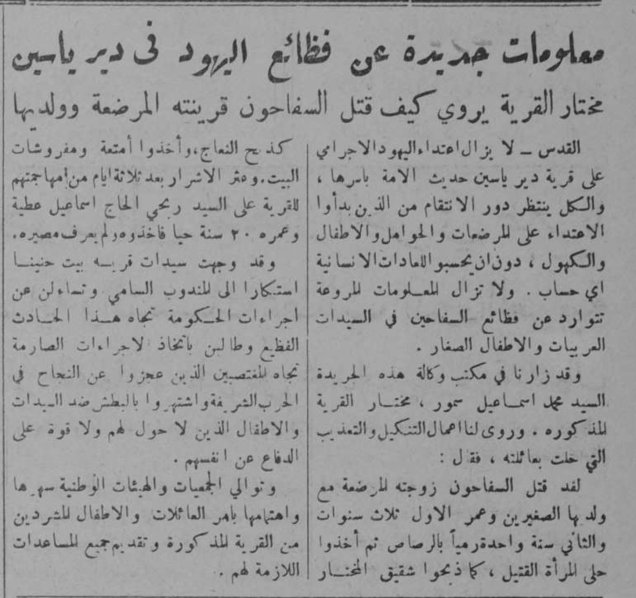
Immediately after the attack, Irgun and Lehi representatives claimed that approximately 245 Arabs had been killed.
This figure spread rapidly through Palestinian, Arab, and international media and was repeated for decades.
Later research established a substantially lower—but still devastating—death toll.
A detailed Birzeit University study based on interviews with survivors and village families identified by name 107 Palestinians killed and twelve wounded.
Other Palestinian historical sources generally estimate the total at around 100 to 110 victims.
The victims included a high proportion of women, children, and elderly people.
The figure of 245 should therefore be understood as an inflated contemporary claim rather than the best-supported modern estimate.
Why Was the Death Toll Exaggerated?
The inflated number itself became part of the historical significance of Deir Yasin.
After the massacre, Irgun and Lehi representatives spoke to journalists and publicized dramatic accounts of their victory.
Palestinian historical sources argue that the attackers deliberately magnified the scale and brutality of the operation in order to spread fear among Palestinian communities.
Whether every later claim was deliberately manufactured or grew through the rapid circulation of wartime rumors, the psychological effect was undeniable.
The name Deir Yasin quickly became synonymous with the possibility that Palestinian civilians in other towns and villages could suffer the same fate.
The Impact on Palestinian Flight
The massacre took place at a decisive stage of the war.
News of Deir Yasin spread through Jerusalem and across Palestine at the same time that Zionist forces were launching increasingly large military offensives.
Fear generated by the massacre contributed to the flight of Palestinians from a number of communities.
Even a contemporary Zionist intelligence report on the depopulation of Palestine later identified the “Deir Yasin effect” as a factor in the departure of Palestinians from some areas around Jerusalem.
The massacre did not by itself cause the Palestinian Nakba, and Palestinian communities were displaced through a variety of mechanisms including direct expulsion, military assault, bombardment, psychological warfare, fear, and the collapse of neighboring towns and villages.
Deir Yasin nevertheless became one of the most powerful symbols of the terror accompanying that process.
The Wider Nakba
By the end of 1948, the populations of more than 400 Palestinian villages had been displaced and many of those communities had been partially or completely destroyed.
Major Palestinian urban centers including Haifa, Jaffa, Acre, Lydda, and Ramla also lost most of their Palestinian inhabitants during the war.
Approximately three-quarters of a million Palestinians became refugees.
Deir Yasin was therefore not the beginning of all Palestinian displacement, nor was it the first massacre committed during the conflict. Its significance lies in the enormous psychological impact it had at a moment when the military balance was shifting rapidly and the mass displacement of Palestinians was accelerating.
Condemnation of the Massacre
The massacre was publicly condemned by the mainstream Zionist institutions, including the Jewish Agency, Haganah, and Chief Rabbinate.
Yet these condemnations did not erase the fact that the Haganah had known of the planned operation and had provided assistance during the battle.
This distinction remains central to historical assessments of responsibility for the attack.
Deir Yasin After the Nakba
Deir Yasin's Palestinian inhabitants were never able to re-establish their village community.
In 1949, Jewish immigrants were settled on and near the village lands in an area named Givat Shaul Bet.
Many of the original Palestinian stone houses survived.
A number of them were incorporated into a psychiatric hospital established on the village site, while other surviving buildings were adapted for residential, commercial, and storage uses.
The old Palestinian cemetery also remained, though historical surveys recorded it as neglected and increasingly surrounded by urban development.
Deir Yasin in Palestinian Memory
Deir Yasin occupies a singular place in Palestinian collective memory.
Its name became a symbol not only of the civilians killed on April 9, 1948, but of the fear, dispossession, and destruction experienced by Palestinian society during the Nakba.
The massacre demonstrated how quickly an inhabited Palestinian village could move from uneasy neutrality to military occupation, mass killing, depopulation, and permanent loss.
From a Palestinian historical perspective, its importance is therefore larger than the disputed details that accumulated around it in the decades that followed.
The documented reality is stark enough: a village whose inhabitants had attempted to maintain a nonaggression arrangement was attacked; civilians were killed indiscriminately; prisoners were executed; survivors were expelled; the death toll was deliberately or recklessly inflated in public accounts; and the resulting fear spread far beyond Deir Yasin itself.
In that sense, Deir Yasin became one of the most enduring symbols of the Nakba of 1948 and of the destruction of Palestinian village life in the struggle that transformed Palestine.
Video clips
Photo gallery

More from the archive
 Download Our Palestine App
The whole archive in the palm of your hand: depopulated villages, the Nakba, the massacres and Al-Aqsa — free, with no ads to erase the story.
Download Our Palestine App
The whole archive in the palm of your hand: depopulated villages, the Nakba, the massacres and Al-Aqsa — free, with no ads to erase the story.

Comments
No comments yet — be the first to write one.
Add your comment
Name and email are optional. Comments appear after review.