
Saffuriya Park

Saffuriya: The Largest Village of Nazareth District, Turned into a "Park" by the Occupation
Saffuriya was the largest village in the Nazareth district by area and population. It sat on a hill crowned by the citadel of Zahir al-Umar and surrounded by olive groves and orchards, with the remains of a Roman theatre, the Church of Saint Anne and ancient mosaics on its land. On the night of 15–16 July 1948, during Ramadan, Israeli aircraft bombed it as families broke their fast; Zionist forces then occupied it, expelled its people and razed it to the ground. Today a pine forest covers its ruins and the site is shown to visitors as a tourist "park" with an entrance fee, while its people live as refugees in the Safafra quarter of Nazareth and in Lebanon and Syria, a few kilometres from their homes. This guide covers Saffuriya's history, antiquities, Nakba and memory.
Quick facts
| Arabic name | صفورية |
|---|---|
| District | Nazareth, Lower Galilee |
| Area (1945) | 55,378 dunams, of which 41,748 Arab-owned |
| Population | 4,330 in 1945; about 5,000 in 1948; local sources estimate about 7,000 |
| Houses | 1,192 in 1948 |
| Citadel | Built by Zahir al-Umar al-Zaydani around 1745 |
| Antiquities | Roman theatre, Church of Saint Anne, mosaics |
| Occupation | 15–16 July 1948, after an air raid during Ramadan |
| Refugees | More than 30,000 (1998 estimate) |
| Today | Ruins under a pine forest; a tourist site with an entrance fee |
Location
Saffuriya lies in the Lower Galilee north-west of the city of Nazareth, on a hill from which the Bay of Acre can be seen. Its houses spread west of the citadel, surrounded by wide farmlands of grain, olives and irrigated orchards.
The village before the Nakba
Saffuriya was the largest village in the Nazareth district. Its lands covered 55,378 dunams in 1945, including 21,841 dunams of grain, 5,310 dunams of irrigated land and orchards and 3,270 dunams of olives, and not a single plot was Jewish-owned. Its population grew from 3,147 in 1931 to 4,330 in 1945, almost all Muslims. It had schools for boys and girls and a transport company, and scholars from al-Azhar came to teach there, especially in Ramadan.
The citadel of Saffuriya
On the summit of the hill stands the citadel of Saffuriya, built by the ruler of Galilee Zahir al-Umar al-Zaydani around 1745 on Byzantine foundations. A third storey was added under the Ottoman Sultan Abdul Hamid II. Parts of its walls have collapsed, but it still stands on the hill, a witness to the village that spread along its western slope.
Antiquities
- The Roman theatre: north-west of the village, uncovered in 1931, seating 4,000–5,000 spectators and probably built in the 1st century CE.
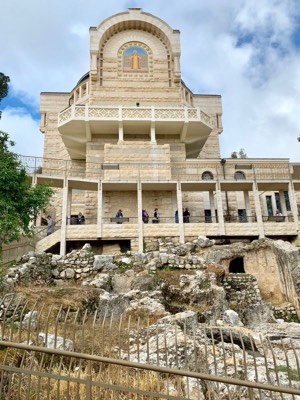
- The Church of Saint Anne: a monastery built over the ruins of a late-6th-century cathedral, with an inscription recording the church's restoration in 516–517 CE. The monastery serves today as an orphanage, and the village also has a Greek Orthodox church.
- Mosaics: ancient mosaic floors have been uncovered at the site.
The Nakba: July 1948
On the night of 15 July 1948, during Ramadan, three Israeli aircraft bombed Saffuriya with barrel bombs as families broke their fast. Several villagers were killed and many wounded, and people fled into the streets and orchards. After fierce resistance, Zionist forces occupied the village on 16 July 1948, ahead of their attack on Nazareth. Many of its people fled north to Lebanon, to Bint Jbeil and then Beirut and the Beqaa, and to Syria, while others took refuge in Nazareth and nearby villages. Hundreds slipped back in the following months and were expelled again. Those who remained were loaded onto trucks in January 1949 and taken to Illut, al-Rayna and Kafr Kanna, and the village was razed to the ground.
From village to "park"
After the village was destroyed, the Jewish National Fund planted a pine forest over most of its ruins. Several settlements were built on its lands from 1949, the place was given a Hebrew name, and a Muslim shrine there was turned into a synagogue. Only a few of its houses remain. The site of the village and its antiquities became a tourist "park" where the citadel, theatre and mosaics are shown to visitors for an entrance fee, in a narrative that ignores the Arab village that lived here until 1948. A Palestinian novel, The Return of My Grandmother Mudallala, tells how the son of a refugee woman from Saffuriya had to pay the entrance fee to gather a handful of soil from her village and water from its spring, to be buried with her.
Memory and the right of return
Many of Saffuriya's refugees settled in the Safafra quarter of Nazareth, a few kilometres from their village, able to see it but not allowed to return, while others live in camps in Lebanon and Syria. Saffuriya's refugees were estimated at more than 30,000 in 1998. Among the village's sons was the poet Taha Muhammad Ali, who said: "Saffuriya is what made me a poet". His brother Amin Muhammad Ali (Abu Arab) founded the Saffuriya Heritage Association and led the annual return marches from 1994, including the 1998 march to Saffuriya on the 50th anniversary of the Nakba. He died in 2022 and was buried in a Nazareth cemetery overlooking his village. Palestinians inside the Green Line still mark the Nakba each year with marches to depopulated villages, Saffuriya foremost among them.
Frequently asked questions
Where is Saffuriya?
In the Lower Galilee north-west of the city of Nazareth. It was the largest village in the Nazareth district.
Who built the citadel of Saffuriya?
Zahir al-Umar al-Zaydani, around 1745, on Byzantine foundations. A third storey was added under Sultan Abdul Hamid II.
When was Saffuriya occupied?
On 16 July 1948, after an air raid on the night of 15 July at the breaking of the Ramadan fast. Its people were then expelled and the village razed.
Where do the people of Saffuriya live today?
In the Safafra quarter of Nazareth and nearby villages, and in refugee camps in Lebanon and Syria. They number more than 30,000.
What is the "Saffuriya park"?
A tourist site set up by the occupation authorities on the ruins of the depopulated village, showing the citadel, Roman theatre and mosaics for an entrance fee, while the village's houses lie under a pine forest.
Conclusion
Beneath the pines and in the shadow of Zahir al-Umar's citadel lie the houses of Saffuriya, destroyed in 1948. Its children today must buy a ticket to enter their village as a "park". Yet the keys they inherited, the poems of Taha Muhammad Ali and the return marches all bear witness that Saffuriya is not a park, but a village waiting for its people.
Photo gallery


More from the archive


 Download Our Palestine App
The whole archive in the palm of your hand: depopulated villages, the Nakba, the massacres and Al-Aqsa — free, with no ads to erase the story.



Comments
No comments yet — be the first to write one.
Add your comment
Name and email are optional. Comments appear after review.