Greek Orthodox Church of the Annunciation in Nazareth
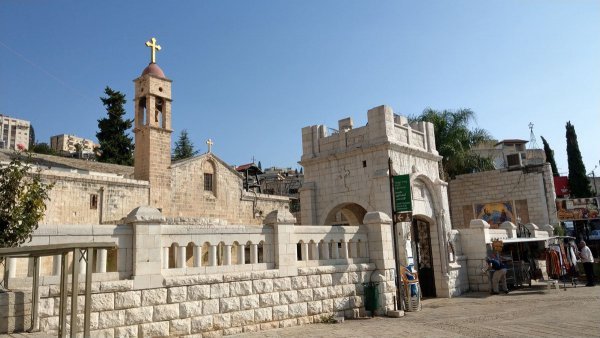
Greek Orthodox Church of the Annunciation in Nazareth: The Church of Mary's Well and the Archangel Gabriel
The Greek Orthodox Church of the Annunciation, also known as St. Gabriel's Church, is an Orthodox church in Nazareth built over the spring known as Mary's Well (Ain al-Adra). Orthodox tradition holds that the Virgin Mary was drawing water here when the Angel Gabriel appeared to her and announced the birth of Jesus. A Crusader church stood on the site in the 12th century, and in 1750 Nazareth's Arab Greek Orthodox community rebuilt it under a decree from Zahir al-Umar al-Zaydani; the community still cares for it today. It holds a carved wooden iconostasis from 1767, and the spring still flows in its crypt. This guide covers the church's history, architecture and significance.
Quick facts
| Arabic name | كنيسة البشارة للروم الأرثوذكس – الناصرة |
|---|---|
| Other names | St. Gabriel's Church, Church of Mary's Well |
| Location | North end of Nazareth's old city, beside Mary's Well |
| Denomination | Greek Orthodox, Greek Orthodox Patriarchate of Jerusalem |
| Tradition | Site of the first Annunciation at the spring |
| Crusader church | 12th century |
| Rebuilt | 1750, under a decree from Zahir al-Umar issued in 1749 |
| Iconostasis | Carved wood, 1767, with icons of the Jerusalem school |
| Frescoes | 1977–1978, by two Romanian artists |
| Feasts | Annunciation 25 March (7 April) and Archangel Gabriel 13 July (26 July), Julian and Gregorian calendars |
The name and tradition
The church bears the name of the Annunciation and is also dedicated to the Archangel Gabriel. The Orthodox tradition rests on the Protoevangelium of James, an early Christian text that spread from the 2nd century, which says the angel first appeared to Mary while she was drawing water from the spring, then completed his message in her home. The Orthodox therefore venerate the spring as the place of the Annunciation, while Catholics venerate the site of Mary's house in the Basilica of the Annunciation to the south. Researchers note that both Christians and Muslims in Nazareth have long sought blessing from the spring's water.
Location and Mary's Well
The church stands at the northern end of Nazareth's old city, close to Mary's Well, the fountain from which the city's people drew water for centuries. The spring's water runs from inside the church through a channel to the fountain in the nearby square, its course diverted outside so as not to disturb worshippers.
History through the ages
- Byzantine period: the Higher Presidential Committee for Church Affairs in Palestine states that the first church was built on the site in the 5th century, while other researchers consider a Byzantine church likely but undocumented.
- 12th century: a round Crusader church stood over the spring, described by a Russian abbot who visited Nazareth early in that century.
- After the Crusader period: the church was abandoned and fell into ruin.
- 1628–1634: the Franciscans built a vaulted room over the spring.
- 1749: Zahir al-Umar al-Zaydani, ruler of Galilee, issued a decree allowing Nazareth's Greek Orthodox community to rebuild the church.
- 1750: the community rebuilt the church on the ruins of the Crusader church and named it the Church of the Annunciation.
- 1767: the carved wooden iconostasis was installed.
- 1977–1978: the church walls were decorated with frescoes of biblical scenes.
Architecture, icons and frescoes
The church has two parts: a main 18th-century prayer hall and an older, well-preserved 12th-century section reached through an arched passage inside the church. A carved wooden iconostasis from 1767 separates the hall from the sanctuary and holds valuable icons of the Jerusalem school of icon painting. In 1977 and 1978 two Romanian artists painted frescoes of biblical scenes on the church walls, and a bell tower rises above it.
The crypt and the spring
Steps lead down to a vaulted Crusader-era crypt lined with icons and tiles, where the spring flows from the rock in a niche beside the altar and collects in a basin from which visitors draw water for blessing. On the lowest level are ancient caves that were part of old Nazareth.
The church and Nazareth's Greek Orthodox community
The Greek Orthodox community is among the oldest and largest Arab Christian communities in Nazareth, and the church has been its spiritual centre since it rebuilt it more than two and a half centuries ago. The community stayed in its city when Zionist militias occupied Nazareth on 16 July 1948, and helped take in refugees from nearby villages such as Saffuriya. In June 2025 a group calling itself "Soldiers of God" stormed the church courtyard while it was closed, removed its outer gate and rang its bell without permission while waving Israeli flags. Church clergy confronted them, the community council filed a complaint, declaring it "will not allow the desecration of a holy place", and national parties in Nazareth condemned the attack as an attempt to sow discord.
The church today (2026)
The church remains a living parish for Nazareth's Orthodox community and a destination for pilgrims, celebrating the feasts of the Annunciation and the Archangel Gabriel. Together with the Basilica of the Annunciation, the White Mosque and the Saraya of Zahir al-Umar, it bears witness to Arab Nazareth, Muslim and Christian, and to Zahir al-Umar's role in fostering coexistence in Galilee.
Frequently asked questions
Where is the Greek Orthodox Church of the Annunciation?
At the northern end of Nazareth's old city, beside Mary's Well.
How is it different from the Basilica of the Annunciation?
The Greek Orthodox church venerates the spring where its tradition says the Annunciation began, while the Latin Basilica of the Annunciation venerates the site of Mary's house.
When was the present church built?
In 1750, on the ruins of a Crusader church, following a decree issued by Zahir al-Umar in 1749.
Does the spring still flow inside the church?
Yes. The spring flows in the church's crypt and runs through a channel to the Mary's Well fountain outside.
When is the Feast of the Annunciation celebrated there?
On 25 March in the Julian calendar, which corresponds to 7 April in the Gregorian calendar.
Conclusion
Over a spring from which Nazareth's people drew water for centuries, the Greek Orthodox Church of the Annunciation bears witness to an ancient Christian tradition and to an Arab community that rebuilt it under Zahir al-Umar and still cares for it. The water of Mary's Well still flows in its crypt, just as Nazareth's people remained in their city despite the Nakba.
More from the archive
 Download Our Palestine App
The whole archive in the palm of your hand: depopulated villages, the Nakba, the massacres and Al-Aqsa — free, with no ads to erase the story.

Comments
No comments yet — be the first to write one.
Add your comment
Name and email are optional. Comments appear after review.