The Acre Aqueduct (al-Kabri Aqueduct)
The Acre Aqueduct (al-Kabri Aqueduct): The Arches That Carried Galilee's Springs to Acre
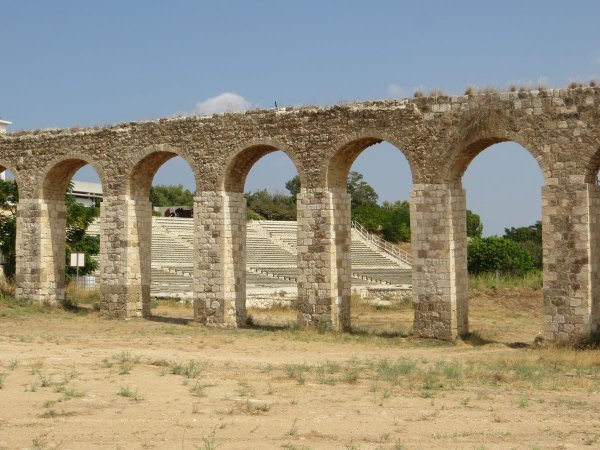
The Acre Aqueduct, known locally as al-Qanatir ("the Arches") or the al-Kabri Aqueduct, is a stone water channel carried on rows of arches that brought fresh water from the springs of al-Kabri in western Galilee to the city of Acre, over a distance of about 13 kilometres by way of al-Mazra'a, al-Sumayriyya and al-Manshiyya. It was built under the governor of Acre Ahmad Pasha al-Jazzar, damaged during Napoleon's siege of Acre in 1799, and replaced by a new aqueduct under his successor Sulayman Pasha in 1814–1815; its arches still stand today. Al-Kabri, the village where the water began its journey, was occupied in 1948, its people expelled and a settlement built on its land. This guide covers the aqueduct's history, route and present state.
Quick facts
| Arabic name | قناطر عكا – قناة الكابري |
|---|---|
| Other names | Al-Kabri Aqueduct, al-Jazzar's Arches |
| Source | The four springs of al-Kabri in western Galilee |
| Destination | The city of Acre |
| Length | About 13 km |
| Route | Al-Kabri – al-Mazra'a – al-Sumayriyya – al-Manshiyya – Acre |
| First aqueduct | Under Ahmad Pasha al-Jazzar |
| Second aqueduct | Under Sulayman Pasha, 1814–1815 |
| Materials | Stone, carried on arches |
| Current state | Sections of the arches still standing |
The name
Local people call it "al-Qanatir" (the Arches) after the rows of stone arches that carry the water channel above the ground, and "Qanat al-Kabri" (the al-Kabri Aqueduct) after the village whose springs fed it; it is also known as al-Jazzar's Arches, after the governor who built the first aqueduct.
The springs of al-Kabri
The aqueduct starts at four springs near the village of al-Kabri, about 12.5 km from Acre: Ayn al-Mafshuh, Ayn Fawwar, Ayn al-Asal and Ayn al-Kabri, which together discharge about 8.6 million cubic metres a year. These springs were among the most important sources of fresh water in Palestine and the main one in the Acre district, which is why their water was carried to Acre as early as the Hellenistic period.
The route
The aqueduct begins at the springs in Wadi al-Mafshuh near al-Kabri, then heads south-west towards the coast, passing the villages of al-Mazra'a, al-Sumayriyya and al-Manshiyya before reaching Acre, a distance of about 13 kilometres. The water ran in a covered stone channel carried on arches wherever the ground dipped, reaching Acre's sabils (public fountains), baths and houses.
History
- Hellenistic period: water from the al-Kabri springs was carried to Acre through ancient channels.
- Under Ahmad Pasha al-Jazzar: the al-Kabri aqueduct was built to supply Acre with water, as part of al-Jazzar's projects to fortify and develop the city.
- 1799: the aqueduct was damaged during Napoleon's siege of Acre, as the French tried to cut off water to the city and its surroundings.
- 1814–1815: a new aqueduct was built under Sulayman Pasha, governor of Acre and al-Jazzar's successor.
- 1873: the aqueduct was restored again in the late Ottoman period.
- Today: sections of the arches still stand along its route.
The aqueduct and Napoleon's siege
In the spring of 1799 Napoleon Bonaparte besieged Acre. Ahmad Pasha al-Jazzar refused to surrender, and the city and its walls held until Napoleon lifted the siege on 21 May 1799 and withdrew to Egypt. During the siege the French destroyed parts of the aqueduct to cut off water to Acre and the surrounding area, but the city held out, and the aqueduct was later rebuilt under Sulayman Pasha so that Acre could again drink from the springs of al-Kabri.
Al-Kabri and the aqueduct villages in the Nakba
Al-Kabri was an Arab Muslim village with some 1,520 inhabitants in 1944–1945. On the night of 20–21 May 1948 it was occupied by the Haganah militia, after most of its people had fled following a reprisal attack in which several of them were killed; according to villagers' testimony, others were killed or captured during the final assault. On 18 January 1949 a settlement was established on the village's land, and today only crumbling walls and heaps of stone remain. The people of al-Sumayriyya and al-Manshiyya, which the aqueduct passes, were also expelled in 1948, and Acre itself fell on 17 May 1948.
The aqueduct today (2026)
Sections of the Acre Aqueduct still stand today, their stone arches stretching across the plain of Acre as a witness to the water engineering of Ottoman Acre. The springs of al-Kabri that fed it lie on the land of the depopulated village, while the people of al-Kabri, al-Sumayriyya and al-Manshiyya and their descendants live in refugee camps and the diaspora, denied return to their villages.
Frequently asked questions
What is the Acre Aqueduct?
A stone water channel carried on arches that brought fresh water from the springs of al-Kabri to Acre over about 13 km.
Who built the Acre Aqueduct?
The first aqueduct was built under Ahmad Pasha al-Jazzar, and the second under Sulayman Pasha in 1814–1815.
Where does its water come from?
From four springs near the village of al-Kabri: Ayn al-Mafshuh, Ayn Fawwar, Ayn al-Asal and Ayn al-Kabri.
What does Napoleon have to do with the aqueduct?
The French destroyed parts of it during the siege of Acre in 1799 to cut off the city's water, but Acre held out.
What happened to the village of al-Kabri?
It was occupied on 20–21 May 1948 and its people expelled, and a settlement was built on its land in 1949.
Conclusion
From the springs of al-Kabri to the sabils of Acre, the arches carried water across the plain for two centuries, survived Napoleon's siege and were rebuilt. Today they stand as a witness to the Ottoman Acre of al-Jazzar and Sulayman Pasha, to the depopulated villages they pass, and to the right of their people to return.
More from the archive
 Download Our Palestine App
The whole archive in the palm of your hand: depopulated villages, the Nakba, the massacres and Al-Aqsa — free, with no ads to erase the story.

Comments
No comments yet — be the first to write one.
Add your comment
Name and email are optional. Comments appear after review.