
Al-Zawiya al-Ahmadiyya

Al-Zawiya al-Ahmadiyya, Gaza: A Mamluk Sufi Lodge in the Old City
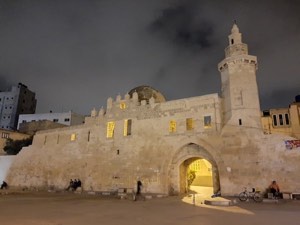
Al-Zawiya al-Ahmadiyya (the Ahmadiyya Sufi Lodge) in the al-Daraj quarter of Gaza's Old City is one of the oldest Mamluk religious buildings in the Gaza Strip, dating to the first half of the 14th century. It was built for followers of the Ahmadiyya (Badawiyya) Sufi order, which traces itself to the Sufi master Ahmad al-Badawi. Beside it lies the marble tomb of Qutlu Khatun, daughter of the Mamluk emir who founded it, dated 733 AH (1332 CE). The lodge is often described as the last surviving Sufi zawiya in Gaza. A restoration project began in 2022, and during the genocide war on Gaza the al-Daraj quarter was heavily bombed. UNESCO has listed the zawiya among the heritage sites with verified damage. This guide covers its history, architecture and fate.
Quick facts
| Arabic name | الزاوية الأحمدية |
|---|---|
| Location | Al-Daraj quarter, Old City of Gaza |
| Period | Mamluk, first half of the 14th century (some sources give 1336) |
| Founder | A Mamluk emir, Bahadur al-Jukandar, according to most sources |
| Sufi order | Ahmadiyya (Badawiyya), after Ahmad al-Badawi (d. 1276) |
| Tomb | Qutlu Khatun, the founder's daughter, died Rabi' al-Awwal 733 AH / December 1332 |
| Main parts | Domed prayer hall, residential wing with fountain courtyard, six-arched hall |
| Distinction | Described as the last surviving Sufi zawiya in Gaza |
| Restoration | Project begun June 2022 by the Iwan Center, Islamic University of Gaza |
| War damage | Listed by UNESCO among sites with verified damage (as of March 2026) |
The name and the Ahmadiyya order
A zawiya (literally "corner") is a Sufi lodge where a shaykh and his disciples gathered for prayer, remembrance of God (dhikr), teaching and retreat, and where travellers could find shelter. This one is named after the Ahmadiyya, also called the Badawiyya, one of the major Sufi orders of Egypt and the Levant. The order traces itself to Ahmad al-Badawi, a Sufi master born in Fez around 1199–1200, who settled in Tanta in Egypt, where he died in 1276 and where his mosque and shrine still stand. The order has no connection with the modern Ahmadiyya movement founded in India in the 19th century.
Location
The zawiya stands in the al-Daraj quarter of the Old City of Gaza, one of the city's oldest neighbourhoods, among the historic buildings of the Old City, including the Great Omari Mosque, the Pasha's Palace and the Sayed Hashim Mosque. According to local sources, a nearby water wheel (saqiya) once fed its fountain.
History
- Mamluk Gaza: under the Mamluks, Gaza was the capital of a province and a key station on the road between Cairo and Damascus. Zawiyas, mosques and schools were built across the city, and Sufi orders spread widely.
- Foundation (14th century): according to most sources, the zawiya was founded by a Mamluk emir, Bahadur al-Jukandar, for followers of the Ahmadiyya order. Some sources date it to 1336, while Al-Monitor gives the founder's name differently. The marble tomb of his daughter, Qutlu Khatun, records her death in Rabi' al-Awwal 733 AH (December 1332). Some local sources say she paid for the building, which remains unconfirmed.
- Later centuries: the zawiya remained in use as a centre for Sufi gatherings in the Ottoman and modern periods, while most of Gaza's other zawiyas disappeared over time through neglect and urban change.
- Before 2023: the building suffered cracks in its walls and ceilings, and some earlier repairs by non-specialists made matters worse. In 2022 a restoration project began.
- Since October 2023: during the genocide war on Gaza, al-Daraj was repeatedly bombed, and UNESCO has listed the zawiya among the sites with verified damage.
Architecture
The zawiya reflects the simple, austere style of Mamluk Sufi buildings in Palestine. It has three main parts:
- The prayer hall, in the southern part, covered by a tall stone dome resting on a cylindrical drum pierced with twelve windows for light and ventilation.
- The residential wing, arranged around a large, square inner courtyard covered by cross vaults, with an octagonal fountain at its centre.
- The northern hall, a polygonal room with six pointed arches and a large mihrab, used for lessons, Sufi rituals and spiritual retreat.
In the outer courtyard, near the southern wall, stands the marble tomb of Qutlu Khatun, whose inscription gives her name, her father's name and the date of her death.
Role in Gaza's religious life
Like other Sufi lodges, the zawiya served for centuries as a place of dhikr, lessons and spiritual retreat. In 2022 the Ahmadiyya order still had about 100 followers in the Gaza Strip, according to Al-Monitor. As the last surviving zawiya, it is a rare witness to the Sufi tradition that once shaped the city's religious life.
The 2022 restoration project
In May 2022 the British Barakat Trust awarded a grant to the Iwan Center for Cultural Heritage at the Faculty of Engineering of the Islamic University of Gaza to restore the zawiya. A team of specialists began work on 19 June 2022 to treat the cracks in its walls and ceilings and to undo earlier damaging repairs. The Islamic University itself was bombed in October 2023, at the start of the genocide war.
The zawiya and the genocide war on Gaza
The al-Daraj quarter was one of the hardest-hit parts of Gaza City's Old City:
- In January 2024 Al Jazeera reported shelling around the zawiya and said its fate was not yet known. UNESCO later included "Az-Zawiya Al-Ahmadiya" in its list of verified damaged sites, which by 24 March 2026 numbered 164 sites in Gaza.
- Nearby, the Pasha's Palace was bombed in December 2023, and the Great Omari Mosque was destroyed on 8 December 2023.
- In al-Daraj, a strike on al-Tabi'in school, which sheltered displaced families, killed at least 100 people on 10 August 2024.
- Across Gaza, the Ministry of Awqaf reports that 1,050 of 1,275 mosques were completely destroyed. The Palestinian Ministry of Tourism and Antiquities counts 226 of 316 heritage sites destroyed or significantly damaged, including Barquq Castle in Khan Yunis.
The destruction of a 700-year-old Sufi lodge, together with the mosques, churches, libraries and archives around it, is part of the systematic erasure of Gaza's memory and identity in the genocide war.
International law
The 1954 Hague Convention for the Protection of Cultural Property and the Fourth Geneva Convention protect places of worship and historic monuments. The Rome Statute of the International Criminal Court (Article 8) classifies intentionally directing attacks against buildings dedicated to religion and historic monuments as a war crime, and UN Security Council Resolution 2347 (2017) condemns the destruction of cultural heritage in armed conflict.
Frequently asked questions
Where is al-Zawiya al-Ahmadiyya?
In the al-Daraj quarter of the Old City of Gaza, near other historic buildings such as the Great Omari Mosque and the Pasha's Palace.
How old is the Ahmadiyya Zawiya?
It dates from the Mamluk period, in the first half of the 14th century. The tomb of the founder's daughter is dated 733 AH (1332 CE), and some sources give 1336 for the building.
Is the zawiya related to the Ahmadiyya movement?
No. It belongs to the Ahmadiyya or Badawiyya Sufi order, named after the 13th-century Sufi master Ahmad al-Badawi of Tanta, and has no link to the movement founded in India in the 19th century.
Who is buried in the zawiya?
Qutlu Khatun, daughter of the Mamluk emir who founded it, who died in December 1332. Her marble tomb stands near the southern wall.
Was the zawiya damaged in the war on Gaza?
Yes. The al-Daraj quarter was heavily bombed, and UNESCO lists the zawiya among the heritage sites in Gaza with verified damage.
Conclusion
For seven centuries al-Zawiya al-Ahmadiyya kept the voices of dhikr alive in the alleys of al-Daraj, outlasting the other Sufi lodges of Gaza. Just as specialists had begun to restore it, the genocide war brought bombardment to its doorstep. Its survival and repair now depend, like the rest of Gaza's heritage, on ending the destruction and allowing its people to rebuild.
More from the archive


 Download Our Palestine App
The whole archive in the palm of your hand: depopulated villages, the Nakba, the massacres and Al-Aqsa — free, with no ads to erase the story.



Comments
No comments yet — be the first to write one.
Add your comment
Name and email are optional. Comments appear after review.