
Barquq Castle
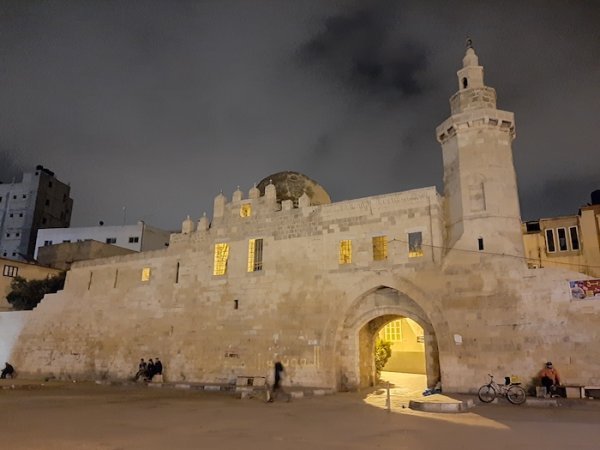
Barquq Castle in Khan Younis: 640 Years of History and Its Destruction in the Genocide War on Gaza
Barquq Castle (Qal'at Barquq), in the heart of Khan Younis in the southern Gaza Strip, was one of the most important Mamluk monuments in Palestine. Built in 789 AH (1387–1388 CE) by Emir Yunus al-Nawruzi on the orders of Sultan al-Zahir Barquq, it was a fortified caravanserai on the road between Cairo and Damascus, and the city of Khan Younis took its name from it. For more than six centuries it survived Mamluk-Ottoman battles, Napoleon's campaign, British shells and the 1956 massacre in the city. But during the genocide war on Gaza, Israeli strikes and bulldozers destroyed large parts of its walls, its mosque's minaret and its entrance, and UNESCO has verified the damage. This guide tells the castle's story, from its foundation to its ruin, and what remains today.
Quick Facts About Barquq Castle
| Arabic name | قلعة برقوق / خان يونس النوروزي |
|---|---|
| Location | Centre of Khan Younis, southern Gaza Strip, about 20 km from the Egyptian border |
| Built | |
| Builder | Emir Yunus ibn Abdullah al-Nawruzi, dawadar (secretary) of Sultan Barquq |
| Period | Circassian (Burji) Mamluk |
| Type | Fortified caravanserai (khan) with a mosque |
| Plan | Square, about 80–85.5 m per side, with round corner towers and two floors |
| Facilities | Mosque and minaret, well, lodgings, stables, four watchtowers |
| War damage | Walls, minaret and entrance destroyed in 2024; verified by UNESCO |
| Status | Heavily damaged; partly standing |
The Name: Barquq, Yunis and Khan Younis
The castle is named after al-Zahir Barquq (r. 1382–1399), founder of the Circassian Mamluk dynasty, in whose reign it was built. It was also known as the Khan of Yunis al-Nawruzi, after the emir who built it, and the town that grew around it took its name: Khan Younis, "the khan of Yunis". Some scholars have suggested the name refers instead to the prophet Jonah (Yunus), but the link to the emir is the more widely accepted. "Castle" (qal'a) describes its fortified character, while "khan" means caravanserai.
Location
The castle stands in the centre of Khan Younis, the main city of the southern Gaza Strip, in the Gaza district, about 20 km from the Egyptian border. It lay on the ancient coastal route between Egypt and the Levant, the Via Maris, and the city's main square and market grew around it.
The Foundation and the Inscription
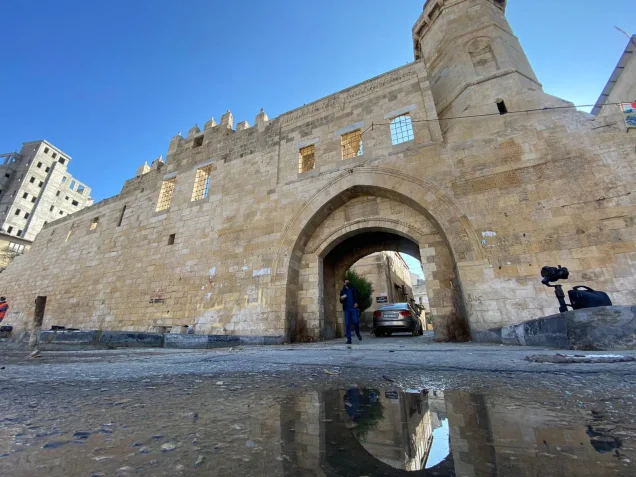
An inscription above the main entrance recorded that the "blessed khan" was built by order of Emir Yunus al-Nawruzi, the dawadar (chief secretary) of Sultan al-Zahir Barquq, in the year 789 AH (1387–1388 CE). The emir built it to protect merchants, pilgrims and travellers on the road between Cairo and Damascus, which was exposed to raids at this point on the edge of the Sinai desert.
Architecture
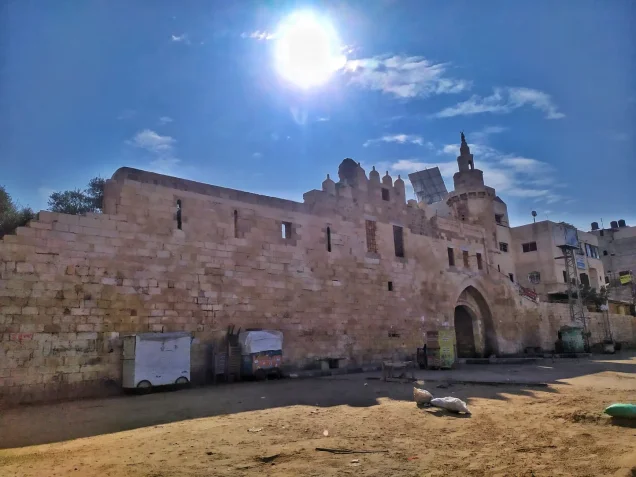
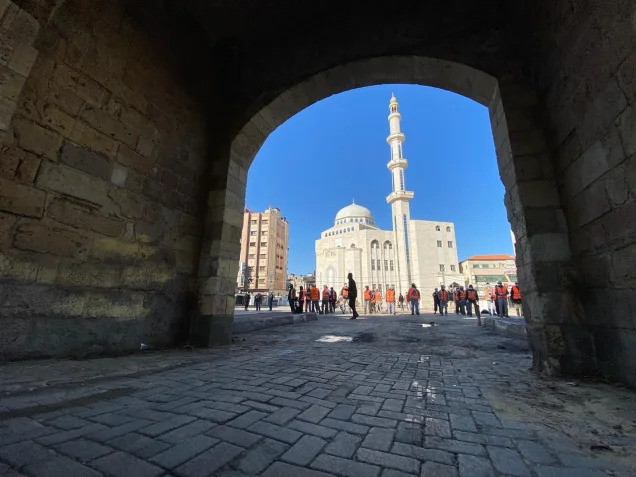
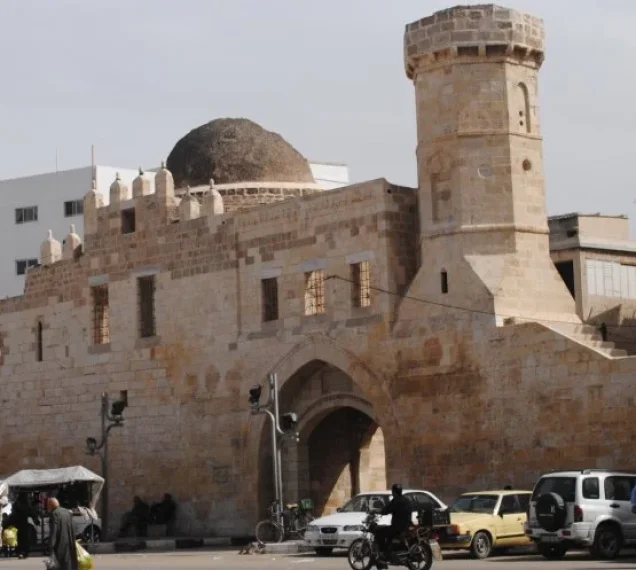
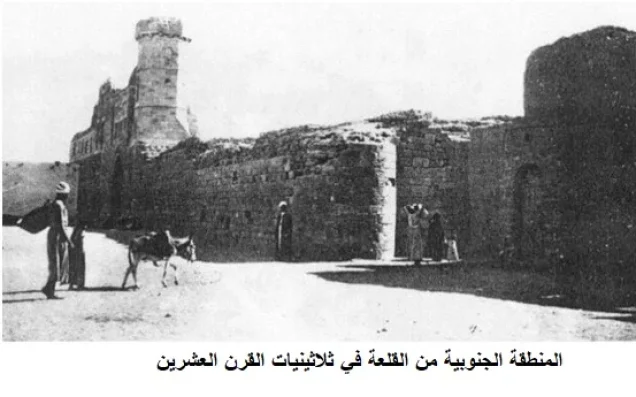
The castle was built on a square plan; sources give its side as about 80 metres or 85.5 metres. Its high stone walls were reinforced at each corner by a round tower, and its monumental main entrance, facing north-west, was crowned by the foundation inscription and decorative Mamluk stonework. Inside, two floors of rooms surrounded a central courtyard, with lodgings for travellers, stables for their animals, storerooms, a well and four watchtowers. A mosque with a minaret stood within the complex, and 19th-century travellers admired its pulpit. By the mid-20th century, the façade, the gateway, the mosque, its minaret and parts of the walls and the south-western tower were still standing.
A Caravanserai on the Cairo–Damascus Road
Barquq Castle was more than a fortress. It was a caravanserai where caravans of merchants and pilgrims rested safely, and a station of the Mamluk postal network (barid), where couriers changed horses on the route linking Cairo and Damascus. Around it, a market, houses and wells grew into the town of Khan Younis.
Six Centuries of History
- 1516: Near Khan Younis, the Ottomans defeated the Mamluks in one of the battles that ended Mamluk rule over Egypt and the Levant, and the castle suffered damage.
- Ottoman period: In the 17th and 18th centuries the Ottomans garrisoned the fortress with troops linked to the Cairo Citadel to guard the road.
- 1799: The castle was damaged during Napoleon's campaign through Gaza towards Acre, according to Palestinian sources.
- 19th century: European travellers found it largely in ruins, though the mosque and its minaret still stood.
- 1917: British naval bombardment during the First World War destroyed several of its buildings.
- 1956: During the Tripartite Aggression against Egypt, Israeli forces occupied Khan Younis and carried out a massacre of its people in November 1956; the castle stood witness at the heart of the city.
The Castle Before the War
Before October 2023, what remained of Barquq Castle, its gateway, walls, mosque and minaret, was the symbol of Khan Younis. Its square was the city's beating heart, a meeting place for families and a destination for visitors from across the Gaza Strip, and for centuries Ramadan nights in Khan Younis were celebrated in its shadow.
Destruction in the Genocide War on Gaza
From December 2023, Israeli forces launched a months-long ground offensive in Khan Younis, reducing much of the city to ruins. Barquq Castle, which had survived six centuries of wars, was badly hit:
- January 2024: Residents report that Israeli forces destroyed part of the castle during the offensive.
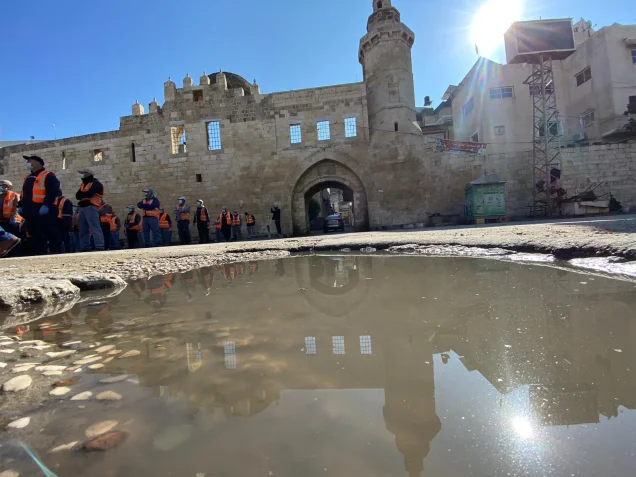
- April 2024: After the Israeli withdrawal from Khan Younis in early April, residents and journalists returning to the city found that Israeli forces had completely destroyed the southern section of the wall, brought down large parts of the eastern wall with missile strikes, demolished parts of the mosque's minaret, bulldozed the entrance, piled rubble inside the castle and damaged its other features. Reports on 18 April 2024 described the castle as largely reduced to rubble. For the first time in centuries, Khan Younis spent Ramadan without its castle.
- 2024–2025: Fighting and strikes in Khan Younis continued, causing further damage. When the ceasefire took effect in October 2025, footage showed piles of rubble around the site and sections of its walls and towers reduced to debris, though parts of the castle still stood. Residents collected fallen stones and stored them for future restoration.
- UNESCO: UNESCO lists "Qal'at Barqouq, Khan Younis" among the sites in Gaza with damage verified by satellite imagery; it is one of 164 damaged sites recorded as of March 2026.
Local officials in Khan Younis accused Israeli forces of targeting the castle deliberately to erase Palestinian history, part of what Palestinians describe as a war on memory and identity alongside the war on people.
Part of the Wider Destruction of Gaza's Heritage
The destruction of Barquq Castle is part of an unprecedented assault on Gaza's cultural heritage:
- As of 24 March 2026, UNESCO had verified damage to 164 sites: 14 religious sites, 128 buildings of historical or artistic interest, 9 monuments, 8 archaeological sites, 2 museums and 3 depositories of movable cultural property.
- The Palestinian Ministry of Tourism and Antiquities counts 226 of 316 key archaeological and cultural sites in Gaza as destroyed or significantly damaged.
- The Great Omari Mosque, Gaza's oldest and largest, was almost completely destroyed on 8 December 2023, and the Mamluk Qasr al-Basha was struck and bulldozed.
- About 20,000 artefacts are estimated to have been looted or lost, including more than 17,000 that had been held at Qasr al-Basha, and around 12 local museums were destroyed or looted.
The Castle Today (2026)
Barquq Castle stands today as a wounded ruin in a devastated city. Parts of its walls and its south-western tower remain, surrounded by the rubble of Khan Younis. Palestinian heritage bodies have documented the damage, and Quds Press has reported the start of efforts to restore the castle, but full reconstruction depends on the entry of building materials and specialised expertise, which the blockade continues to restrict. The ceasefire of October 2025 set no timeline for reconstruction.
International Law and the Destruction of Heritage
The 1954 Hague Convention for the Protection of Cultural Property in the Event of Armed Conflict obliges parties to refrain from attacking historic monuments and from using them or their surroundings for military purposes. Under Article 8 of the Rome Statute of the International Criminal Court, intentionally directing attacks against historic monuments and buildings dedicated to religion is a war crime, and UN Security Council Resolution 2347 (2017) condemned the unlawful destruction of cultural heritage in armed conflict. The UN Commission of Inquiry on the Occupied Palestinian Territory has documented the destruction and looting of Gaza's cultural sites, and Palestinians regard the erasure of their heritage as part of the genocide war on Gaza.
Frequently Asked Questions About Barquq Castle
Where is Barquq Castle?
In the centre of Khan Younis in the southern Gaza Strip, about 20 km from the Egyptian border.
Who built Barquq Castle and when?
Emir Yunus al-Nawruzi, secretary of the Mamluk sultan al-Zahir Barquq, built it in 789 AH (1387–1388 CE) as a fortified caravanserai on the Cairo–Damascus road.
Is Khan Younis named after Barquq Castle?
Yes. The city takes its name from the castle, known as the khan (caravanserai) of Yunis al-Nawruzi, its builder.
Was Barquq Castle destroyed in the war on Gaza?
It was heavily damaged. Israeli forces destroyed the southern section of its wall, large parts of the eastern wall, parts of the mosque's minaret and its entrance during the 2023–2024 offensive in Khan Younis. Parts of the castle still stand, and UNESCO has verified the damage.
How many heritage sites have been damaged in Gaza?
UNESCO had verified damage to 164 sites as of March 2026, while the Palestinian Ministry of Tourism and Antiquities counts 226 of 316 key sites as destroyed or significantly damaged.
Conclusion
For more than six centuries, Barquq Castle gave Khan Younis its name, its centre and its memory. It sheltered caravans in the Mamluk age, survived Ottoman cannon, Napoleon's army and British shells, and stood through the massacre of 1956. In the genocide war on Gaza it was struck and bulldozed along with the city around it. Its fallen stones, gathered by the people of Khan Younis, are kept for the day it can rise again, a reminder that the war on Gaza targeted not only its people but its history.
Photo gallery





More from the archive

 Download Our Palestine App
The whole archive in the palm of your hand: depopulated villages, the Nakba, the massacres and Al-Aqsa — free, with no ads to erase the story.
Download Our Palestine App
The whole archive in the palm of your hand: depopulated villages, the Nakba, the massacres and Al-Aqsa — free, with no ads to erase the story.



Comments
No comments yet — be the first to write one.
Add your comment
Name and email are optional. Comments appear after review.