The Israeli Attack on Qalqilya, 1956
The Israeli Attack on Qalqilya, 1956
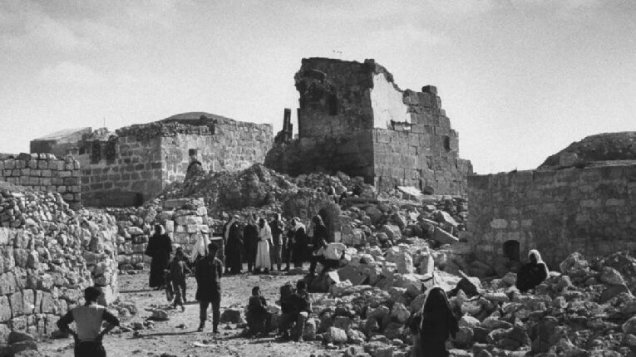
On the night of October 10–11, 1956, Israeli forces crossed the armistice line established in 1949 and launched a large-scale military attack on the Palestinian city of Qalqilya, which at the time was part of the Jordanian-administered West Bank.
The principal military target of the operation was the fortified Qalqilya police post north of the city, but the attack was not confined to it. Qalqilya itself was subjected to artillery shelling, while the fighting spread to surrounding areas and neighboring villages.
In Israeli military terminology, the operation was known as Operation Shomron, and it became one of the largest Israeli military operations to cross the armistice line with Jordan in the years preceding the Tripartite Aggression against Egypt in 1956.
Qalqilya After the Nakba
Qalqilya found itself in an exceptionally vulnerable geographical and economic position after the Nakba and the occupation of large parts of Palestine in 1948, followed by the signing of the 1949 Armistice Agreements.
The new armistice line passed immediately along the western side of the city, separating Qalqilya from extensive areas of agricultural land that had formed one of the main foundations of its economy.
Before 1948, the city was especially known for its citrus orchards and fertile agricultural lands extending westward toward the Palestinian coastal plain.
The new line radically altered this geography, leaving areas of land and orchards on which Qalqilya's inhabitants had depended for many years on the other side of the armistice line.
Published Palestinian testimonies indicate that some residents of Qalqilya crossed the line during the first years after the Nakba to reach their former orchards and gather citrus fruit, despite the increasing dangers posed by military patrols and gunfire along the new frontier.
The city also received Palestinian refugees displaced from villages and areas that had fallen within territory under Israeli control.
Qalqilya consequently became both a frontier city and a refuge for Palestinians uprooted from other areas during the Nakba.
A Highly Volatile Armistice Line
The 1949 Jordan–Israel Armistice Agreement brought the principal phase of military confrontation between the two sides to an end, but it did not make the armistice line peaceful.
Throughout the first half of the 1950s, the area witnessed repeated crossings from both sides, shootings, infiltrations, clashes, and military attacks.
Palestinians displaced in 1948 crossed the line for different reasons. Some attempted to reach homes, land, and property they had left behind, harvest crops, meet relatives, or seek work, while others carried out armed attacks.
Israel, in turn, developed a military policy known as “reprisal operations”, involving Israeli military units crossing the armistice lines to attack villages, police posts, military positions, and infrastructure in Arab-controlled territory.
The United Nations repeatedly criticized this pattern of operations, arguing that unilateral military attacks outside the mechanisms established by the Armistice Agreements threatened the system created to supervise the ceasefire and increased the danger that border incidents could develop into broader military confrontations.
The Escalation of Zionist Aggression in 1956
The summer and autumn of 1956 witnessed a sharp escalation of violence along the armistice line between Jordan and Israel.
During this period, Israeli forces carried out increasingly large-scale operations inside Jordanian-controlled territory, targeting police posts, military positions, and Palestinian villages.
Among the most prominent areas attacked in the months preceding the assault on Qalqilya were al-Dhahiriya, Rahwa, Husan, and Wadi Fukin, as well as other locations.
At the same time, infiltrations, shootings, and armed attacks continued inside areas under Israeli control.
This produced an escalating cycle: killings, shootings, or border crossings were followed by larger and more heavily armed Israeli military operations.
By September and October 1956, some of these operations were being carried out with battalion-scale forces and large formations rather than the smaller units that had characterized some earlier raids.
The Immediate Background to the Qalqilya Attack
The Israeli government and military leadership presented the attack on Qalqilya as a reprisal in response to a series of fedayeen operations that they attributed to armed men who had crossed from Jordanian-controlled territory.
The incidents cited by the Israeli side included the killing of five Israeli workers near Sodom on October 4, followed by the killing of two other workers in an orchard in the coastal region on October 9, 1956.
Israeli authorities attributed these operations to infiltrators coming from Jordanian territory and subsequently decided to launch a major attack on Qalqilya.
The United Nations, however, raised a fundamental objection to this approach. The UN Secretary-General and the leadership of the Truce Supervision Organization warned against one party to the Armistice Agreement conducting its own investigation, independently assigning responsibility, and then using military forces to carry out reprisals without allowing United Nations observers to independently establish the facts.
The United Nations regarded this as a serious weakening of the armistice machinery.
Operation Shomron
The Israeli military command gave the operation against Qalqilya the name “Shomron.”
It took place while Moshe Dayan was serving as Chief of Staff of the Israeli military and involved paratroopers, infantry, artillery, armored vehicles, and supporting forces.
The fortified Qalqilya police post, located very close to the armistice line, was the central target of the attack.
But the scale of the forces and weaponry employed made the operation far larger than a limited frontier raid.
The Attack Begins
United Nations military observers reached the area after the battle and conducted a field investigation.
According to the testimony of the Jordanian police officer commanding the Qalqilya post, a large Israeli force traveling in approximately 30 vehicles advanced toward the position from the north at around 7:30 p.m. GMT.
The post stood approximately one kilometer north of Qalqilya and only several hundred meters from the armistice line.
The attacking forces initially opened fire with small arms and machine guns.
At approximately 7:50 p.m. GMT, intense artillery shelling began striking the position from the west and north.
The Defenders of the Police Post
At the beginning of the attack, approximately twenty policemen and a platoon of the Jordanian National Guard were inside the position.
The defenders returned fire as Israeli forces attempted to storm the fortified compound.
Intense fighting developed around the post.
Under cover of artillery and machine-gun fire, the attacking force eventually succeeded in entering the position and inflicted heavy casualties on the defenders.
A number of those inside managed to withdraw or escape, including the officer commanding the post.
The Shelling of Qalqilya
The attack was not confined to the police post.
The investigation by United Nations observers confirmed that the city of Qalqilya itself was shelled.
The bombardment and fighting continued for hours, with gunfire in the area lasting until after two o'clock in the morning.
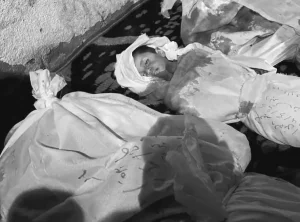
The observers recorded an incident in which a shell struck the roof of a house in Qalqilya at approximately eight o'clock in the evening, killing a young child and wounding his mother and two other children, one of them seriously.
The observers also examined evidence of shelling inside the city and visited Qalqilya Hospital to inspect the casualties and wounded.
Local Palestinian accounts indicate that a number of city residents took part in the defense alongside the National Guard and other defending forces.
The Destruction of the Police Post
After midnight, Israeli forces placed explosives inside the Qalqilya police post.
The building was detonated and completely destroyed.
Destroying the post had been one of the principal objectives of the operation.
The attack, however, developed into a more difficult and costly confrontation than Israeli planners had expected after Jordanian military reinforcements arrived and the fighting expanded.
Jordanian Reinforcements Enter the Battle
Jordanian army units in surrounding areas moved toward Qalqilya after the attack began.
The battle consequently spread beyond the police post and the city itself.
In the area of Khirbat Sufin and along the road east of Qalqilya, Jordanian forces clashed with Israeli units attempting to block the arrival of reinforcements.
One Israeli force faced the danger of encirclement, forcing the command to send additional units to help secure its withdrawal.
Witnesses also told United Nations observers that aircraft had been present over the battle zone and had dropped bombs, while Israeli military accounts describe the use of aircraft to cover the later stages of the operation.
What had been planned as a military reprisal therefore developed into a large and costly battle.
Israeli Losses
Israeli military authorities announced that 18 Israeli soldiers had been killed during the operation.
This figure was exceptionally high compared with many other Israeli reprisal operations during the 1950s.
The casualties and the difficulty of the withdrawal led to criticism within Israeli military circles regarding the planning and execution of the operation.
The Qalqilya attack was one of the last major Israeli nighttime reprisal operations before the outbreak of the Tripartite Aggression against Egypt later that same month.
How Many Palestinians and Jordanians Were Killed?
Casualty figures differ between sources, and it is important not to merge them into a single figure without identifying their source.
Initial Jordanian information submitted to the United Nations reported the deaths of 25 Jordanian soldiers and National Guardsmen and the wounding of 13 others.
However, the final investigation report submitted by Major-General E. L. M. Burns, Chief of Staff of the United Nations Truce Supervision Organization, recorded that United Nations observers had seen the bodies of 48 dead.
The report classified them as follows:
- 43 members of the Jordanian army, National Guard, and police.
- 3 civilians.
- 2 dead whose status the observers were unable to determine.
Palestinian sources, including the WAFA news agency and local Qalqilya accounts, meanwhile report the deaths of more than 70 martyrs from among the people of Qalqilya and the Jordanian army.
Some later military studies also give figures ranging from approximately 70 to 90 Palestinian and Jordanian dead. The higher estimates appear to include casualties from the broader fighting that took place during the arrival of Jordanian reinforcements and the withdrawal of Israeli forces.
It is therefore important not to present all of these casualties as Palestinian civilians. The clearest documentation shows that most of those whose bodies were inspected by United Nations observers were military personnel, police, and National Guardsmen, alongside civilians killed during the shelling of the city.
A Threat Attributed to Moshe Dayan
For decades, local Palestinian accounts have circulated a statement attributed to Israeli Chief of Staff Moshe Dayan, who is said to have threatened Qalqilya after earlier border clashes by saying:
“I will plow Qalqilya.”
The United Nations Investigation
The United Nations Truce Supervision Organization sent military observers to the area immediately after the attack.
They conducted field investigations in Qalqilya, the police post, Khirbat Sufin, Nabi Ilyas, Azzun, and other areas affected by the battle.
The investigation documented the Israeli attack, artillery shelling, destruction of the police post, casualties, and shell damage inside the city and surrounding areas.
The final report was submitted to the Security Council on October 17, 1956.
The United Nations Secretary-General drew particular attention to the practice of Israeli authorities conducting their own investigations into incidents occurring on their side of the armistice line, assigning responsibility themselves, and then deciding to use military force on the basis of their own findings.
He regarded this practice as a serious weakening of essential elements of the Armistice Agreements and of the role of United Nations observers responsible for investigating border incidents.
Jordan Takes the Qalqilya Case to the Security Council
On October 15, 1956, Jordan requested an urgent meeting of the United Nations Security Council to consider the situation along the armistice line.
The Jordanian representative presented a series of Israeli attacks on areas under Jordanian control, including Qalqilya, Sufin, Habla, Nabi Ilyas, Husan, and Wadi Fukin, among other places.
Jordan argued that the Qalqilya operation had not been a limited border incident but a large-scale military attack involving regular forces and heavy weapons.
Israel, in turn, submitted a complaint to the Security Council accusing Jordan of violating the Armistice Agreement and failing to prevent infiltrations and cross-border attacks.
The Security Council debate reflected the extent to which the armistice system established in 1949 had deteriorated.
More from the archive
 Download Our Palestine App
The whole archive in the palm of your hand: depopulated villages, the Nakba, the massacres and Al-Aqsa — free, with no ads to erase the story.
Download Our Palestine App
The whole archive in the palm of your hand: depopulated villages, the Nakba, the massacres and Al-Aqsa — free, with no ads to erase the story.


Comments
No comments yet — be the first to write one.
Add your comment
Name and email are optional. Comments appear after review.