
The Second Gaza Massacre
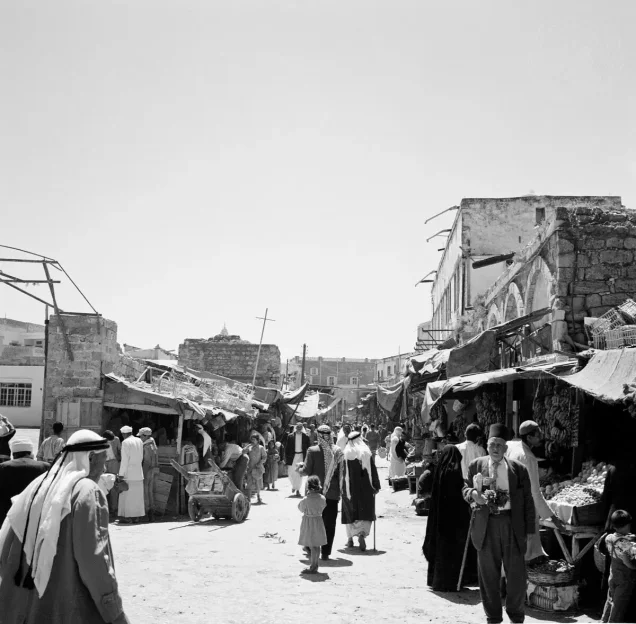
On the afternoon of 5 April 1956, Israeli occupation army artillery shelled the city of Gaza with mortars; the shells fell on the city center and its main street, crowded with people, killing 55–56 civilians, including children, and wounding more than a hundred. The US consul in Jerusalem described the shelling as “evidently the largest attack directed against the civilian population since the Qibya incident.” [1] [2]
Palestinians came to know this massacre as “the second Gaza massacre,” after “the first Gaza massacre” of February 1955. This article tells its context in the years of raids on the Gaza Strip, what happened on the day of the shelling, and its toll according to the sources.
The second Gaza massacre at a glance
| Item | Details |
|---|---|
| Date | 5 April 1956, after an exchange of fire on 4 April [1] [2] |
| Place | The center and main street of Gaza city, and Deir al-Balah [1] |
| Perpetrator | Israeli occupation army artillery, with mortar shells [1] [3] |
| Killed | 55 civilians according to the UN Truce Supervision Organization, 56 according to Palestinian sources [1] [2] |
| Wounded | 102–103 [1] [2] |
| International view | The US consul: “evidently the largest attack directed against the civilian population since the Qibya incident” [1] |
Context: Gaza on the armistice line
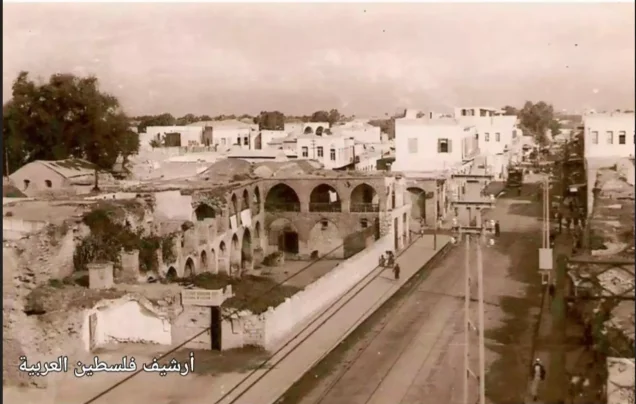
After the Nakba the Gaza Strip came under Egyptian administration and was crowded with hundreds of thousands of refugees driven from their towns and villages in 1948, who lived a few kilometers from their homes behind the armistice line. By the mid-1950s the Strip had become the target of repeated Israeli raids. [2]
The first Gaza massacre and the Khan Yunis raids of 1955
The second Gaza massacre was preceded by a series of raids on the Strip in 1955:
- The first Gaza massacre (28 February 1955): a force of Israeli paratroopers led by Ariel Sharon crossed the armistice line in Operation “Black Arrow,” blew up the water station supplying the city, attacked an Egyptian camp near the railway station, and ambushed a relief convoy; 39 were killed and 33 wounded. [4] [2] The Mixed Armistice Commission upheld the Egyptian complaint, counting 36 military personnel and two civilians among the dead. [5]
- The first Khan Yunis raid (30 May 1955): a dawn raid on the town of Khan Yunis, in which 20 were killed and 20 wounded. [2]
- The second Khan Yunis raid (1 September 1955): it began two hours after midnight, with artillery, tanks, armored half-tracks, infantry and engineering units taking part; 46 were killed and 50 wounded. [2]
The massacre: 5 April 1956
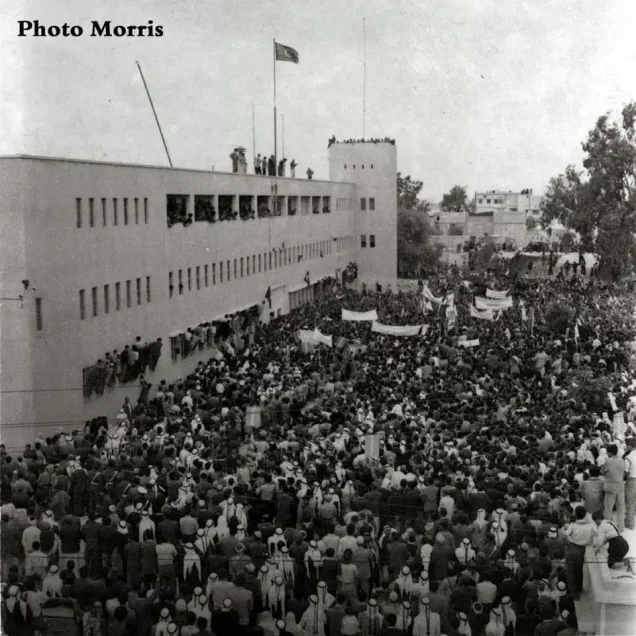
On 4 April 1956 Israeli shells fell on the village of Deir al-Balah, and UN observers counted 48 impacts. [1] [2] On 5 April, at about 1:20 p.m., shelling began near the armistice line, and at about 3:20 p.m. a UN observer reported concentrated shelling of the village of Deir al-Balah. [1]
At about 4:39 p.m. reports came in of mortar shells landing on the city of Gaza itself, including its main street. [1] The chairman of the Mixed Armistice Commission requested a ceasefire at 4:39 p.m., and again at 7:28 p.m., and the shelling stopped at 8 p.m. [1]
The toll
| Source | Killed | Wounded |
|---|---|---|
| UN Truce Supervision Organization (latest figures) | 55 civilians, and one Egyptian soldier | 102 [1] |
| Egyptian statement (evening of 5 April) | 42, including 17 children | 102 [1] |
| Earlier Egyptian statement | 46 civilians | 104 [1] |
| Palestine Remembered | 56 | 103 [2] |
On the other side, the UN counted 4 civilians and two soldiers wounded on the Israeli side in the exchange of fire. [1] The US consul in Jerusalem wrote that firing on civilians “appears to represent a departure” from Israeli policy at the time, and that it was “evidently the largest attack directed against the civilian population since the Qibya incident,” referring to the Qibya massacre of 1953. [1]
After the massacre
After the massacre, fedayeen operations from the Gaza Strip escalated. [3] Seven months later, in November 1956, the occupation army seized the Gaza Strip during the Tripartite Aggression on Egypt, and carried out the Khan Yunis massacre, in which 275 people from the town and its camp were killed, and the Rafah massacre. [2]
Read about Gaza Hashem and the Zionist massacres against the Palestinian people.
Conclusion
On an ordinary April afternoon in 1956, mortar shells fell on Gaza’s main street and markets, killing at least 55 civilians. The second Gaza massacre was not an isolated incident but a link in a chain of raids on a Strip crowded with refugees, beginning with the first Gaza massacre and the Khan Yunis raids, and ending with the occupation of the Strip and the Khan Yunis and Rafah massacres in the autumn of the same year.
Frequently asked questions about the second Gaza massacre
When did the second Gaza massacre take place?
It took place on 5 April 1956, when occupation artillery shelled the center of Gaza city with mortars.
How many people were killed in the second Gaza massacre?
55 civilians were killed according to the UN Truce Supervision Organization, and 56 according to Palestinian sources; 102–103 were wounded.
What was the first Gaza massacre?
It was the raid of 28 February 1955 (Operation “Black Arrow”), in which 39 were killed and 33 wounded.
How is the second Gaza massacre related to the Khan Yunis massacres?
They are different events in the same years: the Khan Yunis raids of 30 May and 1 September 1955, the second Gaza massacre of 5 April 1956, and then the great Khan Yunis massacre of November 1956.
Sources and references
Arabic-language sources are listed with translated titles.
- “Telegram From the Consulate General at Jerusalem to the Department of State,” Foreign Relations of the United States, 1955–1957, Vol. XV, Document 247.
- “Zionist Massacres between 1947 and 1996,” Palestine Remembered.
- “1956 in Israel,” English Wikipedia (for comparison).
- “Israeli Massacres,” Palestinian National Information Center (WAFA).
- Report of the Chief of Staff of UNTSO on the incident near Gaza (S/3373), 17 March 1955.
More from the archive
 Download Our Palestine App
The whole archive in the palm of your hand: depopulated villages, the Nakba, the massacres and Al-Aqsa — free, with no ads to erase the story.



Comments
No comments yet — be the first to write one.
Add your comment
Name and email are optional. Comments appear after review.