
Khan Dunoun Refugee Camp

Khan Dunoun Refugee Camp in Syria: History, the Old Caravan Inn, Villages of Origin and Living Conditions
Khan Dunoun Camp lies about 23 km south of Damascus, near al-Kiswah, around the ruins of an old caravan inn on the ancient road between Damascus and Jerusalem. Refugees from the villages of the Hula Valley in the Safed district, among them al-Mallaha, al-Salihiyya, al-Khalisa, al-Zuq and al-Dawwara, sheltered in the khan in 1948, and the camp was officially established in . On just 0.03 km², it is home to more than 10,000 registered refugees and is considered one of the poorest Palestinian camps in Syria. This guide covers its history, origins, population, services and situation after the war.
Quick Facts About Khan Dunoun Camp
| Arabic name | مخيم خان دنون |
|---|---|
| Country | Syria |
| Location | About 23 km south of Damascus, Rif Dimashq (Damascus Countryside) Governorate |
| Year established | Refugees sheltered in the khan from 1948; camp established in |
| Area | About 0.03 km² (UNRWA) |
| Registered refugees | More than 10,000 (UNRWA); 13,705 after wartime displacement eased |
| Origin of residents | Mainly villages of the Hula Valley in the Safed district |
| UNRWA services | 4 schools, 1 health centre, 1 food distribution centre, 1 community centre |
| Known for | The ruins of an old caravan inn; one of the poorest camps in Syria |
The Nakba: Why Khan Dunoun Camp Exists
Khan Dunoun was born from the Nakba (Arabic for "catastrophe"): the mass expulsion of Palestinians during the occupation of Palestine in . Roughly 750,000 Palestinians were driven from their homes. In the spring of 1948, the villages of the Hula Valley in the far north of Palestine were emptied of their people, who crossed into Syria only a few kilometres away. About 500 of them found shelter in the ruins of an old caravan inn south of Damascus, which became the core of the camp.
The Right of Return
The right of return is the central demand of Khan Dunoun's refugees. It rests on several foundations in international law:
- UN General Assembly Resolution 194 (), paragraph 11, resolved that refugees wishing to return to their homes and live at peace with their neighbours should be permitted to do so at the earliest practicable date, and that compensation should be paid to those choosing not to return and for loss of or damage to property.
- The Universal Declaration of Human Rights (Article 13) affirms everyone's right to leave any country, including their own, and to return to it.
- UN General Assembly Resolution 3236 () reaffirmed the "inalienable right" of Palestinians to return to their homes and property.
History of the Camp
From a caravan inn to a camp (1948–1951)
In 1948, refugees from the Hula Valley crowded into the stone ruins of Khan Dunoun. The khan was too small, so tents were pitched around it, and in 1950–1951 the site was officially established as a camp. Over the years the tents were replaced with concrete houses.
Growth (1950s–2011)
The camp grew from about 500 refugees in 1948 to about 6,000 by 1995 and more than 9,000 by 2009. Syria's General Authority for Palestine Arab Refugees (GAPAR) rents the land, issues building licences and keeps public records, while UNRWA provides education, health and relief services. Several of the camp's sons took part in the Palestinian national movement from the 1970s, and an officer of the Palestine Liberation Army's Hittin forces from the camp was killed on the Golan Heights in the October 1973 war.
Infrastructure works
For decades, the camp had no sewerage system, only pit latrines dug close to water wells; UNRWA described sanitation as "the most pressing problem in the camp". An EU-funded UNRWA project later installed water and sewage networks, roads and wastewater systems.
The Syrian War (2011–2024)
Unlike Yarmouk and other camps, Khan Dunoun remained under government control throughout the war and did not see major fighting. Instead, it became a refuge: large numbers of displaced Palestinians and Syrians crowded in, and its population swelled to about 30,000.
- From 2012 to 2018, two UNRWA schools were turned into shelters for about 130 displaced families.
- The remaining schools moved to three shifts of three hours each, disrupting education.
- Sewage and electricity networks broke down under the pressure, with long power cuts and summer water shortages.
- For about 13 years, the camp's entrances were closed with earth berms and concrete blocks.
As displaced families gradually returned to their areas, the camp's registered population fell back to about 13,705.
The Current Situation (2025–2026)
After the fall of the former regime in December 2024, the earth berms and concrete blocks that had closed the camp's entrances for 13 years were removed on 13 December 2024, easing movement for residents. Yet living conditions remain harsh: residents report long electricity cuts in several neighbourhoods, water shortages that have lasted for years in some areas, high transport costs and rising prices. UNRWA's financial crisis has limited its services, while the camp remains among the poorest Palestinian communities in Syria. Cultural life continues on a small scale, including art exhibitions on the suffering of Palestinian prisoners.
Origin of the Name: The Old Khan
The camp is named after Khan Dunoun, an old stone caravanserai believed to date to the Ottoman period. For centuries it served as an overnight stop for merchant caravans on the road between Damascus and Jerusalem, offering travellers shelter, water and rest. The nearby town of Khiyarat Dunoun shares the name. Today, the ruins of the khan stand at the heart of the camp, a reminder that the refugees first sheltered on the very road that once led home to Palestine.
Location and Geography
Khan Dunoun lies about 23 km south of Damascus, near al-Kiswah, in the Rif Dimashq Governorate. It is bordered by the town of al-Tayba and its farmland to the west and north, the Ein al-Beda farmland to the south, and the town of Khiyarat Dunoun to the east. It is unclear which of three municipalities administers the camp, which has left many of residents' complaints without a responsible authority.
Area and Layout
UNRWA puts the camp's area at about 0.03 km² (about 3 hectares), making it one of the most crowded camps in Syria. It has four parts: the old core around the khan, the southern extension, the western quarters, and a newer northern extension with larger multi-storey homes.
Villages of Origin
Most of Khan Dunoun's refugees come from the villages of the Hula Valley in the Safed district, especially al-Mallaha and al-Salihiyya:
- Safed district (the Hula Valley): al-Mallaha, Al-Salihiyya, Jahula, Al-Dawwara, Al-Khalisa, al-Zuq (al-Tahtani and al-Fawqani), Khiyam al-Walid and Al-Muftakhira
- Bedouin clans of the Galilee: al-Turma and Arab al-Sawalima
The names of the camp's schools, al-Khalisa and Hawla (Hula), carry the memory of these villages.
Population and Demographics
Population of Khan Dunoun Camp over time
- 1948About 500Palestine Studies
- 1995About 6,000Palestine Studies
- 20028,603UNRWA
- 20099,479 registered refugees in 2,191 familiesUNRWA
- 2013More than 10,000 registered refugeesUNRWA
- During the warUp to about 30,000, with displaced peoplePalestine Studies
- Later13,705Palestine Studies
Note: Registered refugees are not the same as residents. During the war, the camp hosted thousands of displaced Palestinians and Syrians who were not registered there.
Housing and Infrastructure
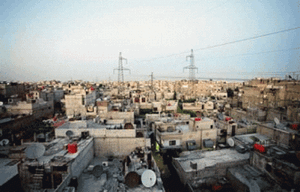
Homes are small, crowded concrete buildings in narrow alleys. Responsibility for services is divided: UNRWA collects rubbish, GAPAR maintains the streets, and government agencies supply electricity and telephone lines. The al-Aqqad quarter still lacks reliable water and sewerage because UNRWA does not consider it within its responsibility. Wells dug without permits have dried up through drought and over-pumping, and many families buy water from tankers that is not always safe to drink.
Economic Situation
Khan Dunoun is among the poorest camps in Syria, if not the poorest. Most residents work as farm labourers or day labourers, and only a few work in factories, government offices or Palestinian organisations. Poverty pushes many children, especially girls, to leave school early. A government cooperative store sells goods near cost, and UNRWA has run EU-funded youth projects. Syria's economic crisis and rising prices have deepened hardship since 2020.
Health Situation
The camp has an UNRWA health centre, the Zaytouna Medical Centre (formerly a Palestine Red Crescent clinic, expanded in 2022 with UNFPA support) and the Safa clinic, which opened in 2017 and offers free care. Illnesses linked to poor environmental conditions are common, as are inherited diseases such as thalassaemia and sickle-cell anaemia, made more frequent by widespread marriage between relatives. Hypertension, diabetes and disabilities are also common.
Education
UNRWA runs four schools on double shifts: two older primary schools, al-Khalisa for boys and Hawla for girls, and two newer schools, Beit Lahya for girls and Ariha for boys, which share one building. During the war, overcrowding forced three short shifts a day. Secondary students attend Syrian government schools, and early school leaving remains a serious problem.
Frequently Asked Questions About Khan Dunoun Camp
Where is Khan Dunoun camp located?
About 23 km south of Damascus, near al-Kiswah, in the Rif Dimashq Governorate of Syria.
Why is it called Khan Dunoun?
After the old caravan inn (khan) on the road between Damascus and Jerusalem, in whose ruins the first refugees sheltered in 1948.
How many people live in Khan Dunoun?
UNRWA counted more than 10,000 registered refugees; the population rose to about 30,000 during the war with displaced people, then fell back to about 13,705.
Where do Khan Dunoun's refugees come from?
Mainly from villages of the Hula Valley in the Safed district, especially al-Mallaha and al-Salihiyya, as well as al-Khalisa, al-Zuq, Jahula, al-Dawwara, Khiyam al-Walid and al-Muftakhira.
Why is Khan Dunoun considered one of the poorest camps in Syria?
Most residents are farm or day labourers, the camp is extremely crowded, and it has long suffered from poor water, sanitation and electricity services.
Conclusion
Khan Dunoun began in the stone ruins of a caravan inn on the old road from Damascus to Jerusalem, where the people of the Hula Valley stopped in 1948 and never moved on. Crowded, poor and long neglected, it sheltered thousands more during Syria's war. Its schools still carry the names of al-Khalisa and the Hula, and its people still wait to complete the journey the khan once served: the road home to Palestine.
More from the archive


 Download Our Palestine App
The whole archive in the palm of your hand: depopulated villages, the Nakba, the massacres and Al-Aqsa — free, with no ads to erase the story.
Download Our Palestine App
The whole archive in the palm of your hand: depopulated villages, the Nakba, the massacres and Al-Aqsa — free, with no ads to erase the story.



Comments
No comments yet — be the first to write one.
Add your comment
Name and email are optional. Comments appear after review.
Social and Political Life
Civil society organisations are few in Khan Dunoun. A notable exception is the Committee to Protect Palestinian Heritage ("Koushan"), which works to preserve the memory and traditions of the Hula villages. Most Palestinian factions have offices in the camp, and UNRWA runs a community centre. Family and village ties remain strong, with families from the same village living side by side.