The Kafr Qasim Massacre, 1956
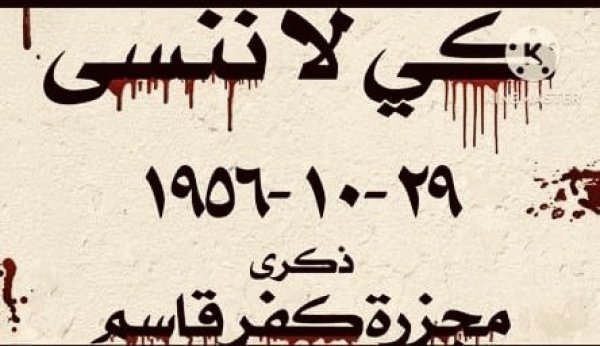
On October 29, 1956, Israeli Border Police killed 49 Palestinian civilians in the village of Kafr Qasim, located in the southern part of the Triangle near the armistice line with Jordan.
The victims were residents returning home from work, agricultural fields, and nearby communities. They had left the village before the authorities suddenly moved the beginning of a military curfew to 5:00 p.m. and therefore had no way of knowing that they would be considered curfew violators upon their return.
Israeli forces had been explicitly instructed to fire on people found outside their homes after the curfew began, without exempting workers returning from outside the village.
Over approximately one hour, Border Police units stopped groups of villagers at the western entrance to Kafr Qasim and shot them at close range.
Men, women, and children were among the dead.
The massacre occurred on the same day that Israel launched its invasion of Egypt's Sinai Peninsula, beginning the military phase of what became known in the Arab world as the Tripartite Aggression of 1956.
Kafr Qasim and the Palestinian Triangle
Kafr Qasim was one of the Palestinian villages in the area known as the Little Triangle, extending from Kafr Qasim northward toward Umm al-Fahm.
The area came under Israeli control following the 1949 Jordan–Israel Armistice Agreement.
Its Palestinian inhabitants became citizens of Israel, but like most Palestinian citizens during this period, they lived under a system of military government that restricted movement, employment, residence, political organization, and access to land.
The military-government system remained in force over Palestinian citizens in many areas until 1966.
The Regional Context: The 1956 War
The massacre occurred during a period of intense regional confrontation.
Egyptian President Gamal Abdel Nasser had nationalized the Suez Canal in July 1956, intensifying tensions with Britain and France.
Israel, Britain, and France subsequently coordinated military action against Egypt.
On October 29, 1956, Israeli forces invaded Sinai.
Israeli authorities simultaneously imposed extraordinary security measures on Palestinian villages located close to the Jordanian armistice line.
Kafr Qasim was far from the Sinai battlefield, but its Palestinian population was nonetheless placed under wartime restrictions.
The Sudden Curfew
On the afternoon of October 29, Israeli military commanders decided to impose an earlier curfew on Palestinian villages along the border.
At approximately 4:30 p.m., only half an hour before it was due to begin, the mukhtar of Kafr Qasim was informed that residents had to remain inside their homes beginning at 5:00 p.m..
The mukhtar immediately raised a critical problem: hundreds of villagers had left early that morning to work in agricultural fields, quarries, construction sites, and nearby communities.
They were outside the village and could not have received the new order.
Nevertheless, the curfew was enforced.
Shmuel Malinki and the Orders to the Border Police
The Border Police battalion responsible for enforcing the curfew was commanded by Major Shmuel Malinki.
Above him in the military chain of command was Colonel Issachar Shadmi, commander of the Israeli army brigade responsible for the area.
Testimony later presented during the trials showed that the troops were instructed to use lethal force against people found outside during curfew hours.
According to Malinki's later testimony, he specifically asked what should be done with Palestinian workers returning home unaware that the curfew had been advanced.
Malinki testified that Shadmi rejected the idea of arrests and indicated that curfew violators should be killed.
Shadmi later denied that the particular question of returning workers had been discussed in this manner.
Whatever the dispute over their conversation, the order transmitted to the Border Police unit operating in Kafr Qasim was clear in practice: people found outside after 5:00 p.m. were to be shot rather than arrested.
The First Killings
The massacre began only minutes after the curfew went into effect.
At approximately 5:05 p.m., the first group of Palestinian workers approached the western entrance of Kafr Qasim.
Border policemen opened fire.
Contrary to one later popular account claiming that three of four workers were killed in this first incident, the detailed trial records reconstructed by the Akevot Institute show that two workers were killed while two others survived by appearing to be dead.
This was only the beginning.
Successive Groups Are Shot
During the following hour, groups of villagers continued returning home unaware of what had happened.
Some arrived on bicycles, others in trucks or carts, while farmers returned with animals after working outside the village.
Border Police units stopped them and opened fire at close range.
The killings occurred in successive waves.
Children were among the victims.
In one incident, a young boy who went outside to bring animals home was shot. Members of his family who rushed toward him were also fired upon.
The Killing of the Women Returning from Work
One of the most devastating shooting incidents involved a truck carrying Palestinian workers back toward Kafr Qasim.
A group of women and men were ordered out of the vehicle.
According to the documented testimony from the massacre investigation, the villagers pleaded for their lives.
The soldiers opened fire.
Of approximately eighteen people gathered together in that incident, seventeen were killed.
Several of the victims were women and teenage girls.
The detailed record therefore confirms the substance of Palestinian accounts that groups of women returning from agricultural work were deliberately shot, although some commonly repeated figures concerning the exact number of women in a single group differ between sources.
Forty-Nine Palestinians Killed
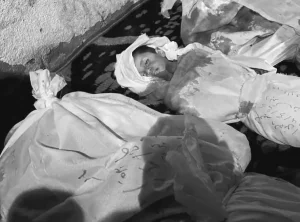
By the time the shooting ended, 49 Palestinians from Kafr Qasim had been killed.
The victims included men, women, and children.
They were not combatants killed during a battle.
They were civilians returning to their village or moving near their homes who had no knowledge of the newly imposed curfew.
This is one of the defining features that distinguishes the Kafr Qasim massacre from military clashes along the armistice line during the 1950s.
The Attempt to Conceal the Massacre
Israeli authorities immediately imposed censorship and restrictions on information about what had happened.
That same night, senior military officials met to discuss the killings.
Military censorship was instructed to suppress publication of the incident.
The following morning, the bodies were taken for identification, and men from the neighboring Palestinian village of Jaljulya were brought to dig graves.
Families of the victims were initially prevented from attending the burials.
Despite the censorship, information began leaking out.
Palestinian political activists and journalists, including Communist Knesset members Tawfik Toubi and Meir Vilner, helped document the massacre and circulate information about it despite military restrictions.
Plan Mole
The massacre later became connected to a broader Israeli military plan known as Plan Mole (Hafarperet).
For decades, significant parts of the documentation surrounding this plan remained secret.
In 2017, the Akevot Institute sought the release of sealed testimony from the Kafr Qasim trials.
In 2022, an Israeli military appeals court authorized the publication of hundreds of pages of previously classified testimony, although the written text of Plan Mole itself remained partly concealed.
The newly released records demonstrated that the Israeli military had developed contingency plans for Palestinian communities along the frontier in the event of war.
Measures described in testimony included strict curfews, arrests, seizure of livelihoods, and the transfer of border-area Palestinian populations into areas farther inside Israel.
Testimony also indicated that some of those involved understood the harsher measures as a way of encouraging Palestinians to flee across the border into Jordan.
Palestinian historians consequently place Kafr Qasim within the broader context of state policies aimed at controlling—and potentially reducing—the Palestinian population in strategically sensitive border regions during the years of military rule.
Was the Massacre Intended to Force Palestinians to Leave?
The released material has strengthened historical arguments that the massacre cannot be understood merely as an isolated mistake by individual soldiers.
The existence of Plan Mole establishes that population transfer and displacement were being considered within Israeli military planning for the Triangle in the event of war.
It does not by itself prove that every killing at Kafr Qasim was individually scripted in advance by the highest political leadership.
What is documented is that lethal curfew orders were issued within this broader military environment and that Border Police in Kafr Qasim implemented them against civilians who could not have known that the curfew had begun.
The Investigation
On November 1, 1956, only three days after the massacre, Prime Minister and Defense Minister David Ben-Gurion appointed an official commission of inquiry.
Military police investigators also began taking statements from commanders and Border Police personnel.
Survivor testimony was collected later in November.
Public pressure eventually made it impossible to treat the event solely as an internal military matter.
The Trial of the Border Police
Contrary to later claims that the perpetrators were not brought to trial until two years after the massacre, the trial of eleven Border Police officers and soldiers began in January 1957.
The proceedings lasted through approximately one hundred court sessions.
On October 16, 1958, eight defendants were convicted and three were acquitted.
Major Shmuel Malinki was convicted in connection with the killing of 43 civilians and sentenced to 17 years in prison.
Lieutenant Gavriel Dahan received a sentence of 15 years.
Squad commander Shalom Ofer was likewise sentenced to 15 years.
Five additional convicted Border Policemen received seven-year sentences.
The “Black Flag” Ruling
The Kafr Qasim trial produced one of the most important doctrines in Israeli military law.
The defendants argued, among other things, that they had been following orders.
Presiding Judge Binyamin Halevy rejected the idea that obedience automatically absolved soldiers of criminal responsibility.
He ruled that certain orders are so obviously illegal that a soldier has a duty to refuse them.
Halevy famously described such an order as one over which a “black flag” of manifest illegality flies.
The principle subsequently became a major element of Israeli military jurisprudence concerning unlawful orders.
The Trial of Colonel Issachar Shadmi
The senior officer whose orders had shaped the curfew operation, Colonel Issachar Shadmi, was not tried together with the original eleven defendants.
He was prosecuted separately beginning in December 1958.
Shadmi faced serious accusations, including responsibility connected to the deaths.
He was ultimately acquitted of the murder charges.
The court found him guilty only of an administrative offense concerning the manner in which the curfew had been imposed without proper authorization.
His punishment was a reprimand and a symbolic fine of ten Israeli cents.
The contrast between the scale of the massacre and this punishment became an enduring symbol for Palestinians of the limits of accountability imposed on senior commanders.
The Sentences Are Rapidly Reduced
Even the prison sentences imposed on the convicted Border Policemen were not served in full.
In April 1959, the appeals court reduced Malinki's sentence from 17 to 14 years and reduced the sentences of Dahan and Ofer from 15 to 10 years.
The sentences of the lower-ranking defendants were also reduced.
Further reductions were granted through decisions by the Israeli chief of staff, presidential clemency, and administrative mechanisms.
Within only a few years of the massacre, all of those convicted were free.
Some later received public or security-related employment.
Malinki later received a security position connected to Israel's nuclear facility in the Negev, while Dahan was later employed in an Arab-affairs position in Ramla.
The Forced Sulha
In November 1957, the Israeli authorities organized a traditional sulha, or reconciliation ceremony, in Kafr Qasim.
Palestinian historical accounts generally describe the ceremony as imposed under the conditions of military rule rather than a freely chosen reconciliation by the victims' families.
The villagers succeeded, however, in preventing the accused perpetrators from attending the ceremony themselves.
Kafr Qasim and Palestinians Who Remained After the Nakba
The massacre occupies a distinctive place in Palestinian history.
Unlike Deir Yasin, al-Dawayima, Safsaf, and other massacres associated directly with the 1948 Nakba, Kafr Qasim occurred eight years after the establishment of Israel.
The victims were Palestinians who had remained in their homeland and had become citizens of the Israeli state.
Yet they were living under military rule, and the people who killed them were members of the state's official security forces.
This made Kafr Qasim a defining event in the history of Palestinian citizens of Israel.
Military Rule Over Palestinian Citizens
From 1948 until 1966, large sections of the Palestinian population inside Israel were subjected to military government.
Travel between villages often required permits.
Curfews could be imposed, communities could be closed, and extensive powers were available to military governors.
Land confiscation and restrictions on residence and movement profoundly affected Palestinian communities during this period.
The massacre demonstrated the extreme vulnerability produced by this system: residents could be placed under a sudden order enforced by lethal force even when they had no realistic way of learning about it.
Kafr Qasim in Palestinian Memory
The massacre became one of the central symbols of Palestinian collective memory inside Israel.
Its significance extended beyond the forty-nine people killed.
For Palestinians who had survived the Nakba and remained within the new state, Kafr Qasim reinforced the sense that survival on their land did not guarantee protection from state violence.
At the same time, the village's refusal to abandon its land became an important symbol of sumud—steadfastness.
The population did not flee Kafr Qasim after the massacre.
The community remained, commemorated its dead, preserved their names and testimony, and gradually turned the massacre into a central marker of Palestinian historical consciousness.
From Kafr Qasim to Land Day
During the early years after the massacre, military rule made large public commemorations difficult.
Over time, however, annual remembrance became increasingly public.
Following the political mobilization surrounding Land Day in 1976, a memorial was erected in Kafr Qasim.
The massacre and Land Day subsequently became two important historical reference points for Palestinian citizens of Israel: Kafr Qasim representing survival in the face of military rule and state violence, and Land Day representing organized resistance to land confiscation and dispossession.
The Historical Meaning of the Kafr Qasim Massacre
The essential facts of Kafr Qasim are not seriously in dispute.
A curfew was moved forward with only thirty minutes' notice.
Israeli commanders knew that hundreds of Palestinians were working outside the village and could not have heard the order.
Border Police were instructed to use lethal force against curfew violators.
When workers, farmers, women, and children returned home, they were stopped and shot.
Forty-nine Palestinians were killed.
The Israeli military court itself subsequently determined that the order being implemented was manifestly illegal and that obedience to such an order could not excuse those who carried it out.
From a Palestinian historical perspective, Kafr Qasim stands at the intersection of two histories: the continuing consequences of the Nakba and the system of military government imposed on Palestinians who remained inside Israel.
It is remembered as a massacre committed not during the chaos of 1948 but by state security forces against civilians who were already citizens of the state that controlled them.
The fact that the victims were killed while simply trying to return home has ensured that October 29, 1956 remains one of the most painful dates in the modern history of Palestinians inside Israel.
Video clips
Photo gallery


More from the archive
 Download Our Palestine App
The whole archive in the palm of your hand: depopulated villages, the Nakba, the massacres and Al-Aqsa — free, with no ads to erase the story.
Download Our Palestine App
The whole archive in the palm of your hand: depopulated villages, the Nakba, the massacres and Al-Aqsa — free, with no ads to erase the story.
Comments
No comments yet — be the first to write one.
Add your comment
Name and email are optional. Comments appear after review.