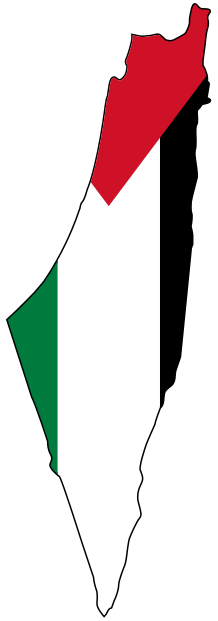
The depopulated village of Jaba' / District of Haifa

About the depopulated village of Jaba'
- District
- Haifa
- Date Jaba' was occupied
- 25 July 1948
- Population in 1948
- 1,322
- Military operation
- Operation Shoter (“Policeman”)
- Brigade that carried it out
- Alexandroni Brigade، Golani Brigade، The Carmeli Brigade
- Who defended the village
- Local Arab militia, Arab Liberation Army volunteers, and some support from the Iraqi Army in Tulkarm
- Distance from the governorate centre
- 18.5 km south of Haifa
- Elevation above sea level
- 50 m
- Cause of displacement
- Direct military assault by Israeli occupation forces during the second truce; a United Nations investigation concluded that all the inhabitants of the three villages were forced to evacuate
- Extent of destruction
- Soon after occupation, the village has been mostly destroyed with the exception of a village shrine
- Ethnic cleansing
- Jaba' inhabitants were completely ethnically cleansed.
- Settlements built on the built-up area of Jaba' after 1948
- Geva' Karmel, established in 1949 on village land, about 1 km northwest of the village site
- Refugees' migration routes
- Refugees were mostly expelled eastward to Jinin (West Bank).
Hover a dot to read the village name, or click to open its card.
Borders of the depopulated village of Jaba'
Jaba': A Depopulated Palestinian Village in the Haifa District
Jaba' was a depopulated Palestinian village in the Haifa District, located approximately 18.5 kilometers south of Haifa on the western slopes of the southern part of Mount Carmel, at an average elevation of about 50 meters above sea level.
- Subdistrict
- Haifa
- Distance from district center
- 18.5 km south of Haifa
- Average Elevation
- 50 m above sea level
- Population in 1931
- 762
- Number of Houses in 1931
- 158
- Population in 1944/1945
- 1,140
- Estimated Population in 1948
- About 1,322 – a later demographic estimate, not an official census
- Total Land Area in 1945
- 7,012 dunams
- Attack and Depopulation
- The village was attacked from late February 1948 and, together with Ijzim and 'Ayn Ghazal (the 'Little Triangle'), held out until the second truce. On 24 July 1948 an assault by a special force drawn from the Golani, Carmeli and Alexandroni Brigades was repulsed, and Israeli occupation forces entered the villages on the night of 25–26 July after a massive artillery and aerial bombardment; the inhabitants were forced to leave or fled eastwards towards Wadi 'Ara, some of them under fire, and the village was systematically destroyed after its occupation.
- Final Israeli Control
- The night of 25–26 July 1948, during the second truce, according to Khalidi
- Military Operation
- Operation Shoter ('Police'), according to the History of the War of Independence as cited by Khalidi in the Ijzim entry; it was framed as a 'police operation' to hide its violation of the second truce
- Military Unit
- A special force of four platoons drawn from the Golani, Carmeli and Alexandroni Brigades, according to the History of the War of Independence as cited by Khalidi
- Cause of Depopulation
- Direct military assault by Israeli occupation forces during the second truce; a United Nations investigation concluded that all the inhabitants of the three villages were forced to evacuate
- Settlements Documented on Village Lands
- Geva' Karmel, established in 1949 on village land, about 1 km northwest of the village site
The Government of Palestine's 1944/1945 statistics recorded a population of 1,140 and a total land area of 7,012 dunums. During the Nakba and the occupation of Palestine in 1948, Jaba', together with Ijzim and 'Ayn Ghazal, formed the Palestinian pocket known as the “Little Triangle,” which resisted Israeli occupation until late July. Following intensive aerial, artillery, and ground attacks during Operation Shoter, Israeli forces entered the villages on the night of 25–26 July 1948. The inhabitants of Jaba' were displaced, and the village was systematically destroyed after its occupation.
Location of Jaba'
- Jaba' was located approximately 18.5 kilometers south of Haifa.
- Its average elevation was about 50 meters above sea level.
- It stood on the western slopes of the southern part of Mount Carmel.
- The village overlooked the coastal plain and the area surrounding al-Sarafand.
- The coastal highway passed approximately 1.5 kilometers east of the village.
- Its lands bordered those of al-Mazar, al-Sarafand, 'Ayn Ghazal, and Ijzim, with Kafr Lam to the southwest.
Jaba' Through History
Some scholars have suggested that Jaba' may have occupied the site of the Roman locality of Gabata, although this identification is not considered conclusive.
In 1596, Jaba' was a village in the nahiya of Shafa within the liwa' of Lajjun and had an estimated population of approximately 99. Its inhabitants paid taxes on wheat and barley as well as goats, beehives, and other forms of production.
By the late nineteenth century, Jaba' was described as a small village of approximately 150 inhabitants with an olive grove, a well equipped with a lifting device, and troughs for watering livestock.
The Built Environment and Facilities of Jaba'
In the modern period, Jaba' extended along a north–south axis following the contours of the slopes on which it stood. Its Muslim inhabitants built their houses of stone.
The built-up area covered approximately 60 dunums according to the 1944/1945 statistics.
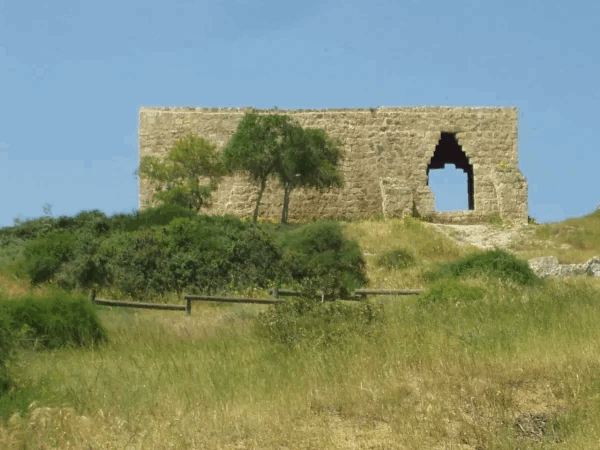
The village also contained a shrine that remained standing after the Nakba according to Walid Khalidi's field description.
Education in Jaba'
An elementary school for boys was established in Jaba' in 1885 during the Ottoman period and served as the village's principal educational institution.
Palestinian local accounts indicate that the school later expanded to include the upper elementary grades and that a plot of agricultural land was attached to it for practical agricultural instruction.
Population of Jaba'
The 1922 census recorded 523 inhabitants in Jaba'. In the 1931 census, the population increased to 762, living in 158 houses.
The Government of Palestine's 1944/1945 statistics recorded 1,140 inhabitants.
The figures of 1,322 inhabitants for 1948 and 8,121 refugees for 1998 published by Palestine Remembered are later estimates rather than official Government of Palestine censuses.
Population of Jaba'
- 159699Historical estimate based on Ottoman records
- Late 19th centuryAbout 150Historical estimate
- 1922523Official census under the British Mandate
- 1931762Official census under the British Mandate
- 1944/19451,140Government of Palestine statistics
- 19481,322Later estimate published by Palestine Remembered
- 19988,121Later refugee-population estimate published by Palestine Remembered
Number of Houses in Jaba'
The 1931 census recorded 158 houses in Jaba'. The figure of 274 houses for 1948 published by Palestine Remembered is a later estimate rather than an official Government of Palestine census figure.
Number of Houses in Jaba'
- 1931158Official census
- 1948274Later estimate published by Palestine Remembered
Land Ownership in Jaba'
The total land area recorded for Jaba' in the 1944/1945 statistics was 7,012 dunums. The official statistics recorded no Jewish land ownership in the village.
The Arabic Palestine Remembered table uses the categories “Palestinian,” “Transferred to Zionists,” and “Masha'.” These terms are preserved below to reflect the terminology used by that source. The Government of Palestine statistics use the official categories “Arab,” “Jewish,” and “Public.”
Land Ownership in Jaba', 1944/1945, Using the Terminology of Palestine Remembered
- Palestinian4,759 dunums68%
- Transferred to Zionists0 dunums0%
- Masha' (source terminology)2,253 dunums32%
Land Use in Jaba' in 1944/1945
A total of 4,705 dunums was cultivated or classified as cultivable, consisting of 4,657 dunums of Arab land and 48 dunums of public land.
Cereal cultivation covered 4,255 dunums, including 4,207 dunums of Arab land and 48 dunums of public land. Plantations and irrigable land covered another 450 dunums, all Arab land.
Land Use in Jaba' According to the 1944/1945 Statistics
- Arab
- Jewish
- Public
- Plantations and Irrigable Land450 dunums
- Cereals4,255 dunums
- Built-up Area60 dunums
- Non-Cultivable Land2,247 dunums
Palestinian sources separately record approximately 710 dunums planted with olive trees in 1943. This figure is supplementary agricultural information and does not appear as an independent additive category in the official 1944/1945 land-use table.
Economic Life in Jaba'
Jaba's economy depended primarily on agriculture and animal husbandry. Wheat, other cereals, and vegetables were among the principal crops, alongside olive cultivation.
In 1943, approximately 710 dunums were planted with olive trees, and the villagers produced olive oil using a hand-operated press.
Livestock and sheep raising also formed an important part of the village economy.
Archaeological and Prehistoric Sites
Mosaic remains, rock-cut tombs, and other architectural remains attested to the antiquity of settlement in and around Jaba'.
In 1930, caves discovered near the entrance to Wadi al-Maghara, less than two kilometers north of the village, yielded evidence of human habitation during prehistoric periods.
Old wells, caves, and remains of stone structures were also found in the village area.
Attacks on Jaba' in February and March 1948
Jaba' was subjected to a series of attacks several months before its final occupation.
On 25 February 1948, a Zionist armored vehicle passed through the village and its occupants fired at two villagers. The Palestinian newspaper Filastin reported no casualties.
On the afternoon of 26 February, a larger force arrived in two armored buses, opened fire, entered a house, and smashed its contents before withdrawing.
On 5 March, a Jewish armored vehicle fired on two Arab buses near Jaba', wounding four people, including a nurse.
Despite continuing hostile military activity around the village, Jaba' remained outside Zionist control for approximately four more months.
Jaba' and the Little Triangle
After most Palestinian villages south of Haifa had been occupied, Jaba', Ijzim, and 'Ayn Ghazal remained as a Palestinian-held pocket surrounded by Israeli-controlled territory. The three villages became known collectively as the “Little Triangle.”
They had held out since 15 May 1948. Their defenders repelled repeated attempts to capture the area and continued to disrupt Israeli military and transportation traffic along the coastal road between Haifa and Tel Aviv.
According to the military account cited by Walid Khalidi and PalQuest, the defenders maintained contact with Iraqi forces in the Tulkarm area by radio and messengers, although by the Second Truce the villages had effectively become isolated from direct Arab military support.
Operation Shoter “Policeman”
The final occupation of Jaba' was associated with Operation Shoter, meaning “Policeman,” which targeted the Little Triangle during the Second Truce in July 1948.
The operation was officially presented as a “police action” against inhabitants portrayed as refusing to recognize Israeli authority. The military account cited by Walid Khalidi, however, states that in practical terms it was a military operation.
The use of a police designation was connected to the fact that launching a major military offensive at that time would constitute a violation of the terms of the Second Truce.
On 24 July, a special force of four platoons drawn from the Golani, Carmeli, and Alexandroni Brigades was assembled to attack Jaba' and the surrounding Palestinian pocket.
The Occupation of Jaba' on the Night of 25–26 July 1948
Abbreviated sources differ over the date of Jaba's occupation. Palestine Remembered lists 24 July 1948, the date on which the principal Operation Shoter assault began.
Walid Khalidi and PalQuest provide a more detailed chronology: the assault of 24 July was repelled, after which Israeli forces subjected the Little Triangle to intensive artillery and aerial bombardment on the following day.
Israeli forces finally entered the villages during the night of 25–26 July 1948. This is therefore the more precise date for Jaba's final military fall, while 24 July represents the beginning of the assault.
The attack resulted in the flight or displacement of the inhabitants eastward toward Wadi 'Ara and the Jenin area. Subsequent international investigation concluded that the inhabitants of the three villages had been forced to evacuate.
Occupation and Depopulation Chronology
- 25 February 1948
Shooting at villagers (possibly a reconnaissance raid)
The Palestinian newspaper Filastin reported that an armoured car passing through Jaba' fired at two villagers; no casualties were reported. Khalidi describes it as what may have been a reconnaissance raid preceding the attack of the following day.
- 26 February 1948
First attack on the village
A large force of Zionist troops attacked the village in the afternoon; according to the New York Times, they arrived in two armoured buses, opened fire, raided a house and smashed up its interior before moving off again. No casualties were reported.
- 5 March 1948
Attack near the village
According to an official British communiqué, an armoured vehicle opened fire at 8:30 a.m. on two Arab buses near the village, wounding four people, among them a nurse.
- 18 June and 8 July 1948 (the dates of the two attempts on Ijzim)
Two attacks on the Little Triangle repulsed
Jaba', Ijzim and 'Ayn Ghazal had held out since 15 May 1948, and their defenders repulsed two previous attacks while disrupting Israeli transportation lines on the coastal road south of Haifa, according to the History of the War of Independence as cited by Khalidi. The Ijzim entry dates the two unsuccessful attempts to occupy Ijzim to 18 June and 8 July 1948.
- 24 July 1948 (18 July according to Bernadotte)
Beginning of the military operation
On 24 July a special force of four platoons drawn from the Golani, Carmeli and Alexandroni Brigades was put together to attack the pocket in Operation Shoter, which was framed as a 'police operation' to hide its violation of the second truce; the first assault that day was repulsed. UN mediator Count Folke Bernadotte, however, reported to the Security Council that Israeli forces attacked the villages on 18 July, at the beginning of the second truce, and that the air and land attack took seven days.
- 25 July 1948
Shelling of the village
Israeli occupation forces unleashed a massive artillery and aerial bombardment on the three villages.
- Night of 25–26 July 1948
Final occupation
Israeli occupation forces finally entered the three villages, which had been completely cut off from Arab military support, although they were in touch with Iraqi forces in the Tulkarm area by radio and messengers. Morris, as cited by Khalidi, writes that units of the Golani, Carmeli and Alexandroni Brigades captured the villages.
- Late July 1948
Depopulation of the village
The residents were forced to leave or fled eastwards towards Wadi 'Ara, and some of those fleeing were fired upon, according to Morris as cited by Khalidi. A United Nations investigation concluded that 'all the inhabitants of the three villages were forced to evacuate' on completion of the attack, and the UN said that 8,000 people from the three villages were made homeless and displaced to the Jenin area.
- July – September 1948
Casualties and massacre allegations
The Israelis admitted to taking only four people prisoner at Jaba', while the Secretary General of the Arab League charged that thousands had been captured and many massacred at the three villages. UN observers initially found only two bodies in the three villages, but in September UN investigators stated that 130 villagers were dead or missing, and Israeli sources report that villagers were made to bury 25–30 burned bodies at 'Ayn Ghazal.
- Soon after the occupation (summer 1948)
Destruction of the village
According to the UN investigation, the systematic destruction of Jaba' was undertaken soon after its occupation, and UN mediator Count Folke Bernadotte told the Security Council in September that the measures involving the destruction of Jaba' and 'Ayn Ghazal were excessive and violated both the spirit and the letter of the truce.
- September 1948 (13 September)
Prevention of return
On 13 September Bernadotte ordered Israel to readmit the refugees to the three villages and to rebuild their homes, and the Israelis refused to comply. According to the New York Times, the Provisional Government of Israel had told him it would rehabilitate the residents and restore the houses at its own expense, but that promise was never fulfilled.
- 1949
Settlement on village lands
Israel established the settlement of Geva' Karmel on village land, about 1 km northwest of the village site.
The United Nations Investigation
The assault on Jaba', Ijzim, and 'Ayn Ghazal during the Second Truce prompted an international investigation into the occupation and depopulation of the Little Triangle.
The United Nations Central Truce Supervision Board concluded that the villages had been attacked by land and air and that their inhabitants were forced to evacuate.
UN observers located more than 8,000 inhabitants of the three villages who had been made homeless. The investigation concluded that fewer than 130 people from the three villages combined were killed or missing. This figure should not be attributed to Jaba' alone.
The investigation also established that Jaba' and 'Ayn Ghazal were systematically destroyed after their inhabitants had been evacuated.
Count Folke Bernadotte and the Destruction of Jaba'
United Nations Mediator Count Folke Bernadotte raised the case of the Little Triangle with the United Nations and informed the Provisional Government of Israel in September 1948 that the military measures taken against the villages were unjustified.
Bernadotte concluded that the systematic destruction of Jaba' and 'Ayn Ghazal was excessive and constituted a violation of both the spirit and the letter of the truce terms.
He also called for the Arab villagers to be allowed to return immediately and for damaged or destroyed houses to be restored at Israeli expense.
The inhabitants of Jaba', however, were not permitted to return to their village.
Settlement Established on the Lands of Jaba'
In 1949, the Israeli settlement of Geva' Karmel was established on the lands of Jaba'.
- Geva' Karmel: established in 1949 on Jaba' land, approximately one kilometer northwest of the village site.
The Site of Jaba' After the Nakba
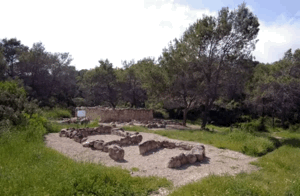
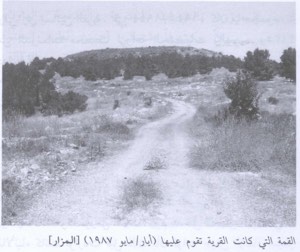
According to Walid Khalidi's field description, piles of stone rubble remained scattered across the site of Jaba', while a village shrine continued to stand on an elevated part of the site.
Remains of graves were also visible around the village. Pine forests grew over nearby land, parts of which were enclosed with barbed wire.
A portion of the village site and surrounding land was used for grazing livestock.
This description is based on fieldwork conducted for Walid Khalidi's All That Remains and should not necessarily be treated as an updated field survey of the site today.
Sources
- PalQuestPalQuest – Interactive Encyclopedia of the Palestine Question: Jaba'
- PalQuestPalQuest: Ijzim – Operation Shoter and the Little Triangle
- Institute for Palestine StudiesInstitute for Palestine Studies: Walid Khalidi, All That Remains
- Palestine RememberedPalestine Remembered: Jaba' – Haifa District
- un.orgUnited Nations: Progress Report of the UN Mediator on Palestine, 1948
- maktabatsabil.comSami Hadawi: Village Statistics 1945 – Haifa Sub-District Land Use
- palestinapedia.psPalestinian Encyclopedia: Jaba' – Population, Economy, and Agriculture
Photo gallery


Photos from the village's people
Photos sent in by visitors and published after review.
Add a photo of this village
Log in to add photos of this village.
Other villages from Haifa

More from the archive
 Download Our Palestine App
The whole archive in the palm of your hand: depopulated villages, the Nakba, the massacres and Al-Aqsa — free, with no ads to erase the story.
Download Our Palestine App
The whole archive in the palm of your hand: depopulated villages, the Nakba, the massacres and Al-Aqsa — free, with no ads to erase the story.
Comments
No comments yet — be the first to write one.
Add your comment
Name and email are optional. Comments appear after review.