: How Britain and France Secretly Planned the Partition of the Ottoman Arab Provinces
The Sykes–Picot Agreement was a secret wartime arrangement negotiated by Britain and France, with the assent of Tsarist Russia, to divide much of the Ottoman Empire's Arab territories into zones of direct control and political influence after an anticipated Allied victory in the First World War.
Negotiations began in November 1915 between the British diplomat Sir Mark Sykes and the French diplomat François Georges-Picot. After months of secret discussions and consultation with Russia, the agreement was formally concluded on May 16, 1916.
From an Arab and Palestinian historical perspective, Sykes–Picot became one of the clearest symbols of European imperial intervention in the region. While Arab leaders were discussing independence from Ottoman rule with Britain, British and French officials were simultaneously negotiating how much of the Arab East would fall within their respective spheres of influence.
How the Sykes–Picot Agreement Was Revealed
The agreement was negotiated in secrecy and took the form of diplomatic correspondence between the governments of Britain and France, with Tsarist Russia consulted and ultimately giving its approval.
The secrecy surrounding these arrangements did not survive the Russian Revolution.
After the Bolsheviks seized power in Russia in 1917, the new Soviet government rejected the secret diplomacy practiced by the former Tsarist regime and began publishing confidential agreements concluded between Russia and its wartime allies.
In November 1917, the Sykes–Picot arrangements and other secret wartime agreements were made public. Their disclosure caused widespread embarrassment for Britain and France and fueled anger and distrust across the Arab world.
The revelation was particularly damaging because the agreement had been negotiated during the same period as the Hussein–McMahon Correspondence of 1915–1916, in which British officials had encouraged Sharif Hussein of Mecca to support an Arab revolt against the Ottoman Empire while discussing British recognition of future Arab independence.
The discovery that Britain was simultaneously negotiating a division of the region with France deepened Arab perceptions that wartime promises of independence had been compromised by secret imperial arrangements.
How the Arab East Was Divided
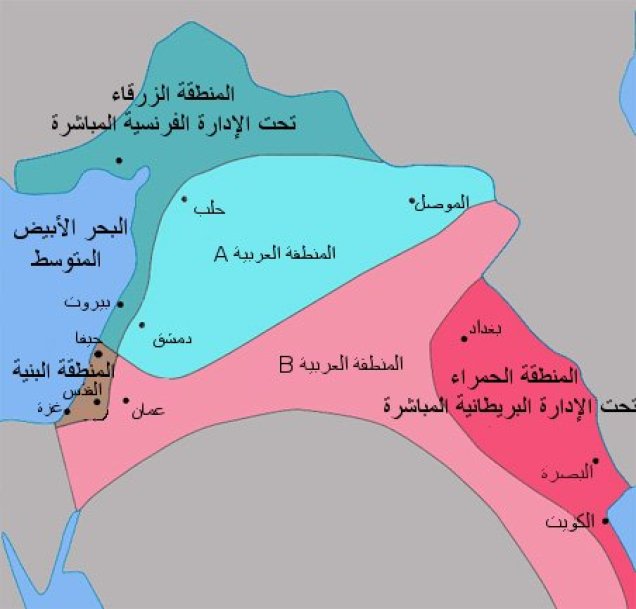
The Sykes–Picot Agreement divided large parts of the Arab provinces of the Ottoman Empire into several zones.
France was assigned a zone of direct or indirect control along parts of the eastern Mediterranean coast, including areas corresponding broadly to parts of present-day Lebanon and coastal Syria, as well as a wider French sphere of influence extending through much of inland Syria and toward Mosul.
Britain received a zone of direct or indirect control in southern Mesopotamia, including areas around Baghdad and Basra, together with a wider British sphere of influence extending westward toward the territories lying between Mesopotamia and the Mediterranean.
The agreement also envisaged the creation of an Arab state, or a confederation of Arab states, in some of the territories between the zones under direct European control. Yet even these nominally Arab areas were divided into French and British spheres of influence, giving the two European powers priority in economic, administrative, and political affairs.
Palestine Under the Sykes–Picot Agreement
Palestine occupied a particularly sensitive place within the agreement.
Most of Palestine was placed within what the agreement's map designated the “brown area,” where an international administration was to be established. Its final form was to be determined after consultation with Russia, the other Allied powers, and representatives of the Sharif of Mecca.
Britain, however, was granted control of the ports of Haifa and Acre, providing it with strategic access to the Mediterranean.
France was guaranteed freedom to use the port of Haifa for French trade, while Britain was granted commercial access to Alexandretta, which lay within the French-controlled zone.
These provisions reveal how Palestine was being discussed primarily in terms of imperial strategy, transportation routes, ports, commerce, and competing European interests rather than according to the political wishes of the population living there.
Arab Expectations and Europe's Secret Partition
From an Arab historical perspective, one of the most controversial aspects of Sykes–Picot was its timing.
Arab leaders were seeking recognition of their right to establish an independent Arab political order following the collapse of Ottoman rule. Britain, meanwhile, was encouraging Arab cooperation against the Ottoman Empire through its correspondence with Sharif Hussein.
At the same time, however, Britain and France were secretly negotiating how the same territories would be divided into European zones of control and influence.
For many Arabs, the later disclosure of the agreement came to symbolize a profound breach of trust: the language of liberation and independence had existed alongside confidential plans for imperial partition.
From a Palestinian perspective, this contradiction was especially consequential. Palestine's political future was being negotiated by foreign powers without meaningful participation by its indigenous Arab population, establishing a pattern that would continue through subsequent wartime declarations and the British Mandate.
Russia, Constantinople and the Straits
Russia's territorial ambitions during the First World War were connected to, but distinct from, the Sykes–Picot Agreement.
In a separate secret arrangement known as the Constantinople Agreement of 1915, Britain and France agreed, in the event of an Allied victory, to recognize Russia's claims to Constantinople, the Bosphorus, the Dardanelles, parts of the Sea of Marmara region, and adjacent territories.
Russia, in turn, recognized that Britain and France would pursue their own territorial and political interests elsewhere in the Ottoman Empire.
The arrangements also provided for commercial navigation through the Straits and addressed British and French interests in Ottoman territories and Persia.
These agreements formed part of a wider series of secret wartime understandings through which the Allied powers anticipated the division of Ottoman territories before the war had even ended.
Russia never received Constantinople or the Straits. The revolutions of 1917 removed the Tsarist government from power, and the Bolsheviks later withdrew Russia from the war and repudiated the imperial agreements of the previous regime.
Sykes–Picot and the Future of Palestine
The borders drawn in the original Sykes–Picot map were not ultimately implemented exactly as negotiated. The collapse of Tsarist Russia, British military victories, disputes between Britain and France, the Balfour Declaration, and the postwar mandate system all altered the political map envisioned in 1916.
Palestine itself provides one of the clearest examples. Although most of the country had been designated for international administration under Sykes–Picot, Britain later sought direct control over Palestine. British forces occupied the country during the war, and Britain was subsequently granted the Mandate for Palestine.
Nevertheless, the historical significance of Sykes–Picot extends beyond the exact borders drawn on its secret map.
For the peoples of the Arab East, it came to symbolize a broader colonial order in which European powers treated Arab lands as territories to be divided, administered, and exchanged according to imperial interests.
For Palestinians, the agreement belongs to a crucial period in which decisions concerning the future of their homeland were increasingly made outside Palestine. Sykes–Picot was followed by the Balfour Declaration of 1917 and then the British Mandate—developments that would profoundly reshape the political and demographic future of Palestine.
Seen from this perspective, Sykes–Picot was not simply a line drawn across a wartime map. It represented an imperial approach to the Arab East in which foreign powers claimed the authority to determine the fate of peoples and territories without their consent—an approach whose consequences continued to shape Palestine and the wider region long after the First World War had ended.
More from the archive


 Download Our Palestine App
The whole archive in the palm of your hand: depopulated villages, the Nakba, the massacres and Al-Aqsa — free, with no ads to erase the story.
Download Our Palestine App
The whole archive in the palm of your hand: depopulated villages, the Nakba, the massacres and Al-Aqsa — free, with no ads to erase the story.
Comments
No comments yet — be the first to write one.
Add your comment
Name and email are optional. Comments appear after review.