
The King–Crane Commission and the Future of Palestine
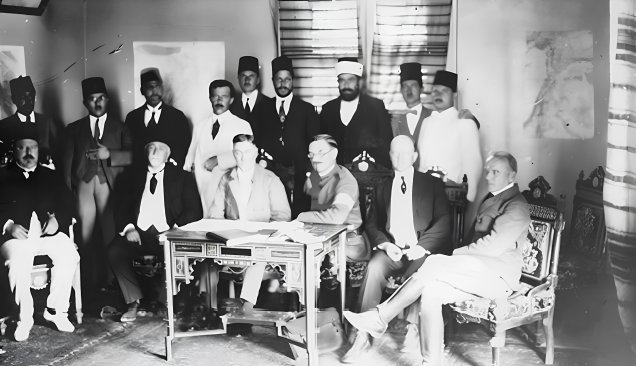
In 1919, as the victorious Allied powers met at the Paris Peace Conference to determine the political future of the territories formerly ruled by the Ottoman Empire, U.S. President Woodrow Wilson proposed sending an international commission to the Arab East to investigate the wishes of its inhabitants.
On March 27, 1919, Wilson appointed Henry Churchill King and Charles Richard Crane as the American representatives. Britain and France, however, ultimately declined to participate, leaving what had originally been envisioned as an international inquiry to proceed as an American commission. It became known as the King–Crane Commission.
The commission toured the region between June and July 1919, visiting Palestine, Syria, and Lebanon and meeting representatives from a wide range of political, religious, economic, and social groups.
For Palestinians, the commission represented a rare moment in the postwar settlement when an international delegation formally asked the inhabitants of Palestine what political future they themselves wanted at a time when European powers were preparing to impose the mandate system on the former Ottoman Arab provinces.
The Commission's Visit to Palestine
The King–Crane Commission began its regional journey in Jaffa on June 10, 1919. It spent approximately ten days in Palestine during a 42-day tour of the region.
The commissioners heard delegations representing religious leaders, merchants, mayors, political notables, tribal representatives, farmers, local councils, and groups of women.
They also collected approximately 260 petitions in Palestine, many bearing dozens of signatures or seals and reflecting the political demands of communities across the country.
A clear pattern emerged from these petitions and testimonies: much of Palestinian Arab public opinion opposed the Zionist political program and large-scale Jewish immigration, while supporting Arab independence and the political unity of Greater Syria, of which Palestine was widely regarded as an integral part.
Palestinian Demands
Palestinian representatives who appeared before the commission emphasized that Palestine was not an empty territory awaiting settlement, but an inhabited Arab country whose people believed they were entitled to political self-determination following the collapse of Ottoman rule.
Many called for the creation of an independent, unified Syrian state that would include Palestine and Lebanon, with representative government and equal citizenship regardless of religious affiliation.
This position was also expressed by the General Syrian Congress, which met in Damascus in July 1919 with representatives from different parts of Bilad al-Sham, including Palestine.
The Congress demanded complete political independence for Syria and explicitly rejected the separation of Palestine from the wider Syrian country. It also opposed Zionist plans to establish a Jewish commonwealth in Palestine and rejected Zionist immigration, while affirming equal rights and obligations for the country's existing Jewish citizens.
This distinction was important in contemporary Palestinian political discourse: opposition was directed at the Zionist political and settlement project rather than at the indigenous Jewish communities already living in Palestine.
Opposition to the Zionist Project
The King–Crane Commission entered the region with a generally sympathetic attitude toward Zionist aspirations. What its members encountered in Palestine and Syria, however, led them to substantially revise their position.
Their final report recorded that opposition to Zionism was widespread and intense. Across Syria as a whole, more than 72 percent of the petitions received by the commission—1,350 petitions—contained opposition to the Zionist program. Only the demands for Syrian unity and independence received broader support.
In Palestine itself, the commissioners noted that the overwhelming majority of the population was non-Jewish and strongly opposed turning the country into a Jewish state.
The report warned that imposing unlimited Jewish immigration on a population that clearly opposed such a policy would violate the principle that the wishes of the inhabitants should be a primary consideration in determining their political future.
The commissioners also reported that the Zionist representatives they consulted anticipated extensive acquisition of land from the existing non-Jewish population.
Most strikingly, the report stated that British officers consulted by the commission believed that implementing the full Zionist program would require military force.
The Commission's Recommendations on Palestine
On August 28, 1919, King and Crane submitted their final report.
Regarding Palestine and Zionism, they recommended a substantial reduction of the Zionist program.
- Jewish immigration into Palestine should be definitely limited.
- The project of transforming Palestine into a distinctly Jewish commonwealth or Jewish state should be abandoned.
- Palestine should remain part of a united Syrian state rather than being politically separated from Syria.
- The holy places should be protected through an international and interreligious arrangement.
- A single mandatory power should administer the united Syrian territory temporarily, with the United States as the commission's preferred choice and Britain as its second choice if the United States declined.
The commission did not reject every form of Jewish national or cultural development in Palestine. Rather, it recommended what it called a greatly reduced Zionist program and explicitly rejected the transformation of Palestine into a Jewish state against the wishes of its existing population.
Greater Syria and Self-Determination
The commission concluded that a large majority of the Arab inhabitants of the region favored political unity and independence.
It therefore recommended preserving the unity of Syria, understood at the time as including present-day Syria, Lebanon, Palestine, and Transjordan, under a single temporary mandate rather than dividing the territory permanently among competing colonial powers.
The commissioners favored a constitutional political system and argued that any mandate should be temporary, with the declared purpose of preparing the country for genuine independence rather than establishing traditional colonial rule.
These recommendations reflected the principles of self-determination that President Wilson had publicly promoted during and after the First World War.
A Report That Was Set Aside
Despite the extensive testimony collected by the commission, its findings had virtually no influence on the postwar settlement imposed on Palestine and the rest of the Arab East.
By the time King and Crane submitted their report, Britain and France were already pursuing their own strategic and colonial arrangements in the region.
The report was not publicly circulated at the time and was only published in 1922, after many of the decisive political arrangements concerning Palestine had already been made.
Britain received the Mandate for Palestine, and the mandate incorporated the commitment of the Balfour Declaration to facilitate the establishment of a Jewish national home in the country.
The Palestinian demand for national independence and representative government, which the King–Crane Commission had documented so extensively, was not implemented.
The King–Crane Report Through a Palestinian Lens
From a Palestinian historical perspective, the King–Crane Report remains an important contemporary record of Palestinian political opinion before the British Mandate was fully established.
It documented that Palestinians were articulating clear political demands for independence, representative government, Arab unity, and protection of their homeland at a time when their future was often being decided in European capitals without their consent.
The report is also significant because its commissioners did not begin their investigation as opponents of Zionism. Their recommendations changed after visiting the country, examining demographic realities, hearing Zionist representatives, and listening to the inhabitants of Palestine and the wider Syrian region.
Their conclusion was explicit: creating a Jewish state in Palestine while disregarding the wishes of the country's overwhelming non-Jewish majority could not be reconciled with the principle of self-determination and, in their assessment, would be extremely difficult to achieve without coercion.
Yet these findings did not alter the course taken by the colonial powers. The mandate system proceeded, British support for the Zionist national home remained in place, and the political conflict over immigration, land, representation, and sovereignty intensified throughout the following decades.
For Palestinian historical memory, the King–Crane Commission therefore stands as early documentary evidence that Palestinian opposition to the political transformation of their homeland was clearly expressed and formally recorded long before the Nakba of 1948.
More from the archive



 Download Our Palestine App
The whole archive in the palm of your hand: depopulated villages, the Nakba, the massacres and Al-Aqsa — free, with no ads to erase the story.
Download Our Palestine App
The whole archive in the palm of your hand: depopulated villages, the Nakba, the massacres and Al-Aqsa — free, with no ads to erase the story.


Comments
No comments yet — be the first to write one.
Add your comment
Name and email are optional. Comments appear after review.