The Camp David Accords and the Egypt–Israel Peace Treaty
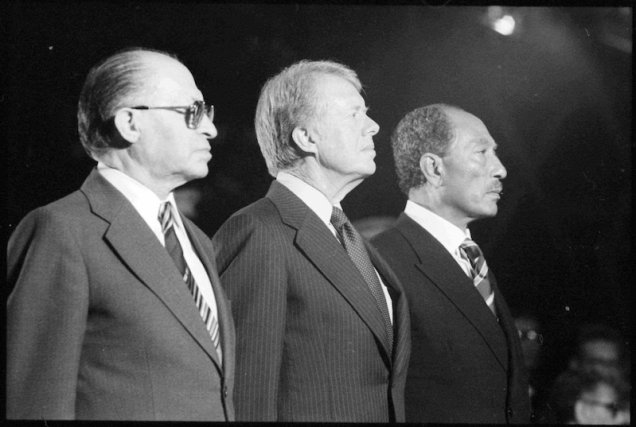
The Camp David Accords were signed on September 17, 1978, after thirteen days of negotiations between Egyptian President Anwar al-Sadat and Israeli Prime Minister Menachem Begin at the Camp David presidential retreat in the United States, under the mediation of U.S. President Jimmy Carter.
They were not themselves the final Egyptian–Israeli peace treaty.
Rather, Camp David produced two framework agreements: one addressing a broader Middle East settlement, including the Palestinian question, and another outlining the principles for a bilateral Egyptian–Israeli peace treaty.
Six months later, on March 26, 1979, Sadat and Begin signed the Egypt–Israel Peace Treaty at the White House in Washington, with Carter serving as witness.
The treaty ended the state of war between Egypt and Israel, established formal diplomatic and peaceful relations, and provided for the complete withdrawal of Israeli occupation forces and Israeli civilians from Egypt's Sinai Peninsula.
Egypt thereby became the first Arab state to conclude a peace treaty with and formally recognize Israel.
The decision produced a profound regional rupture. The Palestine Liberation Organization and most Arab governments rejected the Camp David framework, arguing that Egypt had entered a separate peace that failed to secure Palestinian national rights or comprehensive Israeli withdrawal from the territories occupied in 1967.
Before Camp David: Three Decades of Egyptian–Israeli Confrontation
The Egyptian–Israeli peace process followed approximately three decades of military confrontation.
In 1948, Egypt participated with other Arab armies in the fighting that followed the end of the British Mandate and the establishment of Israel.
For Palestinians, the same historical period became the Nakba: the mass displacement of approximately three-quarters of a million Palestinians and the destruction or depopulation of hundreds of Palestinian communities.
The Gaza Strip subsequently came under Egyptian administration, while the West Bank, including East Jerusalem, came under Jordanian rule.
The Tripartite Aggression of 1956
A second major confrontation occurred in 1956, after Egyptian President Gamal Abdel Nasser nationalized the Suez Canal Company.
Israel, Britain, and France coordinated a military attack against Egypt in what became known in the Arab world as the Tripartite Aggression.
Israeli occupation forces invaded the Sinai Peninsula and Gaza Strip, while Britain and France attacked Egyptian positions around the Suez Canal.
International pressure, particularly from the United States and the Soviet Union, ultimately forced the attacking powers to withdraw.
The Occupation of 1967
The regional balance changed again in June 1967.
Israel occupied Egypt's Sinai Peninsula, Syria's Golan Heights, and the remaining Palestinian territories—the West Bank, including East Jerusalem, and the Gaza Strip.
The Gaza Strip was under Egyptian administration before 1967 but was not sovereign Egyptian territory.
The occupation of Sinai became the central territorial issue in Egyptian policy during the following decade.
The October 1973 Confrontation
On October 6, 1973, Egypt and Syria launched a coordinated military offensive against Israeli occupation forces in Sinai and the occupied Golan Heights.
Egyptian forces crossed the Suez Canal, breached the Bar Lev defensive system, and established bridgeheads on the eastern bank.
Syrian forces simultaneously advanced into parts of the occupied Golan Heights before Israeli occupation forces mounted a counteroffensive.
The October confrontation did not militarily restore all of Sinai or the Golan, but it shattered the political and military status quo that had existed since 1967 and helped reopen a diplomatic path toward Israeli withdrawal from Egyptian territory.
From October to Negotiations
Security Council Resolution 338, adopted on October 22, 1973, called for a ceasefire, implementation of Resolution 242, and negotiations toward a just and durable settlement.
Egypt and Israel subsequently concluded their first disengagement agreement in January 1974 and a second Sinai agreement in September 1975.
These agreements produced staged Israeli occupation withdrawals from parts of Sinai and created a diplomatic process heavily mediated by the United States.
Sadat's Visit to Jerusalem
The most dramatic diplomatic step came in November 1977, when Anwar al-Sadat traveled to Jerusalem and addressed the Israeli Knesset.
His visit represented an unprecedented public opening by an Arab head of state toward direct negotiations with Israel.
Sadat presented the initiative as a means of ending war, recovering occupied Arab territory, and seeking a wider settlement.
The visit was welcomed in the United States and Israel but generated deep controversy throughout the Arab world and within the Palestinian national movement.
The Camp David Summit
Negotiations between Egypt and Israel soon encountered major disagreements, particularly over Sinai, Israeli settlements, the West Bank and Gaza, Jerusalem, and Palestinian political rights.
President Jimmy Carter therefore invited Sadat and Begin to the presidential retreat at Camp David, Maryland.
The summit began on September 5, 1978 and continued for thirteen days.
The negotiations were difficult and at several points appeared close to collapse.
Carter and his advisers frequently carried proposals and counterproposals between the Egyptian and Israeli delegations because Sadat and Begin were at times unable to negotiate effectively face to face.
Two Camp David Agreements, Not One
On September 17, 1978, Sadat and Begin signed two separate framework documents.
The first was:
A Framework for Peace in the Middle East Agreed at Camp David.
It addressed the broader Arab-Israeli conflict and contained a proposed arrangement for the West Bank and Gaza Strip.
The second was:
A Framework for the Conclusion of a Peace Treaty Between Egypt and Israel.
This document established the basic terms from which the bilateral peace treaty would subsequently be negotiated.
Jimmy Carter signed the documents as witness.
The Sinai Framework
The Egyptian–Israeli framework established the principle that Egypt would recover full sovereignty over Sinai.
Israel agreed to withdraw its armed forces and civilians from the peninsula, including the Israeli settlements established there after the occupation of 1967.
Egypt, in return, would establish peaceful and normal relations with Israel.
Security arrangements would restrict military deployments in designated areas on both sides of the international boundary.
The Palestinian Component of Camp David
The broader Camp David framework also attempted to address the Palestinian question.
It stated that a settlement should recognize the “legitimate rights of the Palestinian people” and enable Palestinians to participate in determining their own future.
But the mechanism proposed at Camp David fell substantially short of Palestinian demands for self-determination and independent statehood.
The framework proposed a five-year transitional period for the West Bank and Gaza Strip.
During that period, an elected Palestinian self-governing authority was intended to replace the existing Israeli military government and civilian administration.
Israeli occupation forces would be redeployed to specified security locations rather than being completely removed at the beginning of the transitional period.
The Proposed Palestinian Self-Government
Egypt, Israel, and Jordan were expected to negotiate the detailed arrangements for Palestinian self-government.
Palestinian representatives from the West Bank and Gaza could participate within the negotiating delegations.
The inhabitants of the territories were then supposed to elect a self-governing authority.
During the transitional period, further negotiations were to determine the final status of the West Bank and Gaza and their relationship with neighboring states.
The framework did not explicitly provide for the establishment of an independent Palestinian state.
Nor did it explicitly recognize the Palestine Liberation Organization as the representative of the Palestinian people.
No Recognition of Israeli Sovereignty Over the West Bank or Gaza
The Camp David agreements and the subsequent Egyptian–Israeli Peace Treaty did not recognize Israeli sovereignty over the West Bank, East Jerusalem, or the Gaza Strip.
This distinction is important.
Article II of the 1979 treaty defined the permanent Egyptian–Israeli boundary as the internationally recognized boundary between Egypt and the former Mandate territory of Palestine.
It specifically stated that this boundary was defined without prejudice to the status of the Gaza Strip.
The legal and political future of the Palestinian territories therefore remained unresolved.
Jerusalem Remained Unresolved
Camp David did not resolve the status of Jerusalem.
Egypt and Israel attached separate communications recording fundamentally different positions.
Sadat maintained that Arab East Jerusalem was part of the occupied West Bank and should ultimately return to Arab sovereignty.
Begin maintained Israel's position that Jerusalem was a unified city under Israeli authority.
No common formula resolving that disagreement was reached.
The Palestinian Rejection of Camp David
The Palestine Liberation Organization rejected the Camp David agreements shortly after they were announced.
From the PLO's perspective, Palestinians had been excluded from negotiating an agreement concerning their own land and political future.
The autonomy framework did not recognize Palestinian sovereignty, did not guarantee an independent Palestinian state, and did not provide a clear commitment to complete Israeli withdrawal from the West Bank and Gaza Strip.
Palestinian political organizations and many Palestinians in the occupied West Bank and Gaza therefore opposed the proposed autonomy plan.
Arab Opposition
Most Arab governments also opposed the Camp David agreements.
At the Arab summit held in Baghdad in November 1978, participants declared that the agreements had been concluded outside the framework of collective Arab decision-making and argued that they could not produce the comprehensive peace sought by Arab states.
The opposition intensified after Egypt signed the bilateral peace treaty in March 1979.
Arab governments subsequently suspended Egypt's membership in the Arab League, severed or downgraded relations with Cairo, and transferred the League's headquarters from Cairo to Tunis.
Egypt would remain outside the Arab League for approximately a decade before its membership was restored.
The Egypt–Israel Peace Treaty — March 26, 1979
The negotiations that followed Camp David lasted considerably longer than the three months originally envisioned.
Eventually, Sadat and Begin reached a final agreement.
On March 26, 1979, they signed the Treaty of Peace Between the Arab Republic of Egypt and the State of Israel on the White House lawn in Washington.
Jimmy Carter signed as witness.
The treaty entered into force on April 25, 1979 following the exchange of instruments of ratification.
Ending the State of War
Article I of the treaty formally ended the state of war between Egypt and Israel.
It provided for the establishment of peace and ultimately normal and friendly relations between the two states.
This represented the first formal peace treaty between Israel and an Arab state.
Egypt and Israel subsequently established diplomatic relations, exchanged ambassadors, and developed official economic and other forms of bilateral contact.
Full Israeli Occupation Withdrawal from Sinai
One of the treaty's most important provisions required Israel to withdraw all its armed forces and civilians from Sinai.
The withdrawal was to take place in stages.
The first major phase moved Israeli occupation forces eastward to a line running roughly from east of al-Arish to Ras Muhammad.
The final withdrawal was to be completed within three years after the treaty entered into force.
Egypt would then resume full sovereignty over the peninsula.
The Removal of Israeli Settlements from Sinai
The withdrawal provision applied not only to military forces but also to Israeli civilians.
Israeli settlements established in Sinai after 1967 were therefore evacuated and dismantled.
The removal of the settlements was one of the most politically difficult issues for Menachem Begin and his government.
It nevertheless became a binding part of Israel's withdrawal obligations.
The International Boundary
The treaty restored the internationally recognized boundary between Egypt and the former Mandate territory of Palestine as the permanent Egyptian–Israeli border.
Both governments committed themselves to respect that boundary and each other's territorial integrity.
The treaty explicitly stated that the boundary arrangement was without prejudice to the status of the Gaza Strip.
This clause further demonstrates that Egypt did not recognize Israeli sovereignty over Gaza through the peace treaty.
Normalization
The treaty provided for more than simply the absence of military confrontation.
Egypt and Israel agreed to establish normal relations including:
- Full diplomatic recognition.
- Diplomatic relations and exchange of representatives.
- Economic relations.
- Cultural relations.
- Termination of economic boycotts and discriminatory restrictions.
- Freedom of movement of people and goods subject to the laws of both states.
Egypt thus became the first Arab state to formally establish full diplomatic relations with Israel.
Security Arrangements in Sinai
Egypt's recovery of Sinai was accompanied by extensive security restrictions.
The peninsula and the adjacent Israeli border area were divided into zones with different permitted levels of military personnel and equipment.
Egyptian forces could deploy in agreed strengths in particular zones, while areas closer to the Israeli border were subject to considerably greater military limitations.
A corresponding limited-force zone was established on the Israeli side of the international boundary.
These arrangements were intended to reduce the possibility of a surprise military confrontation and provide both governments with security assurances.
The United Nations Force That Was Never Established
The treaty originally envisaged United Nations forces and observers supervising the security arrangements.
Egypt and Israel agreed to request the United Nations to operate checkpoints, conduct reconnaissance patrols, verify force limitations, and assist in ensuring freedom of navigation through the Strait of Tiran.
This plan was never implemented in the permanent form envisaged by the treaty.
Opposition within the Security Council made it impossible to obtain authorization for the required United Nations peacekeeping deployment.
The Multinational Force and Observers
Egypt, Israel, and the United States consequently negotiated an alternative.
On August 3, 1981, a protocol established the Multinational Force and Observers (MFO).
The MFO is an independent international organization rather than a United Nations peacekeeping mission.
Its principal task is to monitor implementation of the security provisions of the Egyptian–Israeli Peace Treaty in Sinai.
It remains in operation decades later.
Freedom of Navigation
Egypt agreed that Israeli ships and cargoes destined for or originating in Israel would enjoy freedom of passage through the Suez Canal in accordance with international law.
The parties also recognized the Strait of Tiran and the Gulf of Aqaba as international waterways open to shipping and overflight.
These provisions addressed issues that had played an important role in previous Egyptian–Israeli confrontations.
Preventing Hostile Acts
Egypt and Israel undertook to refrain from organizing, instigating, assisting, or participating in acts or threats of war, hostility, subversion, or violence against the other.
Each government also accepted responsibility for ensuring that such acts were not carried out from territory under its control.
These commitments were intended to transform the relationship from an armistice-based military confrontation into a state-to-state peace.
Sinai Returns to Egyptian Sovereignty
Israeli occupation withdrawal proceeded in stages after the treaty.
On April 25, 1982, the principal final stage was completed and Egypt recovered sovereignty over almost all of Sinai.
A dispute remained concerning the small border area of Taba.
That dispute was later submitted to international arbitration.
Taba was ultimately returned to Egyptian sovereignty in 1989.
What Egypt Gained
From the Egyptian state's perspective, the most concrete achievement of the agreement was the recovery of Sinai.
Territory occupied by Israel in 1967 returned to Egyptian sovereignty.
Israeli military installations and settlements were removed.
Egypt recovered the strategically and symbolically important peninsula through a combination of the military transformation produced in October 1973 and the diplomatic process that followed.
What Happened to the Palestinian Framework?
The Palestinian component of Camp David produced a very different result.
Egyptian and Israeli delegations opened negotiations in 1979 on the proposed autonomy arrangements for the West Bank and Gaza.
Jordan did not join the process, and the PLO rejected it.
Fundamental disagreements persisted over the powers of the proposed self-governing authority, control of land and security, settlements, Jerusalem, sovereignty, and the final political status of the territories.
The five-year transitional autonomy system envisaged at Camp David was therefore never implemented in the form proposed in 1978.
The Palestinian Critique
From a Palestinian historical perspective, Camp David created a sharp contrast between the Egyptian and Palestinian territorial questions.
Egypt received a binding commitment to complete Israeli withdrawal from Sinai and the removal of Israeli settlements there.
Palestinians received a proposal for limited transitional self-government whose final outcome was left for future negotiations.
There was no explicit commitment to an independent Palestinian state.
There was no equivalent binding commitment requiring complete Israeli occupation withdrawal from the West Bank, East Jerusalem, and Gaza.
There was no agreement on Jerusalem.
The PLO, which had been recognized by the Arab League in 1974 as the sole legitimate representative of the Palestinian people, was not a party to the negotiations.
These factors explain the strong Palestinian rejection of the accords.
Egypt's Separation from the Arab-Israeli Military Front
The treaty also profoundly changed the strategic balance of the region.
Egypt possessed the largest Arab army and had participated in every major Arab-Israeli military confrontation since 1948.
The peace treaty removed the Egyptian–Israeli front from the cycle of interstate warfare.
Supporters of the treaty regarded this as a major achievement that recovered Egyptian territory and prevented further wars between the two countries.
Palestinian organizations and many Arab governments, by contrast, argued that a separate Egyptian peace weakened collective Arab leverage before Israel had ended its occupation of Palestinian and Syrian territories.
The Arab League Suspends Egypt
The Arab response became formal shortly after the peace treaty was signed.
On March 31, 1979, Arab governments meeting in Baghdad adopted measures that included suspending Egypt's membership in the Arab League, suspending diplomatic relations with Cairo, and transferring the League's headquarters from Cairo to Tunis.
These measures demonstrated the scale of the political rupture produced by the separate Egyptian–Israeli treaty.
Egypt's Arab League membership was later restored, and the organization's headquarters eventually returned to Cairo.
Sadat's Assassination
The peace treaty remained deeply controversial within Egypt as well.
On October 6, 1981, Anwar al-Sadat was assassinated during a military parade in Cairo by members of an Egyptian Islamist militant organization.
His assassination occurred on the anniversary of the October 1973 offensive.
Opposition to the peace with Israel formed part of the broader political and ideological context surrounding hostility toward Sadat, although the motives of those responsible also involved major domestic political and religious conflicts inside Egypt.
A Durable Egyptian–Israeli Treaty
Despite intense regional opposition at the time, the bilateral treaty survived the political crises and wars that followed.
Egypt and Israel did not return to interstate war.
Diplomatic relations and treaty security arrangements continued, even during periods of severe deterioration in wider Arab-Israeli and Palestinian-Israeli relations.
The MFO has continued to monitor the security arrangements in Sinai.
The Historical Significance of Camp David
Camp David changed the political geography of the Arab-Israeli conflict.
For Egypt, it created the diplomatic path that led to the complete withdrawal of Israeli occupation forces and settlers from Sinai and the recovery of Egyptian sovereignty over the peninsula.
For Israel, it produced peace and diplomatic recognition from the most populous Arab state and removed Egypt from future interstate military confrontation.
For the United States, it represented one of the most significant achievements of American mediation in the Middle East.
For the Palestinian national movement, however, its legacy was markedly different.
Camp David addressed Palestinians through an autonomy formula rather than recognizing an independent Palestinian state and left the central issues of occupation, sovereignty, Jerusalem, settlements, refugees, and self-determination unresolved.
Sinai Recovered, Palestine Unresolved
The contrast became increasingly evident over time.
The treaty contained a binding timetable for Israel's complete withdrawal from Egyptian Sinai.
No comparable timetable was established for the withdrawal of Israeli occupation forces from the West Bank, East Jerusalem, or Gaza Strip.
Sinai returned to Egypt.
The Palestinian territories occupied in 1967 did not achieve sovereignty through the Camp David framework.
The Palestinian autonomy negotiations eventually stalled, and the Palestinian question remained unresolved until a different negotiating framework emerged more than a decade later through Madrid and Oslo.
The Legacy of the Egypt–Israel Peace Treaty
The Camp David Accords and the 1979 Peace Treaty therefore produced two very different historical trajectories.
One resulted in a completed territorial settlement between Egypt and Israel, the dismantling of Israeli settlements in Sinai, normalization, and the restoration of Egyptian sovereignty.
The other—the Palestinian track—remained unfinished.
The framework acknowledged that Palestinians possessed legitimate rights and should participate in determining their future, but it did not define those rights as independent statehood, did not recognize Palestinian sovereignty, and did not resolve the occupation created in 1967.
From a Palestinian historical perspective, this distinction is central to understanding Camp David.
It demonstrated that negotiated Israeli withdrawal and removal of settlements were possible when incorporated into a binding state-to-state treaty.
At the same time, the absence of an equivalent binding commitment on Palestine left the West Bank, East Jerusalem, and Gaza at the center of an unresolved conflict that would continue long after Egypt recovered Sinai.
More from the archive



 Download Our Palestine App
The whole archive in the palm of your hand: depopulated villages, the Nakba, the massacres and Al-Aqsa — free, with no ads to erase the story.
Download Our Palestine App
The whole archive in the palm of your hand: depopulated villages, the Nakba, the massacres and Al-Aqsa — free, with no ads to erase the story.

Comments
No comments yet — be the first to write one.
Add your comment
Name and email are optional. Comments appear after review.