Palestinian Agriculture Before the Nakba: Crops, Land and Rural Life
```html

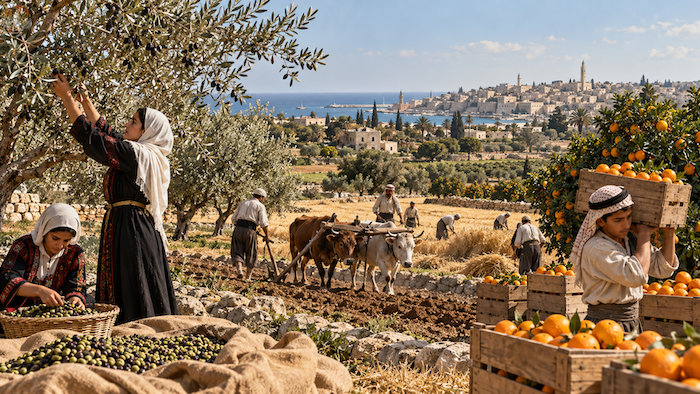
Before 1948, the land was the primary source of livelihood for most Palestinians. In the villages, life revolved around rainfall, plowing, threshing floors, and olive harvesting. On the coastal plain, meanwhile, orange groves supported an entire export industry that made Jaffa famous in European markets.
This article brings together what primary sources document about Palestinian agriculture: what was cultivated, where crops were grown, which methods were used, how much agricultural production was worth, and how land ownership and use were organized. It draws primarily on A Survey of Palestine, prepared by the Government of Mandatory Palestine in 1945–1946; the report of the United Nations Special Committee on Palestine; and the 1945 village statistics presented by the Interactive Encyclopedia of the Palestinian Question. Each figure is attributed to its relevant year and source.
Agriculture at a Glance
- £P 17.1 million
- The value of Arab agricultural production across the main crop groups in the 1944–1945 season, out of a total of £P 21.8 million, excluding citrus fruits.
- Approximately two-thirds of exports
- Citrus fruits accounted for £P 3.75 million out of Palestine's total exports of £P 5.68 million in 1938.
- 11,007 citrus groves
- The number of registered citrus groves in 1945, approximately 90% of which were smaller than 50 dunums.
- £P 3.37 million
- The value of olive production in 1944–1945, 98% of which came from Arab agriculture.
1. Agricultural Regions
Palestine did not have a single agricultural pattern. Soil, rainfall, elevation, and proximity to markets shaped distinct agricultural regions, each with its own crops and seasonal rhythms. The 1945 village records clearly demonstrate this diversity, classifying village land according to categories such as cereals, irrigated land or orchards, citrus and bananas, and land considered unsuitable for cultivation.
The Coastal Plain
The coastal plain contained some of Palestine's most fertile land and areas with abundant groundwater. Citrus groves spread wherever wells could be dug, particularly around Jaffa, Lydda, Ramle, and Tulkarm. Cereals, vegetables, watermelons, and vineyards were also cultivated. Production was connected to ports, railways, and packing centers, making the coastal plain the agricultural region most closely linked to overseas markets.
Galilee
Villages in Galilee combined cereal cultivation on the plains with olive growing on the slopes, alongside watermelons, melons, vegetables, livestock raising, and dairy production. Kuwaykat in the District of Acre exemplified this mixed agricultural economy: its inhabitants cultivated cereals, olives, and watermelons and raised livestock.
The Central Highlands
In the mountains around Nablus, Jerusalem, and Hebron, agriculture relied on terraced hillsides, where stone retaining walls transformed slopes into cultivable land. Olives, grapes, figs, almonds, and apricots, alongside wheat and barley, formed the backbone of village agriculture. Farming depended largely on rainfall, supplemented by springs, wells, and cisterns where available.
The Jordan Valley
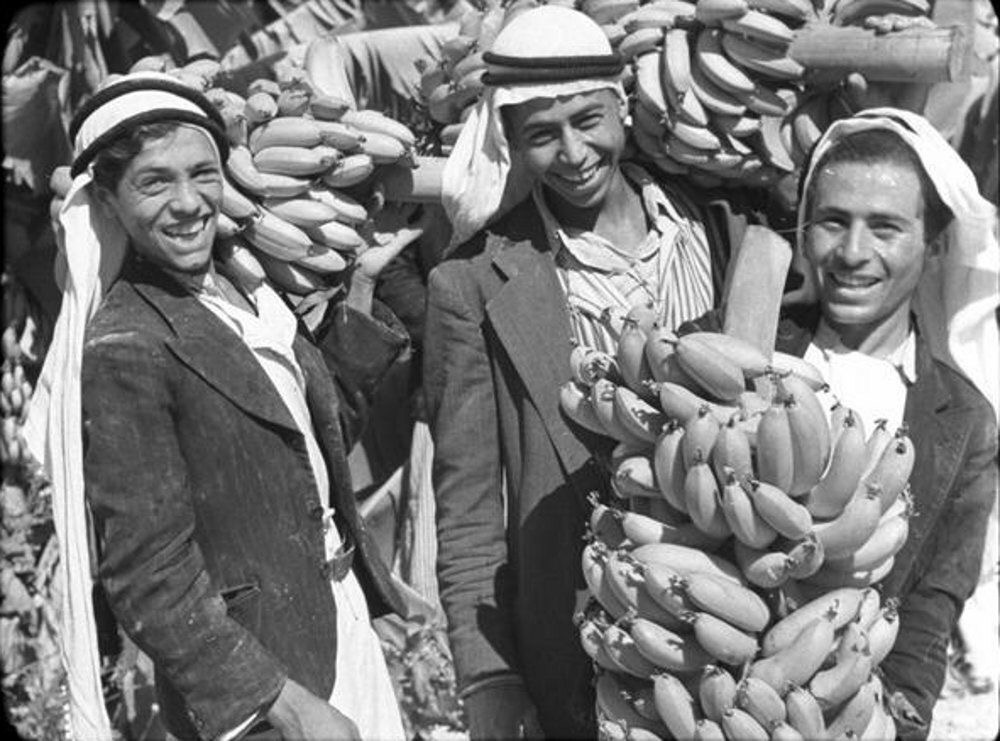
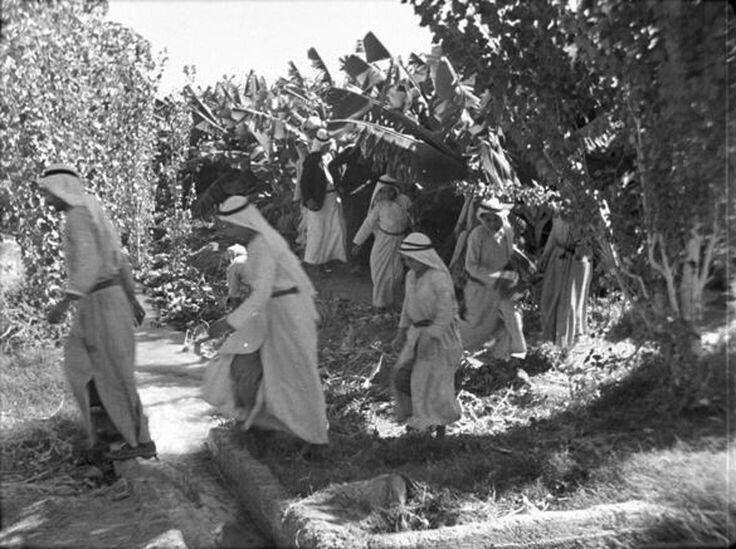
The Jordan Valley's warm winters and spring-fed water sources supported early-season and irrigated crops, including vegetables and bananas around Jericho, as well as livestock grazing.
The South and the Negev
In the south, agriculture was closely tied to variable rainfall. Rain-fed cereals, particularly barley, were common, alongside the raising of sheep, goats, and camels. However, the south was not exclusively pastoral: villages in the District of Gaza, such as Isdud, combined cereal cultivation with citrus groves, vineyards, and fig orchards. Patterns of livelihood varied between established villages and Bedouin communities.

2. Main Crops
Wheat, Barley, and Maize
Cereals were among the most widespread crops by cultivated area and formed the basis of the rural diet. In Ajjur, in the District of Hebron, for example, 25,227 dunums were allocated to cereals in 1944–1945, compared with just 2,428 dunums of irrigated land and orchards. The value of cereal production in Arab agriculture reached £P 4.4 million that season.
Olives
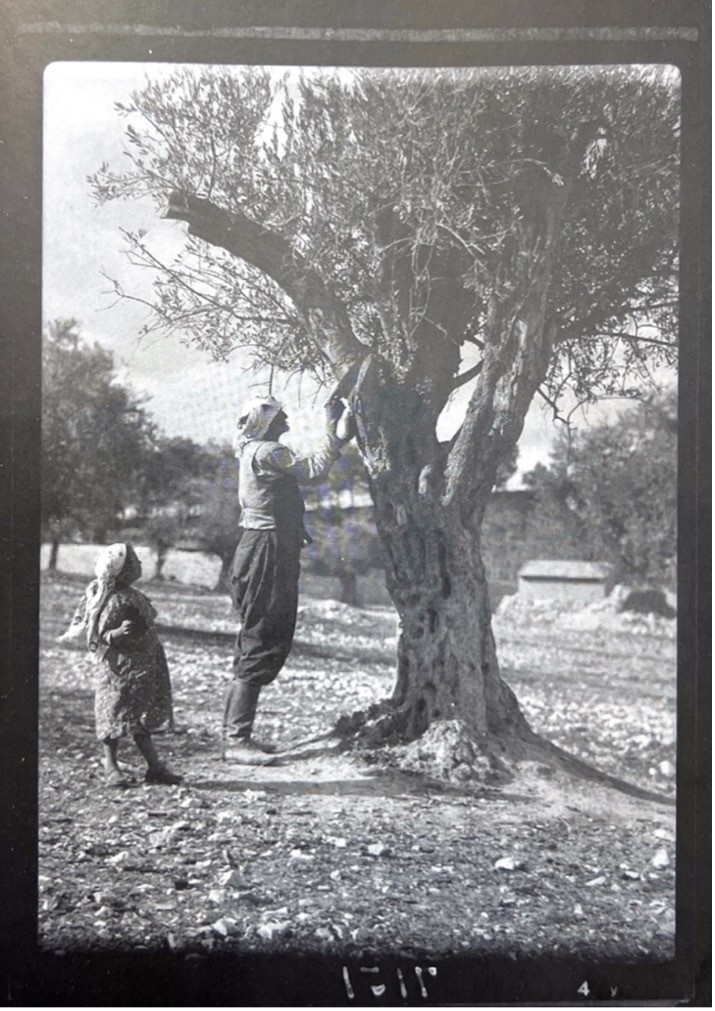
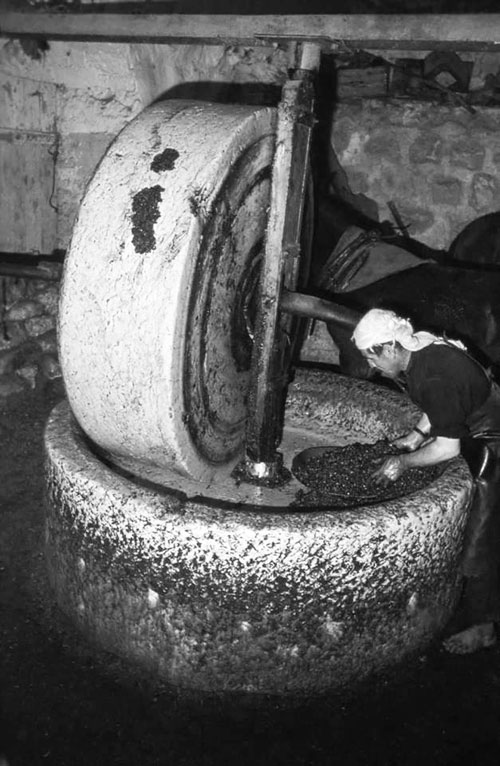
Olives were particularly characteristic of the Palestinian highlands. Olive trees required no intensive irrigation and provided both oil and preserved olives. Olive-mill waste, known as jift, was used as fuel. The autumn harvest involved entire families, after which the olives were transported to presses that, alongside flour mills, formed the heart of the rural economy. Figures for 1944–1945 show that olive production was overwhelmingly Arab: its value in Arab agriculture reached £P 3.32 million, compared with just £P 53,000 in Jewish agriculture.

Grapes, Figs, and Other Fruit Trees
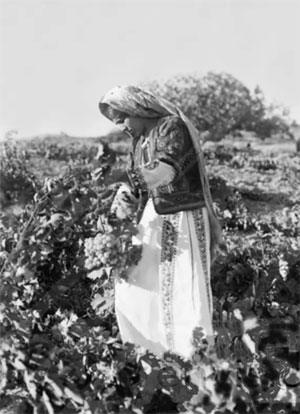
Grapes, figs, apricots, almonds, pomegranates, and apples were cultivated according to the conditions of each region. The vineyards of Hebron, Bethlehem, and Ramallah were well known, and many orchards contained several varieties of fruit. Not all fruit was consumed fresh: figs were dried, as were grapes to produce raisins, while grape molasses and malban, a traditional fruit confection, were prepared for the winter months.
Vegetables
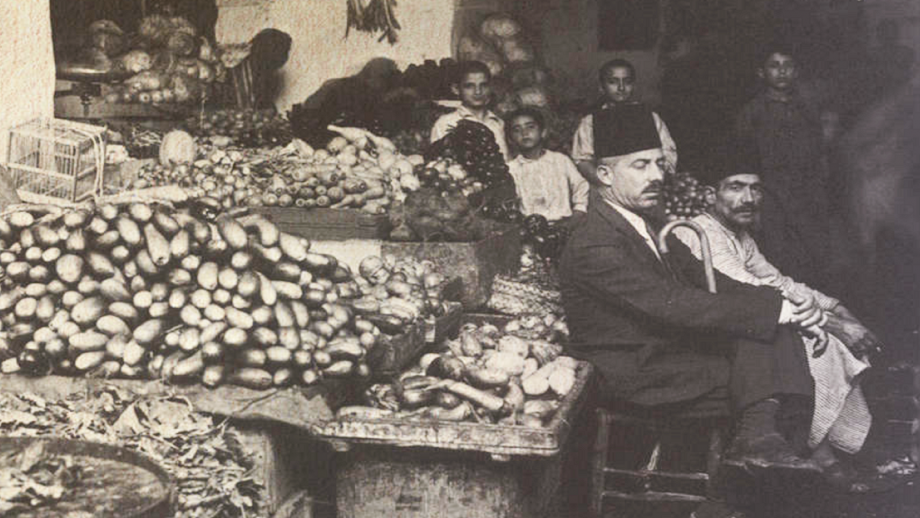
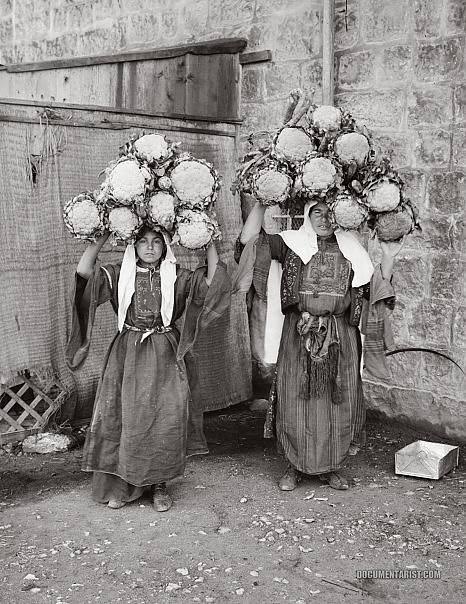
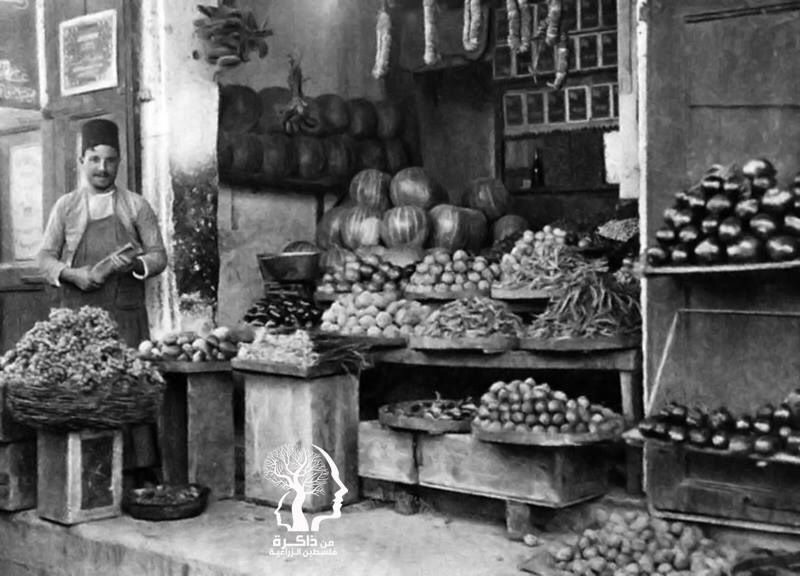
Vegetable crops included tomatoes, potatoes, beans, eggplants, zucchini, cabbage, onions, and many others, grown either with rainfall or irrigation. As cities expanded during the 1930s and 1940s, commercial vegetable production increased. By 1944–1945, vegetables had become the most valuable crop group in Arab agriculture, worth approximately £P 5.1 million.
Watermelons and Melons
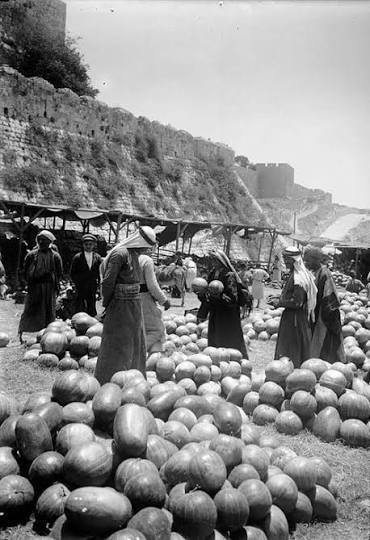
The coastal plains and Galilee were known for their summer melon fields. Records for villages such as al-Damun and Kuwaykat mention watermelon cultivation alongside cereals and olives. The value of watermelon production in Arab agriculture approached £P 1 million in 1944–1945.
3. Jaffa Oranges and Citrus
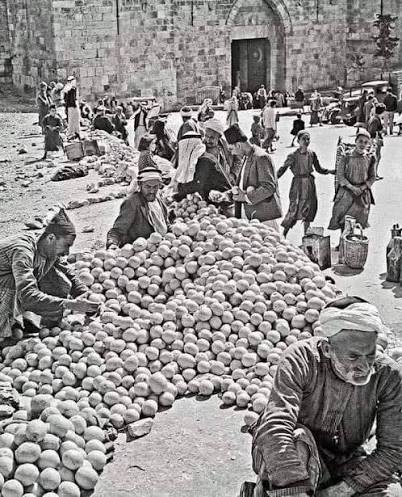
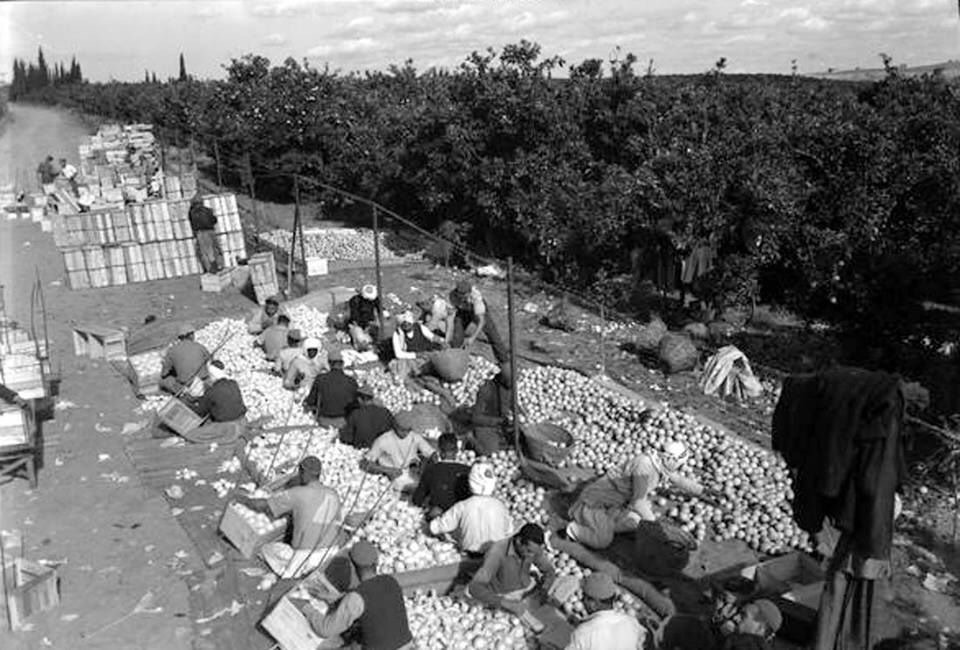
In the decades before the Nakba, citrus became Palestine's most important export commodity. The groves benefited from groundwater beneath the coastal plain and from proximity to the Port of Jaffa. A network of related activities developed around them: digging wells and installing pumps, tending trees, harvesting, sorting, wrapping fruit in paper, packing it into wooden crates, transporting it, and exporting it. The Shamouti orange, internationally known as the Jaffa orange, was the most famous variety.
Export figures demonstrate the sector's importance. In 1938, Palestine's exports were worth approximately £P 5.68 million, of which £P 3.75 million came from citrus fruits—nearly two-thirds of total exports.
Not all groves were large estates. The 1945 census shows that most were small or medium-sized holdings:
| Grove Area | Number of Groves | % of All Groves | % of Total Area |
|---|---|---|---|
| Less than 5 dunums | 1,560 | 14.3 | 1.9 |
| 5–10 dunums | 2,807 | 25.5 | 8.0 |
| 10–20 dunums | 3,006 | 27.3 | 16.4 |
| 20–50 dunums | 2,444 | 22.2 | 28.5 |
| 50–100 dunums | 843 | 7.6 | 22.7 |
| More than 100 dunums | 347 | 3.1 | 22.5 |
| Total | 11,007 | 100 | 100 |
Source: A Survey of Palestine, Supplement, p. 36. The figures cover all citrus groves in Palestine, without distinguishing by ownership.
In other words, approximately 90% of the groves were smaller than 50 dunums, but they occupied only 55% of the total area. The remaining area was distributed among a relatively small number of larger groves.
Citrus exports were severely disrupted during the Second World War because shipping routes were interrupted, but exports subsequently resumed. In the 1945–1946 season, exporters recorded the following figures:
| Product | Number of Boxes | Estimated Value (£P) |
|---|---|---|
| Oranges | 4,014,165 | 2,736,000 |
| Grapefruit | 832,842 | 535,000 |
| Lemons and Other Citrus Fruits | 51,826 | 34,000 |
| Bulk Exports (Box Equivalents) | 483,207 | 191,000 |
| Total | 5,382,040 | 3,496,000 |
Source: A Survey of Palestine, Supplement, p. 36. Values are free on board (F.O.B.) and exclude the cost of boxes. The British Ministry of Food purchased 54% of packed exports.
Citrus groves extended beyond Jaffa to other coastal areas. In Umm al-Faraj, in the District of Acre, citrus and bananas occupied 745 dunums out of 805 dunums of agricultural land classified in the village record for 1945.
4. Irrigation and Seasonal Labor
Rain-Fed and Irrigated Agriculture
Most farmland depended on rainfall and was cultivated through rain-fed agriculture. The success of each season therefore depended on the amount and timing of rain. Irrigated agriculture relied on wells and springs. On the coastal plain, artesian wells and pumps spread alongside citrus groves. In the mountains, springs at the bottoms of valleys supplied water, as in Sar'a, in the District of Jerusalem, where inhabitants combined rain-fed farming with spring irrigation. In Isdud, residents relied on both rainfall and well irrigation.
Terraced Hillsides
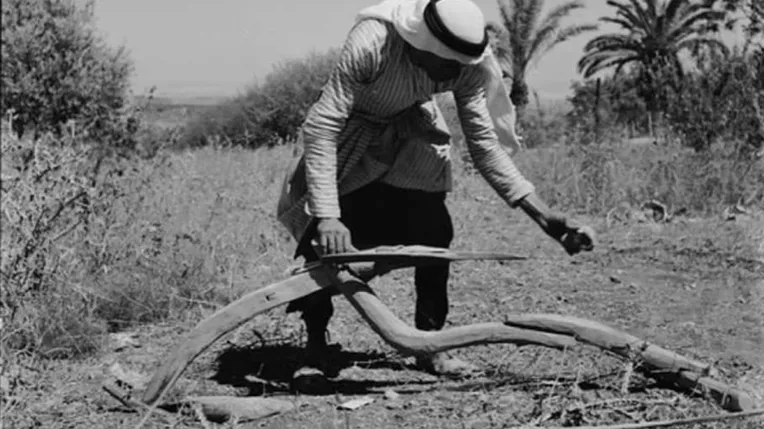
Stone terraces were a traditional means of conserving soil, preventing erosion, and capturing rainwater. They enabled farmers to cultivate olives and grapevines on slopes that would otherwise have been difficult to plow.
The Agricultural Year
| Period | Main Activities |
|---|---|
| October–November | Olive harvesting and pressing; preparing for plowing with the first rains. |
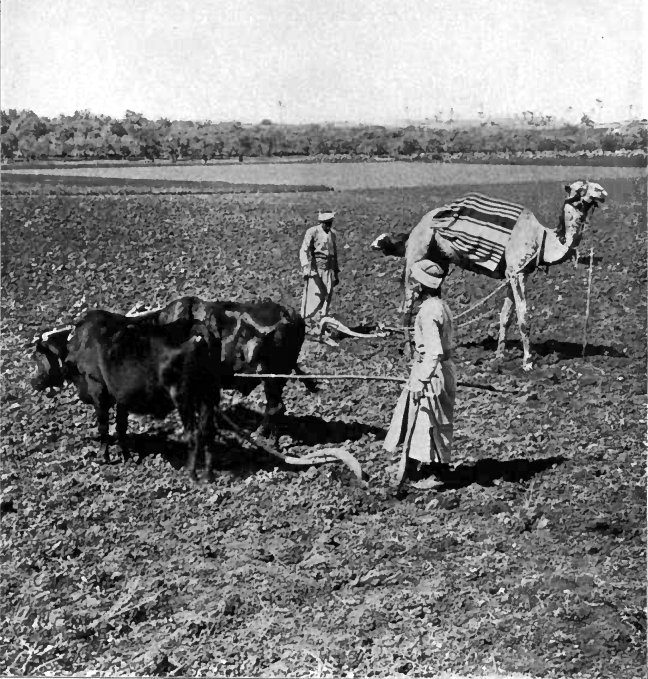
| November–January | Plowing and sowing wheat, barley, and lentils; the beginning of the orange-harvesting and export season. |
| February–April | Weeding fields, planting melons and summer vegetables, and continuing the citrus season. |
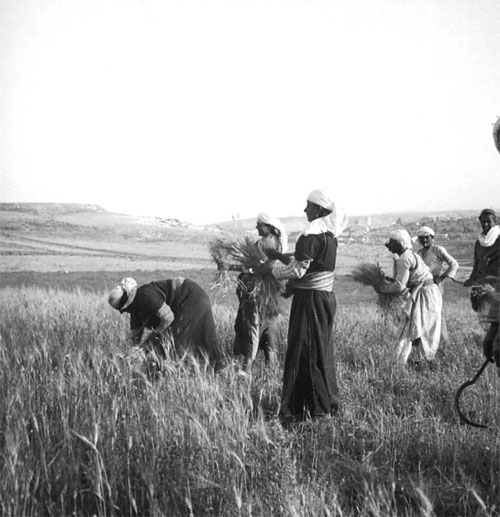
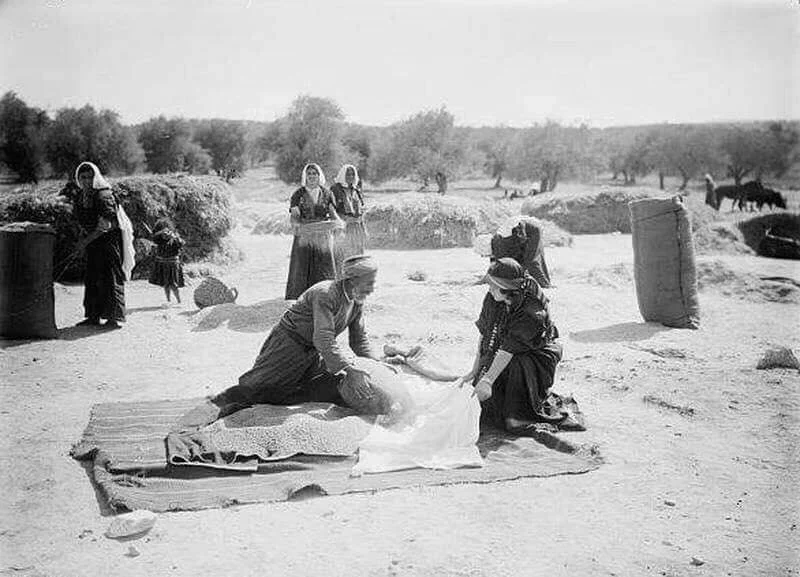
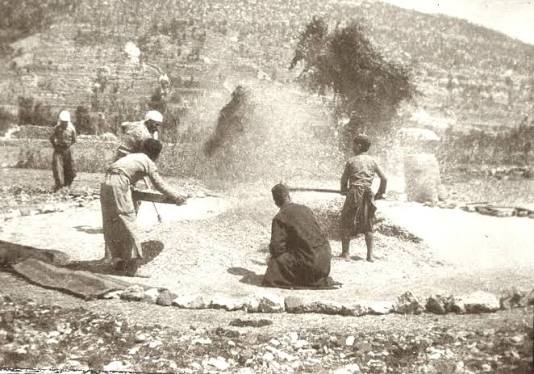
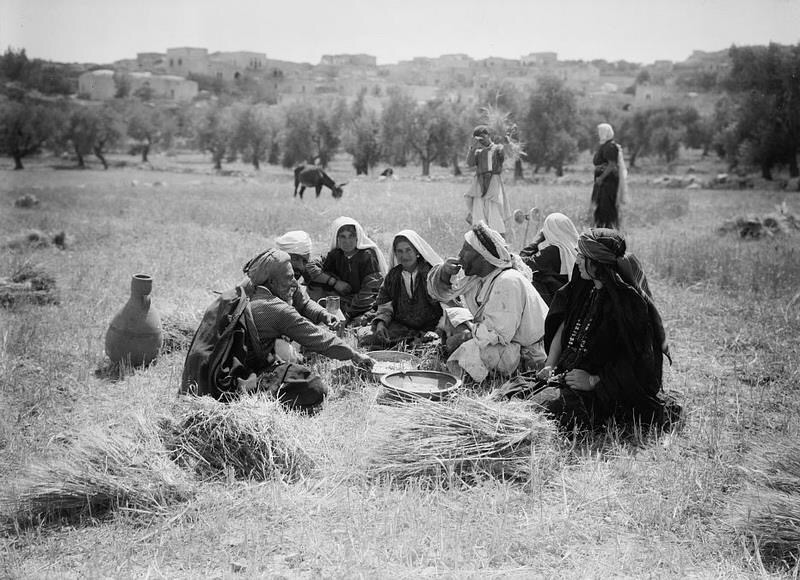
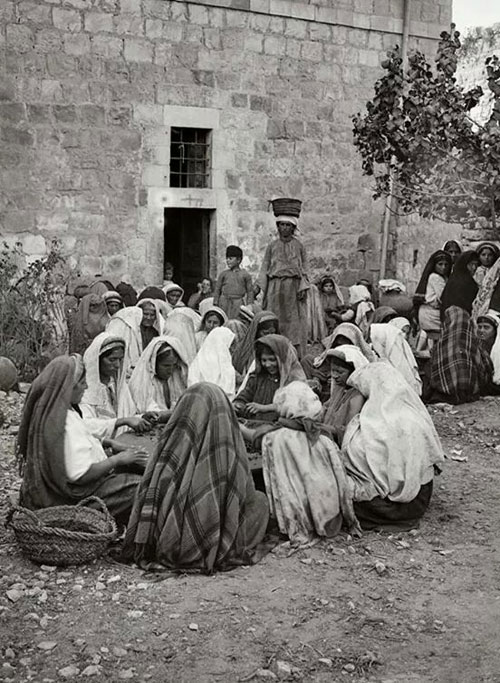
| May–June | Harvesting grain and transporting it to threshing floors. |
| July–September | Threshing and winnowing grain, storing the harvest, and picking and drying grapes and figs. |
These dates are approximate and varied according to region, elevation, and the timing of rainfall.
5. Land Tenure and Ownership
Understanding Palestinian agriculture requires an understanding of the land-tenure system. During the Mandate period, the Ottoman Land Code of 1858 and its classifications remained influential. These included mulk, privately owned land held in full ownership, and miri, land whose underlying title belonged to the state but over which farmers held inheritable rights of use.
Musha' (Communal Land)
Many villages practiced the musha' system, under which land was held communally by the village or its extended families. Cultivation shares were periodically redistributed among families by lot, with the aim of giving everyone a fair share of both good and poor land. Through the Land Settlement Ordinance of 1928 and subsequent measures, the British Mandate government sought to partition communal land and register it in individual names. This process remained incomplete in many areas by 1948.
Ownership, Land Use, and Agricultural Suitability
When reading the 1945 records, three distinct concepts must be kept separate:
- Ownership: The party recorded as owning the land according to the source's classification, such as Arab, Jewish, or public.
- Land use: The actual purpose for which the land was designated, such as cereals, orchards, citrus, or construction.
- Agricultural suitability: A classification describing the land's potential; it does not, by itself, establish that the land was cultivated in a particular year.
The Interactive Encyclopedia of the Palestinian Question notes that ownership data were derived from tax records dated 1 April 1945. It also explains that the public-land category may include land that villagers actually used for grazing, gathering firewood, and cultivation. Ownership tables should therefore be presented separately from land-use tables, with the original classification clearly identified.
6. Agriculture and the Rural Economy
Agriculture was connected to a wider network of weekly markets, flour mills, olive presses, and transport routes. Some villages produced mainly for their own needs, while others specialized in crops sold in cities or exported abroad. Al-Faluja, in the District of Gaza, illustrates this overlap: its inhabitants cultivated cereals, vegetables, and fruit through rain-fed farming, while trade was another important activity. The village also hosted a weekly market attended by traders from neighboring villages.
Rural life, however, was not always prosperous. Many farmers faced small and fragmented holdings resulting from inheritance, fluctuating harvests, and debts to merchants and moneylenders charging high interest. In 1930, the Johnson–Crosbie Committee documented farmers' economic conditions and noted widespread indebtedness among them. During the Second World War, rising agricultural prices eased the burden of debt for many farmers.
For this reason, agricultural importance cannot be measured by cultivated area alone. The area under cultivation, crop volume, monetary value, and the proportion consumed by households versus sold on the market are different indicators, and none can replace the others.
7. Agriculture in Numbers: The 1944–1945 Season
In A Survey of Palestine, the Government of Mandatory Palestine published a table showing the value of agricultural production across major crop groups, distinguishing between Arab and Jewish agriculture. The United Nations Special Committee on Palestine reproduced the figures in its report. The amounts are expressed in Palestinian pounds, not in weights or areas.
Important note: The original table excludes citrus fruits and livestock production. The total below therefore represents only the crop groups listed, not the total value of all agricultural production in Palestine. Citrus figures are presented in Section 3.
| Crop Group | Arab Agriculture (£P) | Jewish Agriculture (£P) | Total (£P) | Arab Share |
|---|---|---|---|---|
| Cereals | 4,403,409 | 497,048 | 4,900,457 | 90% |
| Vegetables | 5,113,553 | 1,745,870 | 6,859,423 | 75% |
| Fodder | 156,847 | 951,178 | 1,108,026* | 14% |
| Fruit (excluding citrus) | 3,139,374 | 1,379,620 | 4,518,994 | 69% |
| Olives | 3,320,320 | 53,235 | 3,373,555 | 98% |
| Watermelons and Melons | 969,630 | 83,975 | 1,053,605 | 92% |
| Total of Listed Groups | 17,103,133 | 4,710,926 | 21,814,059 | 78% |
Source: A Survey of Palestine, Vol. I, Chapter IX, Table 7, p. 327; and the Report of the United Nations Special Committee on Palestine (1947). The Arab share was calculated from the table's figures and rounded. * As reported in the source; the sum of the two columns is £P 1,108,025, reflecting a one-pound discrepancy in the original figures.
How Should These Figures Be Read?
The figures show that Arab agriculture produced the greater share of Palestine's staple foods, including cereals, vegetables, olives, and fruit. Jewish agriculture, by contrast, was more heavily oriented toward fodder associated with dairy cattle and toward citrus, which is not included in this table. However, the table does not measure yield per dunum or account for differences in cultivated area, prices, capital, or technology. It describes one agricultural season, not an average for the entire Mandate period.
8. Examples from Palestinian Villages
The 1945 village statistics make it possible to examine agriculture at the level of individual villages. The following table brings together six villages from different regions and illustrates the significant differences between their agricultural patterns.
| Village | District | Cereals | Irrigated Land or Orchards | Including Olives | Citrus and Bananas |
|---|---|---|---|---|---|
| Ajjur | Hebron | 25,227 | 2,428 | — | — |
| Isdud | Gaza | 22,170 | 8,322 | — | 1,921 |
| al-Damun | Acre | 16,256 | 706 | 484 | — |
| Kuwaykat | Acre | 3,316 | 1,246 | 500 | — |
| Sar'a | Jerusalem | 2,979 | 194 | 115 | — |
| Umm al-Faraj | Acre | — | — | — | 745 |
Source: Interactive Encyclopedia of the Palestinian Question, based on the 1945 village statistics. A dash (—) means that a figure was not listed in the record used here, not that the value was zero. Olive-growing area is included within the irrigated-land-or-orchards category.
What Do These Examples Tell Us?
Ajjur was predominantly a cereal-growing village, with rain-fed olives and flocks of goats and sheep. Isdud, on the southern coastal plain, combined extensive cereal fields with citrus groves, vineyards, and fig orchards. Al-Damun cultivated wheat, barley, and maize alongside olives, watermelons, and melons. Kuwaykat combined cereals and olives with livestock raising and dairy production. The mountainous village of Sar'a relied on rain-fed agriculture and spring irrigation in the valley bottoms. Umm al-Faraj, meanwhile, was a citrus-growing village: citrus and bananas occupied approximately 93% of its classified agricultural land.
The conclusion is that Palestinian agriculture cannot be reduced to Jaffa oranges or olives alone. Documenting each village must begin with its own records.
9. The Nakba and Its Impact on Agriculture
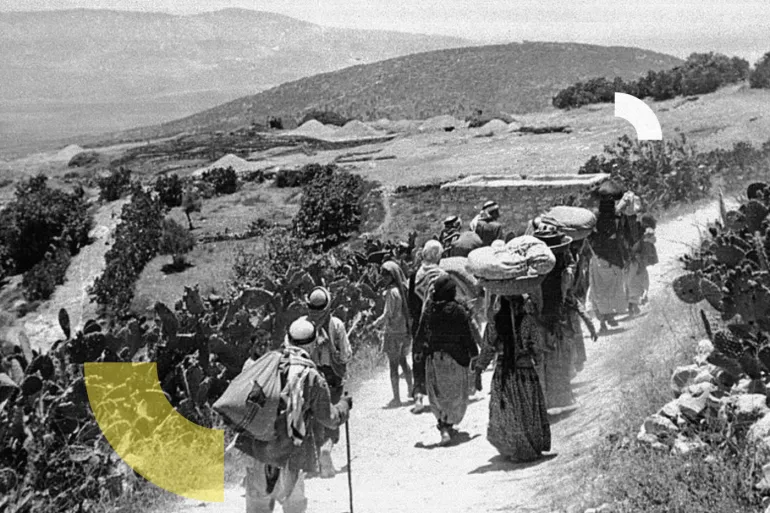
The 1948 war and the forced displacement of Palestinians brought a profound rupture to rural life. Residents of hundreds of villages were displaced, losing their homes, land, and livelihoods. Many villages were destroyed or emptied of their inhabitants. The loss was not simply that of a single harvest: it meant losing access to fields, citrus groves, wells, olive presses, and threshing floors, as well as the collapse of local labor and trading networks and the dispersal of families whose lives depended on farming and livestock.
Documents of the United Nations Conciliation Commission for Palestine, including field visits to Arab citrus groves in the areas of Jaffa, Ramle, Lydda, Tulkarm, and Acre, record that extensive areas were left unattended after their owners were displaced. In one group of villages, only approximately 200 dunums out of 2,000 dunums of citrus groves were being tended, while irrigation infrastructure was destroyed at other sites.
The impact varied from one region to another. The fate of the coastal citrus groves differed from that of rain-fed fields in mountain villages, and each displaced village had its own circumstances. Every location must therefore be documented through its own records and sources rather than through broad generalizations. The Interactive Encyclopedia of the Palestinian Question allows readers to investigate individual villages, including their agricultural activities before 1948, the dates of their occupation and the displacement of their inhabitants, and the subsequent fate of their lands.
Frequently Asked Questions
What were the main agricultural crops in Palestine before the Nakba?
Wheat, barley, maize, olives, vegetables, grapes, figs, other fruit trees, watermelons, melons, and citrus fruits on the coastal plain. The importance of each crop varied by region.
What was the value of Arab agricultural production in 1944–1945?
Approximately £P 17.1 million for the main crop groups, excluding citrus, out of £P 21.8 million for all the groups listed, according to A Survey of Palestine.
Why was Jaffa famous for its oranges?
The coastal plain had fertile soils, abundant groundwater, and access to the Port of Jaffa. A complete industry developed around the groves, including packing, transportation, and export. Citrus fruits accounted for nearly two-thirds of Palestine's exports in 1938.
Did all Palestinian villages depend on olives?
No. Some villages relied primarily on cereals, while citrus and bananas were prominent in certain coastal villages. Other communities combined olives and cereals with fruit growing and livestock raising.
What was the musha' system?
A communal land-tenure system in which village land was held collectively and cultivation shares were periodically redistributed among families. The Mandate authorities sought to partition and register such land in individual names through land-settlement procedures.
What are the main sources for studying Palestinian agriculture before 1948?
A Survey of Palestine (1945–1946), the 1947 report of the United Nations Special Committee on Palestine, the 1945 village statistics, UN Conciliation Commission documents, village records in the Interactive Encyclopedia of the Palestinian Question, and oral-history archives.
References
Primary Sources
- Government of Palestine, A Survey of Palestine, Vol. I, Chapter IX, Table 7, p. 327: Value of Agricultural Production by Crop Group, 1944–1945.
- Government of Palestine, A Survey of Palestine: Areas of Crops, Vegetables, and Permanent Cultivation.
- Government of Palestine, A Survey of Palestine, Supplement, p. 36: The Citrus Industry: Distribution of Groves by Area and Exports in 1945–1946.
- United Nations, Report of the United Nations Special Committee on Palestine (UNSCOP).
- United Nations Conciliation Commission for Palestine, Minutes of a Meeting of the Technical Committee, Including Figures on Exports in 1938–1939.
- United Nations Conciliation Commission for Palestine, Memorandum on the Condition of Arab Citrus Groves after 1948.
- Report of a Committee on the Economic Condition of Agriculturists in Palestine (Johnson–Crosbie Report), Jerusalem, 1930.
Village Data
- Interactive Encyclopedia of the Palestinian Question: Methodology for Village Data and Land Statistics.
- Interactive Encyclopedia of the Palestinian Question: Ajjur, Isdud, al-Damun, Kuwaykat, Sar'a, Umm al-Faraj, and al-Faluja.
Photographs
- Arab orange groves at Bir Salem near Jaffa, 1934–1939. G. Eric and Edith Matson Collection, Library of Congress (matpc 12408), via Wikimedia Commons.
- Olive harvesting in Palestine, 1880–1922. Frank and Frances Carpenter Collection, Library of Congress, via Wikimedia Commons.
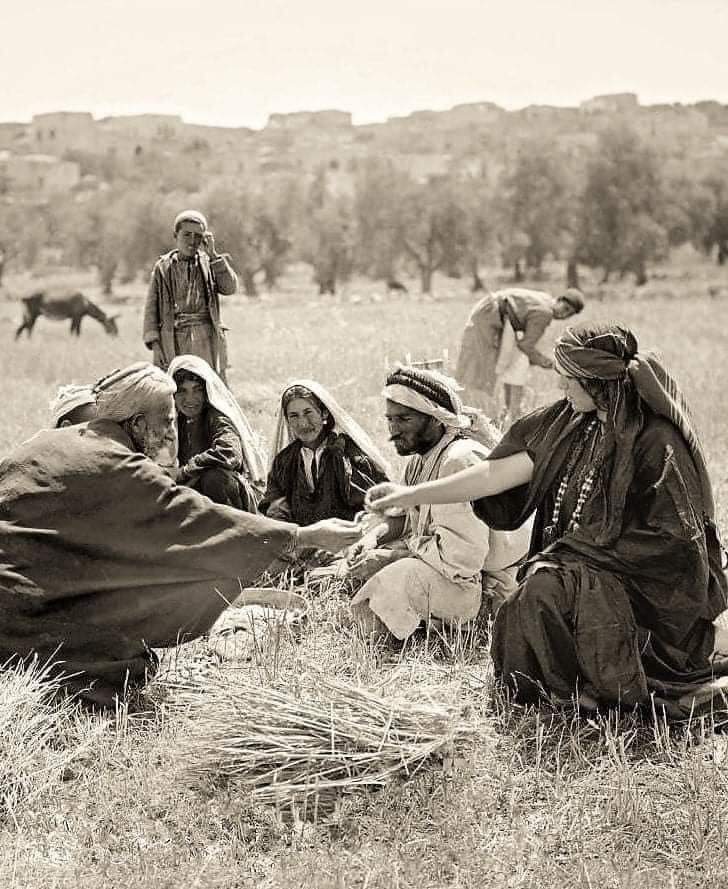
- Threshing floor in the early twentieth century. American Colony and Matson Collection, Library of Congress (matpc 10182).
- Pastoral scene in the Jordan Valley. American Colony and Matson Collection, Library of Congress (matpc 02981).
Methodological Note: The figures presented here refer to specific years, most commonly the 1944–1945 agricultural season, and do not necessarily represent every year of the Mandate period. Village data and classifications of land ownership and use should be interpreted according to the definitions provided by their original sources.
```
Photo gallery
More from the archive

 Download Our Palestine App
The whole archive in the palm of your hand: depopulated villages, the Nakba, the massacres and Al-Aqsa — free, with no ads to erase the story.
Download Our Palestine App
The whole archive in the palm of your hand: depopulated villages, the Nakba, the massacres and Al-Aqsa — free, with no ads to erase the story.
Comments
No comments yet — be the first to write one.
Add your comment
Name and email are optional. Comments appear after review.