
The Great Book Robbery: How the Zionist Occupation Looted 70,000 Palestinian Books in the Nakba
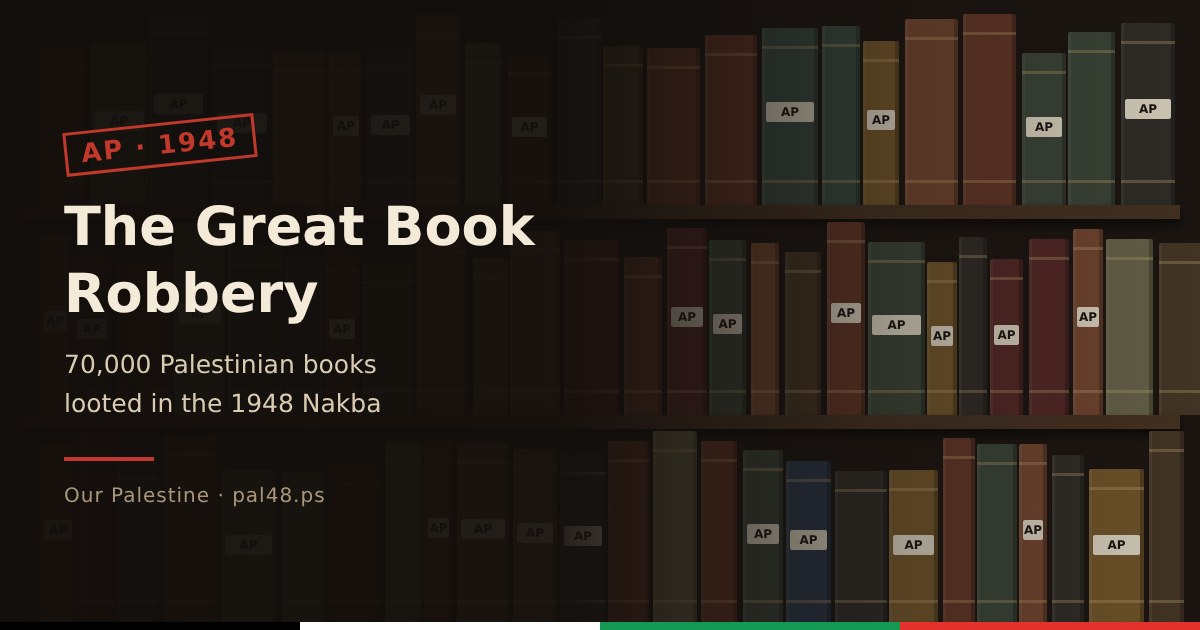
In the spring of 1948, as Zionist militias drove Palestinians from their homes in Jerusalem, Jaffa and Haifa, teams of librarians entered the emptied houses behind them. They did not come for furniture or gold. They came for the books.
This was the beginning of what is now known as "the Great Book Robbery": the looting of some 70,000 Palestinian books during the Nakba, around 30,000 of them from Jerusalem homes alone. Thousands of them still sit today on the shelves of the National Library of the Israeli occupation state, their spines marked with just two letters: AP, for "Abandoned Property."

What happened to Palestinian books during the Nakba?
During the 1948 Nakba, about 750,000 Palestinians were expelled or fled from their towns and villages. They left behind homes full of furniture, photographs, documents and private libraries, expecting to return within days. But the Zionist occupation was not content with seizing the land and the houses; it systematically collected the written culture inside them.
Estimates vary by source, but the overall picture is clear:
| Origin | Approximate number of books | Collected by |
|---|---|---|
| West Jerusalem (Katamon, Talbiyeh, Baq'a, the German Colony, Musrara) | About 30,000 books, manuscripts and newspapers | The National Library and the Hebrew University |
| Jaffa, Haifa, Tiberias, Nazareth and other towns | About 40,000 to 50,000 books, mostly textbooks | The occupation state's "Custodian of Absentee Property" |
| Total | About 70,000 books |
These figures are based on Israeli researcher Gish Amit's work in state archives, according to the Institute for Palestine Studies and Al Jazeera.
Jerusalem: 30,000 books from the homes of the Palestinian elite
Between May 1948 and February 1949, teams of National Library and Hebrew University staff entered the Arab neighbourhoods of West Jerusalem, in coordination with the occupation army. These neighbourhoods were home to the Palestinian cultural elite: teachers, writers, judges, doctors and politicians.
The lists of looted libraries include prominent names, among them:
- Khalil Sakakini: the writer and educator, from Katamon.
- Aref Hikmat Nashashibi and Nasser Eddin Nashashibi: of Jerusalem's Nashashibi family.
- Khalil Beidas: a pioneer of the novel and of translation in Palestine.
- Yusuf Haikal: the last mayor of Jaffa before the Nakba.
- Omar Saleh al-Barghouti: lawyer and historian, whose collection now fills an entire section of the National Library.
- Tawfiq al-Tibi and other Jerusalem intellectuals.
Historian Ilan Pappé describes two kinds of looting: individuals who took books home, and official bodies that collected them for the state and handed them to the National Library. Some Palestinians were even forced to take part: Mohammad Batrawi recounted that the Haganah militia made him loot other Palestinians' homes, including his own, according to Al Jazeera.

"Farewell, my library!": the story of Khalil Sakakini
Khalil Sakakini (1878–1953) was one of the most important educators and writers in the Arab world. In 1934 he began building his house in Jerusalem's Katamon neighbourhood, where he kept his private library.
Sakakini left his home on 30 April 1948; his family was among the last to leave Katamon. Two months later, in exile in Cairo, he wrote a farewell to his library in his diary, opening with the words "Farewell, my library!" He wondered what had become of his books: had they been looted? Burned? Moved to a public library? Or turned into paper for grocers to wrap their goods?
The answer came 19 years later. After the occupation of East Jerusalem in 1967, his daughter visited the National Library in Jerusalem and found her father's books there, with his handwritten notes in them, according to Gish Amit. When Knesset member Jamal Zahalka later asked for their return, he was first asked to submit a list of the books: the victim had to prove ownership of what had been stolen from him.

Where did the books go? Sales, pulping and the AP label
The looted books did not share a single fate. According to the documents Gish Amit uncovered:
- Textbooks were sold to Arab schools inside occupied Palestine, meaning Palestinians paid for their own looted books.
- About 26,000 books were destroyed in 1957: the authorities decided they were unfit for Arab schools and sold them as waste paper. Some were deemed "inciting" against the new state.
- About 6,000 books remained in the National Library's Oriental Studies department, still officially registered to the "Custodian of Absentee Property" in the Israeli Ministry of Finance.
- Others were sold at auction, where some were bought by Palestinians, who thus paid for their own stolen heritage.
Erasing the names: from owner to "AP"
At first, library staff wrote each owner's name in pencil inside the book and gave each collection a code linking it to the owner's home. But in the late 1950s and 1960s these codes were erased and replaced by a single label: AP. This severed the link between each book and its owner, and made recovering it almost impossible.
"Rescue" or looting? Refuting the occupation's narrative
The Israeli occupation's narrative
The Israeli National Library says the collection was a rescue operation to protect the books from being lost in the war, and that they are held in trust for the "Custodian of Absentee Property." Uri Palit, one of the librarians who catalogued them, said the books "were not looted but collected," and that owners' names were recorded so the books could be returned "someday when there is peace," according to the Christian Science Monitor.
The response
- A rescuer does not destroy what it rescued. If the aim was protection, why were 26,000 books sold as waste paper in 1957?
- A rescuer does not erase the owners' names. Replacing owners' names with "AP" is the opposite of preservation; it is a deliberate severing of the link.
- A rescuer does not block the owners' return. The occupation that "kept" the books is the same one that barred their owners from returning home, then demanded they prove ownership.
- Even the Israeli researcher rejects the narrative. Gish Amit says he cannot accept the library's description of what happened as a "rescue," and criticises its refusal to acknowledge the injustice done to Palestinians.
Amit goes further, arguing that the collection was a planned effort to confiscate Palestinian culture, driven by a condescending belief that Palestinians could not protect their own heritage. It is the same idea on which Zionist propaganda was built: a land without a people, and a people without a culture.
How the crime was uncovered: Gish Amit and The Great Book Robbery
The story stayed buried for nearly six decades. Then in 2006, Israeli PhD student Gish Amit of Ben-Gurion University found documents in the National Library's archive referring to the "collection" of Palestinian books. He later published his research in a book titled Ex Libris: Chronicles of Theft, Preservation, and Appropriating at the Jewish National Library.
Israeli-born, Amsterdam-based director Benny Brunner drew on this research for his documentary The Great Book Robbery. Brunner is a former soldier in the occupation army who fought in the 1973 war and later rejected Zionism. The film took five years to make. It premiered in Palestine on 12 January 2013 at the Educational Bookshop in Jerusalem, then aired on Al Jazeera English and was seen in fifty countries, according to ArabLit. It has never been shown on Israeli television.
The film was accompanied by a website documenting the books' titles and their owners' names, with the aim of reaching their heirs.

The looted books today: can they be recovered?
About 6,000 looted Palestinian books remain in the Israeli National Library and can be searched in its online catalogue. But recovering them runs into obstacles:
- The burden of proof falls on the victim: the library requires heirs to prove ownership, while most families lost their documents when they were expelled.
- Erased names: the "AP" label hid the origin of thousands of books.
- The Absentees' Property Law: the occupation state treats everything the displaced left behind as the property of the "Custodian of Absentee Property," the same law that confiscated their homes and land.
In rare cases, descendants have found their grandparents' books. Rasha al-Barghouti found two of her grandfather Omar Saleh al-Barghouti's books in the National Library, where his collection fills an entire section. But finding a book is one thing; getting it back is another.
The story continues to inspire new generations. In 2026 Palestinian poet Lena Jawdat published a poetry collection titled 70,000, in which she writes the numbers from one to seventy thousand by hand, imagining each number as a stolen Palestinian book, according to Asharq News.
The Great Book Robbery is not a side story of the Nakba. It is the cultural face of the occupation of Palestine: whoever seizes the land must also seize the memory of its people, in order to claim they were never there.
Frequently asked questions about the looting of Palestinian books in the Nakba
What was the Great Book Robbery?
The looting by the Zionist occupation of about 70,000 books from Palestinian homes and institutions during the 1948 Nakba, including about 30,000 from West Jerusalem homes collected by the National Library and the Hebrew University.
How many Palestinian books were looted in 1948?
About 70,000 according to the most widely cited estimates: roughly 30,000 from Jerusalem, and 40,000 to 50,000 from Jaffa, Haifa, Tiberias and Nazareth.
What does the AP label on Palestinian books mean?
It stands for "Abandoned Property." The Israeli National Library placed it on the looted books instead of their owners' names, severing the link to them.
Where are the looted Palestinian books today?
About 6,000 remain in the Israeli National Library in Jerusalem, registered to the "Custodian of Absentee Property." About 26,000 were destroyed in 1957, and others were sold to Arab schools or at auction.
Whose library is the best-known one looted in the Nakba?
One of the best known is that of writer and educator Khalil Sakakini in Jerusalem's Katamon neighbourhood. From exile in Cairo he wrote a moving farewell to his library, and in 1967 his daughter found his books in the National Library.
Who uncovered the looting of Palestinian books?
Israeli researcher Gish Amit uncovered it in 2006 while doing PhD research in the National Library's archive, and director Benny Brunner documented it in the film The Great Book Robbery.
Read more on Our Palestine
- The Palestinian Nakba
- Depopulated Palestinian villages and towns
- Palestine before the Nakba
- All Palestinian heritage articles on Our Palestine
Sources
- Ownerless property? The story of the books Palestinians left behind in 1948 (Arabic), Gish Amit, Institute for Palestine Studies
- Israel's 'Great Book Robbery' unravelled, Al Jazeera, 29 January 2013
- Scores of Palestinian books, Nakba's lesser-known victims, +972 Magazine, 29 January 2012
- Israelis, Palestinians dispute books appropriated in 1948, Christian Science Monitor, 27 February 2013
- Stolen Books, Stolen Identity, Nora Lester Murad, ArabLit, 20 January 2013
- The Nakba and the Great Book Robbery of 1948, Mondoweiss, 25 October 2010
- Ex-Libris: Chronicles of Theft, Preservation, and Appropriating at the Jewish National Library, Ostour, Arab Center for Research and Policy Studies
- Khalil Sakakini, Wikipedia
- 70,000 poems for Palestine's stolen libraries (Arabic), Asharq News, 12 October 2026
More from the archive
 Palestinian heritage
The Dead Sea Scrolls: How the Israeli Occupation Seized a Palestinian Treasure Found on the Eve of the Nakba
 Palestinian heritage
The Jaffa Orange: How Palestine's Orange Became an Israeli "Jaffa" Brand
 Palestinian heritage
Palestinian Olive Oil Under Occupation: Uprooted Trees and Settlement Oil in Europe
 Download Our Palestine App
The whole archive in the palm of your hand: depopulated villages, the Nakba, the massacres and Al-Aqsa — free, with no ads to erase the story.



Comments
No comments yet — be the first to write one.
Add your comment
Name and email are optional. Comments appear after review.