
Palestinian Photographers Before 1948: Raad & Abbud
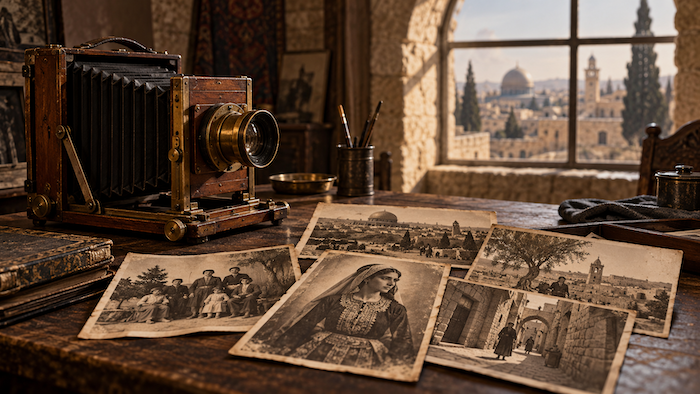
Early Palestinian Photographers Before the Nakba: Khalil Raad, Karimeh Abbud, and the Pioneers Behind the Camera
When the camera arrived in Palestine in the nineteenth century, European travelers brought it in search of the “Holy Land” as they imagined it: ruins, churches, and biblical landscapes in which people were often barely visible. Before long, however, Palestinians took up the camera themselves. They opened studios in Jerusalem, Jaffa, Bethlehem, and Nazareth, photographing their society as they knew it: families, weddings, markets, villages, and embroidered dresses. This article tells the stories of Khalil Raad, Karimeh Abbud, and the pioneers of Palestinian photography before 1948—and explores what the Nakba did to their lives and archives.
From the Traveler’s Lens to the Local Eye
Photography reached Palestine in 1839, the same year its invention was announced in France. Most of the earliest photographers were Europeans traveling on scientific or religious journeys. They focused their cameras on sacred sites and ancient monuments that reminded their readers back home of biblical stories.
Local people soon learned the craft. Around 1860, the Armenian priest Yessai Garabedian established a school of photography in Jerusalem, one of the earliest in the region. It trained several local photographers. In 1885, the Jerusalem Armenian photographer Garabed Krikorian opened a studio outside Jaffa Gate, described by the Interactive Encyclopedia of the Palestine Question as Palestine’s first photographic studio. His workshop trained the man who would become one of the country’s best-known Arab photographers before the Nakba: Khalil Raad.
By 1948, photography had spread throughout Palestinian cities, serving a wide range of needs. Photographers produced images of holy sites for pilgrims and tourists, studio portraits in traditional clothing, wedding photographs, pictures of official occasions, and family portraits. They also photographed soldiers during the First World War and the deceased, whose pictures families kept as mementos.
Khalil Raad: A Pioneer of Arab Photography in Jerusalem
From Bhamdoun to Jaffa Street
Khalil Raad was born around 1854 in Bhamdoun, Mount Lebanon. After his father was killed in the sectarian violence of 1860, his mother moved with him and his sister to Jerusalem. He grew up there and spent most of his life in the city. Raad trained at Garabed Krikorian’s studio and later traveled to Switzerland—Basel, according to the Institute for Palestine Studies—to learn modern photographic techniques.
Around 1890, Raad opened his own studio on Jaffa Street, near Jaffa Gate, directly opposite his former teacher’s premises. A long rivalry followed, becoming part of Jerusalem’s local lore. Around 1913, when Krikorian’s son John returned from Germany, the relationship developed into a partnership. John’s wife was Raad’s niece. Accounts of the period describe this stretch of the city as Jerusalem’s “street of photographers.”
A Lens on the Whole Country
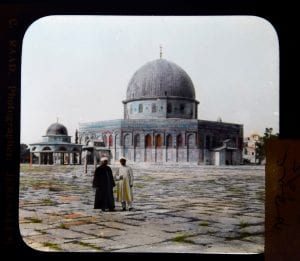
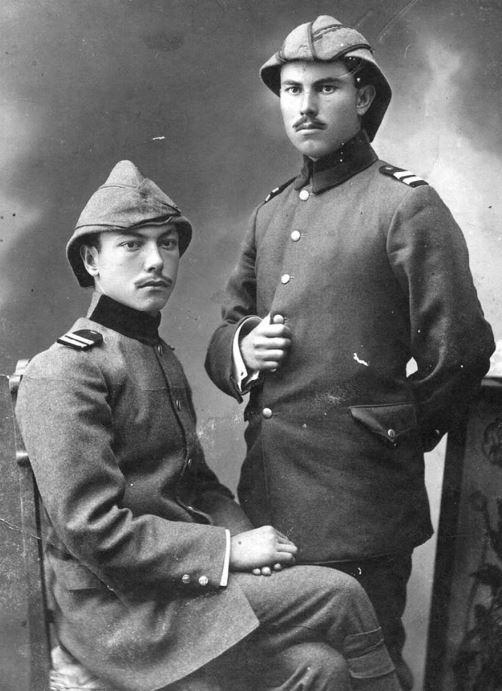
Raad’s work extended far beyond studio portraits. He photographed political events, everyday life, archaeological excavations, villagers, religious festivals, fields, citrus groves, and Jaffa’s harbor. His appointment as an official Ottoman photographer gave him access, through Jamal Pasha, to the Egyptian–Palestinian front during the First World War. Surviving images from this period show Ottoman soldiers and Palestinian officers in uniform. He also photographed figures associated with the national movement, including Izz al-Din al-Qassam and Sa‘id al-‘As.
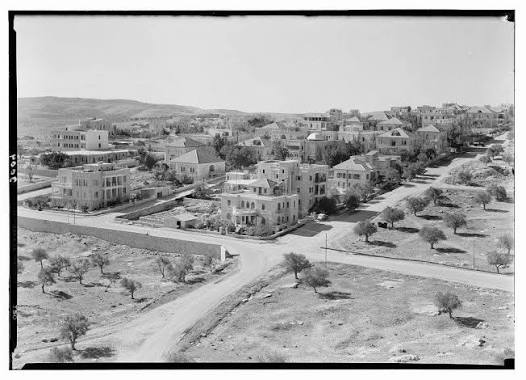
In 1919, Raad married the Swiss-born Annie Müller and settled in Talbiya, in Jerusalem’s newer neighborhoods. He continued photographing for roughly half a century, until 1948. Accounts of his archive describe 1,230 glass plates and a substantial collection of negatives, many of which were never printed.
Karimeh Abbud: A Pioneering Palestinian Woman Photographer
A Young Woman and a Camera
Karimeh Abbud is widely regarded as the first Palestinian woman—and possibly the first Arab woman—to work as a professional photographer offering her services to the public. Sources differ over her date and place of birth. Al Jazeera and Noon Post give Bethlehem, 13 November 1893; the Interactive Encyclopedia of the Palestine Question gives 1894. The Nazareth researcher Ahmad Marwat, drawing on baptismal records, places her birth in Nazareth around 1891. Her father, Reverend Said Abbud, served as a Lutheran pastor in Bethlehem. His work took him between towns and villages, and the family moved with him.
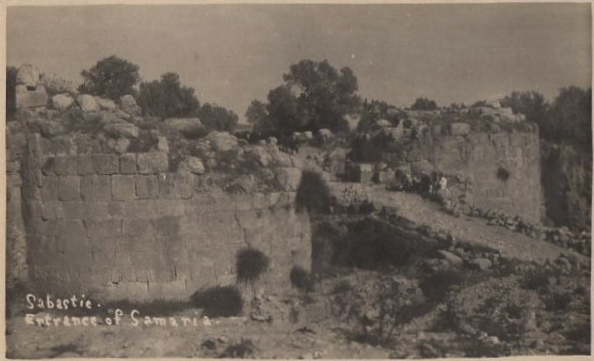
According to accounts of her early life, her father gave her a camera when she was about seventeen. She began photographing around 1913, initially recording churches and mosques, then coastal and lakeside towns such as Tiberias, Haifa, Jaffa, and Caesarea. By the 1920s, she was stamping her photographs with a description of herself as a photographer and printing “Miss Karimeh Abbud” on her postcards. An advertisement in the Haifa newspaper al-Karmil in 1932 described her as the “only national woman photographer.”

Studios in Bethlehem, Nazareth, and Haifa
Abbud first opened a studio in her Bethlehem home, becoming known for hand-colored photographs. Some accounts credit her with operating four studios, although they differ over their locations, naming various combinations of Nazareth, Bethlehem, Haifa, Jaffa, and Jerusalem. She drove her own car and traveled around the country. Accounts also describe photographic journeys to Lebanon, Syria, and Transjordan, and credit her with producing 112 postcards of historic and religious sites.
What distinguished her most was her photography of women. In a conservative society, a woman photographer could enter domestic spaces and photograph women in circumstances they found comfortable. She photographed the wives of prominent families in their homes, students in Jerusalem, Bethlehem, and Beirut, mothers with their children, and women wearing embroidered dresses. Improvised backgrounds and familiar surroundings often gave these portraits an ease that differed from the rigid poses associated with formal European studio portraiture.
Abbud died in 1940, eight years before the Nakba. Noon Post gives the date as 27 April 1940 and attributes her death to a fever. Al Jazeera recounts that her camera was carried beside her coffin, in accordance with her wishes.
Other Pioneers: From Jaffa to Bethlehem and Ramallah
Raad and Abbud were part of a wider generation of Palestinian Arab and Armenian photographers working before 1948:
- Issa Sawabini: Born in 1875, he learned photography in Russia and opened a studio in Jaffa toward the end of the nineteenth century. Daoud Sabonji opened another studio in the city during the same period.
- Ali Za‘rur: Born in 1900 to a farming family, he learned the craft while working with the Hanania photographers in Jerusalem. The Interactive Encyclopedia of the Palestine Question describes him as possibly the city’s first Muslim professional photographer. He documented Jerusalem through 1948 and later worked as a photojournalist.
- Hanna Safieh: Born in Jerusalem in 1910, he trained in the American Colony’s photographic department as an assistant to the Swedish photographer Eric Matson, working with him until 1946. He subsequently worked for the British Mandate government and opened his own studio.
- Elia Kahwajian: An Armenian survivor of the 1915 genocide, he reached Nazareth and later Jerusalem. He began working in Jerusalem in 1924 and became known for his photographs of everyday life.
- David Abdo: Known in Jerusalem for studio images that showed a sitter in several positions within a single photograph. His sister Margaret, also known as Margo, hand-colored the prints.
- Zakariya Abu Fheileh and Youssef Shamieh worked in Bethlehem. In Ramallah, Youssef Kaddoura opened the city’s first photographic studio in 1935, naming it Studio Mai after his daughter.
- Other Jerusalem photographers included the brothers Najib and Jamil Albina, who became archaeological photographers for the Palestine Archaeological Museum, as well as Samaan Sahhar, Hanna Toumayan, and Krikor Ishkhanian.
A Living Society Beyond the Orientalist Frame
Many foreign photographers arrived in Palestine with a preconceived image: an ancient biblical land of ruins and shepherds who resembled figures from scripture. Palestinians sometimes appeared as background figures in a landscape or as studio “types,” dressed to satisfy visitors’ expectations. Such images could reinforce the impression of a land detached from its living inhabitants, a view that overlapped with the Zionist slogan “a land without a people.”
Local photographers, by contrast, photographed relatives, neighbors, and clients. Their images show an educated urban middle class, schoolgirls, families posing for keepsakes, newlyweds, office workers, officers, farmers on threshing floors, the markets of Jerusalem and Jaffa, orange groves, and religious celebrations. Artist and researcher Vera Tamari has read Raad’s photographs as a direct response to the narrative of an “empty land”: they show people working, celebrating, learning, and building their cities.
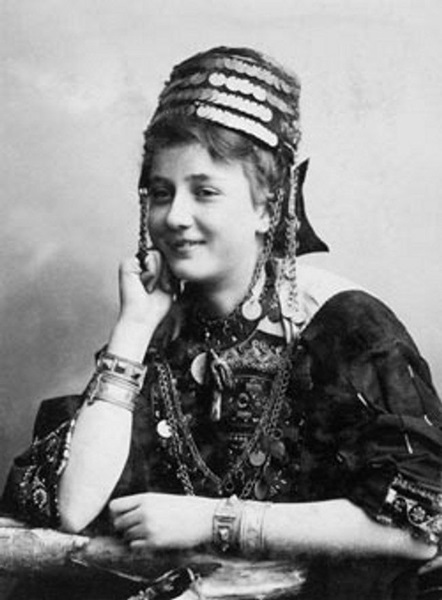
In Abbud’s photographs especially, Palestinian women appear as students, teachers, mothers, and urban householders, extending beyond the “exotic” rural figure favored in much Orientalist imagery. Researchers have therefore understood her work as a departure from established portrait conventions and an affirmation of her subjects’ humanity and ordinary lives.
The Nakba: Studios on the Front Line and Dispersed Archives
Jaffa Street Becomes a Front Line
In 1948, Jaffa Street—the street of photographers—became a battle line between the two parts of Jerusalem. When Zionist forces took control of the area, Raad’s studio and decades of work were left on the other side. The Institute for Palestine Studies recounts that a young Italian friend crossed no-man’s land at night several times to rescue the studio archive. Noon Post also reports that Haganah members looted the studio and that hundreds of photographs ended up in Israeli archives, with only part of the collection saved by his Italian friend.
Raad himself became a refugee at about ninety-four. He moved to Hebron and then Bhamdoun. According to the Institute for Palestine Studies, he later returned to live at the Greek Orthodox Patriarchate in Jerusalem’s Old City until his death in 1957; Noon Post instead places his death in Lebanon. His surviving archive eventually reached the Institute for Palestine Studies in Beirut and is described as containing approximately 3,000 photographs.
Photographers in Exile
Palestine’s photographers were scattered along with the communities they had photographed:
- Ali Za‘rur lost his albums in 1948. Accounts describe the seizure of about 380 photographs after the war, of which his son later recovered 324. The family retained the negatives.
- Hanna Safieh documented the events of 1948, including the aftermath of the Deir Yassin massacre, the funeral of Abd al-Qadir al-Husayni, the site of the Battle of al-Qastal, and destruction in Musrarra. Most of his pre-1948 photographs were subsequently stolen from his studio after the occupation of East Jerusalem in 1967. Images published abroad in newspapers and magazines were among those that survived.
- David Abdo moved his photographic practice to Beirut after the Nakba.
- Samaan Sahhar moved from Jerusalem to Bethlehem in 1948 because his studio lay in the no-man’s land separating the divided city.
- In Gaza, the number of photographers grew after the Nakba as refugees arrived from Jaffa and other occupied cities. They included the Armenian photographer Hrant Nakashian.
Karimeh Abbud’s Photographs Disappear from View
Although Abbud died before the Nakba, her photographs were caught up in its aftermath. Nazareth historian Johnny Mansour has stated that Israeli authorities confiscated her photographs after 1948 and retained them in their archives. Her name remained largely forgotten for decades, before renewed research brought her work back into public view.
A Memory Brought Back to Light
In the mid-2000s, Abbud’s name began to re-emerge. Hundreds of her photographs surfaced in the possession of a Jerusalem collector who sold antiques to tourists. Researcher Ahmad Marwat connected the collection to Qatamon, where Abbud reportedly lived for five years, one of the Arab Jerusalem neighborhoods whose inhabitants were displaced in 1948. Marwat traced her biography, published research about her in 2007, and recovered some of her photographs. In 2016, Google marked her birthday with a commemorative Doodle. Dar al-Kalima College in Bethlehem established a photography award in her name; a film and the book Biography of an Eye also explored her life.
In 2013, the Institute for Palestine Studies organized an exhibition of Raad’s work titled Palestine Before 1948: Not Just Memory, curated by Vera Tamari. The exhibition traveled to the Khalil Sakakini Cultural Center in Ramallah and included photographs gathered from Palestinian families displaced during the Nakba alongside archive material. A second exhibition in Beirut in 2022 displayed 64 photographs from his collection. Raad’s images also appeared in historian Walid Khalidi’s Before Their Diaspora: A Photographic History of the Palestinians, 1876–1948. In 1999, Rafi Safieh published a selection of his father Hanna Safieh’s photographs spanning 1927 to 1967.
These pioneers’ photographs are more than cherished memories. They are historical documents of a country inhabited by people whose lives unfolded in cities and villages, schools and theaters, and around newspapers and public institutions. From this perspective, the confiscation of archives and the looting of studios were part of a wider loss of Palestinian cultural memory. Every photograph recovered today—whether from a dispersed collection or a refugee family’s album—restores another piece of that memory.
Frequently Asked Questions About Palestinian Photographers Before the Nakba
Who was the first Arab photographer in Palestine?
Khalil Raad (c. 1854–1957) is widely described as the first Palestinian Arab photographer to gain recognition across the country. He trained with Garabed Krikorian and opened a studio on Jaffa Street in Jerusalem around 1890, continuing his work until the Nakba.
Who was the first Palestinian woman photographer?
Karimeh Abbud, born in the late nineteenth century and deceased in 1940, is widely recognized as the first Palestinian woman to work professionally as a photographer. She became known for portraits of women and families and for her photographs of Palestinian towns. Sources disagree over her precise birth date and birthplace.
What happened to Khalil Raad’s archive during the Nakba?
His Jaffa Street studio was left beyond the front line in 1948. An Italian friend rescued part of the archive by crossing no-man’s land at night; other accounts describe the looting of hundreds of images. A surviving collection of approximately 3,000 photographs is held by the Institute for Palestine Studies in Beirut.
How did local Palestinian photographs differ from those made by foreign visitors?
Many visiting European photographers emphasized sacred sites and biblical landscapes. Local photographers also recorded families, weddings, students, markets, farmers, and urban life, leaving a broader visual record of the country’s inhabitants and their society.
Which Palestinian photographers documented the events of 1948?
Prominent examples include Hanna Safieh, who photographed the aftermath of Deir Yassin, Abd al-Qadir al-Husayni’s funeral, and the site of the Battle of al-Qastal, and Ali Za‘rur, who documented events in Jerusalem and later worked as a photojournalist.
More from the archive
 Download Our Palestine App
The whole archive in the palm of your hand: depopulated villages, the Nakba, the massacres and Al-Aqsa — free, with no ads to erase the story.





Comments
No comments yet — be the first to write one.
Add your comment
Name and email are optional. Comments appear after review.