
The Battles of Beit Daras 1948: A Gaza Village's Stand and the Massacre of Its Women and Children
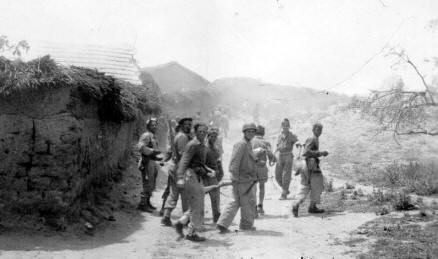
Beit Daras was a Palestinian village in the Gaza district, 32 kilometres north-east of the city, linked by roads to Isdud on the coast and to the village of Julis, and lying on a road that connected several Zionist settlements in the south. For that reason the Zionist militias made it a target from March 1948, attacking it again and again. Its people, and those who rushed from neighbouring villages to their aid, held out for two full months before a massacre was committed against them as they evacuated their women and children; the village then fell and was wiped off the map. [1][2][3]
Contents
- At a glance
- The village
- The March shelling
- The battle of 1 May
- The battle of 21 May and the massacre
- The fall of the village
- The attempt to retake it in July
- The village today
- Between the accounts
- Timeline
- Frequently asked questions about the battles of Beit Daras
At a glance
| Item | Details |
|---|---|
| Date | 27 March to June 1948, with an attempt to retake it in July 1948 |
| Place | Beit Daras, Gaza district, 32 km from Gaza |
| Defenders | The people of Beit Daras and fighters from neighbouring villages, later the Egyptian army and a Sudanese unit |
| Main attacks | 27–28 and 29 March, 13 April, 1 May and 21 May 1948 |
| The crime | Mortar fire that killed 9 civilians in March, and a massacre of women and children as they were evacuated on 21 May |
| Fall of the village | 5 June 1948 according to WAFA, and after the start of the first truce on 11 June according to Egyptian accounts |
| Population | 2,750 in 1945 |
| Area | 16,357 dunums |
| Settlements on its land | Azrikam, Emunim and Givati (1950) |
The village
Beit Daras stood on flat land rising westward to a hill on which the Crusaders built a fort; the Mamluks made it a postal station between Gaza and Damascus and built a khan there. Its population was 1,804 in 1931, living in 401 houses, and 2,750 in 1945, all of them Arab. [2][1]
Its land was fertile and well watered, covering 16,357 dunums, of which 15,896 were Arab-owned; in 1945 some 14,438 dunums were sown with grain and 832 with citrus and bananas. It had two mosques, a primary school founded in 1921 with 234 pupils in the mid-1940s, and a pond to the north, and some of its people worked as stonemasons. [1][2]
The March shelling
On 27–28 March 1948 the Zionist militias shelled Beit Daras indiscriminately with mortars, killing nine villagers, all of them non-combatants, and starting fires that consumed crops and livestock, according to the account of the Arab commander Tariq al-Ifriqi. Two days later, on 29 March, a brief clash took place near the village. [2][1]
WAFA records another attack on the village on 13 April 1948, without details. [3]
The battle of 1 May
On 1 May 1948 a force from the neighbouring settlements advanced on Beit Daras, shelled it from a distance and then seized the village school, while mortar rounds fell on its eastern side. The defenders resisted until the first wave withdrew. [3]
Reinforcements from the neighbouring villages rushed to pursue the retreating attackers, who called on the British army for help; it sent three armoured cars that stopped the pursuit – one more sign of the Mandate authorities’ partiality to the Zionist militias right up to their final days. [3]
The battle of 21 May and the massacre
About three weeks later, on 21 May 1948, the Zionist militias returned, shelling the village and then attacking it from all four sides. The village was encircled from the directions of Isdud and al-Sawafir, and forces took up positions on a hill with a school and a water tank. The defenders resolved to hold out and to move the women, the elderly and the children out through the south. [3][4]
As the villagers neared the edge of the village, the militias opened fire on them and committed a new massacre. Um Mohammed, a child at the time who lives today in Khan Younis camp, recalls that the fighters checked the road to Isdud before the families set out, but once they left they were fired upon; many fell, and she and her sister escaped through the fields hand in hand. Um Adel recalls that the men refused to leave and fought on, and that among the martyrs were Abu Mansi Nassar and his two brothers, Ali Mohammed Hussein al-Usaiji, and four young men of the Maqadma family. [3][4]
The wounded were gathered in houses with almost no treatment; some martyrs were buried in haste and others were left in the fields. The militias burned the village’s threshing floors and some of its houses and blew up others – yet the defenders still drove them back and out of the village. [4][3]
The fall of the village
The massacre, together with the exhaustion of ammunition, struck at the villagers’ morale, and most of them left, with only a few remaining. The militias entered the village only after making sure there was no resistance left, on 5 June 1948 according to WAFA. [3]
Egyptian accounts, including the memoirs of Gamal Abdel Nasser, then a staff officer in the Sixth Battalion, say the occupation forces took the village only after the first truce began on 11 June, exploiting the ceasefire. [2][1]
The attempt to retake it in July
After the truce ended on 9 July 1948, the Egyptian army planned to retake Beit Daras. A Sudanese unit stormed the village by night and entered it, but a soldier fired a red flare instead of a green one; the Egyptian artillery shelled the position believing it still in enemy hands, and the Sudanese unit was forced to withdraw. [2][1]
The village today
The people of Beit Daras were expelled, and many took refuge in the Gaza Strip, where the testimonies of its sons and daughters are still told in Khan Younis camp. All that remains of the village is the foundation of a single house, scattered rubble and wild plants – cactus and eucalyptus – and one of its old streets can still be made out. In 1950 three settlements were built on its land: Azrikam, Emunim and Givati, while settlers farm the adjoining land. [4][2]
Between the accounts
Date of the fall: WAFA says the militias entered on 5 June 1948, while Egyptian accounts say it was occupied after the truce began on 11 June. [3][2]
Date of the massacre: Al Jazeera Net lists two massacres at Beit Daras, on 11 May and 21 May 1948, with the number of martyrs in both given as “unknown,” while WAFA links the massacre to the attack of 21 May. [5][3]
Number of martyrs: the available Arab sources give no total for the massacre, and the testimonies speak of dozens. [4]
Timeline
| Date | Event |
|---|---|
| 27–28 March 1948 | Mortar fire kills 9 civilians and burns crops [2] |
| 29 March 1948 | Brief clash near the village [2] |
| 13 April 1948 | Attack on the village [3] |
| 1 May 1948 | Attack from nearby settlements repulsed; British armoured cars shield the retreat [3] |
| 11 May 1948 | A massacre, according to Al Jazeera Net’s list [5] |
| 21 May 1948 | Attack from four sides and massacre of evacuating women and children [3] |
| 5 June 1948 | The militias enter the village, according to WAFA [3] |
| After 11 June 1948 | Occupation after the truce began, according to Egyptian accounts [2] |
| July 1948 | A Sudanese unit enters the village, then withdraws after a signal error [2] |
| 1950 | Azrikam, Emunim and Givati built on its land [2] |
Frequently asked questions about the battles of Beit Daras
Where is Beit Daras?
In the Gaza district, 32 kilometres from Gaza city, near Isdud, Julis and al-Sawafir. [1][2]
Why did the Zionist militias target Beit Daras?
Because it lay on a road linking several Zionist settlements in the south, and the militias wanted it out of their way. [3]
What happened in the Beit Daras massacre?
On 21 May 1948 the militias opened fire on the women, elderly and children as they were being led out through the south of the village, and many of them fell. [3][4]
When did Beit Daras fall?
On 5 June 1948 according to WAFA, and after the first truce began on 11 June according to Egyptian accounts. [3][2]
Did the Egyptian army try to retake the village?
Yes. In July 1948 a Sudanese unit entered it by night, but withdrew after Egyptian artillery shelled it by mistake because of a wrong flare signal. [2]
What was built on Beit Daras’s land?
Three settlements in 1950: Azrikam, Emunim and Givati. [2]
Read also on Palestinuna
Sources and references
- PalQuest, Interactive Encyclopedia of the Palestine Question, Institute for Palestine Studies: “Bayt Daras” (in Arabic).
- Walid Khalidi, All That Remains: The Palestinian Villages Occupied and Depopulated by Israel in 1948, entry “Bayt Daras,” via Palestine Remembered (in Arabic).
- WAFA – Palestinian National Information Centre, “Battles of the Nakba”: “The Battle of Beit Daras” (in Arabic).
- Ramzy Baroud, “A Hundred Deir Yassin and Counting: Beit Daras and the Buried History of Massacres,” with the testimonies of Um Adel and Um Mohammed of Khan Younis camp.
- Al Jazeera Net, “Israeli massacres against the Palestinian people,” 3 October 2004 (in Arabic).
More from the archive
 Download Our Palestine App
The whole archive in the palm of your hand: depopulated villages, the Nakba, the massacres and Al-Aqsa — free, with no ads to erase the story.



Comments
No comments yet — be the first to write one.
Add your comment
Name and email are optional. Comments appear after review.