
The Battle of Kawkab al-Hawa 1948: The Iraqi Army on the Hill of Belvoir Castle
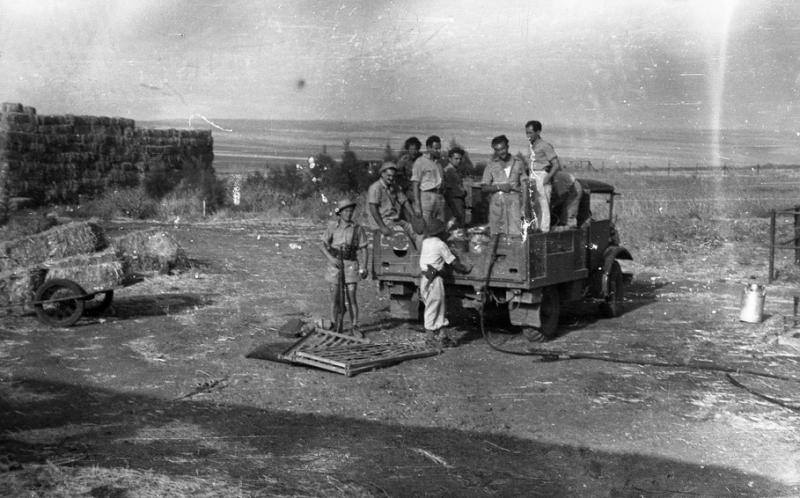
Kawkab al-Hawa was a small Palestinian village in the Baysan district, 11 kilometres from the town, standing some 300 metres above the Jordan Valley and overlooking the river to the east and Lake Tiberias to the north-east. On this hill the Crusaders built their castle of Kawkab, and Saladin fought them for it; in May 1948 the hill became a battlefield again, when the Iraqi army stormed it to protect its attack on the settlement of Gesher. Iraqi martyrs fell on its soil before the Zionist militias occupied it, expelled its people and erased it. [1][2][3]
Contents
- At a glance
- The village and the castle
- Gesher and the importance of the hill
- The Iraqi army on the hill
- The Iraqi martyrs of Kawkab al-Hawa
- The village after the Nakba
- Between the accounts
- Timeline
- Frequently asked questions about the Battle of Kawkab al-Hawa
At a glance
| Item | Details |
|---|---|
| Date | 15–18 May 1948 |
| Place | Kawkab al-Hawa, Baysan district, 11 km from Baysan |
| Arab forces | The village garrison and a company of the Iraqi army on the Kawkab al-Hawa ridge |
| Iraqi objective | To cover the attack on the Gesher settlement and cut off reinforcements coming from Afula |
| Martyrs | 23 Iraqi martyrs according to Aref al-Aref, among them Captain Talib Jasim al-Azzawi |
| Outcome | Iraqi withdrawal on the evening of 18 May; the village occupied and its people expelled |
| Population | 300 in 1945 |
| Area | 9,949 dunums |
The village and the castle
Some scholars identify the site of Kawkab al-Hawa with Yarmuta, named on an Egyptian stele of the late thirteenth century BC. The village was built within the outline of the Crusader castle of Kawkab (Belvoir), which limited its growth, and later its houses spread around the fortress. Yaqut al-Hamawi described its castle, which fell into ruin after Saladin’s reign, and the hill was the scene of successive battles between his army and the Crusaders. [1]
Its population was 220, in 46 houses, in 1931 and 300 in 1945, all of them Arab. Its lands covered 9,949 dunums, of which 5,851 were sown with grain; two springs, Ayn al-Hilu and Ayn al-Jirani, lay to its south and south-east, and a road linked it to Khirbat al-Taqa and the Baysan–Jericho highway. [1]
Gesher and the importance of the hill
The Zionist militias had two strong garrisons in the area: one at the Rutenberg electricity project and another at the settlement of Gesher. After a Jordanian warning to the project’s management, they withdrew to Gesher and reinforced its defences, which included a strong fort the British had built during the Second World War. [2]
The militias concluded that defending Gesher required seizing Kawkab al-Hawa, to prevent its fighters from supporting the expected Iraqi attack on the settlement, and on 15 May 1948 they blew up the Majami bridge over the Jordan River to slow the Iraqi army’s advance. [2]
The Iraqi army on the hill
Iraqi forces under Brigadier Nur al-Din Mahmud moved towards the Jordan Valley as the Arab armies entered Palestine on 15 May. The plan was to establish a bridgehead at al-Majami and advance on Gesher and Kawkab al-Hawa. On 17 May the Iraqi forces attacked the village and fort of Gesher; their tanks reached the gate of the fort, but it did not fall and remained under siege. An Iraqi company was sent to the Kawkab al-Hawa ridge to cut off Zionist reinforcements coming from Afula towards Gesher. [4]
The historian Aref al-Aref relates that the Iraqi forces entered Kawkab al-Hawa and held it between 15 and 17 May, and that the Zionist militias attacked on 18 May to relieve the pressure on Gesher; the village garrison resisted, and the Iraqis withdrew at sunset on 18 May after losing 23 martyrs. [1]
The Iraqi martyrs of Kawkab al-Hawa
The register of Iraqi martyrs published by the Palestinian National Information Centre preserves two names of those who fell at Kawkab al-Hawa: Captain Talib Jasim al-Azzawi of the First Battalion, Fifteenth Brigade, martyred on 17 May 1948, and Private Sabbour Munshid of the engineer companies, from Suq al-Shuyukh, martyred on 18 May. [3]
The same register lists dozens of Iraqis martyred at the nearby Majami bridge between 15 and 21 May 1948, from Diwaniya, Nasiriya, Hilla, Shatra, Abu al-Khasib, Halabja and elsewhere – testimony that Iraqi blood mingled with the soil of the Baysan valley. [3]
The village after the Nakba
After the Iraqi withdrawal the Zionist militias occupied Kawkab al-Hawa and expelled its people. The village was destroyed, and nothing remains on its site but fig and olive trees, while its Crusader castle was excavated and turned into a tourist attraction – as if the place is narrated through the history of the Crusaders while those who lived there for centuries are silenced. [1]
Between the accounts
Date of the fall: Aref al-Aref says the Iraqi forces withdrew on the evening of 18 May 1948, while an Associated Press dispatch of 18 May reported that Iraqi troops had occupied the village, describing it as a formidable concrete-reinforced position; other sources say its occupation was not completed until some days later. [1]
The WAFA text: WAFA’s account of the battle breaks off at 15 May and gives no details of what followed. [2]
Timeline
| Date | Event |
|---|---|
| 15 May 1948 | The Majami bridge is blown up; the Arab armies enter Palestine [2] |
| 15–17 May 1948 | Iraqi forces enter and hold Kawkab al-Hawa [1] |
| 17 May 1948 | Iraqi attack on Gesher; martyrdom of Captain Talib Jasim al-Azzawi [3] |
| 18 May 1948 | Militia attack on the village; martyrdom of Private Sabbour Munshid; Iraqi withdrawal at sunset [1] |
Frequently asked questions about the Battle of Kawkab al-Hawa
Where is Kawkab al-Hawa?
In the Baysan district, 11 kilometres from the town, on a hill overlooking the Jordan River and Lake Tiberias. [1]
Why was the hill important in 1948?
Because it overlooked the Gesher settlement and the route of reinforcements from Afula; the militias wanted it to protect Gesher, and the Iraqi army wanted it to cover its attack. [2][4]
How many Iraqi martyrs fell at Kawkab al-Hawa?
23 according to Aref al-Aref; the WAFA register preserves the names of Talib Jasim al-Azzawi and Sabbour Munshid. [1][3]
How is Kawkab al-Hawa related to the Crusader castle of Kawkab?
The village was built within the outline of the Crusader castle that Saladin fought over, and its houses later spread around it. [1]
What remains of the village today?
The village was destroyed; only fig and olive trees remain, and its castle has become a tourist site. [1]
Read also on Palestinuna
Sources and references
- PalQuest, Interactive Encyclopedia of the Palestine Question, Institute for Palestine Studies: “Kawkab al-Hawa,” citing Aref al-Aref, al-Nakba.
- WAFA – Palestinian National Information Centre, “Battles of the Nakba”: “The Battle of Kawkab al-Hawa” (in Arabic).
- WAFA – Palestinian National Information Centre, “Iraqi martyrs who fell in the Palestine war of 1948” (in Arabic).
- Al-Rafidain Centre for Strategic Studies (RASAM), “The role of the Iraqi army in the Palestine war of 1948” (part 2 of 4), 24 March 2021 (in Arabic).
More from the archive
 Download Our Palestine App
The whole archive in the palm of your hand: depopulated villages, the Nakba, the massacres and Al-Aqsa — free, with no ads to erase the story.



Comments
No comments yet — be the first to write one.
Add your comment
Name and email are optional. Comments appear after review.