
The Battle of al-Samu 1966: Five Hours of Resistance Before the Occupation of the West Bank
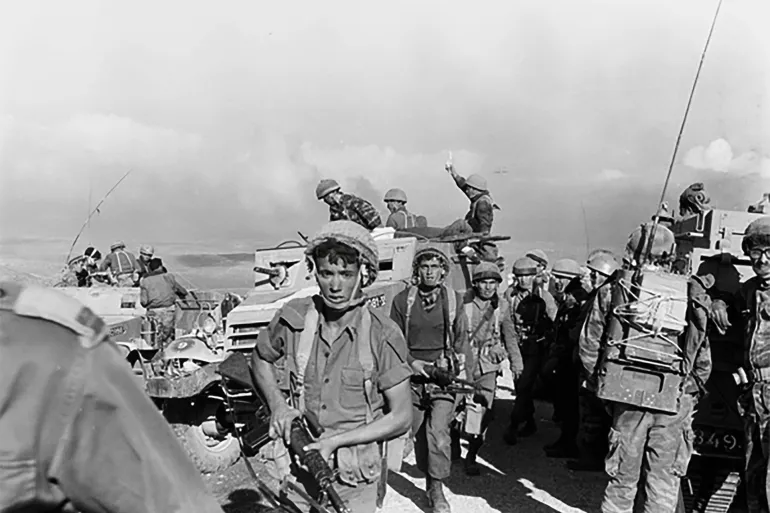
At dawn on Sunday 13 November 1966 Israeli occupation forces stormed the town of al-Samu, south of Hebron – the West Bank was then under Jordanian rule – with dozens of tanks and armoured vehicles, an infantry brigade and warplanes. The battle lasted about five hours; soldiers of the Jordanian Arab Army and the townspeople fought with whatever they had, and 13 soldiers, the pilot Muwaffaq al-Salti and several civilians were martyred. The attackers destroyed some 125 houses, a school, a clinic and a historic mosque before withdrawing. [1][2]
The Security Council unanimously censured the aggression, but al-Samu was only a prelude to something greater: seven months later Israel occupied the whole West Bank in the June 1967 war. [3][2]
Contents
- At a glance
- The pretext
- The assault
- The resistance
- The toll
- The Security Council and Resolution 228
- After the battle
- Between the accounts
- Timeline
- Frequently asked questions about the Battle of al-Samu
At a glance
| Item | Details |
|---|---|
| Date | 13 November 1966, from about 5 to 10 a.m. |
| Place | Al-Samu south of Hebron, with Rafat, Khirbat al-Asfar and Rajm al-Madfa’ |
| Attackers | About 80 tanks, 80 armoured vehicles, an infantry brigade and 12 aircraft |
| Defenders | Units of the Jordanian Arab Army’s Hittin Brigade, the people of al-Samu, and three Hawker Hunter jets |
| Martyrs | 13 soldiers and the pilot Muwaffaq al-Salti, and 3–4 civilians |
| Destruction | About 125 houses and buildings, a school, a clinic and a historic mosque, plus 5 houses in Rafat |
| Attackers’ losses | More than 50 killed and wounded according to the Al Jazeera Encyclopedia |
| International response | Security Council Resolution 228, unanimous, 25 November 1966 |
The pretext
Israel used as its pretext two mines that exploded near Battir in the Bethlehem governorate – one derailing a freight train, the other destroying a military vehicle and killing three soldiers – which it attributed to Fatah fighters, claiming that al-Samu harboured fedayeen bases. [1]
Analysts argue the real aim went further: to draw Jordan in so as to test its military response and expose its methods, to test the Joint Arab Defence Pact, or as part of a wider plan that culminated in the June 1967 war. [1]
The assault
The occupation massed on the border a force that the researcher Mohammed Ibrahim al-Badarin, a native of al-Samu, puts at about 80 tanks, 80 armoured vehicles, an infantry brigade and 12 aircraft. At about five in the morning the force crossed the armistice lines and split in two: one column heading for al-Samu, the other a feint in a different direction. [2][1]
The tanks destroyed Jordanian positions at several points, including Rajm al-Madfa’, and the columns advanced on al-Samu and Khirbat al-Asfar, where they met resistance; they then overran Rafat, destroying five houses there, surrounded al-Samu and began demolishing its homes. [1][2]
The resistance
Jordanian forces moved on al-Samu from two directions, from al-Dhahiriya and from Yatta, under heavy air attack, and the reinforcements ran into ambushes set by the attackers. Soldiers and townspeople resisted with whatever they had. Mohammed Issa al-Mahareeq, a former Jordanian soldier who fought at the town’s southern entrance, recalls taking cover behind stone terrace walls and firing on the advancing forces, though far outgunned, while the townspeople sheltered in caves until the attack ended. [1][2]
Three Jordanian Hawker Hunter jets provided air cover despite the enemy’s numerical superiority. The pilot Muwaffaq Badri al-Salti was martyred in the air battle while returning to his base, and sources say the enemy lost two or three aircraft. The Hittin Brigade’s commander, Colonel Bahjat al-Muhaisen, was wounded. After less than five hours, the attacking forces withdrew at about ten in the morning. [2][1]
The toll
Thirteen soldiers of the Jordanian Arab Army were martyred, among them the battle’s two leaders, Mohammed Daifallah al-Habahbeh and Mohammed Yousef al-Amleh, together with the pilot Muwaffaq al-Salti. Four civilians were killed according to al-Badarin, three from al-Samu and one from neighbouring Yatta, among them a woman from the town. [1][2]
The attackers destroyed about 125 houses and buildings, including the town’s school, its health clinic and its historic mosque with its minaret. The poet Musa Hawamdeh, six years old at the time, describes his town after the attack as a heap of rubble, with cars and trees burning, dust covering the sky, and children collecting spent cartridges and shell fragments. [2][4]
The Security Council and Resolution 228
The Security Council met on 16 November 1966 to consider Jordan’s complaint; the British representative called the Israeli action unjustified and wholly disproportionate, the Soviet Union joined the United States, France and Britain in condemning it, and the US representative Arthur Goldberg called for a resolution condemning Israel. [1]
On 25 November 1966 the Council unanimously adopted Resolution 228, which deplored the loss of life and heavy damage to property, censured Israel for this large-scale military action in violation of the UN Charter and the General Armistice Agreement between Israel and Jordan, and emphasised that actions of military reprisal could not be tolerated and that, if repeated, the Council would have to consider further and more effective steps. [3]
After the battle
King Hussein visited the town and ordered the destroyed homes rebuilt, and each owner received compensation of between 150 and 200 dinars. The people of al-Samu named one of its schools after the pilot Muwaffaq al-Salti and placed a plaque bearing his name on it in his memory. [2]
Less than seven months later the same tanks returned, occupying al-Samu, Hebron and the whole West Bank in June 1967; in Palestinian memory, the assault on al-Samu became the first rehearsal for the Naksa. [2]
Between the accounts
Martyrs and wounded: 13 soldiers martyred and 22 other military personnel according to the Al Jazeera Encyclopedia; about 24 soldiers killed or wounded according to al-Badarin; 18 killed and 130 wounded among residents and soldiers according to Abdelwahab al-Messiri; while the poet Musa Hawamdeh speaks of more than eighty martyrs. [1][2][4]
Size of the attacking force: about 400 infantry and 20 tanks according to the Al Jazeera Encyclopedia, and about 80 tanks, 80 armoured vehicles and an infantry brigade according to al-Badarin. [1][2]
Attackers’ losses: the Al Jazeera Encyclopedia gives more than 50 killed and wounded, 10 tanks and 12 vehicles destroyed and three Mirage jets downed, while the retired pilot Farouq Abedin says Israel lost two aircraft. [1][2]
Timeline
| Date | Event |
|---|---|
| Before 13 November 1966 | Two mines explode near Battir, which Israel uses as a pretext [1] |
| Dawn, 13 November 1966 | Armistice lines crossed; Rafat overrun and al-Samu surrounded [2] |
| 13 November 1966 | Resistance; pilot Muwaffaq al-Salti martyred; some 125 houses demolished [2] |
| About 10 a.m. | The attacking forces withdraw [1] |
| 16 November 1966 | The Security Council considers Jordan’s complaint [1] |
| 25 November 1966 | Resolution 228 unanimously censures Israel [3] |
| June 1967 | Occupation of al-Samu and the entire West Bank [2] |
Frequently asked questions about the Battle of al-Samu
When was the Battle of al-Samu?
At dawn on 13 November 1966; it lasted about five hours. [1][2]
What was the pretext for the attack?
Two mines that exploded near Battir, which Israel attributed to Fatah fighters, claiming al-Samu harboured their bases. [1]
Who was Muwaffaq al-Salti?
A Jordanian air force pilot martyred in the air battle over al-Samu; one of the town’s schools bears his name. [2]
What did Resolution 228 say?
It censured Israel for a large-scale military action violating the Charter and the armistice agreement, and warned that repeated reprisals would lead the Council to consider more effective steps. [3]
How is al-Samu linked to the 1967 war?
Many see it as a prelude to the Naksa, since seven months later Israel occupied the entire West Bank. [1][2]
Read also on Palestinuna
Sources and references
- Al Jazeera Encyclopedia, “The Battle of al-Samu: five hours that paved the way for the 1967 war,” 12 November 2023 (in Arabic).
- Awad al-Rujoub, “56 years since the Battle of al-Samu: only five hours, but pivotal, and a prelude to the occupation of the West Bank,” Al Jazeera Net, 13 November 2021 (in Arabic).
- UN Security Council Resolution 228 (1966), 25 November 1966.
- Musa Hawamdeh, “On the anniversary of the Battle of al-Samu,” Diwan al-Arab, 14 November 2009 (in Arabic).
More from the archive
 Download Our Palestine App
The whole archive in the palm of your hand: depopulated villages, the Nakba, the massacres and Al-Aqsa — free, with no ads to erase the story.



Comments
No comments yet — be the first to write one.
Add your comment
Name and email are optional. Comments appear after review.