
The Moskobiya Church

The Moskobiya Church
The Moskobiya Church in Hebron: The Russian Monastery of the Holy Trinity and Abraham's Oak
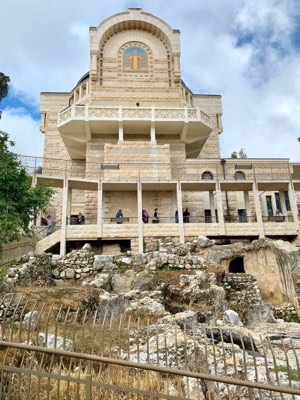
The Moskobiya Church (al-Maskubiyya), officially the Church of the Holy Forefathers in the Russian Orthodox Monastery of the Holy Trinity, stands on a hill overlooking the centre of Hebron (al-Khalil). With its golden domes, cross-shaped plan and tall bell tower, it is the only church in Hebron, a city with no local Christian community. Beside it grows the ancient Oak of Mamre, traditionally linked to Abraham and Sarah, where tradition says the angels brought Abraham news of the birth of Isaac. The Russian Church acquired the land in 1868, built the church in 1906 and consecrated it in 1925. This guide covers its history, architecture, the famous oak and its place in Hebron today.
Quick Facts About the Moskobiya Church
| Arabic name | كنيسة المسكوبية / دير المسكوبية |
|---|---|
| Official name | Church of the Holy Forefathers, Monastery of the Holy Trinity |
| Location | A hill on the western side of Hebron, overlooking the city centre |
| Denomination | Russian Orthodox Church (Russian Ecclesiastical Mission in Jerusalem) |
| Land acquired | |
| Church built | ; consecrated |
| Area | Church about 600 m², on grounds of about 70 dunums |
| Plan | Cross-shaped, with golden domes and a tall tower |
| Landmark | The Oak of Mamre (Abraham's Oak) |
| Status | Hebron's only church; opened for religious occasions and visitors |
Origin of the Name
The name al-Maskubiyya comes from Moscow, "Moskva" in Russian, which became "Maskubi" in colloquial Arabic; Hebron's people called the Russian clergy who lived there "the Muscovites". Officially it is the Monastery of the Holy Trinity and the Church of the Holy Forefathers, a name honouring Abraham, Isaac and Jacob.
Location
The church stands on a high hill on the western side of Hebron, overlooking the city centre and the Old City with the Ibrahimi Mosque. The site, also known as Ain Sibta, is distinct from the older archaeological site of Mamre (Ramat al-Khalil), a few kilometres to the north.
History of the Monastery
- 1868: In November 1868, Archimandrite Antonin Kapustin, head of the Russian Ecclesiastical Mission in Jerusalem, acquired the first plot of land around the oak, the place where tradition says three angels visited Abraham. Because Ottoman law restricted land ownership, the arrangement was made through a long-term lease, according to Al-Monitor.
- 1871–1874: The first Divine Liturgy was celebrated at the site in 1871, and a two-storey stone guesthouse for Russian pilgrims was built in 1874.
- 1884: The Patriarchs of Jerusalem and Constantinople visited the property and blessed the building of a church.
- 1906: The Church of the Holy Forefathers was built.
- 1925: On 22 October 1925 the Patriarch of Jerusalem consecrated the church, with side chapels dedicated to the Holy Trinity and Saint Nicholas.
- After 1917: Following the Russian Revolution, the property passed to the Russian Orthodox Church Outside Russia, and the flow of Russian pilgrims dwindled.
- 1997: The Palestinian Authority handed the monastery to the Moscow Patriarchate, restoring it to the Russian Church based in Russia.
- 2025: On 22 October 2025 the Russian Ecclesiastical Mission marked the centenary of the church's consecration with a liturgy led by the Patriarch of Jerusalem and a procession to the oak.
Architecture and Interior
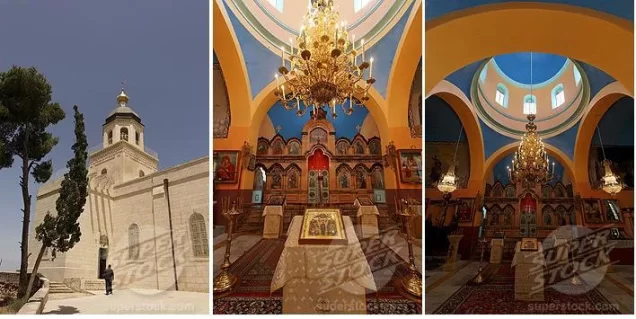
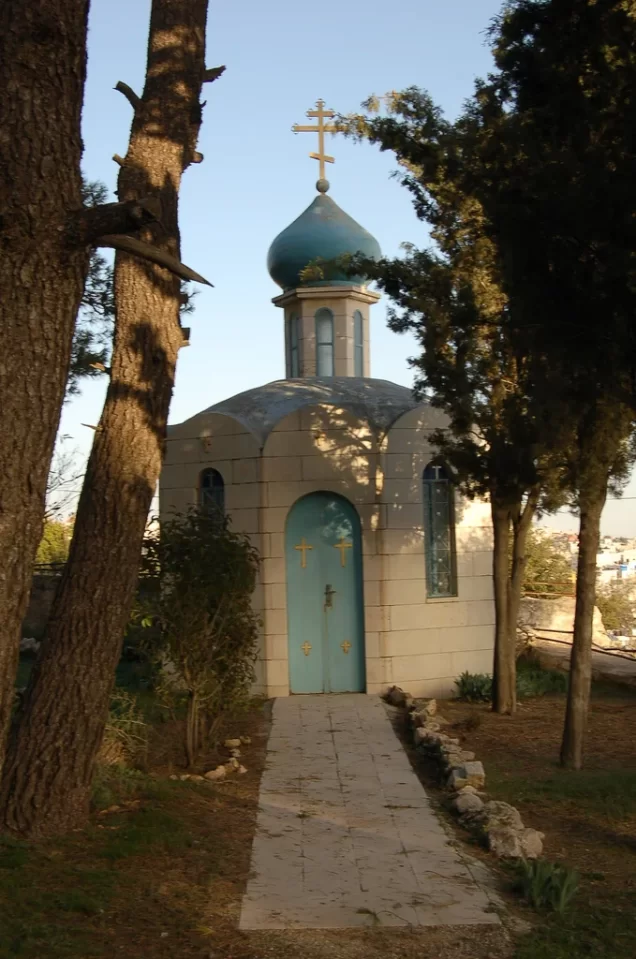
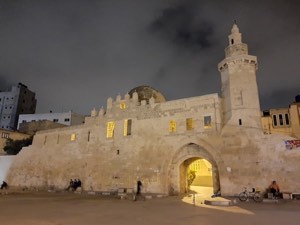
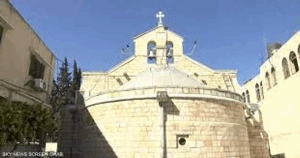
The visitor notices from afar the church's golden domes, its cross-shaped stone building and the tall tower beside it. The church covers about 600 m² on grounds of about 70 dunums. The site includes the church, a castle-like building, monks' houses and the graves of those who served the church.
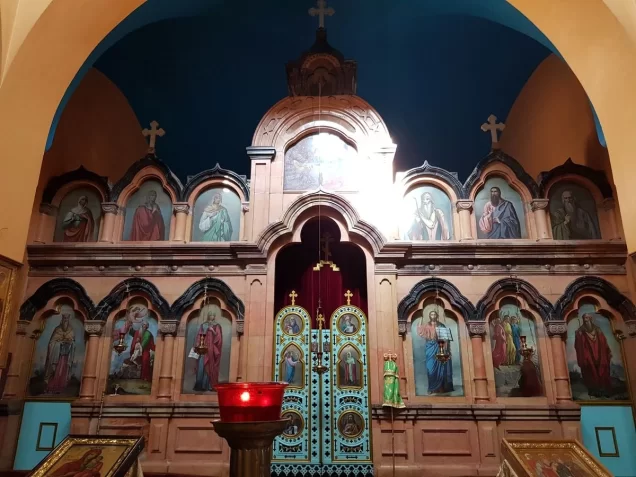
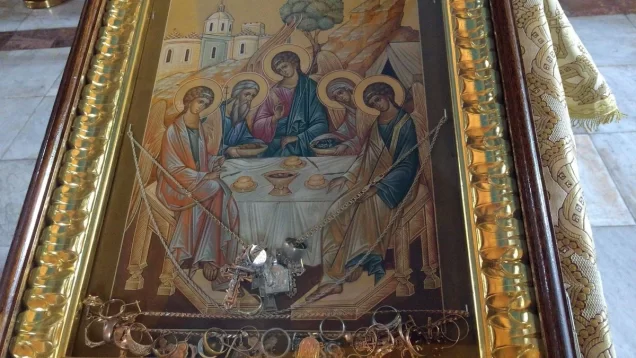
Inside, the church is decorated with icons, paintings and frescoes of figures Christians revere as prophets and matriarchs, among them Abraham, Isaac and Ishmael, and Sarah, Leah and Rachel. Islamic influence can be seen in its arched and decorated windows. The grounds also contain rock-cut living chambers, an ancient wine press, caves and tombs carved into the rock. Local accounts say some old artworks were stolen from the church during the period of Israeli military rule.
Abraham's Oak (the Oak of Mamre)
At the church's gates stands the Oak of Mamre, also called Abraham's Oak, a kermes oak venerated for centuries. Tradition holds that Abraham and Sarah lived beneath it some 5,000 years ago, and that it was here that the angels brought Abraham the news of the birth of Isaac. Popular estimates put the tree's age at 4,500 to 5,000 years, a figure that cannot be verified scientifically.
The ancient trunk appeared dead from 1996, though young shoots sprouted beside it in 1997 and 1998. In 2016 Russian botanists began a project to save the tree, but the old trunk fell in 2019. There are plans to preserve the trunk and nurture the new shoots, so that the oak lives on.
Religious Significance
For Christians, the site recalls the hospitality of Abraham, who welcomed three heavenly visitors under the oak, an episode Eastern Christianity sees as a revelation of the Holy Trinity, hence the monastery's name. For Muslims, Abraham is Khalil al-Rahman, the patriarch after whom Hebron is named, and the place is part of the city's Abrahamic heritage. Thousands of visitors, especially Russian pilgrims, have come to the oak to seek blessing.
A Russian Church in a Palestinian City
The church has long been a window for warm relations between the Palestinian people, the Palestinian Authority and Russia. Hebron's overwhelmingly Muslim population has protected the site and respected this Russian Christian landmark, and many regard it as a source of pride. A Palestinian family from Hebron has guarded the church for generations, and the few resident monks walk the city in their robes, respected by its people.
This stands in contrast to Jerusalem's Russian Compound, known in Arabic as al-Moscobiya, whose former Russian pilgrims' hostels were turned by Israel into a police station and interrogation centre where Palestinian detainees have reported harsh treatment and torture.
The Church Today (2026)
The church does not keep regular opening hours. It opens on religious occasions and to receive visitor groups, especially Russians, and a small number of monks live there. Fewer pilgrims come than in the past, as Israeli restrictions, checkpoints and the closures imposed on Hebron and the West Bank since the genocide war on Gaza began in October 2023 have hit tourism across Palestine. The church remains Hebron's only active Christian site.
Legal Protection
The church is the property of the Russian Orthodox Church and lies outside Hebron's Old City. As part of occupied territory, it is protected under the Fourth Geneva Convention and the 1954 Hague Convention for the Protection of Cultural Property in the Event of Armed Conflict, which require respect for cultural and religious property.
Frequently Asked Questions About the Moskobiya Church
Where is the Moskobiya Church?
On a hill on the western side of Hebron (al-Khalil) in the southern West Bank, overlooking the city centre.
Why is it called the Moskobiya Church?
The name comes from Moscow ("Moskva"), which became "Maskubi" in colloquial Arabic, because the church belongs to the Russian Orthodox Church.
When was the Moskobiya Church built?
The Russian Church acquired the land in 1868. The church was built in 1906 and consecrated on 22 October 1925.
What is Abraham's Oak?
An ancient oak beside the church where tradition says Abraham and Sarah lived and the angels announced the birth of Isaac. The old trunk fell in 2019, but new shoots grow beside it.
Are there Christians in Hebron?
Hebron has no local Christian community. The Moskobiya is the city's only church, served by a few Russian monks and opened for occasions and visitors.
Conclusion
On a hill above Hebron, golden domes rise over a church with no local congregation, beside an oak said to have sheltered Abraham. The Moskobiya Church has stood for more than a century as a Russian landmark in a Palestinian city, protected by its Muslim neighbours, guarded by a Hebron family and visited by pilgrims from afar. It is a reminder that al-Khalil, the city of Abraham, has room for all who honour him.
Photo gallery






More from the archive
 Download Our Palestine App
The whole archive in the palm of your hand: depopulated villages, the Nakba, the massacres and Al-Aqsa — free, with no ads to erase the story.
Download Our Palestine App
The whole archive in the palm of your hand: depopulated villages, the Nakba, the massacres and Al-Aqsa — free, with no ads to erase the story.



Comments
No comments yet — be the first to write one.
Add your comment
Name and email are optional. Comments appear after review.