
Qibya Massacre 1953: Homes Blown Up over Their Families
On the night of 14–15 October 1953, “Unit 101” and a battalion of Israeli paratroopers, under Ariel Sharon, surrounded the village of Qibya west of Ramallah. The soldiers moved from house to house, throwing grenades and shooting anyone who tried to flee, then blew up 45 houses over their occupants, along with the village mosque, its school and its water tank. Between 67 and 69 Palestinians were killed, most of them women and children. [1] [2] [3]
Qibya was one of the most atrocious massacres of the 1950s, coming less than two months after the Bureij camp massacre , carried out by the same unit. The UN Security Council condemned it with “the strongest censure,” while the occupation government denied that its army had carried it out. [4] [2]
The Qibya massacre at a glance
| Item | Details |
|---|---|
| Date | The night of 14–15 October 1953, from about 7:30 p.m. to 4 a.m. [3] [5] |
| Place | The village of Qibya, west of Ramallah, about 11 kilometers north-east of Lydda [3] |
| Perpetrator | “Unit 101” and a paratroop force, under Ariel Sharon [2] [3] |
| Method | Hand grenades thrown into homes, gunfire on those who fled, and homes blown up over their occupants [2] [5] |
| Killed | 67–69, mostly women and children [1] [2] [3] |
| Destruction | 45 houses, the village mosque, a school, and the water tank [1] [2] [3] |
| International response | Security Council Resolution 101 expressed “the strongest censure” of Israel [4] |
Qibya
Qibya is a Palestinian village west of the city of Ramallah, about 11 kilometers north-east of Lydda; before the Nakba it belonged to the Ramla district. In 1953 it had about 1,635 inhabitants. [3] The village lay close to the armistice line, which separated it from its lands and from the depopulated villages of the plain.
The order to attack
The attack came on the pretext of retaliating for an infiltration in which a mother and her two children were killed in a settlement about 15 kilometers east of Tel Aviv. David Ben-Gurion chose Qibya as the target, although it was apparently not linked to that attack. [2] The force was ordered to attack and temporarily occupy the village, and to cause “the greatest possible destruction.” [2]
The force consisted of 103 soldiers from the paratroop battalion and 20 from “Unit 101,” which Sharon founded and led, [2] while international observers estimated the attackers inside the village at no fewer than 225, and the Armistice Commission described them as a force approximating “one half of a battalion.” [5]
The massacre: the night of 14–15 October
On the evening of 14 October Israeli forces surrounded Qibya and cut it off from the neighboring villages, blockading Shuqba, Budrus and Ni’lin and laying mines on the roads to Qibya to prevent help from arriving. [3] A supporting unit shelled the village of Budrus with mortars, and part of the force crossed into the lands of Shuqba. [5]
At about 7:30 p.m. the shelling of Qibya began, continuing until about 4 a.m. [3] The attackers overcame a small handful of National Guardsmen, then moved from house to house, throwing hand grenades through openings, firing indiscriminately through doors and windows, and shooting anyone who tried to flee. [2] [3]
The soldiers then blew up the houses over their occupants. UN observers who reached the village at 6:30 a.m. found bullet-riddled bodies near the doorways of houses, and multiple bullet hits on the doors of the demolished houses. Witnesses said the inhabitants had been forced to stay inside their homes “until their homes were blown up over them.” [5] According to the demolition expert of the UN mission, the attackers used at least seventy demolition charges. [5]
Forty-five houses, the village mosque, a school and the water tank were blown up. [1] [2] [3]
The families wiped out
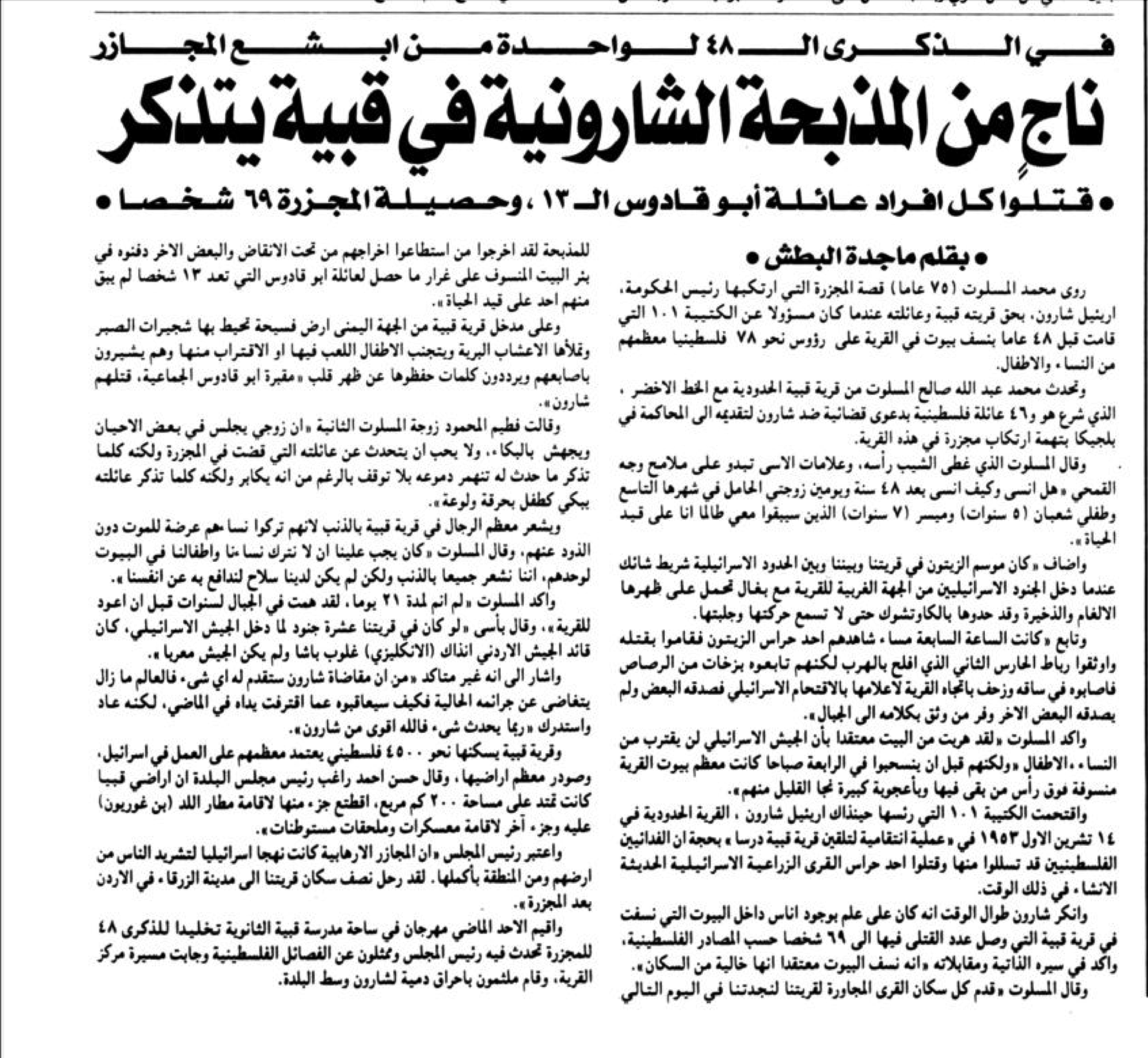
Entire families were wiped out in Qibya, among them the Abu Zeid family (four people), the six children of Mahmoud al-Maslul, the wife of Mahmoud Ibrahim and her three children, and Hussein Abdel Hadi (64) and his daughter Latifa (12). The next morning a woman sat on the rubble of her home, under which her six children lay buried. [3]
The toll: what do the sources say?
| Source | Killed | Notes |
|---|---|---|
| Palestinian National Information Center (WAFA) | 69 | 45 houses, a school and a mosque [1] |
| Al-Araby Al-Jadeed | 69, mostly women and children | 45 houses, a school and a mosque [2] |
| Al Jazeera Net and Al Jazeera Mubasher | 67 | And hundreds wounded [6] [3] |
| Bennike report (UN) | 53 | After the bodies were recovered [5] |
| Mixed Armistice Commission resolution | 42 | Issued before all the bodies were recovered [5] |
The differences stem from the fact that bodies continued to be pulled from the rubble for days; when the Armistice Commission chairman left the village on the morning of 15 October, only 27 bodies had been recovered, and villagers expected the number to reach sixty. [5]
The Israeli denial
Ben-Gurion insisted, and Israeli diplomats announced, that the army had not carried out the attack, but “civilians from a neighboring settlement,” and that no military unit had left its base that night. [2] But US diplomats in Amman wrote that the Israelis had “systematically exterminated those inside the houses,” [2] and international observers confirmed the size of the force and its use of mortars, bangalore torpedoes and explosives, which civilians would not have had. [5]
The international response
The Jordan-Israel Mixed Armistice Commission condemned the attack by majority vote. [5]
On 24 November 1953 the UN Security Council adopted Resolution 101, finding that “the retaliatory action at Qibya taken by armed forces of Israel on 14–15 October 1953” violated the cease-fire, the Armistice Agreement and the UN Charter, expressing “the strongest censure” of that action, and calling on Israel to take effective measures to prevent all such actions in the future. [4] The United States temporarily froze the disbursement of its aid to Israel. [2]
Read about the Zionist massacres against the Palestinian people.
Conclusion
In a single October night in 1953, 45 homes in Qibya were blown up over their occupants, entire families were wiped out, and between 67 and 69 Palestinians were killed, most of them women and children. The occupation government denied it, and the Security Council condemned it with its strongest censure, but the commander of the unit that carried it out, Ariel Sharon, rose through the ranks to become prime minister. Qibya, with Bureij, remains the beginning of a long record of massacres.
Frequently asked questions about the Qibya massacre
When did the Qibya massacre take place?
It took place on the night of 14–15 October 1953, with the attack lasting from about 7:30 p.m. to 4 a.m.
Who carried out the Qibya massacre?
It was carried out by “Unit 101” and the Israeli paratroop battalion under Ariel Sharon.
How many people were killed in the Qibya massacre?
Between 67 and 69 Palestinians were killed according to Palestinian and Arab sources, most of them women and children.
How many houses were blown up in Qibya?
Forty-five houses were blown up, along with the village mosque, a school and the water tank.
What did the Security Council decide on the Qibya massacre?
The Security Council adopted Resolution 101 on 24 November 1953, expressing “the strongest censure” of Israel.
Sources and references
Arabic-language sources are listed with translated titles.
- “Israeli Massacres,” Palestinian National Information Center (WAFA).
- “Palestine: The Qibya Massacre and Israeli Denial,” Al-Araby Al-Jadeed (in cooperation with Orient XXI).
- “On Its 66th Anniversary: The Qibya Massacre, a Curse on Israel,” Al Jazeera Mubasher, 14 October 2015.
- UN Security Council Resolution 101, 24 November 1953.
- “Attacks on Qibya village and Bureij camp: UNTSO report (Bennike) and Security Council debate,” United Nations, 1953.
- “Israeli Massacres against the Palestinian People,” Al Jazeera Net, 3 October 2004.
Photo gallery
More from the archive
 Download Our Palestine App
The whole archive in the palm of your hand: depopulated villages, the Nakba, the massacres and Al-Aqsa — free, with no ads to erase the story.



Comments
No comments yet — be the first to write one.
Add your comment
Name and email are optional. Comments appear after review.