St. Peter's Church in Tiberias
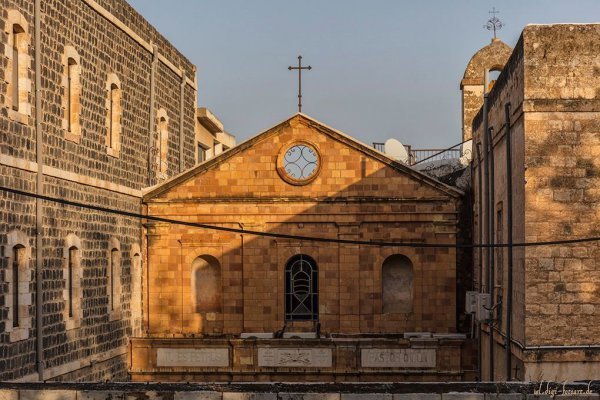
St. Peter's Church in Tiberias: The Crusader Church on the Lakeshore
St. Peter's Church is a Catholic church on the shore of Lake Tiberias, in the heart of the old city of Tiberias. The Crusaders built it around 1100 on a boat-like plan, its apse shaped like a ship's bow, recalling Peter's trade as a fisherman and a Church that weathers the storms. It became a mosque after Tiberias was liberated in 1187 and later passed to the friars of the Franciscan Custody of the Holy Land, who built a friary beside it in 1847; its present façade dates from 1870. The church survived the expulsion of all of Tiberias's Arab inhabitants in April 1948, a witness to an Arab city of Muslims and Christians. This guide covers the church's history, architecture and significance.
Quick facts
| Arabic name | كنيسة القديس بطرس – طبريا |
|---|---|
| Location | Shore of Lake Tiberias, old city of Tiberias |
| Denomination | Latin Catholic, Custody of the Holy Land |
| First built | By the Crusaders, around 1100 |
| After 1187 | Converted into a mosque |
| Franciscans | Acquired it in the 17th century; formal purchase and friary in 1847 |
| Present façade | 1870 |
| Plan | Boat-shaped, with an apse like a ship's bow |
| Statue | Bronze statue of St. Peter, a copy of the one in St. Peter's Basilica in the Vatican |
| Feast | Chair of St. Peter, 22 February |
The name and religious significance
The church bears the name of St. Peter, the fisherman of Lake Tiberias who became the leader of Jesus's disciples. It is dedicated to Jesus entrusting Peter with the care of the faithful, according to the Gospel of John: "Tend my sheep" (John 21:16). John's Gospel also mentions boats coming from Tiberias to the place of the multiplication of the loaves, and many Gospel episodes came to be associated with the city in Christian tradition as the most important town on the lake.
Location
The church stands right on the shore of Lake Tiberias, in the heart of the old city of Tiberias, close to the Omari Mosque built by Zahir al-Umar, the walls of the old city, and the Roman theatre to the south.
History through the ages
- 4th century: Christianity took root in Tiberias, and according to the historian Epiphanius a church was built there under Emperor Constantine.
- Around 1100: the Crusaders built the present church on the lakeshore.
- 1187: after Saladin liberated Tiberias, the church was converted into a mosque and later used for other purposes.
- Mid-17th century: Franciscan friars began coming each year from Nazareth to celebrate the feast of St. Peter there, paying a fee to the Muslim authorities, and the church passed into their hands in the 17th century.
- 1847: the Franciscans formally bought the church and built a friary beside it.
- 1870: the church was restored, and its present façade dates from this year.
Architecture: a church shaped like a boat
The church was built on a boat-like plan, with the apse shaped like a ship's bow, a double symbol: of Peter's trade as a fisherman on the lake, and of a Church that withstands storms as a boat holds fast at sea. In the front courtyard stands a bronze statue of St. Peter, an exact copy of his statue in St. Peter's Basilica in the Vatican. Beside the church stand the friary built by the Franciscans in 1847 and a pilgrims' guesthouse.
Tiberias and the Nakba
Tiberias was an Arab city of Muslims and Christians, rebuilt and fortified by Zahir al-Umar al-Zaydani in the 18th century. On 18 April 1948 the city fell to Zionist militias, and all of its Arab inhabitants, some 6,160 people, were expelled. Much of its old city was destroyed, and only a few landmarks survived, among them St. Peter's Church and the Omari Mosque, where Muslims are barred from praying.
The church today (2026)
The church today belongs to the Custody of the Holy Land and, together with the friary and guesthouse, is run by the Catholic community Koinonia John the Baptist. It receives pilgrims and worshippers, and the feast of the Chair of St. Peter is celebrated there on 22 February. On the lakeshore it remains one of the last witnesses to Arab Tiberias, whose people were expelled in 1948 and never returned.
Frequently asked questions
Where is St. Peter's Church in Tiberias?
Right on the shore of Lake Tiberias, in the heart of the old city.
When was the church built?
The Crusaders built it around 1100, and its present façade dates from 1870.
Why is the church shaped like a boat?
Its plan was designed in the shape of a boat, with the apse like a ship's bow, symbolising Peter's trade as a fisherman and a Church that weathers the storms.
Was the church once a mosque?
Yes. It was converted into a mosque after Saladin liberated Tiberias in 1187, and later passed to the Franciscans in the 17th century.
Who runs the church today?
It belongs to the Franciscan Custody of the Holy Land and is run by the Catholic community Koinonia John the Baptist.
Conclusion
On the shore of the lake where Peter fished, his boat-shaped Crusader church has stood for nine centuries, passing from church to mosque to Franciscan friary. Today, together with the Omari Mosque, it stands as a witness to Arab Tiberias, where Muslims and Christians lived side by side before its people were expelled in 1948.
More from the archive
 Download Our Palestine App
The whole archive in the palm of your hand: depopulated villages, the Nakba, the massacres and Al-Aqsa — free, with no ads to erase the story.
Comments
No comments yet — be the first to write one.
Add your comment
Name and email are optional. Comments appear after review.