
Church of Gethsemane (Church of All Nations)

Church of Gethsemane (Church of All Nations), Jerusalem: The Basilica of the Agony
The Church of Gethsemane, also known as the Church of All Nations or the Basilica of the Agony, stands at the foot of the Mount of Olives in the Kidron Valley in occupied East Jerusalem, where the roads between Jerusalem, al-Tur and Silwan meet. It sits beside the Garden of Gethsemane and its ancient olive trees, and enshrines the Rock of the Agony, where Christians believe Jesus prayed in anguish on the night of his arrest. The present Catholic church was designed by the Italian architect Antonio Barluzzi and built between 1919 and 1924 with donations from many countries, over the remains of Byzantine and Crusader churches. In December 2020 a settler tried to set it on fire, and in March 2026 the Palm Sunday procession that passes its doors was cancelled for the first time in centuries. This guide covers its history, architecture and garden, and its reality under occupation.
Quick facts
| Arabic name | كنيسة الجثمانية |
|---|---|
| Location | Foot of the Mount of Olives, Kidron Valley, East Jerusalem, near the Bab al-Asbat road |
| Denomination | Catholic, in the care of the Franciscan Custody of the Holy Land |
| First church | Byzantine, late 4th century; burned by the Persians in 614 |
| Crusader church | 12th century; a pilgrimage site until the 14th century |
| Present church | Foundation stone 17 October 1919; inaugurated 15 June 1924 |
| Architect | Antonio Barluzzi (Italy) |
| "All Nations" | Funded by many countries; 12 coats of arms in its domes and apses |
| Holy place | The Rock of the Agony before the altar |
| Garden | Eight ancient olive trees, estimated at about 900 years old |
The names
"Gethsemane" (Arabic al-Jathmaniyya or al-Jusmaniyya) comes from the Aramaic for "oil press", recalling the olive groves that covered the slopes of the mountain, which is named the Mount of Olives after them. The church is called the Basilica of the Agony after Jesus's anguished prayer there, and the Church of All Nations because many countries funded its construction.
Location
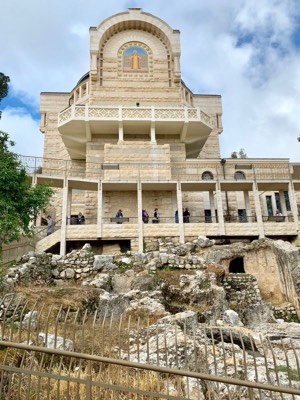
The church stands at the foot of the Mount of Olives in the Kidron Valley, facing the eastern wall of the Old City of Jerusalem and al-Aqsa Mosque, near the Bab al-Asbat road where the routes between Jerusalem, al-Tur and Silwan meet. It is next to the Church of the Tomb of the Virgin Mary, and above it on the slope rises the Russian Church of Mary Magdalene with its golden domes.
History through the ages
- Byzantine period: the first church was built over the rock under Emperor Theodosius I (379–395), and some sources date it to 389 CE. It was modest in size, with a nave, two aisles and mosaic floors, and was burned by the Persians when they entered Jerusalem in 614.
- Crusader period: in the second half of the 12th century the Crusaders built a larger church. Part of it was torn down after Saladin's liberation of Jerusalem, but it remained a pilgrimage destination until at least the early 14th century.
- Rediscovery: remains of the Crusader church came to light in 1891, and the Franciscans began excavating them in 1909. While digging the foundations of the new church, architect Barluzzi found the Byzantine church about two metres below the Crusader level, and excavations continued from 1922 to 1924.
- The present church (1919–1924): the foundation stone was laid on 17 October 1919, and the church was inaugurated on 15 June 1924, following the plan of the Byzantine church.
- 1948–1967: the area was under Jordanian administration until its occupation in 1967.
Architecture and art
- Façade: a portico of columns bearing statues of the four Evangelists, beneath a large golden mosaic by Giulio Bargellini (1930) showing Christ as mediator between God and humanity.
- Domes: twelve small domes cover the roof, and the domes and apses carry the coats of arms of the donor countries: Argentina, Brazil, Chile, Mexico, Italy, France, Spain, the United Kingdom, Belgium, Canada, Germany and the United States. Hungary funded the central apse mosaic, Ireland the "Kiss of Judas" mosaic and Poland the "Ego sum" mosaic.
- Mosaics: Pietro D'Achiardi designed the agony scene in the central apse and reconstructed the geometric floor designs, and Mario Barberis made the two side-apse mosaics.
- Interior: a dark blue ceiling studded with stars evokes the night sky, while violet alabaster windows keep the church in semi-darkness, recalling the night of Jesus's agony.
- The Rock of the Agony: an exposed section of bedrock before the altar, encircled by a wrought-iron crown of thorns, marks the place where Christians believe Jesus prayed and wept before Roman soldiers arrested him.
The Garden of Gethsemane and its olive trees
Beside the church lies the small Garden of Gethsemane, owned by the Franciscans since 1681, with eight ancient olive trees. A study by researchers of Italy's National Research Council, published in 2012, estimated the trees at about 900 years old, and radiocarbon dating placed three of them at 1092, 1166 and 1198, making them among the oldest olive trees in the world. The study found that the trees share the same genetic profile, suggesting they grew from cuttings of a single parent tree, and their roots may be much older.
Religious significance
According to the Gospels, after the Last Supper Jesus went out with his disciples to Gethsemane, where he prayed in anguish ("My Father, if it be possible, let this cup pass from me"), and where Judas betrayed him and he was arrested. The church is a key station of Holy Week: the "Holy Hour" is held there on the evening of Maundy Thursday, and the Palm Sunday procession passes it on its way from the Mount of Olives to the Old City.
Under occupation since 1967
Israeli forces occupied the Mount of Olives along with the rest of East Jerusalem in June 1967, and Israel later declared it annexed, a step rejected by UN Security Council Resolution 478. Since then the churches and holy places of the Mount of Olives have faced repeated pressure:
- 4 December 2020: a settler entered the church, poured a flammable liquid and set fire to its wooden pews, taking advantage of COVID-19 restrictions. The church guard followed him and four young Palestinians stopped him, while others put out the flames before they spread; some pews were partly burned. The adviser to the Council of Heads of Churches said the attack crossed "all red lines", the Higher Presidential Committee of Church Affairs called it part of a series of attempts to change Jerusalem's character, and the Hashemite Fund for the Restoration of al-Aqsa recalled more than 45 similar attacks on holy sites between 2000 and 2018 for which no one was held accountable.
- 2022: the occupation's Nature and Parks Authority proposed expanding what it calls the "Jerusalem Walls National Park" by about 275 dunams, covering large parts of the Mount of Olives, the Kidron Valley and Wadi al-Rababa, and affecting the lands of the Church of Gethsemane, the Tomb of the Virgin Mary and the Church of Mary Magdalene. After a letter of protest from the heads of churches the plan was frozen within 72 hours, amid warnings that it could be revived.
- The "Holy Basin" project: the Mount of Olives is included in this project targeting the surroundings of the Old City and al-Aqsa Mosque.
- Access: Palestinian Christians from the West Bank and Gaza need permits from the occupation authorities to reach the church, and many do not get them, especially since October 2023.
The church today (2026)
Since the war on Iran began on 28 February 2026, the occupation authorities imposed a state of emergency under which they closed the holy places of the Old City and barred Muslims from praying at al-Aqsa Mosque, even during Ramadan and Eid. On Palm Sunday, 29 March 2026, the traditional procession from the Mount of Olives past Gethsemane, usually attended by thousands of Christians, was cancelled for the first time in centuries, and the Latin Patriarch was barred from entering the Church of the Holy Sepulchre to celebrate Mass, drawing international condemnation. The genocide war on Gaza and the regional war continue to keep most pilgrims away, and Al Jazeera's photographs show the church almost empty of tourists.
Legal protection
As a holy place in occupied East Jerusalem, the church is protected by the Fourth Geneva Convention and the 1954 Hague Convention for the Protection of Cultural Property, which require respect for places of worship and freedom of religion, while UN Security Council Resolution 478 rejects the annexation of East Jerusalem.
Frequently asked questions
Why is it called the Church of All Nations?
Because it was built between 1919 and 1924 with donations from many countries, whose coats of arms decorate its domes and apses.
Where is the Church of Gethsemane?
At the foot of the Mount of Olives in the Kidron Valley in East Jerusalem, facing the Old City wall, beside the Garden of Gethsemane and the Church of the Tomb of the Virgin Mary.
What is the Rock of the Agony?
The exposed bedrock before the altar, where Christians believe Jesus prayed in anguish on the night of his arrest.
How old are the olive trees of Gethsemane?
An Italian study published in 2012 estimated the garden's eight olive trees at about 900 years old, making them among the oldest olive trees in the world.
Has the Church of Gethsemane been attacked?
Yes. On 4 December 2020 a settler set fire to its pews, and young Palestinians stopped him while the flames were put out before they spread.
Conclusion
In the violet half-light of the Church of Gethsemane, built with the gifts of nations, pilgrims kneel at the rock of the night of agony. Beneath olive trees more than nine centuries old, the church bears witness to Jerusalem's Christian heritage, to the people of the city who put out the fire in it with their own hands, and to the restrictions that keep many Palestinian Christians from its doors.
More from the archive


 Download Our Palestine App
The whole archive in the palm of your hand: depopulated villages, the Nakba, the massacres and Al-Aqsa — free, with no ads to erase the story.



Comments
No comments yet — be the first to write one.
Add your comment
Name and email are optional. Comments appear after review.