
Church of St Peter in Gallicantu
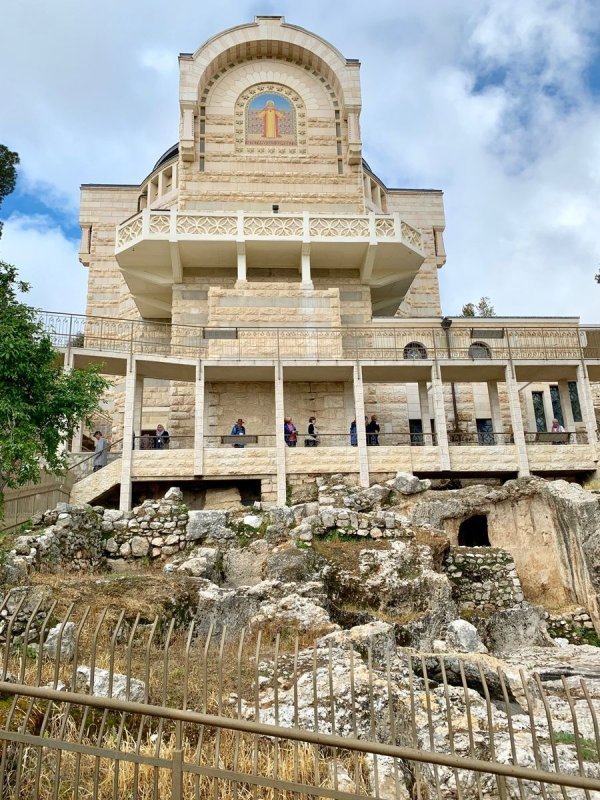
Church of St Peter in Gallicantu, Jerusalem: The Church of the Cock's Crow
The Church of St Peter in Gallicantu, known in Arabic as Kanisat Siyah al-Dik (Church of the Cock's Crow), is a Catholic church on the eastern slope of Jabal al-Nabi Dawud (Mount Zion), southwest of the Old City of occupied Jerusalem and outside its walls. It overlooks the Kidron Valley, Wadi al-Rababa and the Pool of Siloam. Christian belief places it on the site of the palace of the high priest Caiaphas, where Jesus was held and tried on the night of his arrest and where Peter denied him three times before the cock crowed. The present church was built between 1924 and 1931 over the remains of a Byzantine church, and its golden rooster now looks down on the al-Bustan neighbourhood of Silwan, where the occupation authorities are demolishing Palestinian homes. This guide covers its name, history, architecture and archaeology, and its surroundings under occupation.
Quick facts
| Arabic name | كنيسة صياح الديك |
|---|---|
| Meaning of "Gallicantu" | Latin for "at the cock's crow" |
| Location | Eastern slope of Jabal al-Nabi Dawud (Mount Zion), southwest of the Old City, outside the walls |
| Denomination | Catholic, run by the Assumptionist Fathers |
| First church | Byzantine church, 5th century CE |
| Present church | Built 1924–1931 (some sources say 1932) |
| Structure | Three levels, mostly of natural rock |
| Archaeology | Caves, cisterns, presses and roads from the Roman period |
| Christian belief | Palace of Caiaphas, Peter's denial, Jesus held on the night of his arrest |
| Symbol | A golden rooster on the roof |
The name and Peter's denial
"Gallicantu" is Latin for "at the cock's crow", the origin of the Arabic name Kanisat Siyah al-Dik. It recalls the Gospel account in which Jesus told Peter at the Last Supper, "Before the cock crows, you will deny me three times." After Jesus was arrested in Gethsemane and taken to the house of the high priest Caiaphas, Peter waited in the courtyard. When questioned, he denied knowing him three times, the cock crowed, and "he went out and wept bitterly" (Matthew 26:75). The church is also known simply as the Church of St Peter.
Location: Jabal al-Nabi Dawud
The church stands on the eastern slope of Jabal al-Nabi Dawud, southwest of the Old City of Jerusalem and outside its walls, below Bab al-Nabi Dawud (Zion Gate). From its terraces visitors look over the Kidron Valley, Wadi al-Rababa, the Pool of Siloam and the town of Silwan, with the Mount of Olives beyond. The hill rises about 760 metres and lies about 350 metres from al-Aqsa Mosque. Al Jazeera's encyclopedia explains that "Zion" is an ancient name of Jerusalem later borrowed for the hill, with no connection to the Zionist movement. On its summit Sultan Suleiman the Magnificent established the al-Nabi Dawud complex, with its mosque and school, and entrusted the guardianship of the shrine of the Prophet David to the al-Dajani family, who kept it for more than four centuries. Near the church are the Cenacle (Room of the Last Supper) and the Dormition Church.
History through the ages
- Roman period: the caves, cisterns, presses and rock-cut roads beneath the church date to the Roman period.
- Byzantine period (5th century): the first church was built on the site to commemorate Peter's repentance.
- Middle Ages: the church was destroyed and damaged several times, and the Crusaders built another shrine over the Byzantine remains.
- Assumptionist excavations: the Assumptionist Fathers, a French Catholic order, bought the land and excavated it, uncovering the remains of the earlier church, the caves and the cisterns.
- The present church (1924–1931): a new church was built over the ancient remains and completed in 1931.
- 1948–1967: after the occupation of Palestine in 1948 the hill lay on the dividing line, and Bab al-Nabi Dawud stayed closed until 1967.
Architecture and art
The church is built on three levels cut into the hillside, mostly of natural rock. Visitors enter from the third level and descend to the first. Its features include:
- a golden rooster on a cross on the roof, the church's symbol;
- the upper church, with colourful mosaics showing Peter's denial, remorse and forgiveness, and Jesus before Caiaphas;
- the middle church, carved into the rock;
- rooms believed to have been used by soldiers, and others for detention;
- murals and statues inside and around the church depicting the arrest and trial.
Archaeology: caves, cisterns and the ancient steps
Beneath the church is a network of rock-cut caves, cisterns and presses from the Roman period. Christian belief holds that one deep pit was the cell where Jesus was held on the night of his arrest, and visitors can descend into it. This identification remains a tradition rather than a proven archaeological fact, since such cellars and cisterns were common in houses of the period. In the outdoor courtyard visitors recall the place where Peter is said to have warmed himself by the fire.
Beside the church an ancient stone stairway, of disputed date, descends towards the Kidron Valley. Christians believe Jesus walked it on his way to Gethsemane after the Last Supper.
Religious significance
The church is a stop on the pilgrim route of Jesus's last days, between the Cenacle and Gethsemane. Its theme is human weakness and repentance: Peter, who denied Jesus three times, wept and repented, was forgiven and entrusted with leading the disciples. Pilgrims pray in the crypt and look out over the valley Jesus is believed to have crossed.
Under occupation since 1967
Israeli forces occupied all of East Jerusalem in June 1967, and Israel later declared it annexed, a step UN Security Council Resolution 478 declared null and void. Since then the occupation authorities have sought to Judaise Jabal al-Nabi Dawud and erase its landmarks:
- The ground floor of the Cenacle building, near the church, was turned into a synagogue.
- The Elad settler organisation works to turn the hill and its surroundings into tourist sites that promote the Israeli narrative, and the area from Bab al-Maghariba to Wadi al-Rababa is targeted by Judaisation projects near al-Aqsa.
- In January 2023 two attackers smashed dozens of gravestones in the Protestant cemetery on the hill, an attack condemned by the churches.
- Below the church, in Silwan, "national park" and settler tourism projects are expanding at the expense of Palestinian homes.
Al Jazeera correspondent Shireen Abu Akleh was buried in the Greek Orthodox cemetery on the same hill in 2022, after she was killed by Israeli forces' fire while covering the raid on Jenin.
The church today (2026)
The church remains open to visitors, but the genocide war on Gaza since October 2023, followed by the war on Iran in 2026, has sharply reduced pilgrim numbers. The view from its terraces looks over a threatened neighbourhood. According to Al Jazeera:
- In al-Bustan in Silwan, the occupation authorities had demolished 54 of about 120 homes by the end of February 2026, claiming the area was "King David's garden" and seeking to expand what they call the "national park" run by Elad.
- In January 2026 the municipality notified landowners that about 7 dunams of the neighbourhood's land would be seized.
- On 30 March 2026 municipal bulldozers demolished four more homes, and three families were ordered to leave theirs.
Legal protection
The church stands just outside the walls of the Old City of Jerusalem, which with its walls is on UNESCO's List of World Heritage in Danger. As a religious site in occupied territory, it is protected by the Fourth Geneva Convention and the 1954 Hague Convention for the Protection of Cultural Property, while UN Security Council Resolution 478 rejects the annexation of East Jerusalem.
Frequently asked questions
What does "Gallicantu" mean?
It is Latin for "at the cock's crow", recalling the Gospel account of Peter denying Jesus three times before the cock crowed.
Where is the Church of St Peter in Gallicantu?
On the eastern slope of Jabal al-Nabi Dawud (Mount Zion) in Jerusalem, southwest of the Old City and outside its walls, overlooking the Kidron Valley and the Pool of Siloam.
When was the church built?
The present church was built between 1924 and 1931 over the remains of a 5th-century Byzantine church.
Was Jesus imprisoned here?
Christian belief places the house of the high priest Caiaphas here and holds that Jesus was held overnight in a pit beneath the church, but this remains a tradition rather than a proven archaeological fact.
Who runs the church?
It is owned and run by the Assumptionist Fathers, a French Catholic order.
Conclusion
Carved into the rock of Jabal al-Nabi Dawud, the Church of St Peter in Gallicantu preserves the memory of a night of arrest, denial and repentance. Its golden rooster looks down on Silwan, where Palestinian homes are being demolished, a reminder that Jerusalem's holy places and its people share the same fate under occupation.
More from the archive


 Download Our Palestine App
The whole archive in the palm of your hand: depopulated villages, the Nakba, the massacres and Al-Aqsa — free, with no ads to erase the story.



Comments
No comments yet — be the first to write one.
Add your comment
Name and email are optional. Comments appear after review.