
Maghazi Refugee Camp in Gaza

Maghazi Refugee Camp in Gaza
Maghazi Refugee Camp in Gaza: History, Population, the Genocide in Gaza and the Right of Return
Maghazi Camp is one of the smaller Palestine refugee camps in the Gaza Strip, in the centre of the Strip south of Bureij. It was established in for about 9,000 refugees from the villages of the northern Gaza district, Jaffa, Beersheba, Ramla and Hebron, driven out during the occupation of Palestine in 1948. Today more than 30,000 refugees are registered in a camp of about 0.6 km². In the genocide in Gaza, Maghazi suffered some of the deadliest massacres of the war, including the Christmas Eve strike of 24 December 2023 that killed at least 70 people in a single residential block. This guide covers its history, origins, population, living conditions and current situation.
Quick Facts About Maghazi Camp
| Arabic name | مخيم المغازي (Mukhayyam al-Maghazi) |
|---|---|
| Country / Region | Palestine, central Gaza Strip |
| Governorate | Deir al-Balah (Middle Area) |
| Year established | |
| Area | About 0.6 km² (UNRWA); 559 dunums at founding |
| Registered refugees | More than 30,101 (UNRWA) |
| Original population | About 9,000 refugees |
| UNRWA facilities (before October 2023) | 8 schools (2 single-shift, 6 double-shift) and 1 health centre |
| Origin of residents | Villages of the northern Gaza district, Jaffa, Beersheba, Ramla and Hebron districts |
| Current status | Heavily struck since October 2023; residents live amid ruins and tents as of 2026 |
Note: UNRWA counts refer to refugees registered in the camp, not necessarily the number of people living there at any given time.
The Nakba: Why Maghazi Camp Exists
Maghazi Camp was born from the Nakba (Arabic for "catastrophe"): the mass expulsion of Palestinians during the occupation of Palestine in . Roughly 750,000 Palestinians were driven from their homes, and more than 200,000 of them poured into the narrow Gaza Strip.
Among them were Bedouin from the Beersheba region and Jaffa, who arrived first, followed by farming families from Isdud, Bayt Daras, Julis, 'Aqir, Lydda, Ramla and other villages. About 9,000 of them settled in the centre of the Strip, on the site of a former British army camp, forming Maghazi Camp in 1949.
The Right of Return
The right of return is the central demand of Maghazi's refugees. It rests on several foundations in international law:
- UN General Assembly Resolution 194 (), paragraph 11, resolved that refugees wishing to return to their homes and live at peace with their neighbours should be permitted to do so at the earliest practicable date, and that compensation should be paid to those choosing not to return and for loss of or damage to property.
- The Universal Declaration of Human Rights (Article 13) affirms everyone's right to leave any country, including their own, and to return to it.
- UN General Assembly Resolution 3236 () reaffirmed the "inalienable right" of Palestinians to return to their homes and property.
The camp's Popular Committee for Refugees, founded in 1996, works to defend refugees' rights until they can return to the villages and cities from which they were expelled, opposes any project that would undermine the right of return, and organises annual commemorations of the Nakba.
History of the Camp
Founding (1949–1950s)
Maghazi was established in 1949 on about 559 dunums, on land belonging to families from the area, around a former British army camp. In the early years, the Quakers set up a school in one of the old British army buildings, where children sat on stones in place of desks. UNRWA took over in 1950, replacing tents with simple shelters.
Under Egyptian administration and occupation (1949–1993)
From 1948 to 1967 the Gaza Strip was under Egyptian administration. With the occupation of the West Bank and Gaza Strip in , the camp came under Israeli military rule. Because of its location close to the armistice line, the camp played a strong role in the First Intifada of 1987.
Incursions and siege (2000–2023)
During the Second Intifada and afterwards, Israeli incursions into the camp killed and wounded many residents, destroyed infrastructure and razed farmland to create a buffer zone near the border fence. After the blockade of 2007, unemployment among workers and graduates reached about 59%, construction materials were banned, and the camp was struck again in the wars of 2008–2009, 2012, 2014 and 2021.
Maghazi and the Genocide in Gaza (2023 onward)
Since October 2023, Maghazi has been one of the camps hit hardest in the genocide in Gaza. In September 2025, the UN Independent International Commission of Inquiry concluded that Israel has committed genocide against Palestinians in Gaza, finding that four of the five acts defined in the 1948 Genocide Convention had been committed. A genocide case brought by South Africa against Israel is also before the International Court of Justice. Israel rejects these findings. By mid-2026, Gaza's health ministry reported more than 72,000 Palestinians killed since October 2023.
Maghazi lies in the area to which people from northern Gaza were ordered to flee, so its homes were packed with displaced families when the strikes came:
Massacres (2023–2024)
- 17 October 2023: an UNRWA school in the camp that was sheltering displaced families was hit.
- 5 November 2023: Israeli airstrikes on the camp killed about 50 people, according to Gaza's health ministry.
- 6 December 2023: a strike on a residential building killed 18 people, most of them children, and injured 20.
- 24–25 December 2023: the Christmas Eve massacre, described below.
- 1 January 2024: an airstrike on a home in the camp killed 15 people.
- October 2024: shelling of a house killed nine people, including children, and a strike on the camp's sports club, which was sheltering displaced families, killed four.
After the ceasefire agreement (2025–2026)
Even after the ceasefire agreement of October 2025, attacks did not stop: in January 2026, an Israeli drone strike in the camp killed two people. Large parts of the camp remain destroyed or uninhabitable, many families live in tents or among the ruins of their homes, and repeated displacement, shortages of clean water, food and medicine, and unexploded ordnance continue to make life extremely difficult.
The Maghazi Massacre of 24 December 2023
On the night of 24 December 2023, Christmas Eve, Israeli airstrikes hit a crowded residential block in Maghazi Camp. Gaza's health ministry reported at least 70 people killed; later counts put the toll at 86 or more, and the monitoring group Airwars recorded as many as 106 civilian deaths. Residents said they received no warning, and that each home held at least 50 people, many of them displaced from the north. Entire families were wiped out, and mass funerals were held at Al-Aqsa Martyrs Hospital in Deir al-Balah.
The Israeli military later acknowledged that the wrong type of munition had been used, causing "extensive" harm to civilians, and said it regretted the harm. For the people of Maghazi, the massacre remains one of the deepest wounds of the genocide.
Origin of the Name
There are several local accounts of the name "Maghazi":
- It may come from an old cemetery at the entrance of the area called al-Maghaza, known by that name since early Islamic times, whose name gradually became "al-Maghazi".
- Another account links it to the name of a local fighter from the area.
- A third account connects it to a woman's shrine on the lands of nearby al-Musaddar, whose name evolved over time into "Maghazi".
Location and Geography
Maghazi Camp lies in the Deir al-Balah Governorate (Middle Area) of the Gaza Strip, east of the main Salah al-Din Road. Its boundaries are:
- North: Bureij Camp
- South: the village of al-Musaddar
- West: the town of al-Zawayda
- East: the 1949 armistice line (Green Line)
Its proximity to the border has long exposed the camp to incursions and gunfire, and to the destruction of the farmland around it.
Area and Land
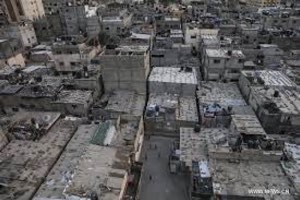
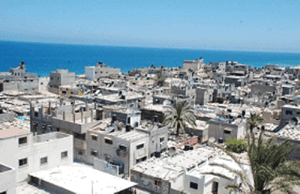
The camp was established on about 559 dunums; UNRWA gives its area as about 0.6 square kilometres. The surrounding Maghazi municipality has grown much larger over time. The camp is characterised by narrow alleys and high population density, and its cemetery has run out of space, forcing families to bury their dead in the graves of their ancestors.
Villages of Origin
Maghazi's refugees came mainly from the villages of the northern Gaza district and from the Jaffa and Beersheba districts, with some from the Ramla district and a small number from the Hebron district. Villages and towns of origin include:
- Kawkaba
- Isdud
- Bayt Daras
- Julis
- Tall al-Turmus
- Al-Batani al-Gharbi
- 'Aqir, Lydda and Ramla
- Jaffa and the Beersheba region, including Bedouin clans
Living together under one roof, these families from different villages and backgrounds formed a closely woven community, blending their customs and traditions.
Population and Demographics
| Year | Population | Source |
|---|---|---|
| 1949 | About 9,000 refugees | Encyclopedia of Palestinian Camps |
| 1967 | About 8,167 | Encyclopedia of Palestinian Camps |
| 1997 | About 16,846 | Encyclopedia of Palestinian Camps |
| 2005 | About 23,399 | Encyclopedia of Palestinian Camps |
| 2007 | About 25,064 | Encyclopedia of Palestinian Camps |
| Before October 2023 | More than 30,101 registered refugees | UNRWA |
| 2023–2026 | Residents repeatedly displaced; the camp also sheltered many people displaced from the north | UN agencies |
Housing and Infrastructure
Before October 2023, about 70% of the camp's homes were dilapidated, and many houses held more than one family. The blockade's ban on building materials made construction and repair impossible, electricity was inadequate, water was often cut off, especially in summer, and there were not enough wells to supply clean drinking water.
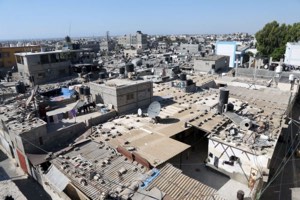
Since 2023, a large share of the camp's homes have been totally or partly destroyed, and entire neighbourhoods have become uninhabitable. Many families live in tents or among the rubble, with long power cuts, scarce clean water, damaged sewage systems and debris and unexploded ordnance blocking movement and reconstruction.
Health Situation
Before the war, the camp was served by an UNRWA health centre (since 1979), a Ministry of Health clinic and private and charitable clinics, while Al-Aqsa Martyrs Hospital in Deir al-Balah served the whole Middle Area. There were no evening emergency clinics or ambulances in the camp. Since 2023:
- Al-Aqsa Martyrs Hospital has been overwhelmed by mass casualties from Maghazi and the other central camps.
- Nearby health facilities work at limited capacity because of shortages of fuel and supplies.
- Food and medicine are scarce and expensive, and malnutrition has spread.
- Children and families suffer severe psychological trauma.
Economic Situation
The Maghazi area was known for olive and citrus farming and livestock, which helped support camp families. Repeated incursions destroyed many farms and trees, and the blockade pushed unemployment and poverty to very high levels. The camp's central market had about 50 shops and hundreds of stalls, but many shopkeepers struggled to make sales. Its distance from the cities also limited job opportunities.
Since 2023, the camp's economy has been almost entirely destroyed, and nearly all families depend on humanitarian aid, which has itself been severely restricted.
Education
Before October 2023, UNRWA ran eight schools in the camp, two on a single shift and six on double shifts, with 40–45 pupils per classroom. The Ministry of Education ran secondary schools for girls, and a private college offered higher education. Since 2023, schools have been turned into shelters, several have been struck, and the camp's children have lost years of education.
Frequently Asked Questions About Maghazi Camp
Where is Maghazi refugee camp located?
Maghazi is in the Deir al-Balah Governorate in the central Gaza Strip, east of Salah al-Din Road, south of Bureij Camp, with al-Zawayda to the west and al-Musaddar to the south.
How many refugees live in Maghazi camp?
UNRWA reports more than 30,101 registered refugees in the camp, on an area of about 0.6 square kilometres.
When was Maghazi camp established?
It was established in 1949, around a former British army camp, for about 9,000 refugees.
What happened in Maghazi on 24 December 2023?
On Christmas Eve 2023, Israeli airstrikes hit a crowded residential block in the camp, killing at least 70 people according to Gaza's health ministry, with later counts of 86 or more. The Israeli military acknowledged using the wrong munition.
Where do Maghazi's refugees come from?
Mainly from villages of the northern Gaza district such as Kawkaba, Isdud, Bayt Daras and Julis, and from the Jaffa, Beersheba, Ramla and Hebron districts.
Conclusion
Maghazi Camp grew from a former British army camp into a tightly knit community of refugees from Kawkaba, Isdud, Bayt Daras, Julis and many other villages. In the genocide in Gaza, it suffered some of the deadliest massacres of the war, losing entire families in a single night. Its survivors continue to live among the ruins, caring for each other and holding onto the right to return to the villages their families lost in 1948.
More from the archive
 Download Our Palestine App
The whole archive in the palm of your hand: depopulated villages, the Nakba, the massacres and Al-Aqsa — free, with no ads to erase the story.
Download Our Palestine App
The whole archive in the palm of your hand: depopulated villages, the Nakba, the massacres and Al-Aqsa — free, with no ads to erase the story.



Comments
No comments yet — be the first to write one.
Add your comment
Name and email are optional. Comments appear after review.
Social Life and Sports
Maghazi is known for its closely knit social fabric, with many families of Bedouin and village origin, family councils (diwans), a Popular Committee for Refugees, women's centres, a cultural centre, rehabilitation services for people with disabilities, and many charitable associations. Khadamat al-Maghazi Club, founded in 1952, has teams in football, basketball, handball, volleyball and other sports. The camp lacks playgrounds, so children often play in the streets.
The genocide has torn this social fabric apart, wiping out entire families and displacing survivors again and again.