Destruction of Jaffa 1936: Britain Blows Up the Old City
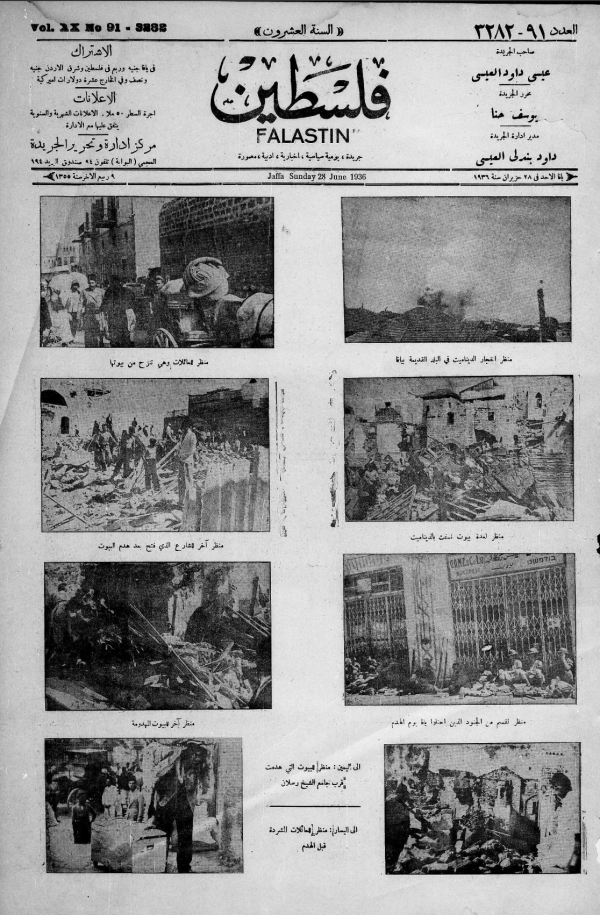
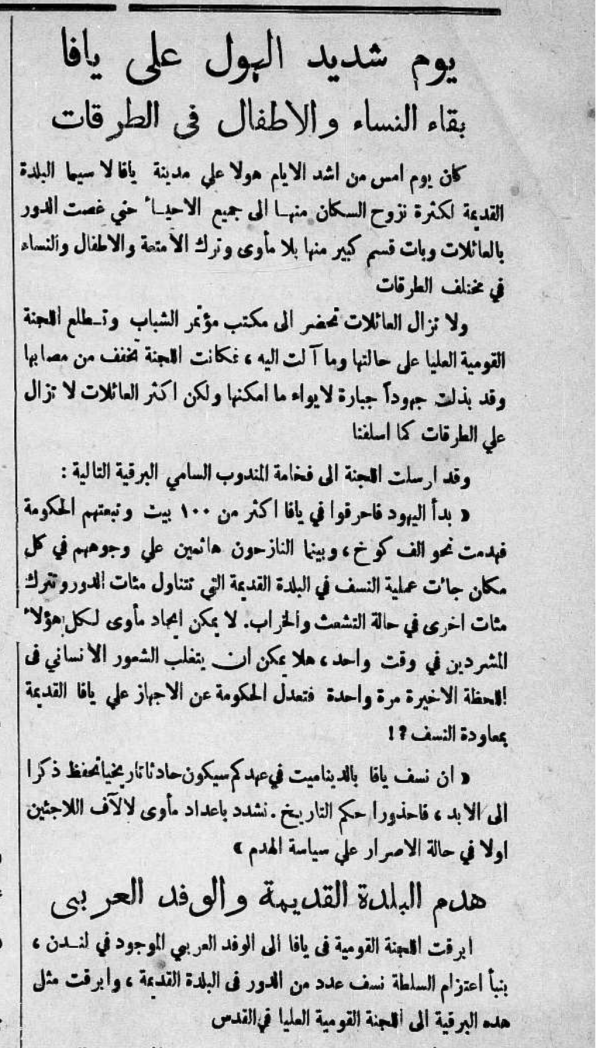
In June 1936, at the height of the Great Palestinian Revolt and general strike, British Mandate forces blew up large parts of the Old City of Jaffa in two rounds, on 18 June and again on 29–30 June, under the pretext of “improving the town and widening its roads.” About 220 residential buildings were destroyed and between 6,000 and 10,000 Palestinians were made homeless, in one of the largest acts of collective punishment of the Mandate era. [1] [2] [3]
The destruction of Jaffa at a glance
| Item | Details |
|---|---|
| Event | British Mandate forces blow up large parts of the Old City of Jaffa [1] [2] |
| Date | 18 June 1936, then 29–30 June 1936 [2] |
| Context | The Great Palestinian Revolt and the 1936 general strike [1] |
| Stated pretext | “Town improvement” and road building [2] [4] |
| Real aim | Collective punishment and opening roads to hunt rebels [4] [1] |
| Homes blown up | About 220–240 residential buildings [3] |
| Made homeless | Between 6,000 and 10,000 Palestinians [3] |
Jaffa at the heart of the revolt and strike
Jaffa, the city of the port, the press and the oranges, was one of the main centres of the Great Palestinian Revolt, which broke out in spring 1936, and among the first cities to observe the general strike called by the Arab Higher Committee in protest at Zionist immigration and a Mandate policy that favoured the Zionist project [1] [4]. The tangled alleys of the Old City became a refuge for rebels that British troops struggled to enter; the British military report described it as a centre of resistance to the forces and spoke of identifying houses that had “harboured rebels” for demolition [5].
For more on the city and its life before the occupation, read Jaffa before the Nakba.
The “town improvement” pretext
On 16–17 June 1936 a British aircraft dropped leaflets over the city and the government issued an official communiqué announcing that it was “about to begin a project to widen and improve the Old City of Jaffa by building two roads that will benefit the whole town,” and that the first step would be “the demolition and removal of some congested and unhealthy buildings,” taking advantage of the presence of Royal Engineers units in Palestine [2]. It threatened force if residents resisted and promised compensation to owners.
The pretext convinced no one. Strikingly, the British military report itself, compiled by the headquarters of British forces in Palestine in 1938, openly admitted that the “town improvement” communiqué “deceived nobody,” and classed the demolition as “Phase 3 of the punitive measures” [2]. The real aim was to widen the narrow streets so British troops could pursue the rebels, and to punish the city collectively for its steadfastness and its strike [4] [1].
The demolition plan and its four phases
On the orders of the commander of British forces in Palestine and Transjordan, Air Vice-Marshal Richard Peirse, and according to Palestinian accounts, the British officer Lieutenant-Colonel Otterson-Kelso drew up the plan with Southern District Commissioner Crosbie and police inspector Foley. It was divided into four phases:
- Heavy, sustained Vickers machine-gun fire on rebel positions until they fell silent, in clashes that Palestinian accounts say lasted about 18 days.
- Forced labour imposed on residents, notables and shopkeepers to clear the barricades from the streets.
- Blowing up the eastern and western parts of the Old City and cutting a road through it.
- Blowing up the northern and southern parts and cutting a second road through the middle.
18 June 1936: the first road
At 4 a.m. the Royal Engineers, covered by the 1st Battalion Royal Scots Fusiliers, forced their way into the city and found the Old City deserted [2]. An infantry battalion cordoned off the area and searched everyone leaving, with infantry and armoured companies in reserve, while, according to Palestinian accounts, the warship HMS Active lay offshore. By nightfall dynamite had driven a road ten metres wide through the heart of the city [2], running from al-Ajami police station to Dayr al-Latin.
29–30 June 1936: the second road
In the fourth and final phase a north–south circular road was blown through the Old City [2]. Palestinian accounts report that Peirse said the haste in carrying out this phase was meant to pre-empt the Supreme Court before it could rule on a petition residents had filed against the demolitions. In the same period a shanty quarter was flattened by driving tanks across it, after its inhabitants, mostly workers from Hauran, had been deported to Syria [2].
The toll: homes, churches and mosques
| Phase | Homes | Families | Source |
|---|---|---|---|
| First demolition (18 June 1936) | 70 homes | 150 families | Palestinian accounts |
| Second demolition (29–30 June 1936) | About 150 homes | About 300 families | Palestinian accounts |
| Total | 220–240 residential buildings | About 450 families | Palestinian accounts [3] |
| Shanty quarters | About 850 wooden shacks | About 4,000 people | Palestinian accounts [2] |
Palestinian accounts put the number left without shelter at about 10,000, while other sources give 6,000 [3]. Many neighbouring houses were damaged and cracked, and the destruction reached places of worship:
- Al-Khadr Church in al-Ajami: cracked by the dynamite blasts.
- Sheikh Raslan Mosque: part of its minaret was destroyed.
- Dayr al-Rum Church: falling stones wrecked its roof and damaged some of its lamps.
- Dayr al-Latin Church (known as al-Qal‘a): the dynamite damaged its contents and disfigured its facade.
According to Palestinian accounts, the compensation promised by the Mandate authorities did not exceed twenty mils per family member, with no serious plan to shelter the displaced.
After the demolition
The demolitions did not break the rebels’ will. Their operations escalated across Palestine, peaking around the 100th day of the strike in late July 1936, and Britain was forced to call in military reinforcements [1]. Palestinian accounts report that Peirse wrote to his command that his forces were “no longer able to crush the rebellion with the required speed,” asking for a full division of three brigades and an additional bomber squadron.
The two roads that dynamite cut through Old Jaffa remained a testament to collective punishment, and to a method the Zionist occupation would later inherit in demolishing homes and expelling residents, from the Saraya massacre in 1948 to the occupation of Jaffa and the expulsion of most of its people in the Nakba.
Conclusion
Under the banner of “town improvement,” Britain blew up the historic heart of Jaffa, made thousands of Palestinians homeless and damaged its churches and mosques, and then its own army admitted in internal reports that the pretext “deceived nobody.” The destruction of Jaffa in 1936 was an early lesson in colonial collective punishment that paved the way for what befell the city and its people twelve years later.
Frequently asked questions about the destruction of Jaffa in 1936
When did the British destroy the Old City of Jaffa?
In two rounds: on 18 June 1936, and again on 29–30 June 1936.
Why did Britain blow up Old Jaffa?
To punish the city for its part in the Great Revolt and the general strike, and to open roads for pursuing the rebels. The British military report itself admitted that the “town improvement” pretext deceived nobody.
How many homes were destroyed in Jaffa in 1936?
About 220 to 240 residential buildings, plus some 850 wooden shacks.
How many people were made homeless?
Between 6,000 and 10,000 Palestinians, according to different estimates.
Which places of worship were damaged?
Al-Khadr Church in al-Ajami, Sheikh Raslan Mosque, Dayr al-Rum Church and Dayr al-Latin Church.
Sources and references
Arabic-language sources are listed with translated titles.
- “Great Palestinian Rebellion, 1936–1939: A Popular Uprising Facing a Ruthless Repression,” Interactive Encyclopedia of the Palestine Question (Institute for Palestine Studies).
- General Staff, HQ British Forces in Palestine & Trans-Jordan, “Military Lessons of the Arab Rebellion in Palestine 1936,” February 1938, British Library IOR/L/MIL/17/16/16, f. 15r, Qatar Digital Library.
- Farrukh Husain, “How Zionism Consumed Jaffa,” The Friday Times, 21 May 2021.
- Abd al-Qadir Yasin, “Palestinian Jaffa: A Cradle of Journalism and Culture Before the Nakba,” Arabi21, 20 March 2020.
- Ibid., f. 101v, Qatar Digital Library.
Video clips
Photo gallery
More from the archive
 Download Our Palestine App
The whole archive in the palm of your hand: depopulated villages, the Nakba, the massacres and Al-Aqsa — free, with no ads to erase the story.
Comments
No comments yet — be the first to write one.
Add your comment
Name and email are optional. Comments appear after review.