
Al-Aqsa Massacre 2000: Gunfire on Worshippers Ignites the Intifada
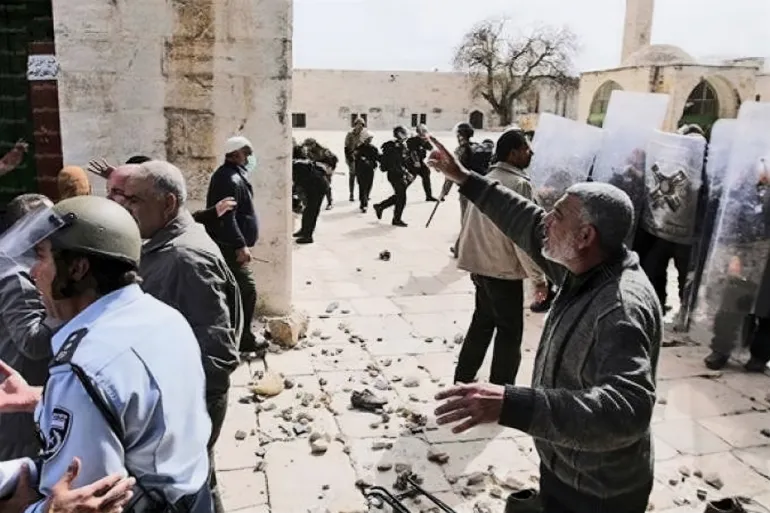
On 29 September 2000, after Friday prayers at Al-Aqsa Mosque, Israeli occupation forces opened fire on worshippers in its courtyards, killing 7 Palestinians and wounding about 250. The massacre came the day after Ariel Sharon stormed the mosque, and it ignited the Al-Aqsa Intifada. [1] [2]
The UN Security Council deplored the “provocation” at Al-Haram Al-Sharif and “the subsequent violence.” The massacre is one of the Zionist massacres against the Palestinian people. [3]
The Al-Aqsa massacre at a glance
| Item | Details |
|---|---|
| Date | Friday, 29 September 2000 [3] [1] |
| Place | The courtyards of Al-Aqsa Mosque (Al-Haram Al-Sharif) in occupied Jerusalem [1] [2] |
| Perpetrator | Israeli occupation forces [1] [3] |
| Background | Ariel Sharon’s incursion into Al-Aqsa on 28 September under the protection of about 2,000 soldiers [1] [2] |
| Killed | 7 Palestinians [1] [2] |
| Wounded | About 250 [1] [2] |
| Outcome | The outbreak of the Al-Aqsa Intifada (Second Intifada) [1] [4] |
28 September: Sharon’s incursion
On 28 September 2000 Ariel Sharon, then leader of the opposition Likud party, stormed the courtyards of Al-Aqsa Mosque under the protection of about 2,000 soldiers and special forces, with the approval of the occupation’s prime minister, Ehud Barak, [1] ignoring Palestinian warnings that the visit could set the region ablaze. [4]
During the incursion Sharon declared that the Haram “will remain an Israeli area,” provoking the worshippers, who gathered to confront him. [2] The UN Commission on Human Rights described the visit as “provocative” and said it “triggered the tragic events that followed.” [5]
29 September: gunfire on the worshippers
The next day, Friday 29 September, thousands of worshippers gathered at Al-Aqsa Mosque. As prayers ended, occupation forces opened fire on them in the mosque’s courtyards, killing 7 Palestinians and wounding about 250. [1] [2] Thirteen Israeli soldiers were injured in the confrontations. [1]
The spark of the Intifada
The uprising spread across Jerusalem, the West Bank and the Gaza Strip. [4] The next day, 30 September, the occupation executed the child Muhammad al-Durra in Gaza as he sheltered beside his father behind a concrete barrier. [1] The confrontations spread to the Palestinians inside the Green Line, in the October 2000 uprising in the Galilee.
The Al-Aqsa Intifada lasted for years; between September 2000 and June 2006 about 4,464 Palestinians were killed and some 47,440 wounded, according to the Palestinian National Information Centre. [4]
The international position
On 7 October 2000 the Security Council adopted resolution 1322, which “deplores the provocation carried out at Al-Haram Al-Sharif in Jerusalem on 28 September 2000, and the subsequent violence there and at other Holy Places,” and “condemns acts of violence, especially the excessive use of force against Palestinians, resulting in over 80 Palestinian deaths.” It was adopted by 14 votes, with the United States abstaining. [3]
On 19 October 2000 the Commission on Human Rights, in a special session, condemned the excessive use of force that had caused the deaths of 120 civilians, many of them children. [5]
Conclusion
Sharon stormed Al-Aqsa protected by two thousand soldiers, and the next day the occupation answered unarmed worshippers with bullets, killing seven and wounding hundreds in the mosque’s courtyards. The massacre was the spark of an uprising that lasted years and cost Palestinians thousands of martyrs.
Frequently asked questions about the Al-Aqsa massacre of 2000
When did the Al-Aqsa massacre take place?
On Friday 29 September 2000, the day after Sharon stormed the mosque.
How many people were killed in the Al-Aqsa massacre of 2000?
7 killed and about 250 wounded.
How is the massacre related to Sharon’s incursion?
Sharon stormed Al-Aqsa on 28 September under the protection of about 2,000 soldiers; confrontations broke out, and the next day the occupation fired on the worshippers.
What did the Security Council say?
It adopted resolution 1322, deploring the provocation at Al-Haram Al-Sharif and the violence that followed, and condemning the excessive use of force against Palestinians.
Is it the same as the Al-Aqsa massacre of 1990?
No. The first Al-Aqsa massacre took place on 8 October 1990; this one took place on 29 September 2000.
Sources and references
Arabic-language sources are listed with translated titles.
- “The Second Intifada: A Comprehensive Palestinian Uprising Ignited by Sharon’s Storming of Al-Aqsa,” Al Jazeera Encyclopedia.
- “20 Years Since the Second Intifada: What Was Achieved?” Arabi21, September 2020.
- UN Security Council, resolution 1322 (2000), 7 October 2000, press release.
- Awad al-Rujoub, “22 Years Since the Al-Aqsa Intifada: Events and Names Not Forgotten,” Al Jazeera Net, 28 September 2022.
- UN Commission on Human Rights, fifth special session, resolution S-5/1, document E/CN.4/S-5/5, 19 October 2000.
More from the archive
 Download Our Palestine App
The whole archive in the palm of your hand: depopulated villages, the Nakba, the massacres and Al-Aqsa — free, with no ads to erase the story.



Comments
No comments yet — be the first to write one.
Add your comment
Name and email are optional. Comments appear after review.