
Jenin: From An Epic Place to Massacre
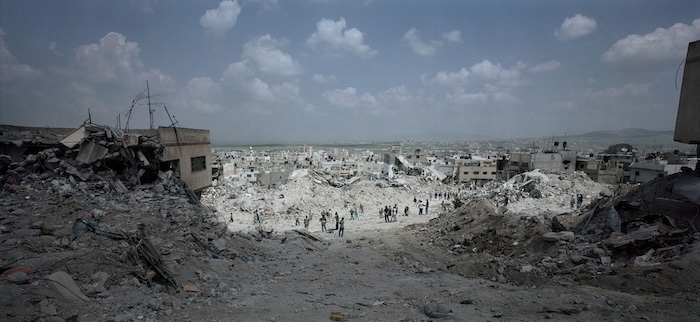
Between 3 and 11 April 2002, the fighters of Jenin refugee camp fought one of the fiercest battles of the Second Intifada, holding out for eight days against tanks and helicopters and killing 13 occupation soldiers in a single ambush. Then the occupation sent in its bulldozers, levelling the al-Hawashin neighborhood in the heart of the camp, destroying some 150 buildings, and killing 52 Palestinians, up to half of them possibly civilians, while keeping ambulances from the wounded and the world from the camp for days. UN envoy Terje Roed-Larsen, after entering the camp, said the scene was “horrifying and shocking” and the means used “morally repugnant.” [1] [2]
Palestinians came to know the battle of Jenin camp as “the epic,” and what it ended in as “the massacre.” This article tells both stories: the resistance of the fighters, then the destruction, the siege and the killing, along with the differences between sources over the figures.
The Jenin massacre at a glance
| Item | Details |
|---|---|
| Date | 3–11 April 2002; the army withdrew on 18 April [1] [3] |
| Place | Jenin refugee camp, northern West Bank [1] |
| Operation | “Defensive Shield,” in which the occupation stormed the cities of the West Bank [1] |
| Attacking forces | Infantry brigades and commando units, more than 60 tanks, dozens of armored vehicles and attack helicopters [4] |
| Killed | 52 confirmed dead, up to half of them possibly civilians [1] |
| Occupation losses | 23 soldiers, 13 of them in the ambush of 9 April [1] |
| Destruction | About 150 buildings, 450 families left homeless, and the al-Hawashin neighborhood levelled [1] |
Before the battle
On 29 March 2002 the occupation launched Operation “Defensive Shield,” storming its major cities one after another. [1] Jenin camp was no stranger to incursions: this was the sixth time the camp and city had been stormed since the start of the Second Intifada, the last just a month earlier in the February–March incursion. [5]
The fighters knew the assault was coming, and declared that they would allow the camp to be taken only over their dead bodies, and would not withdraw. The circulating account says the occupation massed more than 20,000 reservists and some 400 tanks and personnel carriers for the operation; the figure of 20,000 is known to refer to Operation “Defensive Shield” as a whole, while sources state that more than 60 tanks and dozens of armored vehicles and attack helicopters took part in the assault on Jenin. [4]
The epic: eight days of resistance
On 3 April 2002 occupation forces entered the city of Jenin and its camp and imposed a round-the-clock curfew. [1] Several hundred fighters from various factions fought in the camp’s narrow alleys, and the occupation’s advance stalled for days. [4]
The fighters turned the camp into a real battlefield, planting explosive devices in the alleys, squares and entrances, and setting ambushes inside homes for soldiers who advanced by breaking through walls from house to house. [5] The circulating account relates that the fighters booby-trapped entire houses they expected soldiers to enter, among them the house of Mahmoud Tawalbeh, where two soldiers were killed and five wounded.
Among the battle’s most prominent leaders were Mahmoud Tawalbeh, commander of the Al-Quds Brigades in the camp, who refused to leave the camp despite his comrades’ urging and was killed on 8 April with his comrades Shadi al-Nubani and Abd al-Rahim Faraj; and Yousef Rayhan, “Abu Jandal,” who moved from position to position urging the fighters to hold on. [5] The circulating account says the occupation’s losses led its leadership to change the operation’s field commanders more than once.
Unable to storm the camp for days, the occupation intensified its bombardment with helicopters and missiles; bulldozers advanced ahead of the tanks, and houses that proved hard to storm were shelled and demolished. [5] [1] The heaviest fighting came between 5 and 9 April. [1]
The ambush of 9 April
On 9 April 2002 occupation soldiers fell into an ambush inside the camp, and 13 of them were killed at once; another soldier was killed elsewhere in the camp the same day. [1] “The ambush of 13” became the turning point of the battle. [5] In all, 23 occupation soldiers were killed in Jenin. [1] [6]
The massacre: bulldozers and al-Hawashin
After the ambush the occupation escalated its assault. By 11 April the fighting was over. [1] Military bulldozers advanced in the front lines, demolishing houses and opening the way for the tanks. [5] [4]
The al-Hawashin neighborhood in the heart of the camp was completely destroyed, “effectively levelled” according to the UN Secretary-General’s report. Some 150 buildings were destroyed, many others were left structurally unsound, about 450 families were left homeless, and the damage was estimated at about $27 million. [1] Sources state that bulldozers demolished homes on top of their inhabitants. [4]
The siege: the wounded and the hospital
On 4 April occupation forces sealed Jenin hospital, and the Palestinians inside were not allowed to leave until 15 April. UN agencies were denied entry to the camp for days, and the Red Crescent and the Red Cross entered only on 15 April, under military escort, recovering seven bodies before withdrawing. [1] The wounded were left in homes and alleys for days without medical care. [1]
On 18 April the curfew was lifted and the army withdrew, and senior UN officials criticized the occupation’s refusal to allow “full and safe access to the affected populations.” [1]
The testimony of journalists and the UN
The UN Middle East envoy, Terje Roed-Larsen, entered the camp on 18 April and said the scene was “horrifying and shocking,” that “the smell was horrible, of decaying corpses below the rubble,” and that “it looks as if there’s been an earthquake there.” He described the means used as “totally unacceptable and morally repugnant.” [2] Arabic sources circulate his words as: “It is beyond imagination and description.”
French journalist Pierre Barbancey of L’Humanité described the encirclement of the camp’s center as “resembling what happened in Berlin in 1945,” said he smelled the bodies, and reported that bodies were thrown into a large pit in al-Hawashin square, then covered with rubble and flattened. [7] Other journalists described charred bodies under the rubble, among them a correspondent of the Italian newspaper Il Manifesto, who saw five charred bodies piled in a single room. [7] The circulating account also reports 14 bodies found under the rubble of one house.
The director of Jenin hospital, Mohammed Abu Ghali, confirmed 36 bodies on 18 April and estimated the number could reach 200–400. [6]
The toll: what do the sources say?
| Source | Killed | Notes |
|---|---|---|
| Jenin hospital (UN report) | 52 confirmed by the end of May 2002 | Up to half possibly civilians [1] |
| Human Rights Watch | At least 22 civilians among the dead | According to the UN report [1] |
| Director of Jenin hospital (18 April) | 36 bodies confirmed | Estimate that the number could reach 200–400 [6] |
The first Palestinian estimates of the dead ran into the hundreds, because the camp remained sealed for days, bodies lay under the rubble, and dozens were missing. The confirmed figure later settled at 52, with continuing dispute over the number of civilians among them. [1] [6] But the toll does not sum up the massacre: an entire neighborhood levelled, a hospital sealed, the wounded left to bleed, and thousands of the camp’s people left homeless.
The investigation that never happened
On 22 April 2002 UN Secretary-General Kofi Annan set up a fact-finding team for Jenin. But the occupation raised “concerns” that prevented the team from deploying, and the Secretary-General was forced to disband it on 3 May, writing that Israel’s objections had become “fundamental in nature.” [1] So no international on-the-ground investigation was ever carried out into what happened in Jenin camp.
Read about Jenin and the Zionist massacres against the Palestinian people.
Conclusion
In April 2002 Jenin was both an epic and a massacre: a small camp that held out for eight days against an entire army, inflicting losses it had not expected, then paid the price with an entire neighborhood levelled, dozens killed, wounded left without care, and an international investigation prevented from taking place. Since that spring, the name “Jenin camp” has remained a symbol of steadfastness in Palestinian memory.
Frequently asked questions about the Jenin massacre of 2002
When did the Jenin massacre take place?
It took place during the incursion into Jenin camp between 3 and 11 April 2002, as part of Operation “Defensive Shield,” and the occupation army withdrew on 18 April.
How many people were killed in the Jenin massacre of 2002?
According to Jenin hospital and the UN report, 52 Palestinians were confirmed killed, up to half of them possibly civilians, while the first Palestinian estimates ran into the hundreds.
What was the ambush of 13 in Jenin?
It was the ambush the fighters set for occupation forces inside the camp on 9 April 2002, in which 13 soldiers were killed; it became the turning point of the battle.
What happened to the al-Hawashin neighborhood?
Occupation bulldozers levelled it, among some 150 buildings destroyed in the camp, and about 450 families were left homeless.
Why did the UN not investigate the Jenin massacre?
The Secretary-General set up a fact-finding team on 22 April 2002, but Israel prevented its deployment, and the team was disbanded on 3 May 2002.
Sources and references
Arabic-language sources are listed with translated titles.
- “Report of the Secretary-General on the events in Jenin and in other Palestinian cities” (A/ES-10/186), United Nations, 30 July 2002.
- CNN broadcast transcript, 18 April 2002.
- “The Jenin Camp Massacre, 2002,” Palestinian National Information Center (WAFA).
- “The Jenin Massacre,” Marefa encyclopedia.
- Mazen Walid, “The Battle of Jenin Camp 2002: Glimpses of a War That Has Not Ended,” Etar, 23 September 2023.
- “Middle East, 18 April 2002,” PBS NewsHour.
- “Jenin Camp, Witness and Martyr,” Al Bayan, 22 May 2002.
More from the archive
 Download Our Palestine App
The whole archive in the palm of your hand: depopulated villages, the Nakba, the massacres and Al-Aqsa — free, with no ads to erase the story.



Comments
No comments yet — be the first to write one.
Add your comment
Name and email are optional. Comments appear after review.