
The Biltmore Conference: A Turning Point in Zionist Strategy and the Rise of American Zionist Influence
The Biltmore Conference: A Turning Point in Zionist Strategy and the Rise of American Zionist Influence
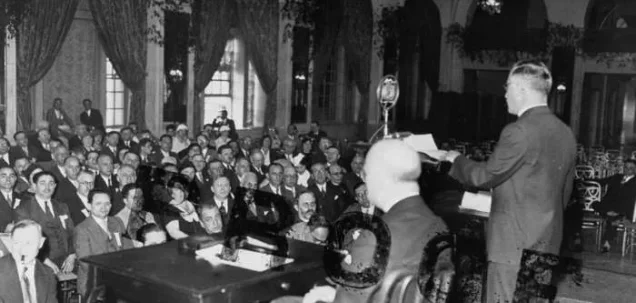
In May 1942, in the midst of the Second World War, Zionist leaders gathered at the Biltmore Hotel in New York City for an extraordinary conference that became one of the most important turning points in the history of the Zionist movement and the Palestinian question.
The Extraordinary Zionist Conference was held in New York from May 6 to 11, 1942, while the principal Biltmore sessions are generally associated with May 9 to 11. On May 11, the final declaration that became known as the Biltmore Program was adopted.
Approximately 550 delegates attended the conference, most of them American Zionists, alongside Zionist leaders and representatives from various countries. Among the most prominent participants were Chaim Weizmann, president of the World Zionist Organization, and David Ben-Gurion, chairman of the Jewish Agency Executive.
From a Palestinian historical perspective, the Biltmore Conference represented a significant escalation in the political objectives of the Zionist movement. After decades of using the less specific expression “Jewish national home” in Palestine, the new program openly called for Palestine itself to be established as a “Jewish Commonwealth”, a formulation that in the following years was widely understood as a clear demand for the establishment of a Jewish state.
The Biltmore Program
The conference adopted eight resolutions that collectively became known as the Biltmore Program.
Among the program’s most important political demands were:
- Opening the gates of Palestine to large-scale Jewish immigration.
- Giving the Jewish Agency control over immigration into Palestine.
- Granting the Jewish Agency extensive powers relating to the development and settlement of the country.
- Rejecting the British White Paper of 1939 and the restrictions it imposed on immigration and settlement.
- Establishing Palestine as a “Jewish Commonwealth” within the international order that would emerge after the war.
The program also called for recognition of a Jewish military force fighting under its own flag as part of the Allied war effort against the Axis powers.
Although the word “state” was not used directly in the program’s central formulation, the demand for a “Jewish Commonwealth” represented a decisive move beyond the language of the Balfour Declaration and the Mandate.
Several years later, the Anglo-American Committee of Inquiry in 1946 described the Biltmore Program as a program ultimately aimed at establishing a Jewish state and noted that this demand went beyond the obligations contained in the Balfour Declaration and the Mandate.
From a “National Home” to a Jewish State
This change in terminology was historically significant.
Since 1917, official Zionist diplomacy had generally relied on the expression “Jewish national home” in Palestine, a phrase whose ultimate political meaning remained ambiguous at many stages.
At Biltmore, much of that ambiguity was removed.
The demand for a “Jewish Commonwealth” made sovereignty and statehood a more explicit objective within the mainstream Zionist movement.
From a Palestinian perspective, this meant that a movement that had expanded over decades through immigration, settlement, land acquisition, and the construction of separate political and economic institutions was now demanding sovereignty over Palestine more openly, at a time when Palestinian Arabs still constituted the majority of the country’s population.
How Did the Program Refer to Palestinian Arabs?
It would be inaccurate to say that the Biltmore Program ignored Arabs entirely.
The declaration referred to the Jewish community’s “Arab neighbours” and expressed a willingness to cooperate in the economic, agricultural, and national development of the Arab peoples and states.
However, this language did not recognize Palestinian Arabs as the national majority entitled to determine the sovereignty and political future of Palestine itself.
At the same time, the program called for Palestine to become a Jewish Commonwealth, for the Jewish Agency to control immigration, and for the country to be opened to expanded Jewish immigration and settlement.
From a Palestinian perspective, this was the central contradiction of the program: Palestinians appeared in the text as “Arab neighbours” with whom cooperation could be offered, rather than as the majority population whose consent should have been a prerequisite before transforming their homeland into the national state of another people.
The Language of “Empty” or “Uncultivated” Land
The Biltmore declaration praised what it regarded as the achievements of Zionist settlement in transforming neglected land and called for the development of what it described as Palestine’s “unoccupied and uncultivated lands.”
This language reflected a broader discourse used in some Zionist literature to portray Palestine as an underdeveloped country containing areas available for settlement and development.
From a Palestinian perspective, this image obscured the reality of a country filled with Palestinian towns and villages, agricultural lands, grazing areas, orchards, and communal lands, as well as long-established social and economic relationships between the population and the land.
Land classified administratively as uncultivated or sparsely populated was not necessarily without owners or users, nor was it necessarily free of grazing, seasonal agricultural use, or other social and economic functions.
The issue therefore went beyond language alone. Describing Palestinian land as empty, unused, or awaiting development helped construct a political narrative that marginalized the presence of the Palestinian population and its relationship to the land when the country’s future was being discussed.
Moving Away from Dependence on Britain
The Biltmore Conference also reflected the growing deterioration in relations between the Zionist movement and Britain.
Since the Balfour Declaration of 1917, Britain had been the most important great power supporting the Zionist project and providing the political framework for its expansion in Palestine.
However, the White Paper of 1939 convinced a growing number of Zionist leaders that Britain was no longer able or willing to carry the project toward the political outcome they sought.
David Ben-Gurion increasingly favored a strategy of resisting British restrictions while strengthening Zionist political and institutional power both inside and outside Palestine.
By contrast, Chaim Weizmann remained more inclined to preserve cooperation with Britain, and differences in approach and strategy became increasingly visible within the Zionist leadership.
Biltmore therefore represented a shift in the Zionist movement’s international political orientation, as the United States became an increasingly central arena for securing political support, financial resources, public backing, and diplomatic pressure.
The Rise of Zionist Political Mobilization in the United States
The Biltmore Conference was not an official decision by the United States government to support the establishment of a Jewish state.
Nor did President Franklin D. Roosevelt’s administration formally adopt the Biltmore Program in 1942.
The conference’s immediate significance instead lay in helping unite broad sectors of the American Zionist movement around a clearer political program calling for the establishment of a Jewish state in Palestine.
In the years that followed, American Zionist organizations expanded their political activity through the American Zionist Emergency Council and a broad network of local organizations, political and media campaigns, and lobbying efforts.
These organizations sought to gain the support of members of Congress, political parties, religious leaders, civic organizations, and American public opinion for opening Palestine to Jewish immigration and establishing a Jewish state there.
As British power declined during and after the Second World War and the United States emerged as a major international power, Washington became increasingly important in international diplomacy concerning the future of Palestine.
From Biltmore to 1948
The Biltmore Conference alone did not cause the events of 1948, nor did it produce an immediate transformation in U.S. government policy toward Palestine.
Its historical importance lies instead in the political direction it helped consolidate within the Zionist movement.
It made the establishment of a Jewish state a more explicit objective of mainstream Zionism, rejected British restrictions on immigration, demanded extensive powers for the Jewish Agency, helped mobilize American Zionism around these goals, and contributed to the gradual shift of the Zionist movement’s diplomatic center of gravity toward the United States.
Six years later, on May 14, 1948, the Zionist leadership proclaimed the establishment of the State of Israel in Palestine.
For Palestinians, this occurred amid the Palestinian Nakba, which involved the mass displacement of Palestinians, the destruction or depopulation of hundreds of Palestinian towns and villages, and the transformation of most Palestinians in the areas on which Israel was established into refugees and displaced persons.
More from the archive



 Download Our Palestine App
The whole archive in the palm of your hand: depopulated villages, the Nakba, the massacres and Al-Aqsa — free, with no ads to erase the story.
Download Our Palestine App
The whole archive in the palm of your hand: depopulated villages, the Nakba, the massacres and Al-Aqsa — free, with no ads to erase the story.


Comments
No comments yet — be the first to write one.
Add your comment
Name and email are optional. Comments appear after review.