
UN Security Council Resolution 242 After the 1967 Occupation of Palestine
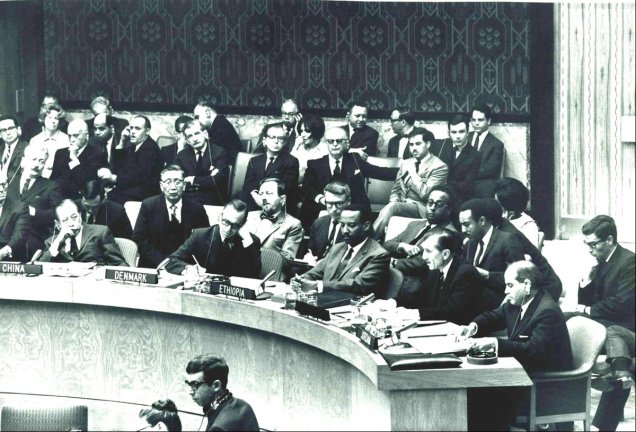
On November 22, 1967, the United Nations Security Council unanimously adopted Resolution 242, one of the most consequential diplomatic documents to emerge from Israel's June 1967 occupation of the remaining Palestinian territories and other Arab lands.
Five months earlier, Israeli forces had occupied the West Bank, including East Jerusalem, and the Gaza Strip—the approximately 22 percent of Mandatory Palestine that had remained outside Israeli control after the Nakba of 1948.
Israel had also occupied Egypt's Sinai Peninsula and Syria's Golan Heights.
Resolution 242 attempted to establish a framework for addressing the new territorial reality.
Its central premise was that territory should not be permanently acquired through military conquest and that a lasting settlement required both Israeli withdrawal from territories occupied in 1967 and the establishment of peaceful relations in which every state in the region could live within secure and recognized boundaries.
Over the following decades, Resolution 242 became one of the principal foundations of Arab-Israeli diplomacy and eventually of Palestinian-Israeli negotiations.
Yet from a Palestinian perspective, the resolution contained a fundamental flaw: it addressed Palestinians only through the language of a “refugee problem” and did not recognize them as a people possessing national rights, including self-determination and independent statehood.
The Political Context After the 1967 Occupation
The territorial map of the region changed dramatically in June 1967.
Israel came to control the entire West Bank, including East Jerusalem, and the Gaza Strip, bringing the remaining Palestinian territories under Israeli military occupation.
Egypt lost Sinai, while Syria lost the Golan Heights.
Hundreds of thousands of Palestinians were displaced during and immediately after the Israeli occupation, many of them crossing from the West Bank into Jordan.
Some were refugees from the Nakba of 1948 who were now displaced for a second time.
The international community was therefore confronted not only with a new military and territorial balance but with the question of what political principles would govern the territories Israel had occupied.
Resolution 242 — November 22, 1967
The Security Council adopted Resolution 242 unanimously at its 1382nd meeting on November 22, 1967.
The resolution was sponsored in its final form by the United Kingdom and emerged after months of negotiations among the permanent members of the Security Council and the states directly involved in the conflict.
Its preamble established a principle that would become central to subsequent international diplomacy:
“the inadmissibility of the acquisition of territory by war”
It then declared that a just and lasting settlement should include two interconnected principles.
- Withdrawal of Israeli armed forces from territories occupied in the recent conflict.
- Termination of claims or states of belligerency and respect for the sovereignty, territorial integrity, political independence, and right of every state in the region to live in peace within secure and recognized boundaries.
The resolution also called for freedom of navigation through international waterways, a just settlement of the refugee problem, and guarantees for the territorial integrity and political independence of states in the region.
The Foundation of What Became Known as “Land for Peace”
Resolution 242 did not itself contain the phrase “land for peace.”
That formulation emerged as a diplomatic shorthand for the relationship between the two principal provisions of the resolution.
Israel was expected to withdraw from territory occupied in 1967, while Arab states were expected to move toward ending belligerency and accepting peaceful relations within recognized boundaries.
In subsequent decades, the United Nations, the United States, Arab governments, and international diplomatic initiatives routinely described this framework as the principle of land for peace.
It eventually became one of the foundations of the Middle East peace process.
The Dispute Over the Withdrawal Clause
Few sentences in modern Middle Eastern diplomacy have generated as much debate as the withdrawal provision of Resolution 242.
The English text calls for:
“Withdrawal of Israel armed forces from territories occupied in the recent conflict.”
The English wording does not contain the definite article “the” before “territories.”
Israeli governments and some Western diplomats subsequently argued that this wording meant Resolution 242 did not require withdrawal from every part of every territory occupied in June 1967 and allowed boundaries to be modified through negotiations.
Arab governments rejected that interpretation.
They emphasized the resolution's opening principle that acquisition of territory through war was inadmissible and maintained that Israel was required to withdraw from all Arab territory occupied in 1967.
The French Text
The linguistic controversy became even more significant because the authoritative French text uses the formulation:
“retrait des forces armées israéliennes des territoires occupés lors du récent conflit”
The wording has commonly been rendered as withdrawal of Israeli armed forces from the territories occupied during the recent conflict.
Arab and Palestinian diplomacy frequently cited the French version, together with the principle against acquisition of territory by force, in support of the interpretation requiring complete withdrawal.
The existence of different linguistic formulations and the absence of a detailed map or implementation mechanism allowed competing interpretations to persist for decades.
Resolution 242 therefore became both a common diplomatic framework and a continuing source of disagreement over precisely what withdrawal required.
No Palestinian State Mentioned
For Palestinians, the most important limitation of Resolution 242 was not simply the wording of the territorial clause.
It was the near-complete absence of the Palestinian people as a political actor.
The resolution was constructed primarily as a framework governing relations between states.
It recognized the sovereignty, territorial integrity, and political independence of “every State in the area,” but it did not recognize Palestinian national self-determination, an independent Palestinian state, or Palestinian sovereignty over the West Bank and Gaza Strip.
Palestinians appeared only indirectly through the phrase:
“a just settlement of the refugee problem.”
From a Palestinian perspective, this reduced a national cause to a humanitarian problem.
From a People to a “Refugee Problem”
By 1967, Palestinians were not simply refugees seeking humanitarian assistance.
They were a people whose homeland had been divided in 1948 and whose remaining territories had now come under Israeli occupation.
Hundreds of thousands lived as refugees outside Palestine, while others remained in Israel, the West Bank, East Jerusalem, Gaza, and neighboring Arab countries.
Yet Resolution 242 contained no explicit reference to Palestinian political rights.
It did not mention the Palestine Liberation Organization, Palestinian self-determination, or the creation of a Palestinian state.
This omission would become one of the principal reasons for the PLO's rejection of the resolution.
The Initial Palestinian Rejection of Resolution 242
The Palestine Liberation Organization initially rejected Resolution 242.
The rejection was repeatedly reaffirmed by the Palestine National Council during the late 1960s and early 1970s.
Palestinian political leaders argued that the resolution treated the conflict as a dispute between Israel and neighboring Arab states while ignoring the Palestinian people whose land and national future were at the center of the conflict.
The Fifth Palestine National Council in February 1969 explicitly rejected Resolution 242 as one of the international proposals it believed would liquidate the Palestine question.
The Sixth Council later reaffirmed that position.
In 1970, an emergency session of the National Council once again referred to previous resolutions rejecting 242.
Why the PLO Rejected the Resolution
The Palestinian objection evolved over time.
Initially, part of the objection concerned the resolution's expectation that the Arab states acknowledge the sovereignty and territorial integrity of every state in the region—an implicit acceptance of Israel.
As the PLO emerged as the recognized representative of the Palestinian people during the 1970s, its criticism increasingly focused on another issue: Resolution 242 had failed to recognize the Palestinians as a people possessing national and political rights.
It had reduced the Palestine question to the problem of refugees while assigning the political negotiations primarily to existing states.
Resolution 338 and the Revival of Resolution 242
The October 1973 confrontation between Egypt and Syria on one side and Israel on the other brought Resolution 242 back to the center of international diplomacy.
On October 22, 1973, the Security Council adopted Resolution 338.
Resolution 338 called for an immediate ceasefire, demanded implementation of Resolution 242 in all its parts, and called for negotiations aimed at establishing a just and durable settlement.
From that point onward, international diplomacy increasingly referred to Resolutions 242 and 338 together.
They became the principal diplomatic framework for negotiations concerning the Arab territories occupied in 1967.
The Palestinian Political Transformation
Palestinian strategy changed substantially during the 1970s and 1980s.
In 1974, the Arab League recognized the PLO as the sole legitimate representative of the Palestinian people.
The same year, Yasser Arafat addressed the United Nations General Assembly, and the PLO received observer status at the United Nations.
Palestinian diplomacy increasingly sought international recognition not merely of the refugee question but of Palestinian national rights, including self-determination and independent political representation.
This shift gradually changed how Palestinian leaders approached Resolution 242.
Why Resolution 242 Later Became Useful to Palestinian Diplomacy
The same resolution that Palestinians had rejected for decades eventually acquired strategic importance.
Its opening rejection of the acquisition of territory by war and its call for Israeli withdrawal from territories occupied in 1967 provided an internationally recognized basis for demanding an end to Israeli control of the West Bank, including East Jerusalem, and the Gaza Strip.
As Palestinian diplomacy increasingly moved toward seeking an independent state in the territories occupied in 1967, Resolution 242 became relevant in a way it had not been when the PLO's stated objective centered on the entirety of historic Palestine.
The First Intifada and the Political Shift of 1988
The outbreak of the First Intifada in December 1987 transformed Palestinian politics and international diplomacy.
The uprising demonstrated the depth of Palestinian opposition to Israeli occupation in the West Bank and Gaza Strip and restored the Palestine question to the center of international attention.
In July 1988, Jordan announced the severing of its legal and administrative ties with the West Bank, further reinforcing the PLO's claim to represent Palestinians in the occupied territory.
These developments helped prepare the way for one of the most significant shifts in the history of Palestinian diplomacy.
The Palestinian Declaration of Independence
The Nineteenth Palestine National Council met in Algiers from November 12 to 15, 1988.
On November 15, it adopted the Palestinian Declaration of Independence, proclaiming the State of Palestine with Jerusalem as its capital.
The Declaration invoked Palestinian historical and legal rights, self-determination, United Nations legitimacy, and the peaceful settlement of disputes.
It did not, however, explicitly mention Security Council Resolutions 242 and 338 by number.
Their explicit acceptance appeared in a separate but closely connected document adopted at the same National Council session: the Political Communiqué.
The PLO Accepts Resolutions 242 and 338
In its political communiqué of November 15, 1988, the Palestine National Council called for an international peace conference under United Nations auspices based on Security Council Resolutions 242 and 338.
At the same time, it demanded recognition of Palestinian national rights, particularly the right to self-determination.
The communiqué called explicitly for:
Israeli withdrawal from all Palestinian and Arab territories occupied in 1967, including Arab East Jerusalem.
It also called for the reversal of Israeli annexation measures and the removal of settlements established in occupied Palestinian and Arab territory since 1967.
This represented a major change in formal PLO diplomacy.
From Rejection to a Palestinian Diplomatic Instrument
The transformation was profound.
In the late 1960s, the PLO had rejected Resolution 242 because the resolution failed to recognize Palestinian national rights and treated the Palestine question primarily as a refugee problem.
By 1988, the PLO was using the same resolution to support a diplomatic strategy centered on ending the Israeli occupation of the territories seized in 1967 and establishing Palestinian sovereignty there.
The resolution had not changed.
Palestinian political strategy had.
Yasser Arafat at the United Nations in Geneva
The political change was reinforced in December 1988.
Because the United States refused to grant Yasser Arafat a visa to address the United Nations in New York, the General Assembly temporarily moved its consideration of the Palestine question to Geneva.
On December 13, 1988, Arafat addressed the General Assembly and presented the PLO's new political initiative.
The following day, during a press conference, he further clarified the organization's acceptance of Resolutions 242 and 338 and its position regarding political violence.
These statements satisfied the conditions the United States had demanded for opening official contacts with the PLO.
The United States Opens Dialogue with the PLO
On December 14, 1988, the Reagan administration announced that the United States would begin a substantive dialogue with representatives of the Palestine Liberation Organization.
It was a major diplomatic breakthrough.
For years, Washington had refused official dialogue with the organization unless it accepted Resolutions 242 and 338, recognized Israel's right to exist, and addressed the question of political violence.
The Palestinian decisions of 1988 therefore marked the transition from prolonged PLO rejection of Resolution 242 to formal participation in a diplomatic process based partly upon it.
Resolution 242 and the Madrid Conference
The next major stage came with the Madrid Peace Conference, convened by the United States and the Soviet Union in October 1991.
The invitations established Resolutions 242 and 338 and the principle later described as land for peace as central elements of the negotiating framework.
The PLO itself was not formally seated at Madrid under its own name.
Instead, Palestinians participated within a joint Jordanian-Palestinian delegation, subject to restrictions concerning who could formally serve as a representative.
The delegation nevertheless coordinated closely with the PLO leadership, and Madrid opened the first sustained direct negotiating process between Israeli and Palestinian representatives.
From Madrid to Oslo
The public negotiations that began after Madrid made limited progress.
Meanwhile, secret direct negotiations developed between Israeli representatives and the PLO in Norway.
Those negotiations produced the Oslo Declaration of Principles, signed in Washington on September 13, 1993.
Several days earlier, on September 9, Israel and the PLO had exchanged letters of mutual recognition.
In his letter to Israeli Prime Minister Yitzhak Rabin, Yasser Arafat explicitly confirmed that:
“The PLO accepts United Nations Security Council Resolutions 242 and 338.”
Rabin, in return, announced Israel's recognition of the PLO as the representative of the Palestinian people and agreed to negotiate with it.
Resolution 242 Inside the Oslo Framework
Resolution 242 did not disappear once the Oslo process began.
The Declaration of Principles explicitly stated that the interim arrangements were intended to lead to a permanent settlement based on Security Council Resolutions 242 and 338.
The permanent-status negotiations were expected to address Jerusalem, refugees, settlements, borders, security arrangements, and other unresolved questions.
The Oslo process also created the framework from which the Palestinian Authority emerged in parts of the West Bank and Gaza Strip.
It did not, however, itself establish a sovereign Palestinian state or determine the final borders between Israel and Palestine.
Resolution 242 and the Borders of a Palestinian State
Resolution 242 did not explicitly refer to a Palestinian state or define Palestine's borders.
Over subsequent decades, however, the pre-June 1967 lines became the principal international territorial reference for proposals concerning two states.
Palestinian diplomacy increasingly interpreted implementation of Resolutions 242 and 338 together with later United Nations resolutions as requiring Israeli withdrawal from the Palestinian territories occupied in 1967, including East Jerusalem.
The Palestinian position consequently developed around the establishment of an independent state in the West Bank and Gaza Strip with East Jerusalem as its capital.
These territories represent approximately 22 percent of Mandatory Palestine.
The Limitations of Resolution 242 for Palestinians
Despite its later diplomatic importance, Resolution 242 never fully resolved the fundamental Palestinian objections raised when it was adopted.
It did not explicitly recognize the Palestinian people.
It did not mention Palestinian self-determination.
It did not call for the establishment of a Palestinian state.
It referred to the refugees only through the general formulation of a “just settlement of the refugee problem,” without specifying return, compensation, or Resolution 194.
And its withdrawal provision remained open to competing interpretations.
Later United Nations resolutions and developments in international law increasingly addressed some of these omissions by explicitly affirming Palestinian self-determination and the right to an independent state.
Settlement Expansion and the Unresolved Occupation
The political framework established after 1967 did not prevent Israel from constructing and expanding civilian settlements throughout the occupied Palestinian territory.
Settlements were established in the West Bank and East Jerusalem beginning soon after the occupation.
Later Security Council resolutions, including Resolution 2334 of 2016, reaffirmed that Israeli settlements in the Palestinian territory occupied since 1967, including East Jerusalem, have no legal validity under international law.
Settlement expansion has continued despite these resolutions.
As of 2026, United Nations reporting continues to describe the West Bank, including East Jerusalem, and Gaza as the Occupied Palestinian Territory and continues to report the expansion and approval of Israeli settlements in the occupied West Bank.
Resolution 242 More Than Half a Century Later
More than half a century after its adoption, Resolution 242 remains one of the most influential and contested documents in the diplomacy surrounding Palestine.
It established a principle against territorial acquisition through military conquest.
It called for Israeli military withdrawal from territories occupied in 1967.
It linked withdrawal to a wider framework of peaceful relations and secure, recognized boundaries.
It later became associated with the principle of land for peace and served, together with Resolution 338, as a foundation for Madrid, Oslo, and subsequent diplomatic initiatives.
Yet it also reflected the political limitations of the international approach to Palestine in 1967.
The Palestinian people—whose homeland had been divided, whose refugees remained displaced, and whose remaining territory had just been occupied—were not recognized in the resolution as an independent political people possessing national rights.
From Rejection to Political Reference
The history of Palestinian engagement with Resolution 242 reflects the broader transformation of Palestinian politics.
The PLO initially rejected it because it marginalized Palestinian national rights and reduced the Palestine question to refugees and interstate diplomacy.
Two decades later, the organization accepted 242 and 338 as part of a new political strategy seeking Israeli withdrawal from the territories occupied in 1967 and the establishment of Palestinian statehood.
The resolution therefore changed from a document rejected as inadequate into an important diplomatic instrument in Palestinian efforts to end the occupation.
The Unfinished Question
Resolution 242 was adopted in November 1967 in response to a territorial transformation that had taken place only months earlier.
It was intended to help produce a just and lasting settlement.
Yet the central Palestinian territorial issue that emerged from the occupation of 1967 remains unresolved.
The West Bank, including East Jerusalem, remains under Israeli occupation, while the United Nations continues to regard Gaza as part of the Occupied Palestinian Territory.
Israeli settlement activity has continued, and no final Palestinian-Israeli agreement has resolved the questions of borders, Jerusalem, refugees, settlements, security, and sovereignty.
From a Palestinian historical perspective, Resolution 242 therefore carries a double legacy.
It remains an international affirmation that territory cannot legitimately be acquired through military conquest and a diplomatic reference for ending the occupation that began in 1967.
At the same time, its original failure to recognize Palestinian national and political rights demonstrates how the Palestinian people were largely absent from the diplomatic framework created immediately after the occupation of their remaining homeland.
The Palestinian struggle over Resolution 242 was therefore not only a dispute over territory.
It was also a struggle to transform Palestinians in international diplomacy from a “refugee problem” into a people possessing the right to self-determination, sovereignty, and an independent state.
More from the archive



 Download Our Palestine App
The whole archive in the palm of your hand: depopulated villages, the Nakba, the massacres and Al-Aqsa — free, with no ads to erase the story.
Download Our Palestine App
The whole archive in the palm of your hand: depopulated villages, the Nakba, the massacres and Al-Aqsa — free, with no ads to erase the story.

Comments
No comments yet — be the first to write one.
Add your comment
Name and email are optional. Comments appear after review.